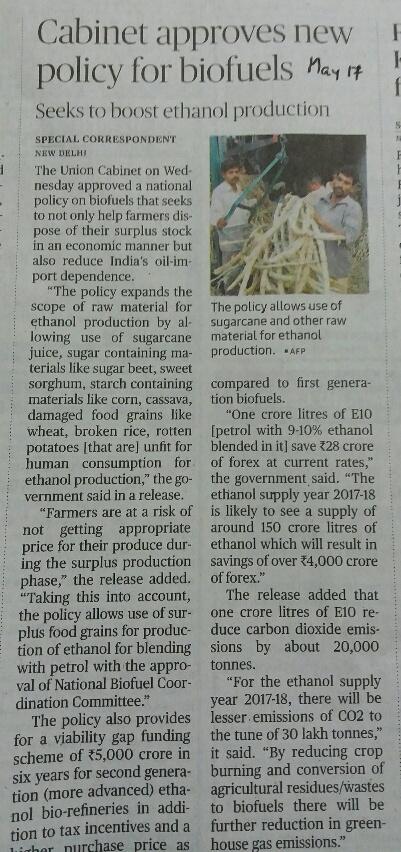
CABINET APPROVAL for E 10 [9 TO 10 % ETHANOL ON FUEL]
No doubt a good decision though not late .Ehanol produced from Sugar cane Juice and sugar containing materials and surplus grains.
This decision should be a boon to India as
* Sizeable amoun foreign exchange on fuel imports can be saved .
* Emission of CO2 can be reduced by 30,00, 000 Tonnes .
It will demand some minor adjustments from our side which is negligible from the benefits that will acrue . more
This decision should be a boon to India as
* Sizeable amoun foreign exchange on fuel imports can be saved .
* Emission of CO2 can be reduced by 30,00, 000 Tonnes .
It will demand some minor adjustments from our side which is negligible from the benefits that will acrue . more
Viewed by 54

Government balancing between grain and sugar ethanol so the benefits being distributed among all farmers. https://www.moneycontrol.com/news/opinion/indian-sugar-mills-in-sticky-ethanol-spot-13642370.html "A spike in sugarcane arrears could return as a risk for sugar companies, if industry association ISMA is to be believed. That is, if the government does not accept its demands on the ethanol policy front. Strangely, it was the government’s liberal ethanol policy that nearly eliminated the ever-present risk of huge cane arrears due to farmers in the first place. ISMA has outlined its reasons for a bearish view. Every year, oil marketing companies invite tenders for supply of ethanol from distillers. While sugar mills were the main suppliers, grain-based ethanol producers have become a significant contributor. In the 2025-26 ethanol supply year, oil companies had invited bids for 10.49 billion litres of ethanol. Sugar mills offered 4.72 billion litres but were allotted only 2.89 billion litres. Grain-based ethanol has been given the lion’s share of 7.6 billion litres. The sugar industry is understandably upset, as they claim to have the ability to supply 5 billion litres, and having invested significant sums in creating ethanol capacity, will suffer if it is under-utilised. The current allocation will mean a diversion of sugar of 3.4 million tonnes, the same level as the previous season. But why it’s still a big deal is anticipated higher cane output in the current sugar season. The gross sugar output (before diversion for ethanol) is expected at 34.9 million tonnes, compared to 29.5 million tonnes in the previous year. Flat allocation to ethanol will mean excess sugar output, which creates a problem as it lowers prices in the domestic and international market. A higher cane output also means more money to be paid to farmers, which brings us to the rest of their complaints. Mills want a higher procurement price for sugarcane-based ethanol. The central government-determined Fair and Remunerative Price (FRP) for sugarcane has risen by 16.5 percent since 2022-23, though the procurement price for sugarcane juice and B-heavy molasses-based ethanol is unchanged. But the government has increased the price for C-heavy molasses-based ethanol, which has the least sugar content of the three feedstocks. They want the other types also to fetch a higher price. Mills also want a higher minimum sugar selling price, which has remained stagnant at Rs 31 a kg since February 2019. Mills are not allowed to sell below this price. But market prices have anyway risen way above this level, so it’s not very relevant. But ISMA wants the MSP to be revised to above the current estimated cost of Rs 40.24 a kg. The benefit of this is that during times of ample output, as in the current season, this will prevent prices from falling too much. Another demand is to announce the export policy for 2025-26 so that mills can plan accordingly. However, global sugar prices are under pressure mainly due to healthy output trends in key exporting countries such as India and Brazil. Raw sugar futures are down by 17 percent from six months ago and down 35 percent from a year ago. Exports are going to be less remunerative as a result. But a liberal policy gives them options, such as exporting the surplus and keeping domestic supply tight. Or, if international prices increase later in the season, they can take advantage of it. But there may be hope for sugar mills yet. The government’s cautious stance on sugar-based ethanol may stem from its desire to keep sugar prices under check. Keeping inflation in control is not only a political necessity but also helps monetary policy easing. While preliminary estimates of sugar output are healthy, the actual output at times has been much lower. This happens due to weather-related, pest-related or sugar yield-related events. That’s why the government may be keeping the current procurement tilted towards grain-based sources. ISMA has asked for more allocation of 1.5 billion litres of ethanol in the second cycle. If cane output is healthy as expected, then they could expect some relief. Meanwhile, the times have turned uncertain for sugar mills. The unfavourable market and policy environment is likely to see them make payments in phases to farmers, at a slower pace than earlier. This will mean mounting cane arrears that will lead to loud protests from farmers. Mills will cite working capital pressures, unfavourable ethanol allocation and lower profitability overall as reasons for their inability to clear these arrears. On the one hand, mills are dependent on the government for policy support but on the other, they need to push back when policy measures are not supportive enough. How the government responds to this pushback will be a key risk to watch out for in the coming months. Investors will be hoping that they announce measures that provide relief to mills and not take the tough measures available with them." more
Oct 31

Moving to E10 (and eventually beyond) is broadly a good decision in terms of energy security (reducing crude imports), supporting agriculture (sugar‑cane/ethanol producers), and environmental goals (ethanol is a cleaner additive). However, the success will depend significantly on implementation details: Ensuring older vehicles don’t suffer unduly (owners should not bear disproportionate burden). Guaranteeing fuel quality and consistency so that the blend actually meets specifications (as user complaints elsewhere show trust deficits). Keeping consumer communication clear so owners understand impacts (if any) on mileage, maintenance, compatibility. Maintaining infrastructure readiness before rolling out higher blends widely. more
Oct 30
https://www.financialexpress.com/business/working-on-10-biofuel-blending-with-diesel-nitin-gadkari-3945674/ "Union minister for road transport and highways Nitin Gadkari has called for faster diversification of agriculture into the energy and power sectors. Building on the success of ethanol-petrol blending, he said the focus must now shift to diesel, with plans to blend 10% isobutanol under the biodiesel programme. Speaking at an event hosted by Praj Industries in Pune late Monday, Gadkari said research, development, and standard-setting for isobutanol—a promising alternative biofuel—are in progress. Once finalised, the proposal will be sent to the Prime Minister and the Cabinet for approval. Noting that diesel consumption is two to three times higher than petrol, he stressed the urgency of including diesel in the blending programme." Diesel being more polluting petrol, and more used in transport, especially commercial vehicles and logistics greater the scale and scope for environment improvement under the biodiesel programme. more
Sep 12
No doubt. Already 20% blending in 11 states happening! India saved as much as ₹53,894 crore in forex outgo from 10 per cent blending. Benefiting the farmers, and greenhouse gas emissions reduction, an extra! https://www.thehindu.com/news/national/pm-modi-rolls-out-20-ethanol-blended-petrol-in-11-statesuts/article66476921.ece more
May 10

There is need of more such Research results District-wise for making use of conventional and non conventional Resources RR Labs to regain status. more
May 19