As Supreme Court pulls up Whatsapp for privacy, 96% of its users surveyed confirm receiving pesky messages daily: Say WhatsApp Business is now being actively used by spammers
- ● Financial services, real estate, healthcare/ pathology services and job/ earnings offer are most common among promotional, or spam WhatsApp messages received
- ● Citizens report regularly receiving spam via WhatsApp business accounts
- ● LocalCircles survey on the subject receives 42,000 responses from users across 324 districts of India
February 4, 2026, New Delhi: The Supreme Court in a February 3rd hearing directed global technology major Meta Platforms and its messaging service WhatsApp to file an affidavit giving a clear undertaking that WhatsApp user data will not be shared for advertising purposes. Warning of serious consequences, the court said failure to provide such an assurance within a week could result in the dismissal of Meta’s challenge to proceedings against WhatsApp’s 2021 privacy policy.
The long-running dispute over the privacy policy has travelled through multiple regulatory forums, including the Competition Commission of India (CCI) and the National Company Law Appellate Tribunal (NCLAT), before reaching the apex court. Regulators have examined whether the policy allows excessive data sharing within the Meta group and undermines user consent and competition.
The Supreme Court’s direction comes amid renewed international scrutiny of WhatsApp’s privacy claims. On January 23, 2026, a group of international plaintiffs filed a lawsuit against Meta Platforms in the US District Court in San Francisco, alleging that WhatsApp made misleading statements about the privacy and security of user communications. According to a Bloomberg report, the suit claims that Meta and WhatsApp store, analyse and can access virtually all user communications, contradicting the company’s long-standing assertion that messages, calls and statuses are end-to-end encrypted and inaccessible even to WhatsApp.
With hundreds of millions of users in India—out of more than three billion globally—WhatsApp has become deeply embedded in India’s communication and commerce ecosystem. In his article “WhatsApp Owns India”, author Dharmesh B.A. warns that reliance on a single foreign platform poses risks to Indian MSMEs, including operational vulnerability, data exposure, rising costs and reduced competition.
Amid rising fraud on over-the-top (OTT) platforms, WhatsApp has introduced new in-app safety tools in 2025 and early 2026 to combat scams, abuse and unauthorised content sharing. Meanwhile, the Ministry of Electronics and Information Technology has initiated stakeholder consultations following concerns raised by TRAI and telecom operators that fraud is increasingly shifting from calls and SMS to OTT platforms such as WhatsApp.
To address this, the Department of Telecommunications has rolled out initiatives including the Digital Intelligence Platform and Chakshu portals, while TRAI plans to implement Calling Name Presentation nationwide by early 2026. Together, these measures aim to improve accountability, transparency and user protection in an increasingly platform-driven communication landscape. However, OTT platforms like WhatsApp are currently not governed by TRAI.
With new complaints mounting every week about pesky and fraudulent WhatsApp messages, LocalCircles in a new nationwide survey attempted to find out from WhatsApp users their experience in the last 12 months with such messages. The study becomes important as WhatsApp is piloting ads which could worsen the situation for the users, many of whom are already receiving lots of promotional and pesky messages. The study received over 42,000 responses from WhatsApp users located in 324 districts of India. 67% respondents were men while 33% respondents were women. 39% of respondents were from tier 1 locations, 30% were from tier 2 locations while 31% were from tier 3, 4 and rural locations.
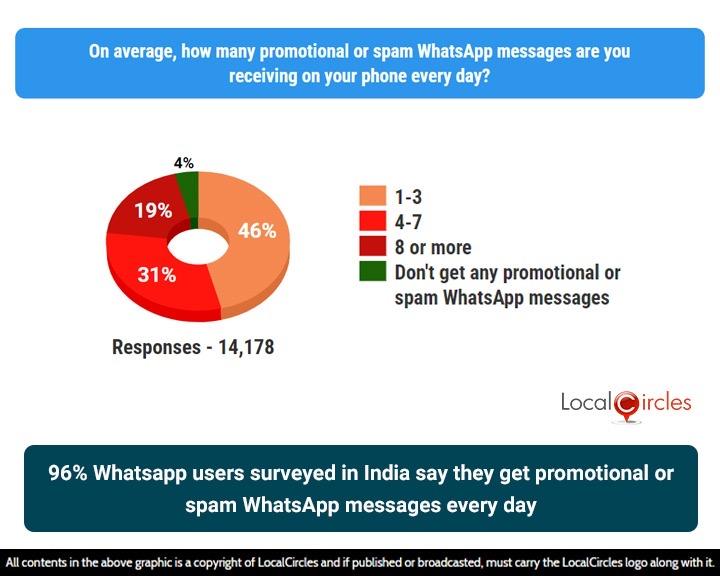
96% WhatsApp users surveyed in India say they get pesky or unsolicited commercial messages every day
The survey first asked, “On average, how many promotional or spam WhatsApp messages are you receiving on your phone every day?” Out of 13,362 WhatsApp users who responded to the query only 4% stated that they “don’t get any promotional or spam WhatsApp messages”. Of the remaining respondents 54% indicated that they get 1-3 promotional or spam WhatsApp messages every day; 30% stated that they get 4-7 such messages every day and 11% stated that they get 8 or more such messages on average every day. In effect, 96% WhatsApp users surveyed in India say they get pesky or unsolicited commercial messages every day. In community discussions, many of the members expressed that such messages are also coming via WhatsApp Business in an unchecked manner. WhatsApp Business is a service where the sender pays WhatsApp for sending messages to users.
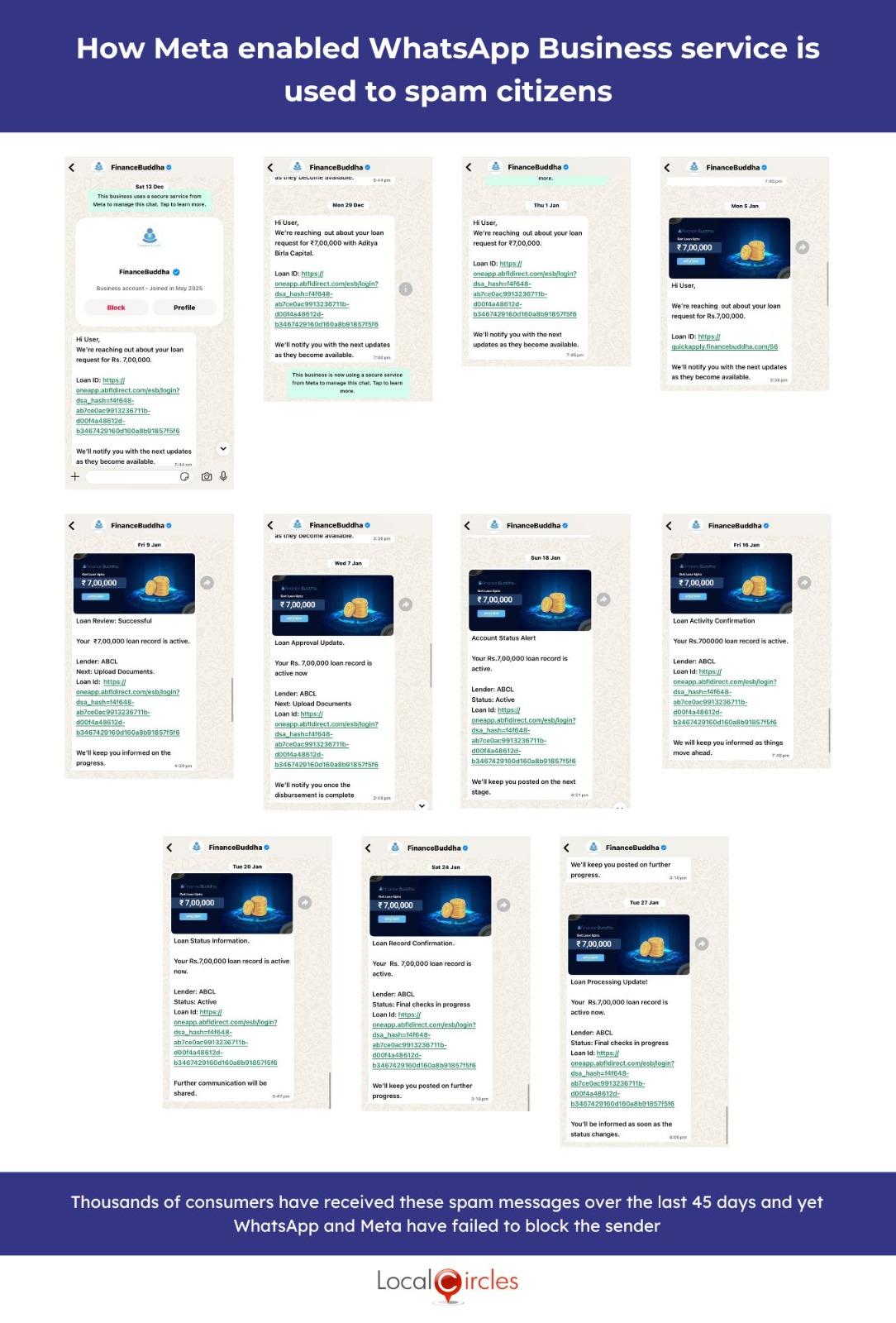
In the example shared in this report, a fraudulent message is sent by some account FinanceBuddha to a large number of users about receiving their loan application through Whatsapp Business and then sending repeated messages over 45 days finally indicating that the loan application has been approved and they are ready to remit the loan. None of the users ever applied for the loan. Users allege that such fraudulent messages are going undetected by WhatsApp or rather enabled by WhatsApp as it generates revenue for the platform.
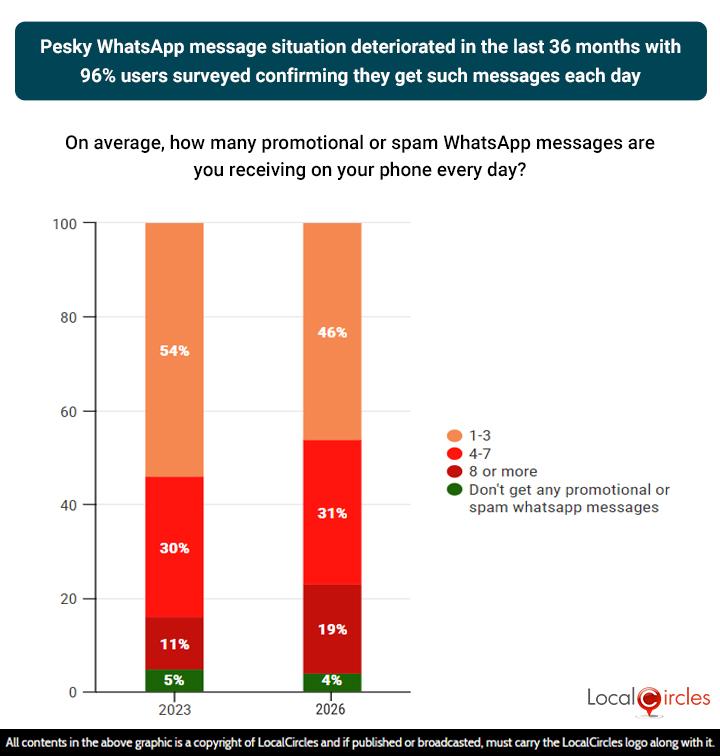
WhatsApp message situation deteriorated in the last 36 months with 96% users surveyed confirming they get such messages each day
When comparing the new survey results with the study done in 2023, 46% of the WhatsApp users surveyed stated they receive 1-3 messages each day now compared to 54% three years ago. However, 31% receive 4-7 spam or promotional messages now as against 30% in 2023 and 19% of respondents receive 8 or more pesky messages now as against 11% in 2023. The percentage of those who don’t get any pesky messages has marginally dipped from 5% in 2023 to 4% now.
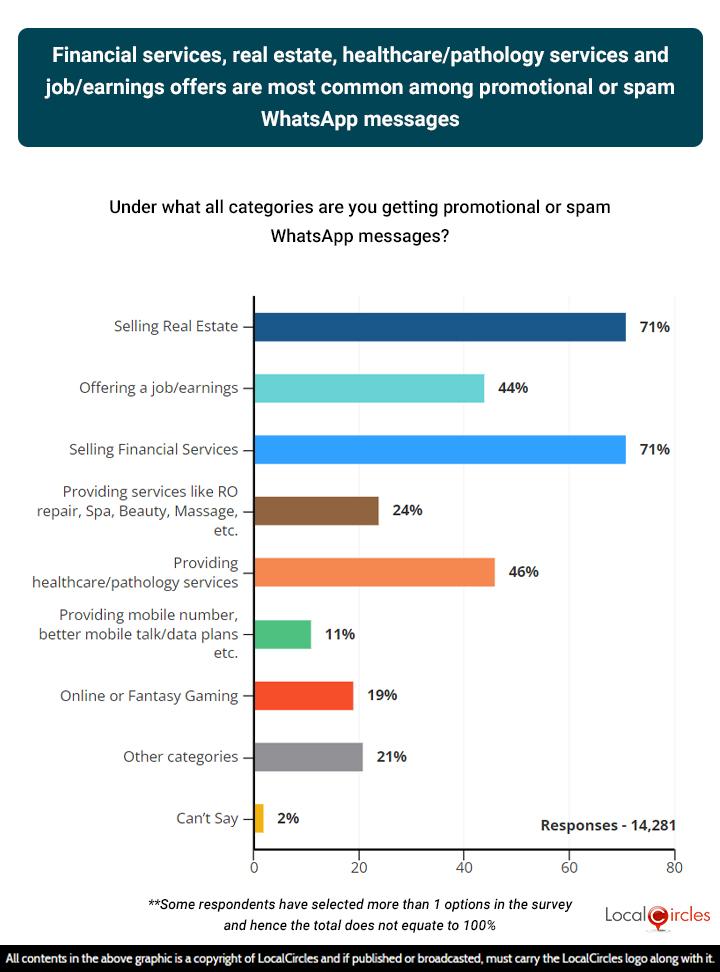
Financial services, real estate, healthcare/ pathology services and job/earnings offer are most common among spam WhatsApp messages received by users
WhatsApp users get many pesky messages right from automobile service centers to financial services to real estate developers, etc. The survey asked, “Under what all categories are you getting promotional or spam WhatsApp messages?” Some among 14,281 respondents who replied to this query chose more than one option. The largest group of 71% stated that they get messages related to “selling real estate” and another 71% stated “selling financial services”; 46% pointed to “providing healthcare/ pathology services”; 44% pointed to “offering a job/ earnings”; 24% pointed to “providing services like RO repair, spa, beauty, massage, etc.”; 19% stated “online or fantasy gaming”; 11% indicated “providing mobile number, better mobile talk time/ data plans, etc.”; 21% to “other categories” not mentioned; and 2% of respondents did not give a clear reply. To sum up, financial services, real estate, healthcare/ pathology services and job/ earnings offer are most common among promotional, or spam WhatsApp messages received.
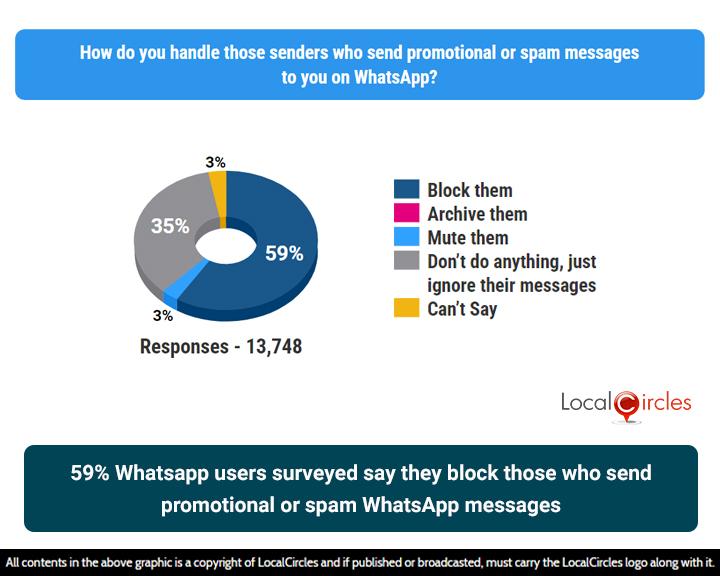
59% WhatsApp users surveyed say they block those who send promotional or spam WhatsApp messages
When a person receives spam calls or messages on WhatsApp there is an option to block them. The survey asked, “How do you handle those senders who send promotional or spam messages to you on WhatsApp?” The query received 13,748 responses with the largest group of 59% stating that they “block them” (senders of spam messages). Of the rest, 35% stated that they “don’t do anything, just ignore their messages’; 3% stated that they “mute them” and 3% of respondents did not give a clear reply. In effect, 59% of WhatsApp users surveyed say they block those who send promotional or spam WhatsApp messages. However, the senders, despite getting blocked, find new ways or numbers to send messages.
In summary, the survey finds that only 4% of those surveyed stated that they don’t receive any promotional/ spam messages on WhatsApp while 54% indicated that they get 1-3 promotional or spam WhatsApp messages every day; 30% stated that they get 4-7 such messages every day and 11% stated that they get 8 or more such messages on an average every day. The survey shows that financial services, real estate, healthcare/ pathology services and job/ earnings offer are most common among promotional, or spam WhatsApp messages received. The biggest issue is that many of these messages are now coming through WhatsApp Business which indicates lack of checks and balances by WhatsApp or rather it acts as an enabler of spam. This has to change and Government bodies like MEITY which are responsible for enforcing India Personal Data Protection Act have to intervene and ensure enforcement. The Supreme Court clearly is to be lauded for taking a firm stance on privacy policy of WhatsApp and the problem it poses to the common man.
Survey Demographics
The study received over 42,000 responses from WhatsApp users located in 324 districts of India. 67% respondents were men while 33% respondents were women. 39% of respondents were from tier 1 locations, 30% were from tier 2 locations while 31% were from tier 3, 4 and rural locations. The survey was conducted via LocalCircles platform, and all participants were validated citizens who had to be registered with LocalCircles to participate in this survey.
About LocalCircles
LocalCircles, India’s leading Community Social Media platform enables citizens and small businesses to escalate issues for policy and enforcement interventions and enables Government to make policies that are citizen and small business centric. LocalCircles is also India’s # 1 pollster on issues of governance, public and consumer interest. More about LocalCircles can be found on https://www.localcircles.com
For more queries - media@localcircles.com, +91-8585909866
All content in this report is a copyright of LocalCircles. Any reproduction or redistribution of the graphics or the data therein requires the LocalCircles logo to be carried along with it. In case any violation is observed LocalCircles reserves the right to take legal action.
Enter your email & mobile number and we will send you the instructions.
Note - The email can sometime gets delivered to the spam folder, so the instruction will be send to your mobile as well


