54% households surveyed in Delhi NCR currently have one or more individuals with flu/viral fever like symptoms
- ● 23% households surveyed have 4 or more individuals currently down with flu/viral fever like symptoms
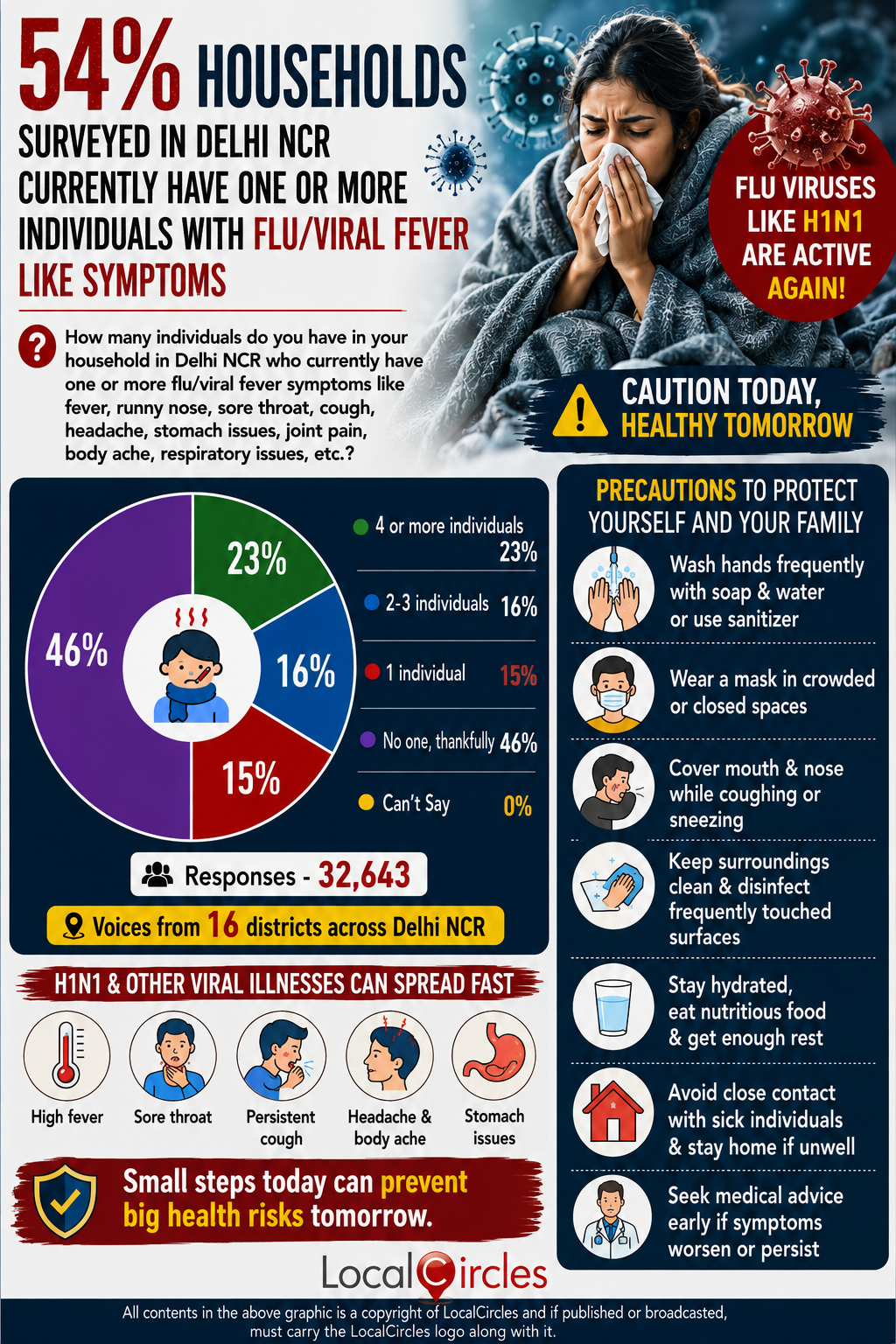
August 27, 2026, New Delhi: Delhi NCR is going through one of its heaviest fever seasons in recent years, with influenza, Covid, dengue and a broad set of undifferentiated viral fevers circulating at the same time. Delhi has now recorded 2,392 Influenza-A cases in 2026, of which 1,777 are confirmed H1N1 (swine flu), against 229 H1N1 cases by the corresponding point last year, a nearly eight-fold rise, according to Delhi Health Department data. H1N1 is the predominant identified strain, and on August 20 alone the capital logged 114 fresh cases, with no deaths recorded this season.
The rise prompted Union Health Minister J.P. Nadda to chair a high-level review of H1N1 and seasonal-disease preparedness on August 21, 2026, attended by Delhi Health Minister Dr Pankaj Kumar Singh. Nadda called for continued vigilance, robust surveillance and early identification of any unusual clustering of cases, and urged the public to follow respiratory and hand hygiene and seek prompt care for severe symptoms. Singh assured that the capital is fully prepared, with no shortage of hospital beds, doctors, medicines or equipment, and that separate wards have been set aside for H1N1 and dengue patients.
What makes this season difficult is that no single pathogen explains the illness. Following the 2009 pandemic, H1N1 has remained an established part of India's seasonal influenza circulation, so the current increase does not by itself signal a new pandemic. But its symptoms — fever, cough, sore throat, headache, body aches, chills and fatigue — overlap almost entirely with those of Covid, dengue, malaria, chikungunya and ordinary viral fever, and cannot be told apart without a laboratory test. Doctors across Delhi NCR report outpatient departments carrying swine flu, viral fever, dengue, typhoid and gastroenteritis at once, with a few cases progressing to viral pneumonia among the elderly, young children and those with existing conditions. Clinicians note that H1N1 activity in India characteristically peaks between August and October, placing the current wave closer to the start than the end of its run.
On the vector-borne side, Delhi has reported 246 dengue, 80 malaria and 19 chikungunya cases so far this year, lower than last year but still building as monsoon water drives transmission through August and September. Doctors warn that painkillers and antibiotics taken without medical advice can mask symptoms or worsen complications, that ibuprofen and diclofenac should not be taken until dengue is ruled out, and that delayed diagnosis, rather than the infections themselves, is the main driver of severe outcomes this season.
Against this backdrop, LocalCircles conducted a survey to establish how widespread flu/viral fever like symptoms currently are inside Delhi NCR households, and how many members of a household are affected at the same time. The survey received over 32,000 responses from residents of Delhi, Gurugram, Noida, Faridabad and Ghaziabad.
54% households surveyed in Delhi NCR currently have one or more individuals with flu/viral fever like symptoms
Official case counts capture only those citizens who reached a hospital or a laboratory and were tested. To establish how deep the current wave actually runs inside homes, the survey asked, “How many individuals do you have in your household in Delhi NCR who currently have one or more flu/viral fever symptoms like fever, runny nose, sore throat, cough, headache, stomach issues, joint pain, body ache, respiratory issues, etc.?” This question received 32,643 responses. In response, the largest single group at 46% said “no one, thankfully”, while 23% reported 4 or more individuals in the household with such symptoms, 16% reported 2-3 individuals and 15% reported 1 individual. Nil respondents were unable to answer. In summary, 54% of households surveyed in Delhi NCR currently have one or more individuals with flu/viral fever like symptoms, and 39% have two or more such individuals at the same time. Percentages may not add up to 100 as they have been rounded to the nearest whole number.
Household clustering points to transmission inside homes, workplaces and schools
The more telling finding is the clustering: 39% of households surveyed have two or more members symptomatic at the same time and 23% have four or more, which points to sustained transmission inside homes, workplaces and schools rather than scattered individual infections. Read alongside the near eight-fold rise in confirmed H1N1 cases and the arrival of the August to October influenza peak, the trend indicates a wave that is still building rather than one that has crested. The concurrent circulation of influenza, Covid and vector-borne disease also means a household cannot assume a fever is “just viral” and wait it out.
In summary, the survey findings indicate that the fever wave in Delhi NCR is considerably wider than laboratory-confirmed case counts suggest. With 54% of households surveyed currently reporting one or more symptomatic individuals, the illness burden in the region is running at a level that official H1N1, dengue, malaria and chikungunya tallies do not capture, because the large majority of citizens with mild to moderate fever never get tested and self-medicate instead.
Precautions to protect yourself and your family
As flu viruses like H1N1 circulate widely, LocalCircles and health authorities advise citizens to take simple precautions: wash hands frequently with soap and water or use a sanitizer; wear a mask in crowded or closed spaces; cover the mouth and nose while coughing or sneezing; keep surroundings clean and disinfect frequently touched surfaces; stay hydrated, eat nutritious food and get enough rest; avoid close contact with sick individuals and stay home if unwell; and seek medical advice early if symptoms worsen or persist. Warning signs such as breathlessness, a persistent or worsening fever, bluish lips, confusion or severe weakness call for prompt medical attention.
These findings carry an important signal for the Delhi Government's Health Department, the Municipal Corporation of Delhi and the health authorities of Gurugram, Noida, Faridabad and Ghaziabad as the monsoon peaks and the festive season approaches. The citizen pulse indicates a need for wider and freely available testing for influenza, Covid and dengue at government dispensaries, mohalla clinics and district hospitals, extended fever clinic hours, and clear public advisories on when a fever needs laboratory confirmation and when self-medication becomes dangerous. The real-time reporting discipline now applied to vector-borne disease could usefully be extended to influenza and influenza-like illness, so that the scale of a respiratory wave is visible to authorities in the same week it is being felt inside homes. LocalCircles will conduct this survey again in the coming weeks to track how the situation in Delhi NCR households evolves.
Survey Demographics
The survey received over 32,000 responses from residents of Delhi, Gurugram, Noida, Faridabad and Ghaziabad. 69% respondents were men while 31% respondents were women. The survey was conducted via LocalCircles platform, and all participants were validated citizens who had to be registered with LocalCircles to participate in this survey.
About LocalCircles
LocalCircles, India’s leading Community Social Media platform enables citizens and small businesses to escalate issues for policy and enforcement interventions and enables Government to make policies that are citizen and small business centric. LocalCircles is also India’s # 1 pollster on issues of governance, public and consumer interest. More about LocalCircles can be found on https://www.localcircles.com
For more queries - media@localcircles.com, +91-8585909866
All content in this report is a copyright of LocalCircles. Any reproduction or redistribution of the graphics or the data therein requires the LocalCircles logo to be carried along with it. In case any violation is observed LocalCircles reserves the right to take legal action.
Enter your email & mobile number and we will send you the instructions.
Note - The email can sometime gets delivered to the spam folder, so the instruction will be send to your mobile as well


