UPI @ 10: 3 in 4 users still opposed to paying any transaction fee
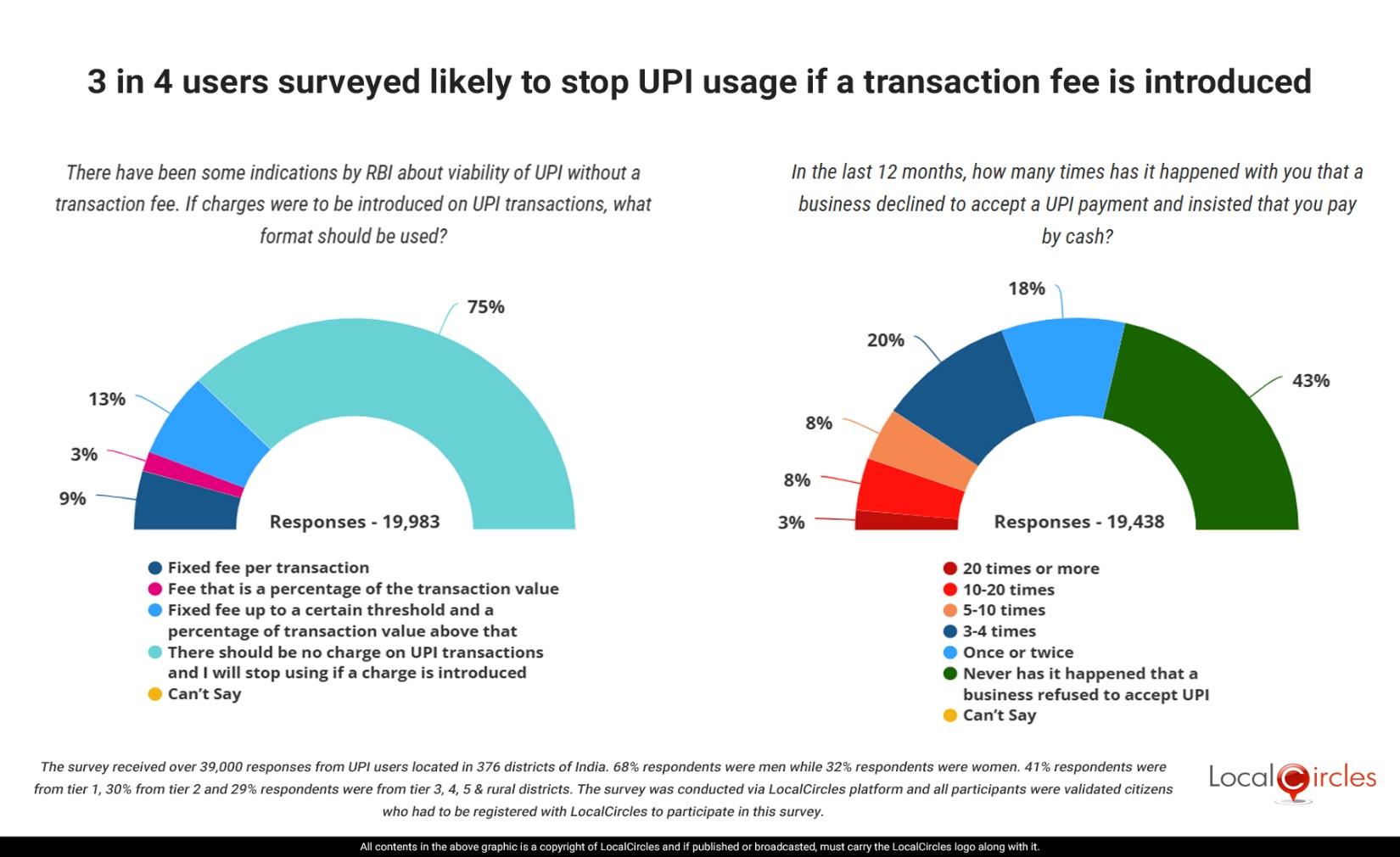
- ● Despite regular use, most users are likely to stop usage if a transaction fee was introduced
- ● Only 25% of UPI users surveyed are currently willing to bear a transaction fee
- ● 57% of UPI users surveyed say they have had one or more business decline use of UPI as a mode of payment in the last 12 months
April 11, 2026, New Delhi: Over the last decade, Unified Payments Interface (UPI) has fundamentally transformed the way India transacts. Launched in 2016, UPI has evolved from a nascent digital payments infrastructure into the backbone of the country’s financial ecosystem, enabling billions of real-time transactions every month across urban and rural India. From street vendors and small kirana stores to large enterprises and government services, UPI has made digital payments instant, interoperable, and universally accessible. Its QR-code driven simplicity, mobile-first design, and zero-cost structure for users have driven mass adoption, making India one of the world’s leading digital payment economies.
The scale of UPI’s growth has been unprecedented. With annual transaction volumes now running into hundreds of billions and values reaching hundreds of lakh crore rupees, UPI has not only reduced dependence on cash but also accelerated financial inclusion by bringing millions of first-time users into the formal financial system. Supported by policy backing from the Reserve Bank of India and sustained government incentives, UPI has become a public digital good that powers everyday commerce in India.
UPI’s growth in FY 2025–26 highlights its dominance in India’s digital payments landscape. The platform processed over 240 billion transactions, with a total value exceeding INR 314 lakh crore, marking strong year-on-year growth. Monthly records were consistently broken, with March 2026 alone witnessing over 22 billion transactions, while daily volumes crossed 700 million transactions. This reflects UPI’s deep penetration across both urban and rural regions.
From a consumer experience perspective, UPI has transformed everyday financial transactions. Users benefit from instant, seamless, and cost-free payments, whether paying for groceries, utility bills, or online services. The ease of QR code-based payments and integration with mobile apps has made transactions highly convenient, even for small-value purchases. The absence of transaction fees has further encouraged frequent usage, especially among small consumers and micro-businesses.
However, as UPI completes 10 years, a critical paradox has emerged. While users have fully embraced the convenience, speed, and reliability of UPI, their adoption has been deeply anchored in its zero-cost nature. The expectation that digital payments should be free has become firmly entrenched among consumers. Any discussion around introducing transaction fees—whether as a fixed charge or a percentage—faces strong resistance, raising questions about the long-term sustainability of the ecosystem.
This tension between scale and sustainability is now at the center of policy and industry debate. As the cost of maintaining and expanding the infrastructure continues to grow, stakeholders have raised concerns about viable revenue models. Yet, for millions of users, even a small transaction fee could alter behaviour, potentially slowing down the momentum that UPI has built over the past decade.
Looking at the evolving scenario, LocalCircles has surveyed people using digital payments to find out whether they would be willing to pay any transaction fees, if it is implemented. The survey received over 39,000 responses from UPI users located in 376 districts of India. 68% respondents were men while 32% respondents were women. 41% of respondents were from tier 1, 30% from tier 2 and 29% of respondents were from tier 3, 4, 5 & rural districts.
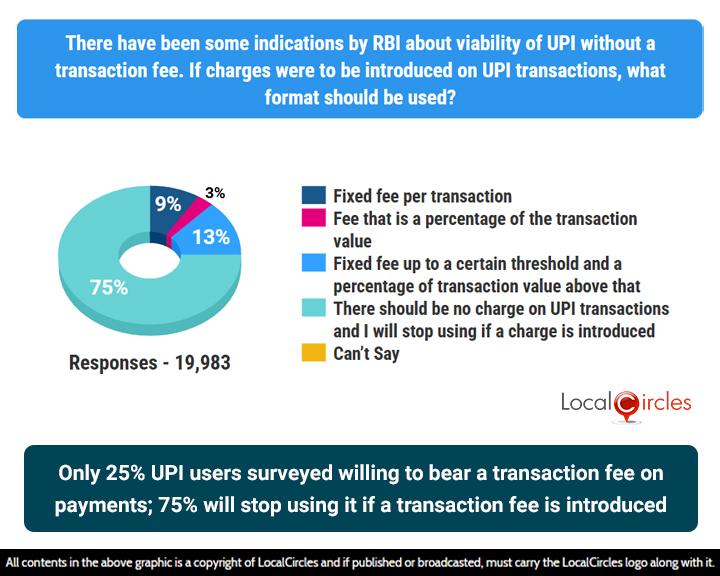
Only 25% of UPI users surveyed are willing to bear a transaction fee on payments; 75% will stop using it if a transaction fee is introduced
In the light of talk about a possible transaction fee, the survey asked digital payment users, “There have been some indication by RBI about viability of UPI without a transaction fee. If charges were to be introduced on UPI transactions, what format should be used?” Out of 19,983 UPI users surveyed 9% stated they would prefer a “fixed fee per transaction”; 3% of respondents said they would prefer “fee that is a percentage of the transaction value”; 13% of respondents indicated “fixed fee up to a certain threshold and a percentage of transaction value above that”; and 75% of respondents stated “there should be no charge on UPI transactions and I will stop using if a charge in introduced”. In essence, only 25% of UPI users surveyed are willing to bear a transaction fee on payments; while 75% have indicated that they will stop using it if a transaction fee is introduced.
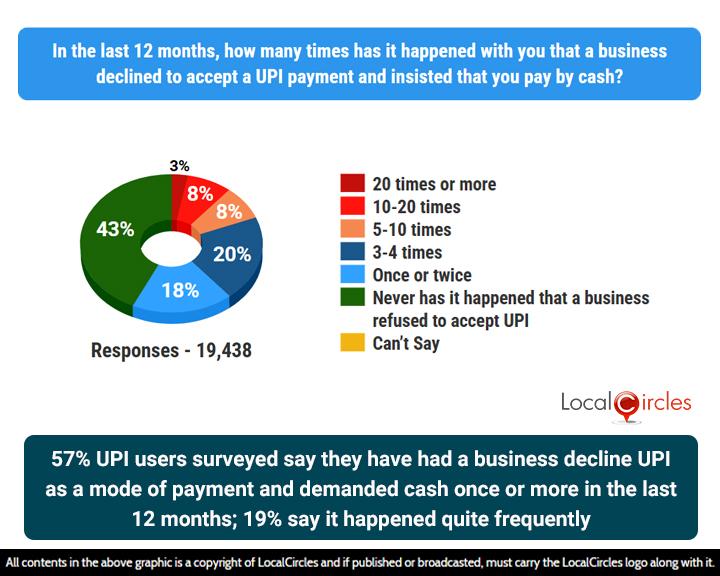
57% UPI users surveyed say they have had a business decline in UPI as a mode of payment and demanded cash once or more in the last 12 months; 19% say it happened quite frequently
In the light of the reports that small traders, shopkeepers and vendors are insisting on cash payments, the survey asked, “In the last 12 months, how many times has it happened with you that a business declined to accept a UPI payment and insisted that you pay by cash?” Out of 19,438 UPI users who responded 3% indicated “20 times or more”; 8% of respondents indicated “10-20 times”; 8% of respondents indicated "5-10 times”; 20% of respondents indicated "3-40 times”; 18% of respondents indicated "once or twice”; and 43% of respondents stated “never has it happened that a business refused to accept UPI”. To sum up, 57% of UPI users surveyed say they have had a business decline UPI as a mode of payment and demanded cash once or more in the last 12 months; 19% of respondents say it has happened quite frequently with them.
In summary, as Unified Payments Interface completes a decade of transforming India’s payment landscape, the findings highlight a clear and critical reality: while adoption is universal, willingness to pay is not. Just 25% of UPI users surveyed are open to bearing any transaction fee, while a significant 75% indicate they would stop using UPI if such charges are introduced. This overwhelming resistance underscores how deeply the “zero-cost” expectation is embedded in consumer behaviour. What began as an incentive to drive adoption has now become a non-negotiable feature for users, making any shift to a paid model highly sensitive and potentially disruptive.
At the same time, friction at the merchant level is already visible. The survey reveals that 57% of users have encountered businesses refusing UPI and asking for cash at least once in the past year, with nearly 1 in 5 experiencing this frequently. This signals early stress points in the ecosystem, even before any formal fee introduction.
Taken together, the data presents a clear policy dilemma: how to sustain and scale a system that users expect to remain free, while ensuring viability for ecosystem participants. As India looks ahead, the path forward may lie not in direct transaction charges, but in building alternative revenue models and value-added services that preserve UPI’s core promise of free, seamless payments.
The next phase of UPI’s journey will therefore depend on maintaining this delicate balance between consumer expectations and ecosystem sustainability.
Survey Demographics
The survey received over 39,000 responses from UPI users located in 376 districts of India. 68% respondents were men while 32% respondents were women. 41% of respondents were from tier 1, 30% from tier 2 and 29% of respondents were from tier 3, 4, 5 & rural districts. The survey was conducted via LocalCircles platform, and all participants were validated citizens who had to be registered with LocalCircles to participate in this survey. The survey was conducted between January 15, 2026 and April 5, 2026.
About LocalCircles
LocalCircles, India’s leading Community Social Media platform enables citizens and small businesses to escalate issues for policy and enforcement interventions and enables Government to make policies that are citizen and small business centric. LocalCircles is also India’s # 1 pollster on issues of governance, public and consumer interest. More about LocalCircles can be found on https://www.localcircles.com
For more queries - media@localcircles.com, +91-8585909866
All content in this report is a copyright of LocalCircles. Any reproduction or redistribution of the graphics or the data therein requires the LocalCircles logo to be carried along with it. In case any violation is observed LocalCircles reserves the right to take legal action.
Enter your email & mobile number and we will send you the instructions.
Note - The email can sometime gets delivered to the spam folder, so the instruction will be send to your mobile as well


