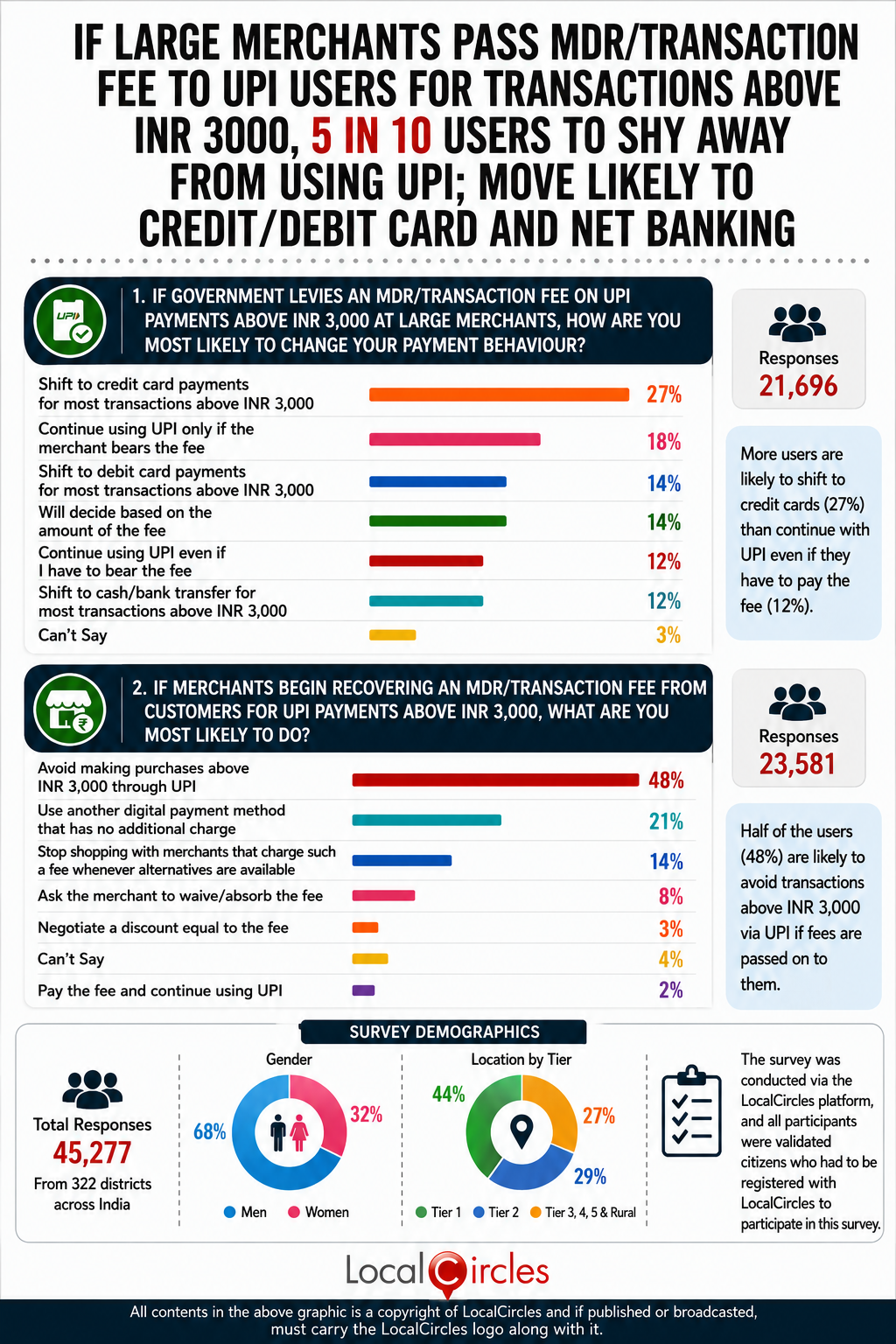
If large merchants pass MDR/transaction fee to UPI users for transactions above INR 3000, 5 in 10 users to shy away from using UPI; Move likely to credit/debit card and net banking
- ● Only 12% UPI users surveyed say they will continue using UPI even if they have to bear the fee on transactions above INR 3000
- ● Combined 27% UPI users surveyed will shift to credit card and 14% to debit card, while 21% will switch to another digital mode with no additional charge
August 10, 2026, New Delhi: Unified Payments Interface (UPI), which now processes the bulk of India’s retail digital payments and remains free for both consumers and merchants, is at the centre of a fresh policy debate. The Government is weighing a proposal to reintroduce a Merchant Discount Rate (MDR)/transaction fee on person-to-merchant (P2M) UPI payments made to large merchants, with reports indicating the levy could apply on higher-value transactions above INR 2,000–INR 3,000. This debate has now moved from speculation to legislation. On August 4, 2026, the Government introduced the Taxation and Other Laws (Amendment) Bill, 2026 in the Lok Sabha, which proposes to amend Section 10A of the Payment and Settlement Systems Act, 2007 — the very provision that has kept UPI free of charges. The Bill proposes to substitute the words “the electronic modes of payment prescribed under section 269SU of the Income-tax Act, 1961” with “one or more electronic modes of payment as the Central Government may, by notification, specify”, in effect repealing the earlier zero-MDR linkage to the tax law and shifting to the Central Government the power to decide which digital payment modes remain free of charges.
Two provisions have kept UPI free so far. Section 269SU of the Income-tax Act requires businesses with turnover above INR 50 crore to accept notified electronic modes — specified by the Central Board of Direct Taxes in December 2019 as UPI, UPI QR and RuPay debit cards — while Section 10A of the Payment and Settlement Systems Act bars banks and system providers from charging either the payer or the recipient on those modes. Once the amendment takes effect, the list of protected modes will no longer be drawn from the tax law but will be whatever the Central Government notifies in the Official Gazette. A future notification could leave out categories such as P2M UPI payments at large merchants, making a charge on such transactions possible without the Government having to return to Parliament. The Bill itself does not specify any fee, rate or timeline, and UPI and RuPay debit card transactions remain free of charge for now, but industry sources view it as the first concrete step towards an MDR on UPI for large merchants.
Under the versions being discussed, the fee could range from about 5–7 basis points to the 0.3% sought by the Payments Council of India, while small merchants (with annual turnover up to around INR 1.5 crore), street vendors and person-to-person (P2P) transfers would stay exempt. Banks, fintech companies and the Parliamentary Standing Committee on Finance have pressed for restoring MDR for large merchants, arguing that payment providers need a way to recover the rising cost of running and expanding the UPI infrastructure. The Payments Council of India has for the past few years sought a 30 basis point MDR on UPI and RuPay debit card payments at large merchants, its chairman having written to the Prime Minister’s Office in March 2025 that zero MDR could continue for smaller merchants on low-value transactions while enabling sustainable monetisation for service providers. The industry estimates the cost of operating and expanding the payments system at at least INR 10,000 crore a year, even as the Union Budget allocated INR 2,000 crore this year to incentivise low-value P2M transactions through UPI and RuPay debit cards — about 8.9% lower than the final FY26 allocation of roughly INR 2,196 crore.
Officials and industry bodies have maintained that any such MDR is meant to be a merchant cost and “should not be passed on to consumers,” and the Finance Ministry has separately termed reports of an MDR on UPI transactions above INR 3,000 as “false, baseless and misleading”, stating there is no proposal to charge consumers. However, the key concern of citizens is whether large merchants, once charged, will recover the fee from customers either directly or through higher prices. Against this backdrop, and with the enabling legislative change now tabled in Parliament, LocalCircles conducted a national survey to gauge how UPI users would respond if large merchants were permitted an MDR/transaction fee on transactions above INR 3000 and began recovering it from them.
The survey received over 45,000 responses from UPI users located across 322 districts of India. The findings show that over 5 in 10 users are likely to move away from UPI to credit cards, debit cards or bank transfers if such a fee is levied on large merchants, and nearly 5 in 10 would avoid making purchases above INR 3000 through UPI if the fee is recovered from them — signalling a significant risk of reversal in UPI adoption for higher-value payments. With the Government now seeking the power to notify which payment modes stay free of charges, these findings have a direct bearing on how any MDR framework that follows is designed. The key findings of the survey are detailed below.
Over 5 in 10 UPI users surveyed are likely to shift to credit card, debit card or bank transfer for transactions above INR 3000 if the Government permits an MDR/transaction fee on large merchants
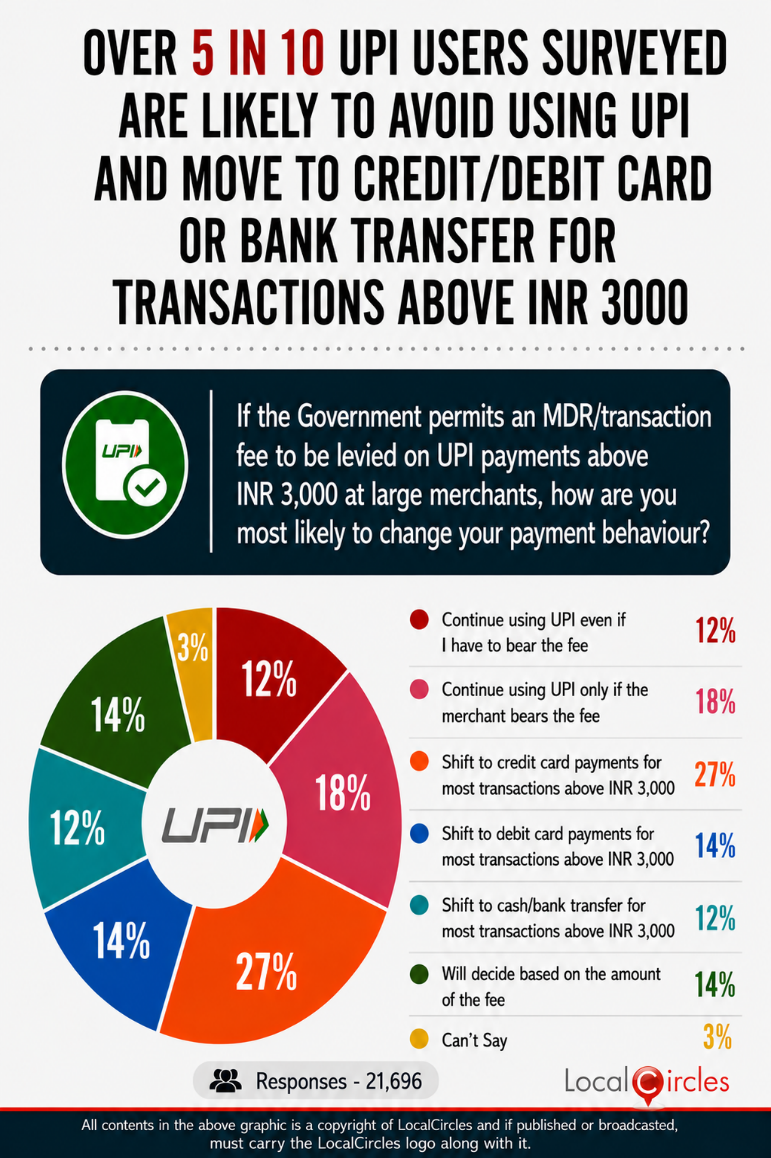
To understand how the proposed fee — which the proposed amendment to Section 10A of the Payment and Settlement Systems Act, 2007 would make administratively possible through a simple gazette notification — could reshape payment behaviour, the survey asked, “If the Government permits an MDR/transaction fee to be levied on UPI payments above INR 3000 at large merchants, how are you most likely to change your payment behaviour?” This question received 21,696 responses. In response, the largest group at 27% said they would shift to credit card payments for most transactions above INR 3000, followed by 18% who would continue using UPI only if the merchant bears the fee. Another 14% would shift to debit card payments, 14% said they would decide based on the amount of the fee, 12% would continue using UPI even if they have to bear the fee, and 12% would shift to cash/bank transfer for most transactions above INR 3000. Taken together, a combined 53% of users surveyed — 27% moving to credit card, 14% to debit card and 12% to cash/bank transfer — are likely to move away from UPI for higher-value payments, with only 12% willing to absorb the fee and stay on UPI.
Nearly 5 in 10 UPI users surveyed are likely to avoid making purchases above INR 3000 through UPI if large merchants begin recovering the MDR/transaction fee from them
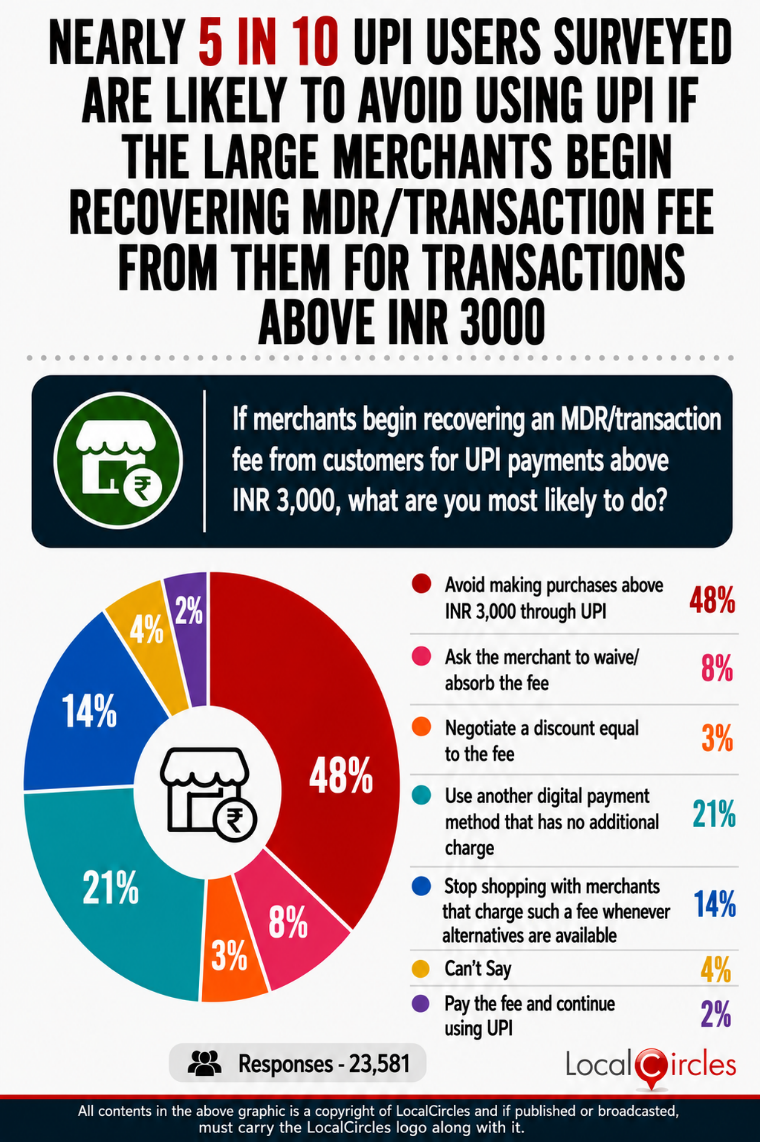
The survey next tested what users would do if merchants passed the fee on to them — the scenario citizens are most concerned about now that the Government is seeking the power to notify which payment modes remain free of charge —, asking, “If merchants begin recovering an MDR/transaction fee from customers for UPI payments above INR 3000, what are you most likely to do?” This question received 23,581 responses. In response, nearly half at 48% said they would avoid making purchases above INR 3000 through UPI, while 21% would use another digital payment method that has no additional charge. A further 14% said they would stop shopping with merchants that charge such a fee whenever alternatives are available, 8% would ask the merchant to waive or absorb the fee, and 3% would negotiate a discount equal to the fee. Only 2% said they would pay the fee and continue using UPI, while 4% could not say. In effect, the overwhelming majority would either move their higher-value spends off UPI or push back on merchants, and only a marginal 2% are willing to simply pay the fee and continue as before.
In summary, the survey findings indicate that while UPI has become the default mode for everyday digital payments in India, its adoption for higher-value transactions is closely tied to the fact that it is free for users. The moment a cost is attached — whether through an MDR/transaction fee that large merchants are permitted to levy or one they recover directly from customers — a large share of users are prepared to switch away. Over 5 in 10 users surveyed would move to credit cards, debit cards or bank transfers for transactions above INR 3000, and nearly 5 in 10 would avoid making such purchases through UPI altogether if the fee is passed to them, with only 2% willing to simply pay the fee and continue. This is no longer a hypothetical scenario: with the Taxation and Other Laws (Amendment) Bill, 2026 proposing to move the zero-charge protection out of the Income-tax Act and into the hands of the Central Government by notification, the legal path to an MDR on UPI at large merchants is being cleared.
These findings carry an important signal for policymakers as Parliament considers the Taxation and Other Laws (Amendment) Bill, 2026 and the Government finalises its position on MDR for large merchants. Although officials maintain that any such fee is intended to be a merchant cost and not a consumer charge, the citizen pulse shows that even the possibility of the cost being recovered from users could dent UPI usage for higher-value payments and push spends back to cards and net banking. LocalCircles will be escalating these findings to the Ministry of Finance, the Reserve Bank of India, the National Payments Corporation of India (NPCI) and other relevant authorities so that the citizen pulse can inform the ongoing deliberations and any safeguards placed around the design of an MDR framework for UPI. Given that the Bill would enable an MDR to be introduced through executive notification rather than through Parliament, LocalCircles is also urging that any such notification be preceded by public consultation and be accompanied by an explicit bar on merchants recovering the fee from consumers.
Survey Demographics
The survey received over 45,000 responses from UPI users located across 322 districts of India. 68% respondents were men while 32% respondents were women. 44% of respondents were from tier 1, 29% from tier 2 and 27% respondents were from tier 3, 4, 5 & rural districts. The survey was conducted via the LocalCircles platform, and all participants were validated citizens who had to be registered with LocalCircles to participate in this survey.
About LocalCircles
LocalCircles, India’s leading Community Social Media platform enables citizens and small businesses to escalate issues for policy and enforcement interventions and enables Government to make policies that are citizen and small business centric. LocalCircles is also India’s # 1 pollster on issues of governance, public and consumer interest. More about LocalCircles can be found on https://www.localcircles.com
For more queries - media@localcircles.com, +91-8585909866
All content in this report is a copyright of LocalCircles. Any reproduction or redistribution of the graphics or the data therein requires the LocalCircles logo to be carried along with it. In case any violation is observed LocalCircles reserves the right to take legal action.


