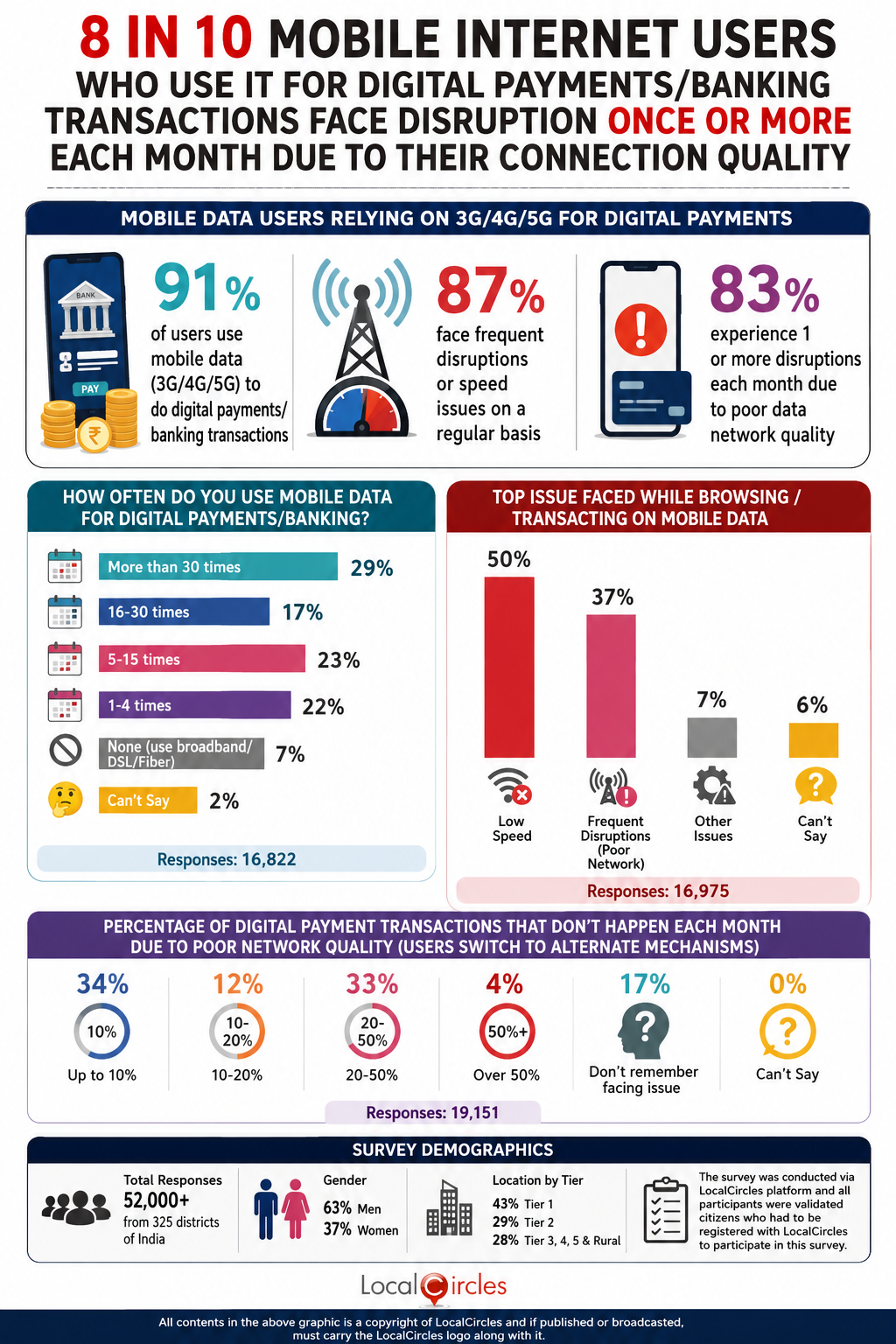
8 in 10 mobile internet users who use it for digital payments/banking transactions face disruption once or more each month due to their connection quality
- ●83% of 3G/4G/5G connection users who conduct digital payment/banking transactions experience 1 or more disruptions each month due to poor data network quality, up sharply from 58% in 2024, with 37% now reporting that over a fifth of their transactions fail
- ● 91% of those who conduct digital payment/banking transactions are using their mobile data connection to do so, up from 85% in 2024 and 62% in 2022, while 87% face frequent disruptions or speed issues on a regular basis
August 21, 2026, New Delhi: India's digital payment story has never looked stronger on paper. In July 2026 the Unified Payments Interface processed 23.66 billion transactions worth ₹29.88 lakh crore, its highest-ever monthly volume, averaging 763 million transactions and ₹96,383 crore a day — and it did so without the support of a festival or a quarter-end settlement rush.
UPI already accounts for 81% of all retail digital payments in the country. The rails on which all this runs, however, are not bank servers alone but the mobile data connection in the consumer's hand. Telecom Regulatory Authority of India’s (TRAI) June 2026 subscription report puts India's telecom subscriber base at 1.348 billion, with 1,300.25 million wireless subscribers and 1.087 billion broadband subscribers, the overwhelming majority of them accessing the internet over 3G, 4G or 5G mobile networks rather than a fixed line. When that connection falters mid-transaction, the payment does not go through — and the consumer, not the operator, absorbs the consequence at the counter, at the fuel pump or at the toll gate.
The regulator itself has acknowledged that quality of service has not kept pace with scale. On August 5, 2026, TRAI released a consultation paper proposing sweeping amendments to the Standards of Quality of Service Regulations, 2024, with comments due by August 26, 2026, and counter-comments by September 7, 2026. The draft would require operators to maintain at least 98% accuracy in the geospatial coverage maps published on their websites and to validate them through drive tests in areas where consumers have reported poor coverage.
It widens the definition of a significant network outage to any disruption lasting more than four hours in a district or affecting more than 10% of subscribers in a service area, requiring it to be reported to TRAI within 24 hours, and it obliges operators to compensate subscribers — rental rebates for postpaid users and validity extensions for prepaid users — where an outage runs beyond 24 hours. On speed, it proposes that the 80th percentile measured speed must equal or exceed the advertised speed for every 4G and 5G tariff plan. It also introduces a Silence Call Rate benchmark of 1% or less, Quality of Experience Scores published operator-wise, and financial disincentives rising from ₹2 lakh to ₹10 lakh for false compliance reporting and repeated non-compliance. That such a wide-ranging tightening is being contemplated in the eighth year of 4G saturation and the fourth year of 5G rollout is itself an admission that network quality remains an unsolved problem.
On the payments side, the pressure has been building through 2026. In late March 2026 UPI users encountered widespread transaction declines, with NPCI attributing them to financial year-end activity at the bank end; volumes on March 26 fell to 550 million, about 7% below the daily average for that month. A fresh round of failures followed on April 1, 2026, affecting customers of SBI, HDFC Bank and ICICI Bank. National Payments Corporation of India (NPCI) reported downtime at 11 banks in February 2026 alone, with one bank down for roughly 14 hours in the month, and among the top 50 UPI participants the highest technical decline rate stood at 7.26%.
The Centre has since asked banks and NPCI to work together to bring failure rates down, with smaller lenders and regional rural banks flagged for weaker technology infrastructure. Significantly, the official taxonomy of a UPI failure lists network disruption alongside system outages as a technical cause — an acknowledgement that a payment can fail without anything being wrong at either the bank or the payer's end.
Connectivity has also been interrupted by administrative action. India recorded roughly 24 internet shutdowns in 2026 up to July 22. In July 2026, authorities suspended landline, mobile and broadband services across the entire Doda district of Jammu & Kashmir, with local business operations and UPI payments being reported as severely disrupted; mobile internet was switched off within a 1.5 km radius of Jantar Mantar in Central Delhi between July 23 and July 25, 2026; and services were suspended in parts of Muzaffarpur district in Bihar from July 24 to July 26, 2026. For a consumer or a small merchant, a shutdown and a weak signal produce the same outcome — the transaction does not complete. NPCI, for its part, is developing an offline UPI Lite ‘tap and pay’ facility using NFC (Near Field Communication) for transactions of up to ₹2,000 without an internet connection, targeted for launch by the end of 2026, explicitly to address payment failures in low-connectivity locations such as basements, metro stations and remote villages. That such a workaround is being built is the clearest signal yet that connectivity, not the payment system, is now the binding constraint.
It is against this backdrop — record transaction volumes riding on a network that consumers say they cannot rely on — that LocalCircles surveyed mobile internet users on how mobile data quality is affecting their digital payment and banking transactions. The survey received over 52,000 responses from mobile internet users located across 325 districts of India. LocalCircles had last run this survey in 2024 and before that in 2022, which allows the current findings to be read as a four-year trend rather than a snapshot. That comparison is not reassuring.
The proportion of mobile data users conducting digital payment or banking transactions on their mobile data connection has risen from 62% in 2022 to 85% in 2024 and 91% now, while the proportion reporting one or more transaction disruptions each month due to poor network quality — which had improved from 68% in 2022 to 58% in 2024 — has jumped to 83%. In other words, dependence has deepened and reliability has deteriorated at the same time. The key findings of the survey are detailed below.
91% of 3G/4G/5G connection users who conduct digital payment/banking transactions are using their mobile data connection to do so
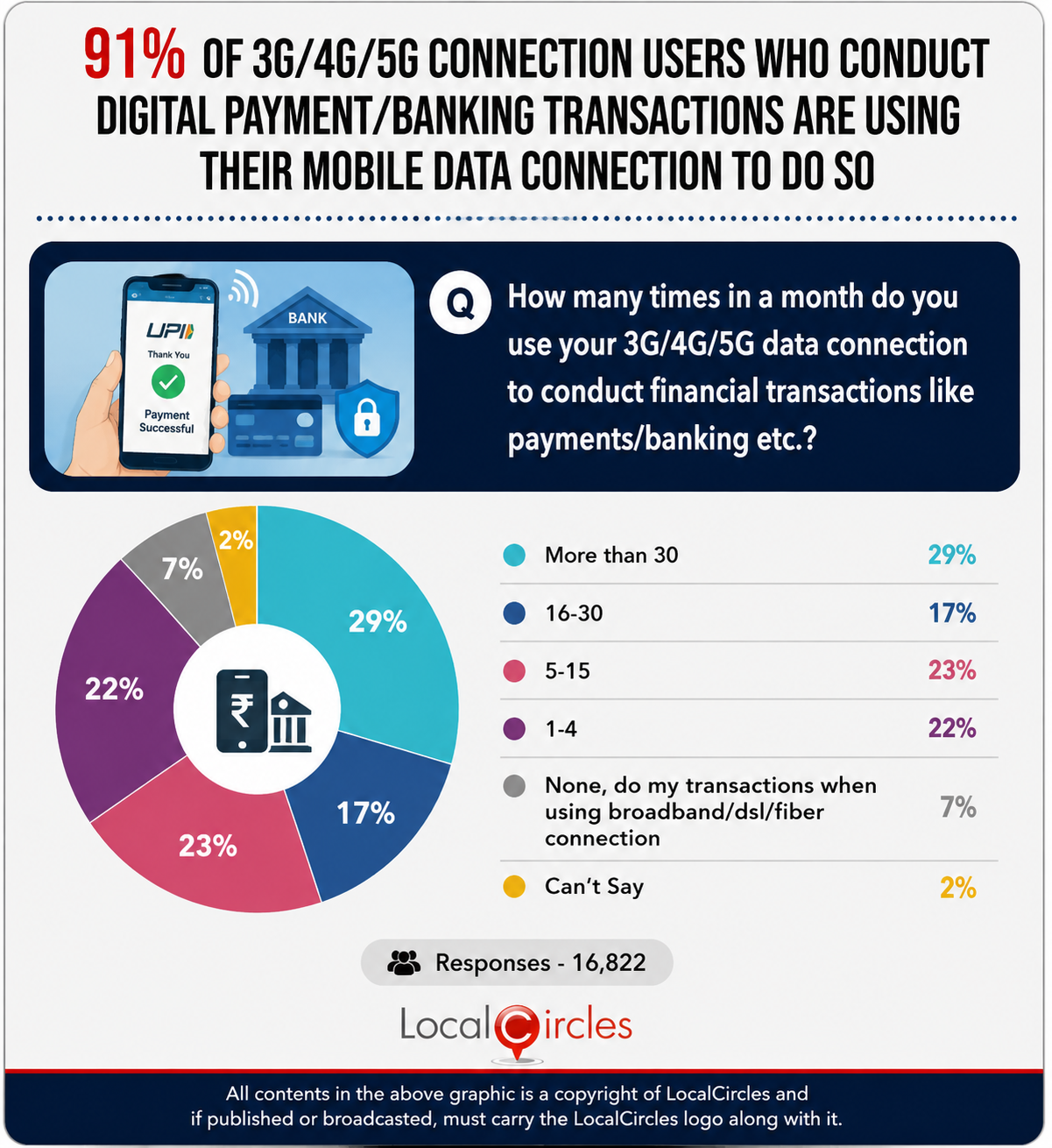
To establish how central the mobile data connection has become to everyday money movement, the survey first asked mobile internet users, “How many times in a month do you use your 3G/4G/5G data connection to conduct financial transactions like payments/banking etc.?” This question received 16,822 responses. In response, 29% said they use it more than 30 times a month, 17% said 16-30 times, 23% said 5-15 times and 22% said 1-4 times. Only 7% said they conduct no such transactions on mobile data and do them instead over a broadband, DSL or fibre connection, while 2% could not say. Taken together, 91% of 3G/4G/5G connection users who conduct digital payment or banking transactions are using their mobile data connection to do so, and 46% — nearly one in two — are doing so more than 15 times a month. The direction of usage is unmistakable: this number stood at 62% in 2022, before the 5G rollout, rose to 85% in 2024 and has now reached 91%. Just as telling is the collapse of the fixed-line alternative. The share of users who route their financial transactions through broadband, DSL or fibre instead of mobile data has fallen from 12% in 2024 to 7% now, which means the fallback option that consumers once had when the mobile network failed is available to fewer of them than before. For the overwhelming majority, the mobile data connection is not the preferred route to a digital payment — it is the only one.
87% of 3G/4G/5G connection users face either frequent disruptions or speed issues on a regular basis
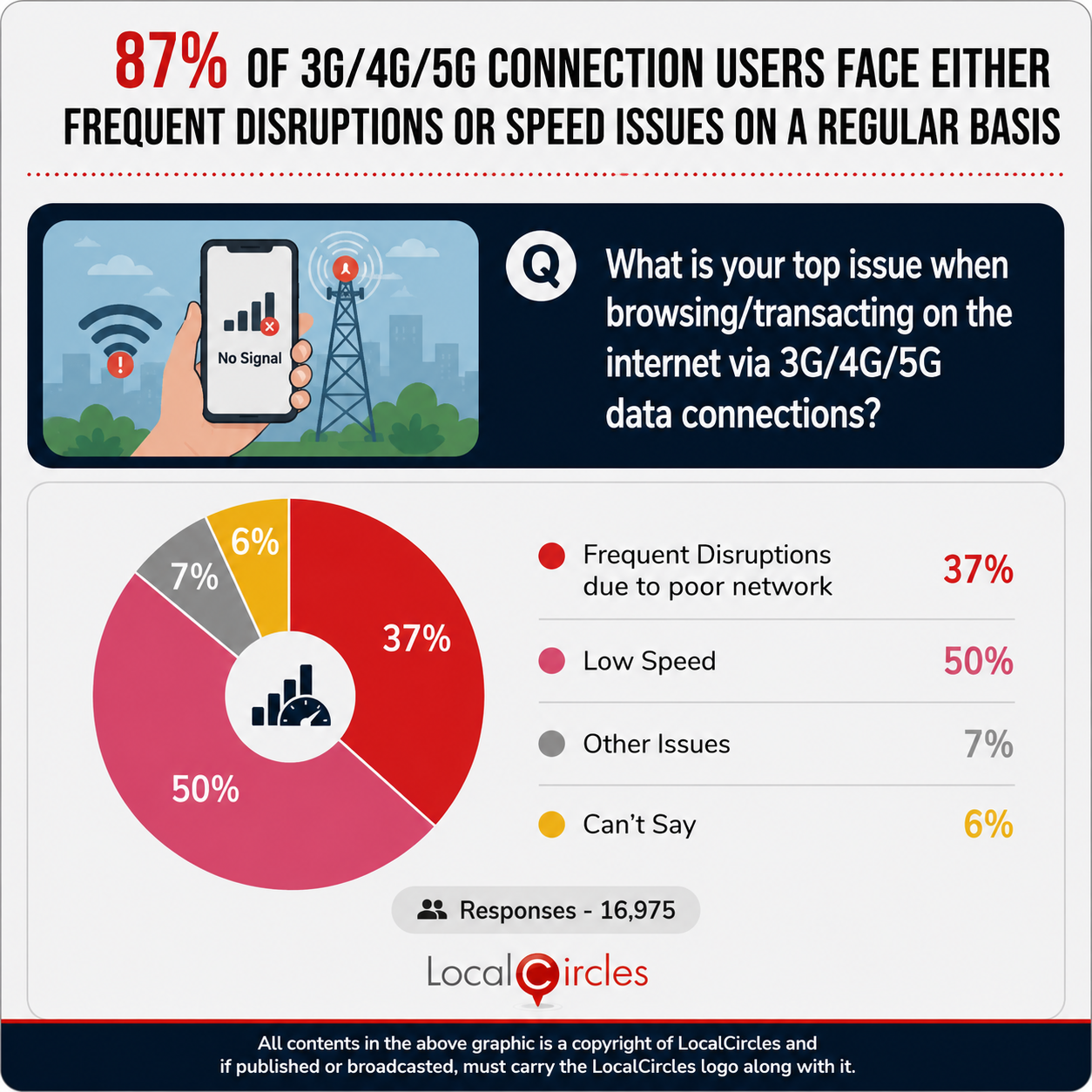
The next question sought to identify what exactly goes wrong when consumers transact or browse on mobile data, asking, “What is your top issue when browsing/transacting on the internet via 3G/4G/5G data connections?” This question received 16,975 responses. Half of all respondents at 50% identified low speed as their top issue, while 37% pointed to frequent disruptions due to poor network. Another 7% cited other issues and only 6% could not say. In total, 87% of 3G/4G/5G connection users report either frequent disruptions or speed issues on a regular basis. This marks a clear reversal of the improvement recorded two years ago. In 2022 the figure stood at 92%; by 2024 it had fallen to 75%, a gain attributed at the time to the transition to 5G; it has now climbed back to 87%, giving up most of that ground. The internal composition of the answer has also shifted. In 2024, 42% cited low speed and 33% cited frequent disruptions, with a large 21% unable to say; today only 6% cannot say, and both low speed at 50% and frequent disruptions at 37% have risen. Consumers have become considerably more definite about what is failing them, which is what one would expect as dependence on the connection deepens and the failures become impossible to overlook. It is worth reading this alongside TRAI's own proposal that the 80th percentile measured speed on every 4G and 5G plan must match the advertised speed — a benchmark that would not need to be written into regulation if advertised speeds were being delivered in practice.
83% of 3G/4G/5G connection users who conduct digital payment/banking transactions said they experience 1 or more disruptions each month due to poor data network quality
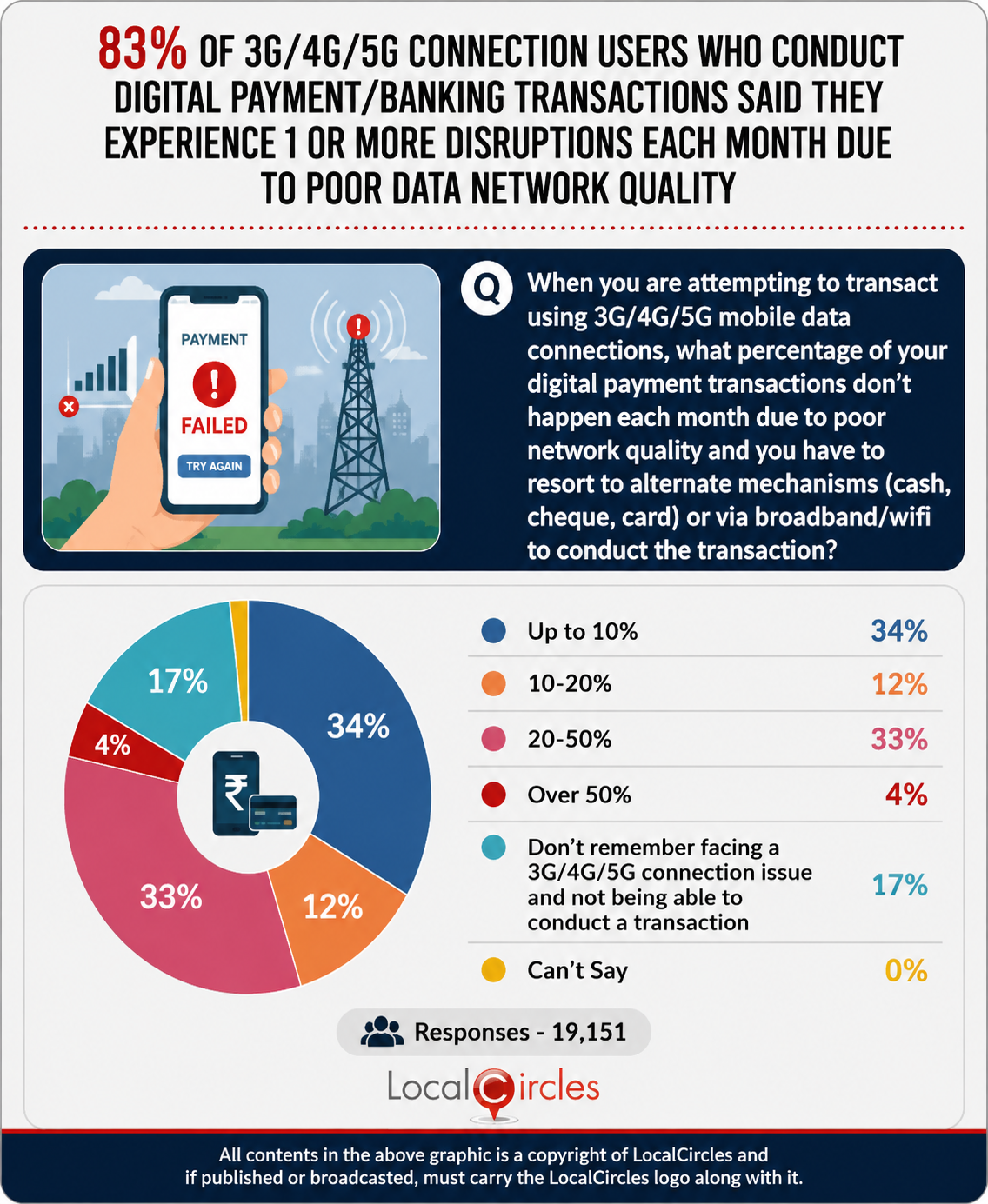
The final question in the survey went to the heart of the matter, asking, “When you are attempting to transact using 3G/4G/5G mobile data connections, what percentage of your digital payment transactions don't happen each month due to poor network quality and you have to resort to alternate mechanisms (cash, cheque, card) or via broadband/wifi to conduct the transaction?” This question received 19,151 responses. In response, 34% said up to 10% of their transactions fail each month, 12% said 10-20%, 33% said 20-50% and 4% said over 50%. Another 17% said they do not remember facing a 3G/4G/5G connection issue that prevented them from conducting a transaction, and 0% could not say. Taken together, 83% of 3G/4G/5G connection users who conduct digital payment or banking transactions — more than 8 in 10 — experience one or more disruptions each month due to poor data network quality. The severity is the more troubling part of this finding. The share of consumers reporting that between a fifth and half of their monthly transactions fail has risen from 8% in 2024 to 33% now, a fourfold increase, and a further 4% report that more than half fail. Put together, 37% of those surveyed — well over one in three — are seeing more than a fifth of their digital payments not go through in a typical month. The headline number tells the same story of reversal: 68% in 2022, 58% in 2024 and 83% today. The proportion of those who do not recall facing such an issue has meanwhile halved from 35% to 17%, confirming that the experience has spread rather than merely become more salient. Each of these failed transactions has a consequence that does not show up in any payment statistic — a consumer stranded at a fuel pump, a bill payment missed past its due date, a small merchant asked to wait or turned away, or a fallback to cash that the same consumer has been encouraged for a decade to move away from.
In summary, the survey findings indicate that India's digital payments problem is no longer one of adoption but one of dependability. 91% of mobile internet users who conduct digital payment or banking transactions now do so over their mobile data connection, up from 62% in 2022, and only 7% still have a broadband or fibre route to fall back on. Yet 87% face frequent disruptions or speed issues on a regular basis and 83% experience at least one transaction disruption every month because of poor data network quality, with 37% reporting that more than a fifth of their monthly transactions fail. On all three measures, the consumer experience has deteriorated since 2024, and on two of them it is now worse than or close to where it stood in 2022 before 5G was rolled out. The improvement that consumers reported in 2024 has not been maintained.
This sits awkwardly alongside the headline numbers being celebrated elsewhere. UPI processed a record 23.66 billion transactions worth ₹29.88 lakh crore in July 2026 and accounts for 81% of retail digital payments, and India's wireless subscriber base crossed 1.3 billion in June 2026. Volume growth of that order does not indicate that the underlying network is working; it indicates that consumers have no practical alternative and are absorbing the failures themselves. NPCI's own move to build an offline UPI Lite tap-and-pay facility for transactions up to ₹2,000, targeted for end-2026, is a tacit acceptance that the connectivity layer cannot be relied upon. So is the Centre's push, running since early 2026, to get banks and NPCI to lift transaction success rates, in which network disruption is formally recognised as a technical cause of failure alongside system outages? The consumer does not distinguish between a bank server that is down, a network that has dropped and a district where services have been suspended — in each case the payment simply does not happen.
These findings carry a direct signal for TRAI, the Department of Telecommunications, RBI, NPCI and MEITY. The citizen pulse here is not a complaint about coverage in the abstract; it is about money that does not move on a network that everyone assumes works. TRAI's August 2026 consultation on quality of service is timely, and the survey findings make the case for carrying its key proposals through to regulation rather than allowing them to lapse — particularly the 98% coverage-map accuracy requirement, the 80th percentile speed benchmark for 4G and 5G tariff plans, mandatory outage reporting within 24 hours and subscriber compensation for prolonged outages. What the survey adds is that the outages consumers experience are not the district-wide, multi-hour events that current and proposed definitions capture, but short, frequent, hyper-local failures that occur several times a month, leave no regulatory trace and are invisible in every operator's compliance report.
LocalCircles will be escalating these findings to TRAI, the Department of Telecommunications, RBI, NPCI and MEITY, and will be submitting them as part of the ongoing TRAI consultation on the Standards of Quality of Service Regulations. LocalCircles is urging that transaction-level failure attribution be made mandatory so that when a digital payment fails, the consumer is told whether the cause was the bank, the payment system or the network, and that such network-attributed failure data be published operator-wise and district-wise. The TRAI's proposed Quality of Experience Score needs to include a mobile data reliability measure derived from real transaction outcomes rather than drive tests alone. The definition of a reportable outage needs to be widened to capture short, repeated, cell-level failures rather than only district-wide disruptions lasting over four hours. The telecom operators should be required to publish honest, independently validated coverage maps and be held accountable to the advertised speeds of the plans they sell. The RBI and NPCI need to accelerate the rollout of offline and low-bandwidth payment modes with adequate consumer protection and no additional cost to the user. In addition, wherever internet services are suspended by administrative order, an assessment of the impact on digital payments and small merchants needs to be placed in the public domain. With cash use declining and consumers increasingly left with no alternative to digital payment, ensuring that the connection works are no longer a telecom service issue — it is a financial inclusion issue.
Survey Demographics
The survey received over 52,000 responses from mobile internet users located in 325 districts of India. 63% respondents were men while 37% respondents were women. 43% respondents were from tier 1, 29% from tier 2 and 28% respondents were from tier 3, 4, 5 and rural districts. The survey was conducted via LocalCircles platform, and all participants were validated citizens who had to be registered with LocalCircles to participate in this survey.
About LocalCircles
LocalCircles, India’s leading Community Social Media platform enables citizens and small businesses to escalate issues for policy and enforcement interventions and enables Government to make policies that are citizen and small business centric. LocalCircles is also India’s # 1 pollster on issues of governance, public and consumer interest. More about LocalCircles can be found on https://www.localcircles.com
For more queries - media@localcircles.com, +91-8585909866
All content in this report is a copyright of LocalCircles. Any reproduction or redistribution of the graphics or the data therein requires the LocalCircles logo to be carried along with it. In case any violation is observed LocalCircles reserves the right to take legal action.
Enter your email & mobile number and we will send you the instructions.
Note - The email can sometime gets delivered to the spam folder, so the instruction will be send to your mobile as well


