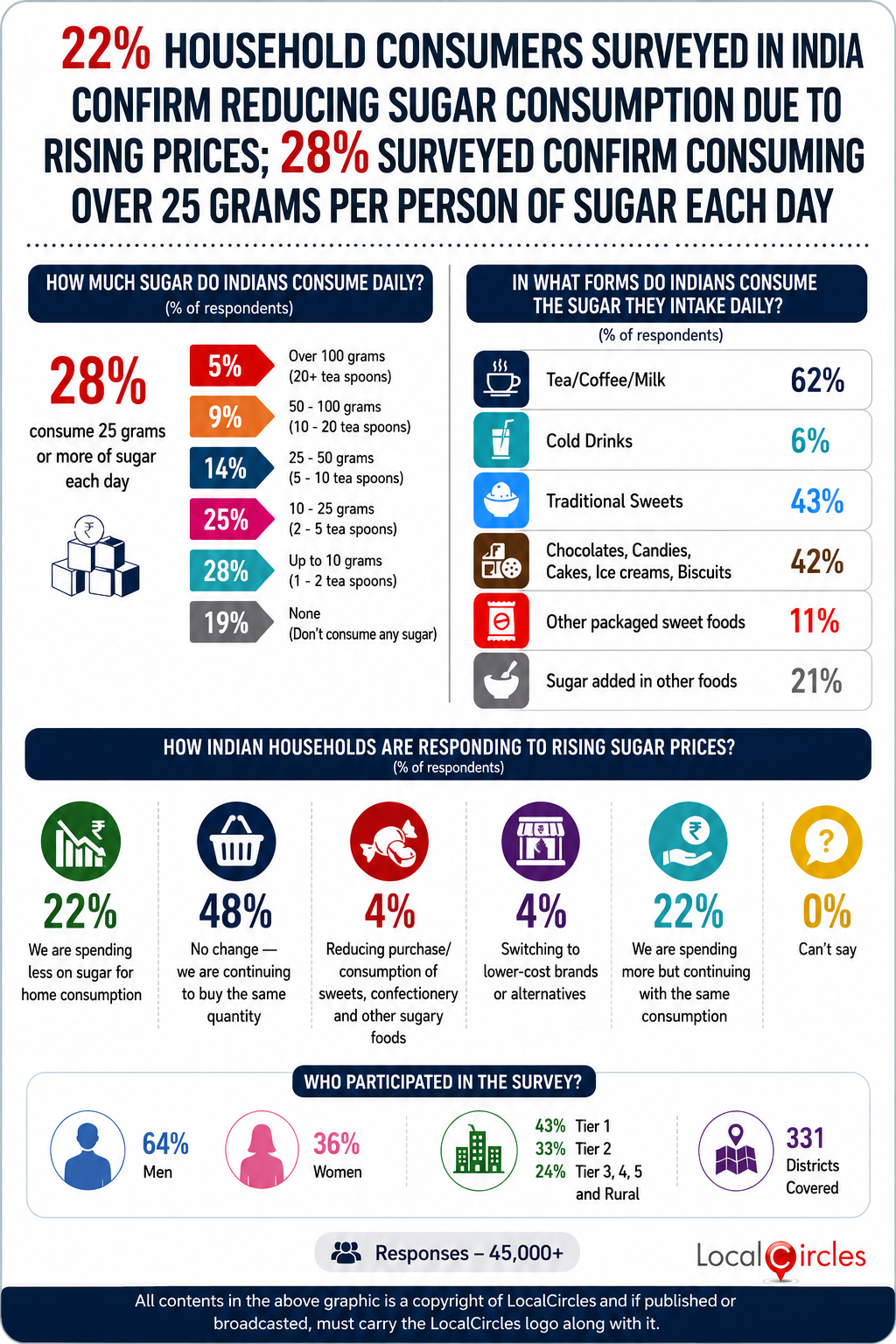
22% household consumers surveyed in India confirm reducing sugar consumption due to rising prices; 28% surveyed confirm consuming over 25 grams per person of sugar each day
- ● 28% of consumers surveyed consume 25 grams or more of sugar a day, the outer limit ICMR recommends, and 5% consume over 100 grams; only 19% report consuming no sugar at all
- ● 22% of households surveyed are buying less sugar as retail prices rose nearly 16% in a month to Rs 55.70 per kg, while 22% are spending more to keep consumption unchanged
- ● 62% of daily sugar consumers surveyed take their sugar via tea, coffee or milk, while 43% take it via traditional sweets and 42% via chocolates, cakes, ice creams and biscuits
- ● Centre bans sugar exports till September 30, 2026 and permits duty-free import of 10 lakh tonnes of raw sugar till October 31, 2026, alongside a 400 tonne stock cap on dealers and a 15-day cap on bulk consumers
August 27, 2026, New Delhi: Sugar has become the most closely watched item in the Indian kitchen this month. The all-India average retail price of sugar stood at Rs 48.18 per kg on July 20, 2026. By August 20, 2026, it had climbed to Rs 55.70 per kg, a rise of nearly 16% in a single month, as per the Department of Consumer Affairs price monitoring data. In several markets retail rates have crossed Rs 60 per kg, and pockets such as Dombivli in Maharashtra have reported rates as high as Rs 70 per kg. In the week beginning August 21, 2026, ex-mill rates in parts of Karnataka and Maharashtra were quoted between Rs 62 and Rs 64 per kg, before easing marginally once the Centre announced duty-free imports and stock limits.
The wholesale trade tells the same story. Ex-factory prices for M-grade sugar in Uttar Pradesh crossed Rs 5,400 a quintal on August 18, 2026, while Delhi wholesale touched Rs 5,800 a quintal. That is about 32% higher than two months earlier, when the rate was near Rs 4,400. For a household that buys sugar every month, this is the sharpest increase in recent memory. Seen over a longer window, ex-mill prices ran up from about Rs 3,800 a quintal in June 2026 to a peak of Rs 6,800 to Rs 7,000 a quintal by mid-August 2026, an increase of roughly 80% in two months, against about Rs 3,900 a quintal a year earlier. After the measures announced on August 20, 2026, Maharashtra ex-mill rates eased back to Rs 5,800 to Rs 6,000 a quintal, an early sign that the intervention has begun to bite at the wholesale end even as retail prices have yet to follow.
The reasons lie in a shortfall in output. The 2025-26 season opened with an estimate of 34.3 million tonnes. Production is now placed at about 30.6 million tonnes. Red rot and top borer infestations damaged the crop in key belts, and heavy rain caused waterlogging. Net of the cane diverted to ethanol, sugar available for the market is close to 29.3 million tonnes, against annual domestic consumption of 28 to 29 million tonnes. Closing stocks on September 30, 2026 are projected at 3 to 3.3 million tonnes, which would be among the lowest in decades. The Government places the September 30, 2026 stock marginally higher, at 3.3 to 3.5 million tonnes, and maintains that this is adequate to meet requirements until fresh crushing begins. International prices have moved in the same direction, rising 16.4% between June 30 and August 20, 2026, from USD 474 to USD 552 a tonne.
Trade policy has already been tightened once this season. On May 13, 2026, the Directorate General of Foreign Trade moved raw, white and refined sugar from the restricted list to the prohibited list, banning exports until September 30, 2026. Of the 15 lakh tonnes originally permitted for the 2025-26 season, about 6.5 lakh tonnes had already been shipped before the ban took effect, with a further 40,000 to 60,000 tonnes in the pipeline against contracts already approved. Exemptions were retained only for shipments to the European Union under the CXL arrangement, to the United States under its tariff rate quota, for advance authorisation consignments and for government-to-government supplies. Within a single season, therefore, India has moved from exporting sugar to importing it duty-free, which is the clearest indication of how tight the domestic balance has become.
The Centre has stepped in on several fronts. Stock limits have been imposed from August 1 to November 30, 2026, capping dealers at 400 tonnes, and bulk consumers who use more than 10 tonnes of sugar a month will be capped at 15 days of consumption from September 1 to November 30, 2026, under the Essential Commodities Act, 1955. Mills have separately been directed to ensure that buyers lift their purchased stock within seven days, so that sold sugar does not sit in mill godowns while the market runs short. Physical verification of mill stocks has been ordered, with penalties under the Sugar Control Order, 2025 for discrepancies. Duty-free import of 10 lakh tonnes of raw sugar has been permitted under a tariff rate quota notified by the Directorate General of Foreign Trade on August 20, 2026, the first duty-free sugar import India has allowed in about a decade. The application window was open from August 21 to 28, 2026, refiners are required to complete imports by October 15, 2026 and the overall window closes on October 31, 2026. States and mills have also been advised to advance the start of the crushing season to October 15, 2026, with October 2026 output expected to cross 10 lakh tonnes against a normal 3 to 4 lakh tonnes for that month. The Ministry of Consumer Affairs has rejected the view that ethanol diversion is behind the price rise, pointing out that sugar-based ethanol has fallen to 9% of output this season from 12% in 2022-23, with grain now supplying roughly three-fourths of ethanol. It has also confirmed that 97% of sugarcane farmer dues for the 2025-26 season have been paid. Food Secretary Sanjeev Chopra has described the ex-mill increase from Rs 47 to Rs 48 per kg to about Rs 62 per kg within seven to ten days as not being based on any fundamentals, and has pointed to speculation and hoarding rather than supply as the immediate trigger. Joint Central and State teams are verifying stocks at mills, and State Governments have been asked to act against hoarding and black marketing, with Uttar Pradesh among the States that have ordered enforcement drives. The monthly release quota for August 2026 was held at 22.50 lakh tonnes, unchanged from August 2025. The sugar industry has separately sought an upward revision of the minimum selling price of sugar, on which the Ministry of Consumer Affairs, Food and Public Distribution has said a decision will be taken.
Price, however, is only half the story. The other half is health. The ICMR-National Institute of Nutrition dietary guidelines, released in May 2024, recommend that added sugar stay below 5% of daily calorie intake. For a 2,000-calorie diet, that works out to about 25 grams a day, or five teaspoons. The guidelines advise no added sugar at all for children under two years. The World Health Organization makes the same recommendation. Against this benchmark, the ICMR-INDIAB study estimates that 101 million Indians live with diabetes and another 136 million with prediabetes.
Obesity is rising in parallel. UNICEF data released in September 2025 shows adult obesity in India has roughly doubled in fifteen years, reaching 24% among women and 22.9% among men. India is projected to have 27 million obese children and adolescents by 2030, about 11% of the global burden. Sales of ultra-processed foods in India grew from USD 900 million in 2006 to USD 37.9 billion in 2019, and much of the sugar in these products is invisible to the buyer.
Policy has begun to respond. The GST Council has placed aerated waters and other drinks containing added sugar in the highest 40% slab. In May 2025, CBSE directed schools to put up sugar boards, citing a marked rise in Type 2 diabetes among children over the past decade, and later extended the idea to oil boards. Front-of-pack labelling, however, remains unsettled. FSSAI filed an affidavit on August 3, 2026 proposing that packs display government-recommended daily limits for added sugar, salt and saturated fat rather than warning symbols. On August 21, 2026, the Supreme Court gave FSSAI two weeks to consult experts and arrive at a decision, warning that it would otherwise pass further directions.
It is against this backdrop of costlier sugar and mounting health concern that LocalCircles surveyed household consumers on how much sugar they consume, in what forms they consume it, and how their household is responding to the price rise. The survey received over 45,000 responses from consumers located across 331 districts of India. The key findings of the survey are detailed below.
28% of Indians surveyed confirm consuming 25 grams or more of sugar each day
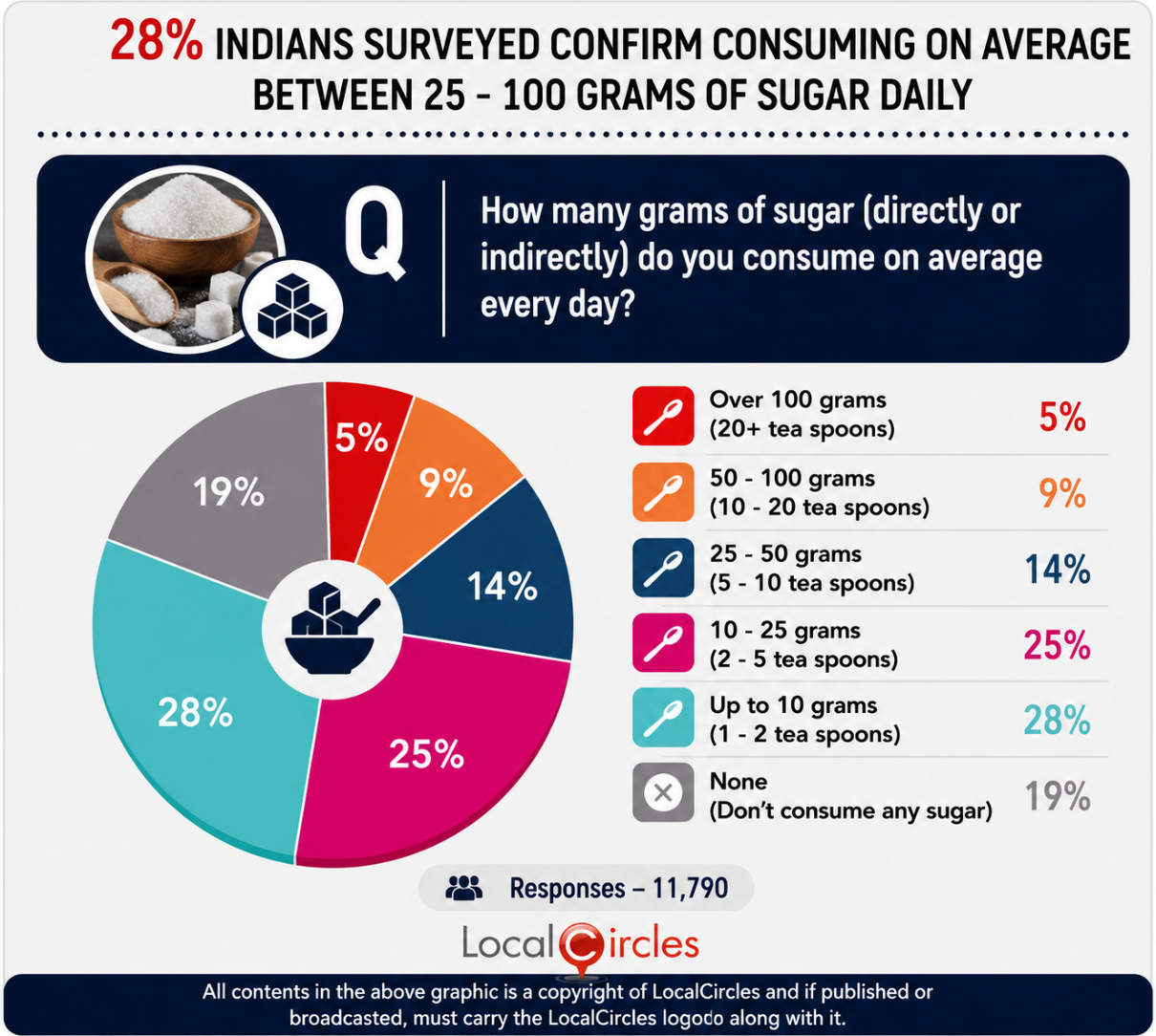
To establish how much sugar Indians actually take in, the survey asked consumers, "How many grams of sugar (directly or indirectly) do you consume on average every day?" This question received 11,790 responses. In response, 5% said they consume over 100 grams a day, which is 20 teaspoons or more. Another 9% said 50-100 grams, or 10 to 20 teaspoons. 14% said 25-50 grams, or 5 to 10 teaspoons. A further 25% said 10-25 grams and 28% said up to 10 grams. Only 19% said they do not consume any sugar at all.
Taken together, 28% of Indians surveyed consume 25 grams or more of sugar each day. That is at or above the ceiling that ICMR and the WHO recommend for an adult. Within this group, 23% fall in the 25 to 100 gram band and 5% are above 100 grams a day. For that 5%, daily intake is four times the recommended limit and more, every single day.
Two points deserve attention. First, these are self-reported numbers. Sugar that arrives through packaged food, restaurant meals and sweetened drinks is difficult for any consumer to count, so the real figure is likely higher than what respondents state. Second, the 19% who report zero sugar are almost certainly reporting zero added sugar in tea, coffee or milk rather than zero sugar overall. What the finding establishes with reasonable confidence is that more than one in four Indian consumers knowingly exceed the recommended daily limit.
6 in 10 of those who consume sugar daily take it through tea, coffee or milk
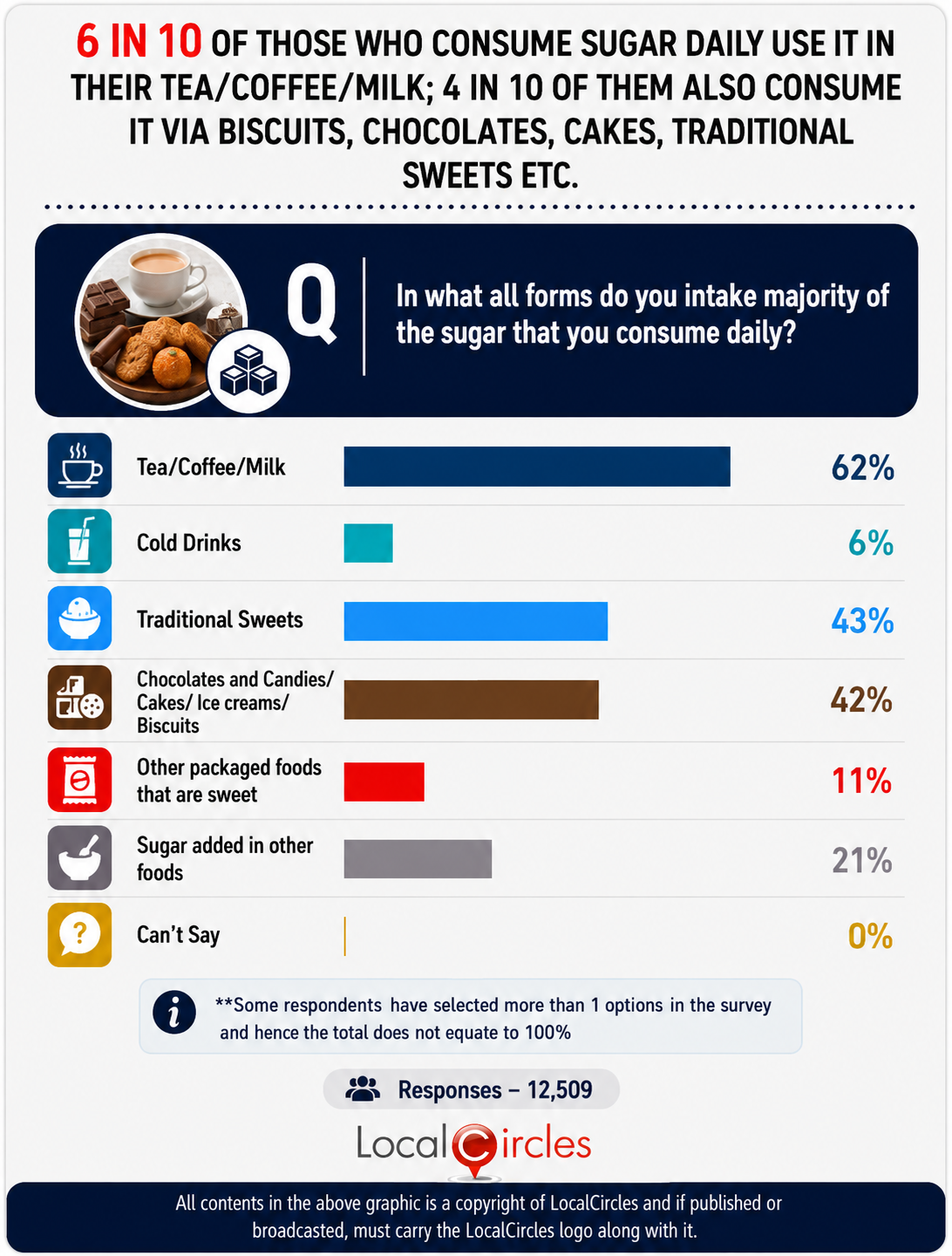
The next question sought to identify where the sugar is coming from, asking consumers, "In what all forms do you intake majority of the sugar that you consume daily?" This question received 12,509 responses, and respondents could select more than one option. In response, 62% said tea, coffee or milk. 43% said traditional sweets. 42% said chocolates, candies, cakes, ice creams and biscuits. Another 21% said sugar added in other foods, 11% said other packaged foods that are sweet and 6% said cold drinks. Only 0% could not say.
So 6 in 10 of those who consume sugar daily take it through their tea, coffee or milk, and roughly 4 in 10 also take it through manufactured or prepared sweet foods. This split matters for policy. The single largest source is the household sugar bowl, which is exactly what a price rise touches, and that is why a price shock translates so directly into a consumption decision. But a comparable share of intake comes from products where the consumer cannot see how much sugar is inside. A biscuit, a chocolate bar or a slice of cake carries no visible teaspoon count.
This is the gap that front-of-pack labelling is meant to close, and it is the reason the Supreme Court has pressed FSSAI on the matter. It is also worth noting that cold drinks, at 6%, are a small contributor for the average Indian consumer. The 40% GST slab on sugar-added beverages addresses a real but narrow slice of the problem, while traditional sweets, biscuits and chocolates, which together account for a much larger share, carry no comparable disincentive or warning.
22% household consumers surveyed confirm reducing sugar consumption due to rising prices
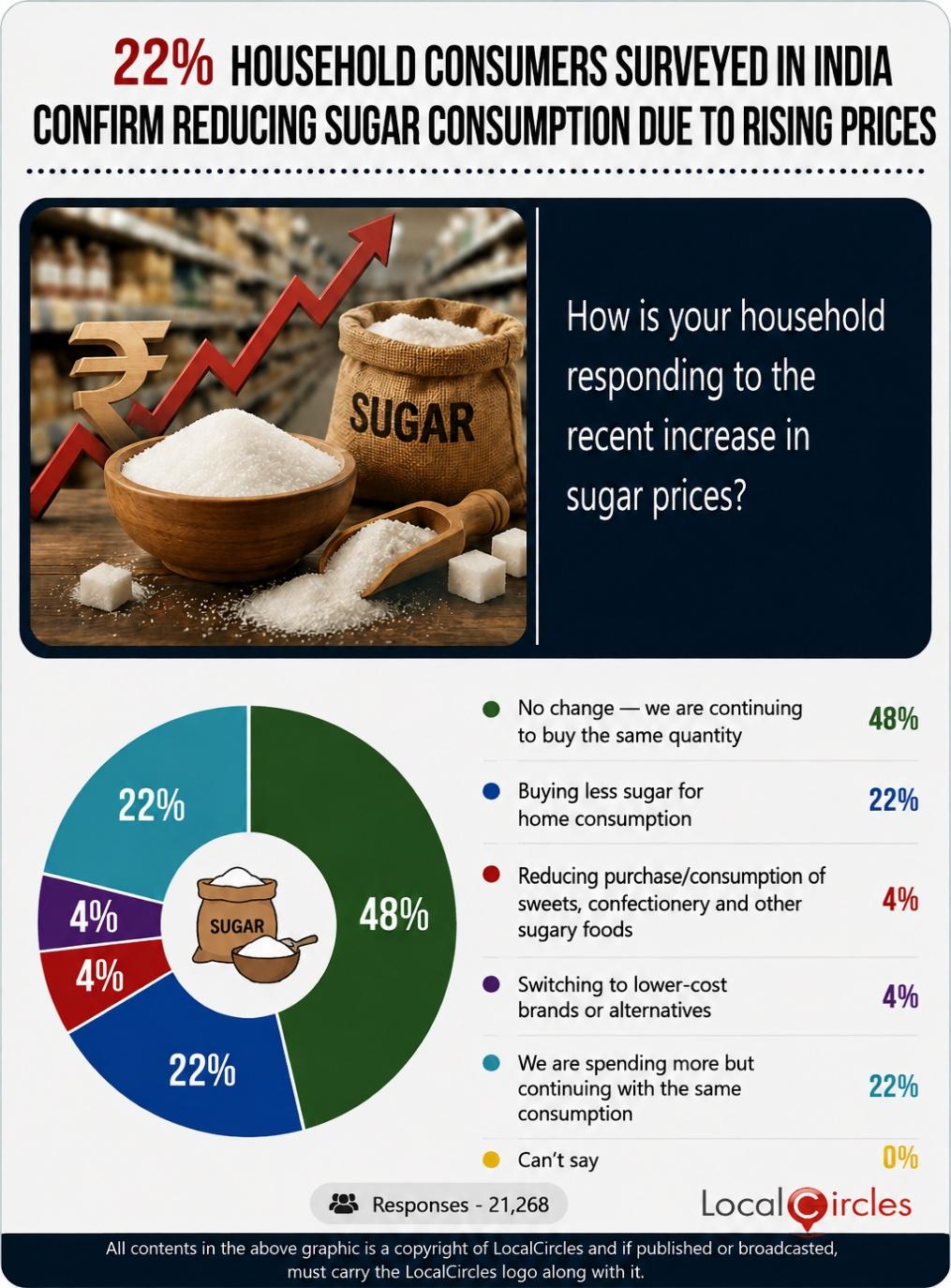
The final question in the survey went directly to the price rise, asking consumers, "How is your household responding to the recent increase in sugar prices?" This question received 21,268 responses. In response, 48% said there has been no change and they are continuing to buy the same quantity. 22% said they are buying less sugar for home consumption. Another 22% said they are spending more but continuing with the same consumption. 4% said they are reducing purchase or consumption of sweets, confectionery and other sugary foods, and 4% said they are switching to lower-cost brands or alternatives. Only 0% could not say.
Taken together, 22% of households surveyed have cut the quantity of sugar they buy, and a further 4% have cut back on sweets and confectionery. That puts a little over one in four households in the reduction camp. The larger share, however, has not changed course. Nearly 7 in 10 households are consuming the same amount of sugar as before, with 22% openly stating that they are absorbing a higher bill to do so.
This tells us something important about sugar as a household purchase. It behaves like an essential rather than a discretionary item. A 16% price increase in one month has moved only about a fifth of households to buy less. For most families, sugar is not something the monthly budget negotiates with. There is also a second reading. The 22% who are buying less are doing so because of price, not because of health advice, which suggests that price is currently a more effective lever on sugar consumption than a decade of dietary messaging has been.
In summary, the survey findings point to a consumption pattern that price alone will not fix. 28% of Indian consumers surveyed take in 25 grams or more of sugar a day, at or beyond the ICMR limit, and 5% take in more than 100 grams. 62% of daily consumers get their sugar from tea, coffee or milk, while 43% get it from traditional sweets and 42% from chocolates, cakes, ice creams and biscuits. On the price side, 22% of households are buying less sugar and another 4% are cutting back on sweets, but nearly 7 in 10 have not reduced consumption at all, and 22% are simply paying more.
The two halves of the sugar story are now pulling in opposite directions. The Government is working to bring prices down, with duty-free imports of 10 lakh tonnes, stock limits on dealers and mill-level verification, and it is right to do so ahead of the festive season, when household demand peaks. At the same time, ICMR, FSSAI and CBSE are all trying to bring sugar consumption down. Cheaper sugar will ease the household budget. It will not, by itself, move consumption towards the 25 gram mark. The price relief may also take time to arrive. Raw sugar has to be shipped, refined and moved into the market before the new crushing season begins, and trade participants have argued that permitting white sugar imports alongside raw sugar would have replenished pipeline stocks far faster. The Indian Sugar and Bio-energy Manufacturers Association has held that much of the rally reflects speculation and panic buying ahead of the festive season rather than an absolute shortage. Looking beyond this season, the United States Department of Agriculture projects India’s 2026-27 output at about 33.6 million tonnes, a recovery of 12%, with domestic production exceeding consumption for the first time in two years. If that materialises, the price problem eases from next season, and the consumption problem the survey documents remains.
What the survey suggests is that awareness is the missing piece. Most consumers do not know what 25 grams looks like on a plate or in a cup. Nearly one in five believes they consume no sugar at all, which is unlikely to be accurate once packaged food is counted. And 4 in 10 draw a large part of their intake from products that carry no readable indication of how much sugar they contain.
LocalCircles will be escalating these findings to the Ministry of Consumer Affairs, Food and Public Distribution, the Ministry of Health and Family Welfare, FSSAI and ICMR. LocalCircles is urging that FSSAI finalise front-of-pack labelling without further delay in line with the Supreme Court direction of August 21, 2026, and that the label make added sugar per serving immediately readable rather than leaving the consumer to work it out from a per-100-gram table. It is also urging a sustained public awareness campaign built around the 25 gram daily limit, expressed in teaspoons rather than in percentages of calorie intake, so that an ordinary consumer can apply it. Rules on advertising high-sugar foods to children need to be tightened, alongside the sugar boards already introduced in schools. On the price side, adequate supply must be ensured through the festive season, with district-wise retail price data published so that local profiteering is visible. LocalCircles is also urging that the duty-free import window be widened to include white sugar so that pipeline stocks are replenished before the festive peak, that arrivals and offtake of imported sugar be tracked and published so that the benefit reaches the retail consumer rather than stopping with the trade, and that any decision on the minimum selling price of sugar be weighed against its effect on the household consumer. Sugar is one of the few consumption choices where a household can act on its own, but it can only act on what it can see and measure.
Survey Demographics
The survey received over 45,000 responses from consumers located across 331 districts of India. 64% respondents were men while 36% respondents were women. 43% respondents were from tier 1, 33% from tier 2 and 24% respondents were from tier 3, 4, 5 and rural districts. The survey was conducted via LocalCircles platform and all participants were validated citizens who had to be registered with LocalCircles to participate in this survey.
About LocalCircles
LocalCircles, India’s leading Community Social Media platform enables citizens and small businesses to escalate issues for policy and enforcement interventions and enables Government to make policies that are citizen and small business centric. LocalCircles is also India’s # 1 pollster on issues of governance, public and consumer interest. More about LocalCircles can be found on https://www.localcircles.com
For more queries - media@localcircles.com, +91-8585909866
All content in this report is a copyright of LocalCircles. Any reproduction or redistribution of the graphics or the data therein requires the LocalCircles logo to be carried along with it. In case any violation is observed LocalCircles reserves the right to take legal action.
Enter your email & mobile number and we will send you the instructions.
Note - The email can sometime gets delivered to the spam folder, so the instruction will be send to your mobile as well


