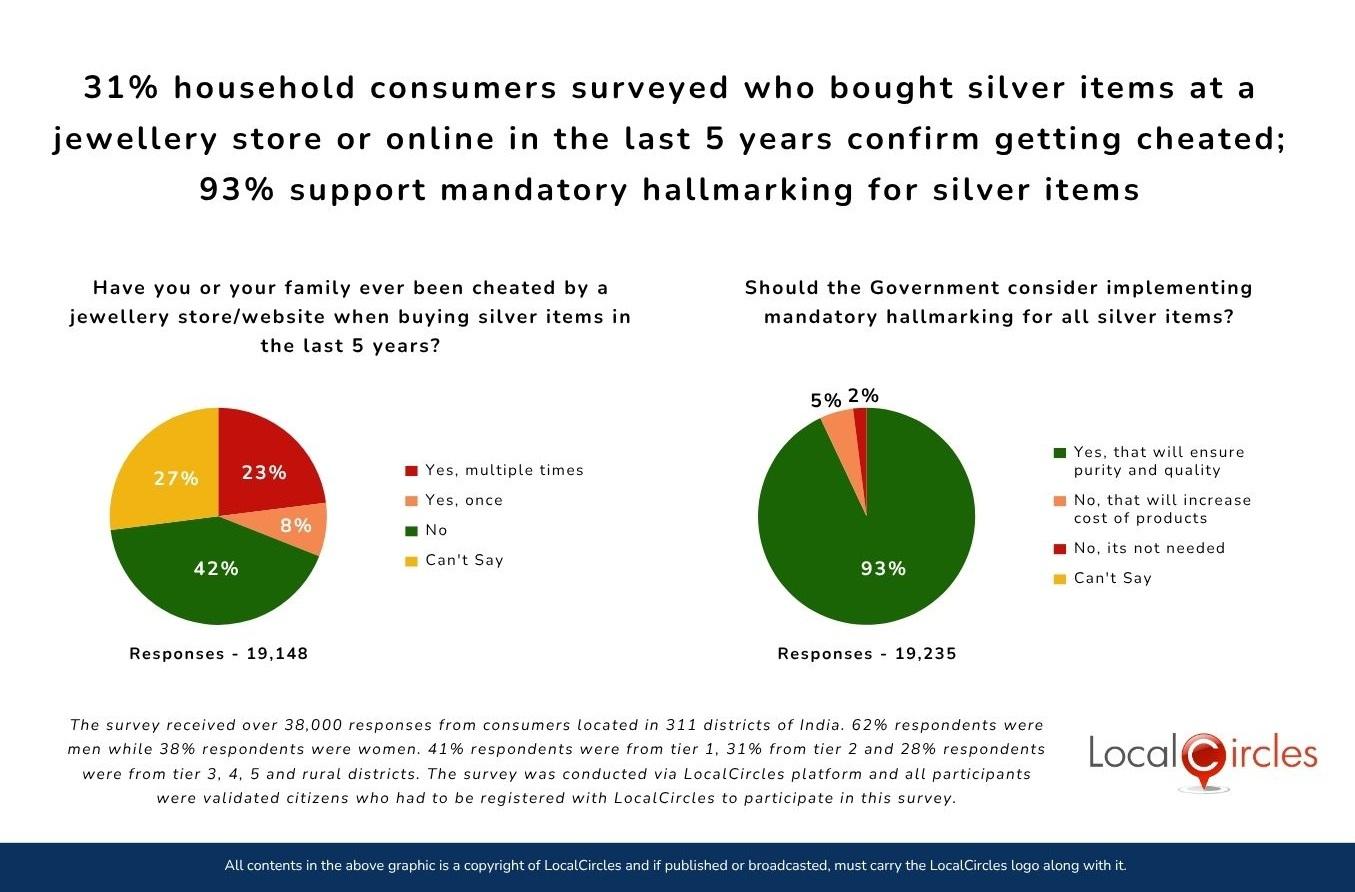
31% household consumers surveyed who bought silver items at a jewellery store or online in the last 5 years confirm getting cheated; 93% support mandatory hallmarking for silver items
- ● 23% of those surveyed indicated they have been cheated by jewellery store/ website multiple times
April 18, 2026, New Delhi: Akshaya Tritiya, symbolizing eternal prosperity and "never-diminishing" good fortune, is considered an auspicious time) to start ventures, purchase gold and silver. With gold regaining its upward trend, many are likely to opt for silver items on Akshaya Tritiya this year. The Government of India introduced voluntary hallmarking for silver jewellery and articles, backed by a digital identification system, effective September 1, 2025, to assure quality and protect consumers. A silver hallmark is a stamped mark on a silver item indicating its purity, origin, date, and manufacturer.
The Bureau of Indian Standards (BIS) updated its hallmarking standard with the release of IS 2112:2025, replacing the earlier IS 2112:2014 version. The revision introduced Hallmarking Unique Identification (HUID)-based hallmarking for silver, aligning it with the gold hallmarking system and significantly improving traceability and transparency across the value chain. According to official updates, consumers can verify key details such as article type, purity grade, hallmarking date, testing center information, and jeweller registration number through the BIS Care mobile application. This facility applies to all silver jewellery hallmarked after 1 September 2025 and has seen increased adoption in 2026 as consumer awareness improves.
The updated standard specifies seven purity grades: 800, 835, 925, 958, 970, 990, and 999—with 958 and 999 newly added to reflect evolving consumer and industry preferences. Each hallmark carries three components: the BIS Standard Mark with the word “SILVER,” the purity grade, and the HUID code.
By 2026, the hallmarking ecosystem has expanded, with over 300 BIS-recognised Assaying and Hallmarking Centres for silver operating across more than 110 districts, improving accessibility and coverage compared to 2025. The number of hallmarked silver articles has also increased significantly, with over 5 million articles estimated to be hallmarked in FY 2025–26, reflecting growing acceptance of the new system. In the financial year 2024–25, more than 3.2 million silver articles were hallmarked under the earlier system. Under IS 2112:2014, hallmarking was permitted in six grades—800, 835, 900, 925, 970, and 990—with a four-part hallmark including centre and jeweller identification.
Ahead of the rollout, BIS conducted stakeholder consultations and has continued awareness campaigns through branch offices, digital media, and jeweller outreach programs in 2026 to encourage adoption among both retailers and consumers.
With gold prices remaining volatile, consumers are increasingly turning to silver as a viable and stylish option for both fashion and investment. This trend has strengthened further in 2026, particularly among younger consumers and in tier-2 and tier-3 cities, where affordability plays a key role.
Silver prices have remained elevated. After crossing ₹1,60,000 per kg in 2025, prices in 2026 have continued to fluctuate in the range of ₹1,70,000–₹1,90,000 per kg, driven by strong industrial demand (especially in electronics and solar energy), global economic uncertainty, and sustained investor interest. Analysts continue to project a potential rise toward ₹2,00,000 per kg in the near term, depending on global commodity cycles.
India’s silver demand has also shown robust growth. In 2026, demand for silver jewellery and household use is estimated to grow by around 18–22% year-on-year, supported by affordability relative to gold, increasing fashion adoption, and rising awareness of certified purity through hallmarking. Additionally, growing investor interest in silver as a commodity and hedge against inflation continues to influence demand and pricing dynamics.
LocalCircles through a survey has strived to find out awareness amongst consumers about the quality of silver they invest in and whether they believe hallmarking of silver should be made mandatory. Already some silversmiths do provide hallmarked products. The survey received over 38,000 responses from consumers located in 311 districts of India. 62% respondents were men while 38% respondents were women. 41% respondents were from tier 1, 31% from tier 2 and 28% respondents were from tier 3, 4, 5 and rural districts.
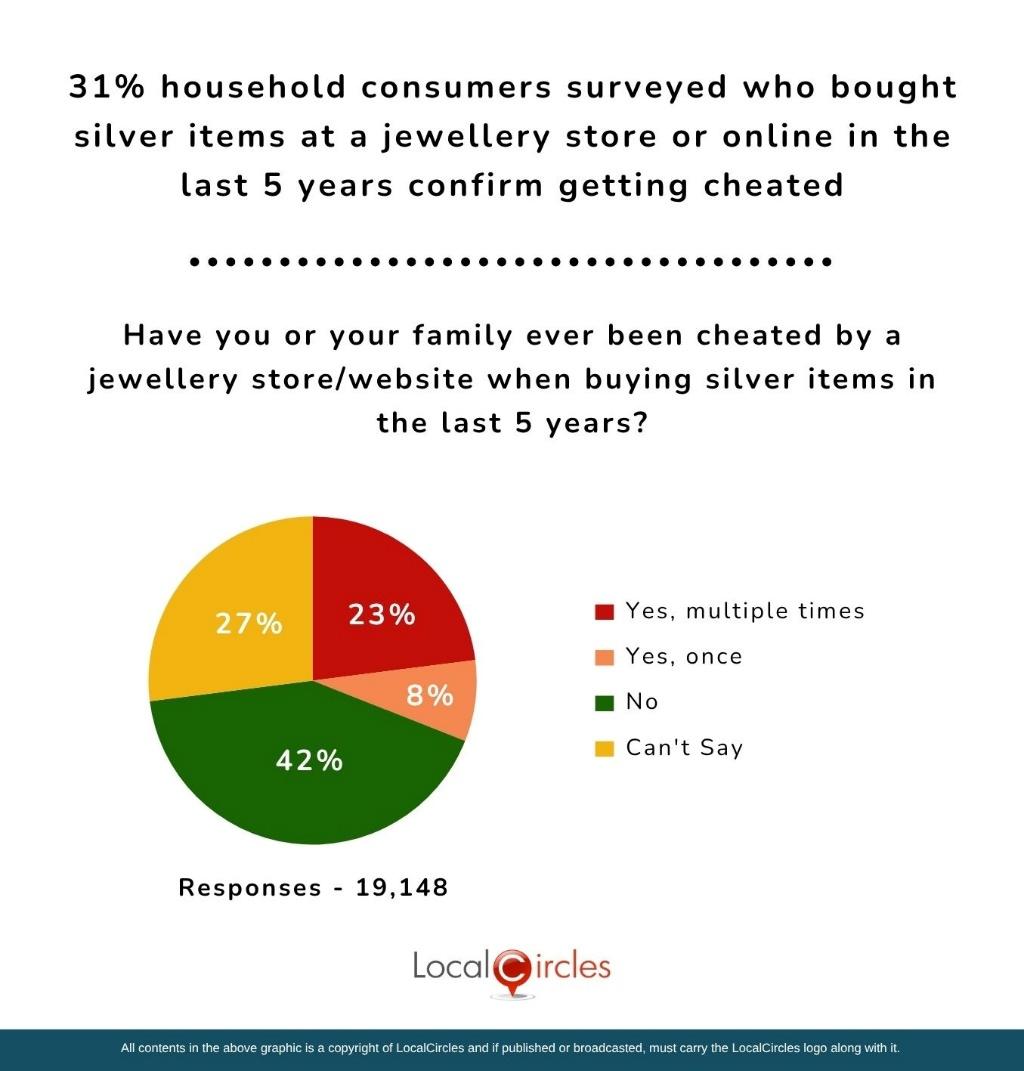
31% household consumers surveyed who bought silver items at a jewellery store or online in the last 5 years confirm getting cheated
People buy silver for all occasions in India right from coins to jewellery and even utensils used for special puja, etc. Very few of the consumers check whether the items are hallmarked for quality certification. The survey asked consumers, “Have you or your family ever been cheated by a jewellery store/ website when buying silver items in the last 5 years?” Out of 19,148 consumers who responded to the question 23% indicated “yes, multiple times” they have been cheated by jewellery store/ website; 8% of respondents indicated “yes, once”; 42% of respondents stated “no” they have never been cheated and 27% of respondents did not give a clear answer. In essence, 31% of household consumers surveyed who bought silver items at a jewellery store or online in the last 5 years confirm getting cheated.
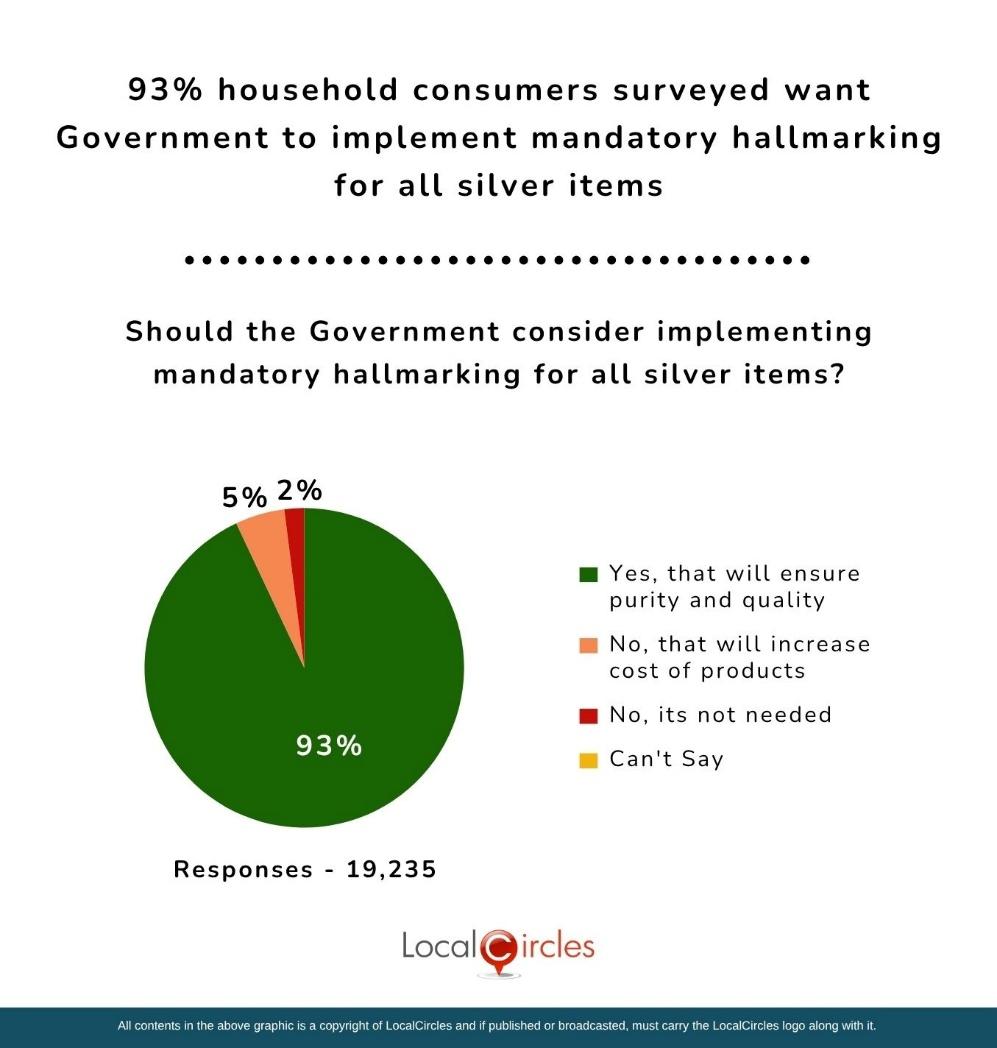
93% household consumers surveyed want Government to implement mandatory hallmarking for all silver items
Given that almost 3 in 10 people surveyed have been cheated in the last 5 years, the survey asked, “Should the government consider implementing mandatory hallmarking for all silver items?” Out of 19,235 who responded to the question 93% stated “yes, that will ensure purity and quality” of silver items bought, 5% of respondents stated “no, that will increase cost of products” and 2% of respondents stated “no, its not needed”. In essence, 93% of household consumers surveyed want Government to implement mandatory hallmarking for all silver items.
In summary, the surveyreveals that 31% of household consumers surveyed, who bought silver items at a jewellery store or online in the last 5 years admitted to having been cheated. That is a huge percentage. No wonder, 93% of household consumers surveyed want Government to implement mandatory hallmarking for all silver items.
Considering the high prices of gold and silver, consumers need to be protected through compulsory hallmarking of all silver items, else as in case of gold, many more stand to lose a lot of investment, which sees a surge in villages after a bumper harvest. To swing the consumers into demanding and buying hallmarked products, the government will have to try to inform consumers in cities, towns and cities, so that people don’t end up with steel or some white metal camouflaged to look like a silver item.
Survey Demographics
The survey received over 38,000 responses from consumers located in 311 districts of India. 62% respondents were men while 38% respondents were women. 41% respondents were from tier 1, 31% from tier 2 and 28% respondents were from tier 3, 4, 5 and rural districts. The survey was conducted via LocalCircles platform, and all participants were validated citizens who had to be registered with LocalCircles to participate in this survey.
About LocalCircles
LocalCircles, India’s leading Community Social Media platform enables citizens and small businesses to escalate issues for policy and enforcement interventions and enables Government to make policies that are citizen and small business centric. LocalCircles is also India’s # 1 pollster on issues of governance, public and consumer interest. More about LocalCircles can be found on https://www.localcircles.com
For more queries - media@localcircles.com, +91-8585909866
All content in this report is a copyright of LocalCircles. Any reproduction or redistribution of the graphics or the data therein requires the LocalCircles logo to be carried along with it. In case any violation is observed LocalCircles reserves the right to take legal action.
Enter your email & mobile number and we will send you the instructions.
Note - The email can sometime gets delivered to the spam folder, so the instruction will be send to your mobile as well


