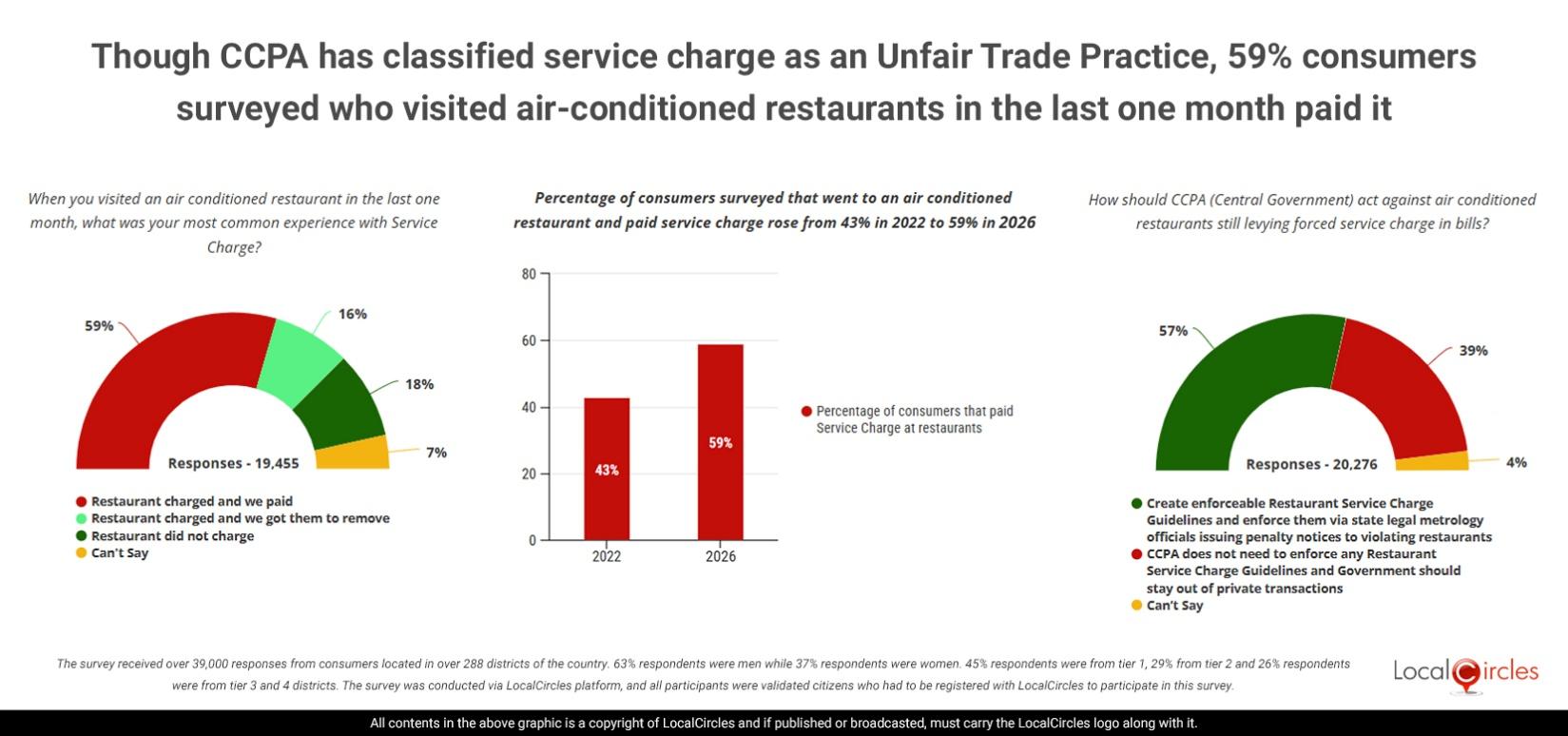
Though CCPA has classified service charge as an Unfair Trade Practice, 59% consumers surveyed who visited air-conditioned restaurants in the last one month paid it
- ● Percentage of consumers surveyed who paid service charge rose from 43% in 2022 to 59% in 2026
- ● Government’s expectation that the consumer will fight the service charge battle when visiting a restaurant with friends/family is misplaced; 54% consumers surveyed believe that CCPA should create enforceable restaurant service charge guidelines and enforce them via state legal metrology departments
February 11, 2026, New Delhi: The Central Consumer Protection Authority (CCPA) has directed Barbeque Nation Hospitality Ltd to stop charging service fees at its restaurants after taking suo motu cognisance of a complaint filed on the National Consumer Helpline (NCH). The complaint alleged that the restaurant chain was adding a service charge to customer bills in addition to applicable central and state Goods and Services Tax (GST).
This action follows a broader enforcement drive by the CCPA. In January, the authority initiated suo motu proceedings against 27 restaurants across the country for mandatorily levying service charges, holding the practice to be a violation of consumer protection laws. Based on complaints supported by invoices received through the NCH, the restaurants were fined up to INR 50,000, directed to refund the service charges collected, and instructed to modify their billing systems to remove any default addition of such charges.
The CCPA stated that these actions were taken for violation of consumer rights and adoption of unfair trade practices under Section 2(47) of the Consumer Protection Act, 2019, which prohibits mandatory service charges.
Earlier, in December last year, the authority imposed a INR 50,000 penalty on China Gate Restaurant Private Limited, which operates the Bora Bora restaurant chain in Mumbai. The CCPA found that the restaurant had added a 10% service charge by default and levied GST on the service charge, despite clear guidelines stating that such charges must be voluntary and cannot be imposed automatically. The issue has also attracted widespread public attention. Consumers have shared numerous complaints on LocalCircles and other online platforms like X, Reddit etc. alleging that restaurants continued to force service charges even after objections. In some cases, establishments reportedly attempted to bypass the rules by renaming the levy as “staff contribution” or similar terms while insisting it was mandatory.
On March 28, 2025, the Delhi High Court upheld the CCPA’s guidelines prohibiting mandatory service charges. The court ruled that service charges or tips are voluntary payments and cannot be made compulsory by restaurants or hotels. It rejected petitions filed by the National Restaurant Association of India (NRAI) and the Federation of Hotel and Restaurant Associations, affirming that automatic levying of service charges is contrary to law.
The court also clarified that the CCPA is not merely an advisory body and has the authority to direct inquiries and investigations. Following the judgment, several restaurants removed service-charge entries from bills, though continued violations prompted further notices and refund orders in April 2025. The Consumer Affairs Ministry has reiterated that consumers may tip voluntarily but cannot be compelled to pay service charges. Consumers facing such practices can lodge complaints by calling the National Consumer Helpline at 1915.
While restaurant associations argue that service charges benefit staff and consumers, consumer sentiment has largely opposed compulsory levies. A LocalCircles 2022 survey found that 71% of consumers had experienced service charges being imposed despite poor service. Another survey in 2023 showed that only 10% supported renaming service charge as “staff contribution,” while 77% wanted it abolished or made optional. Concerns persist over transparency. About 42% of consumers surveyed were unsure how service charges are used or whether staff benefit, while 34% believed that a portion of the amount is retained by management or misused.
Relooking at the service charge issue, LocalCircles has conducted a new survey to find out whether so far, the government and court intervention has made any difference to the practice of adding service charge to the bills consumers have to pay in air-conditioned restaurants. The survey received over 39,000 responses from consumers located in over 288 districts. of the country. 63% respondents were men while 37% respondents were women. 45% respondents were from tier 1, 29% from tier 2 and 26% respondents were from tier 3 and 4 districts.
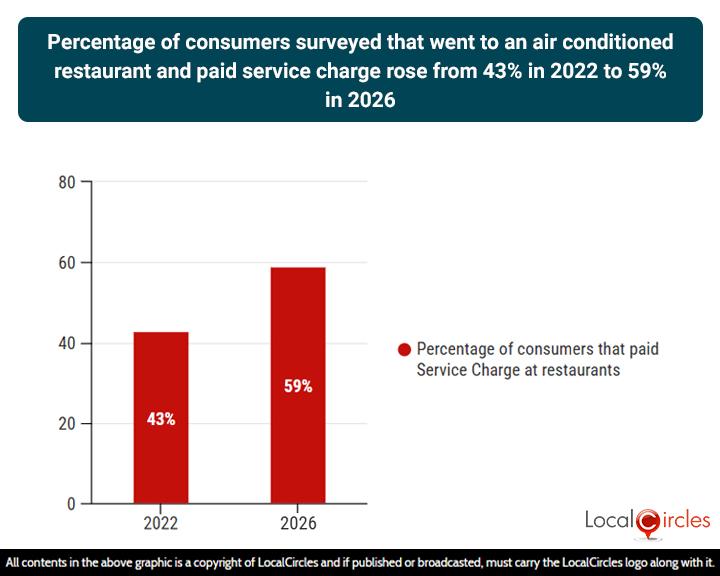
59% of consumers who went to an air-conditioned restaurant in the last one month paid a service charge; Percentage of consumers surveyed that paid service charge rose from 43% in 2022 to 59% in 2026
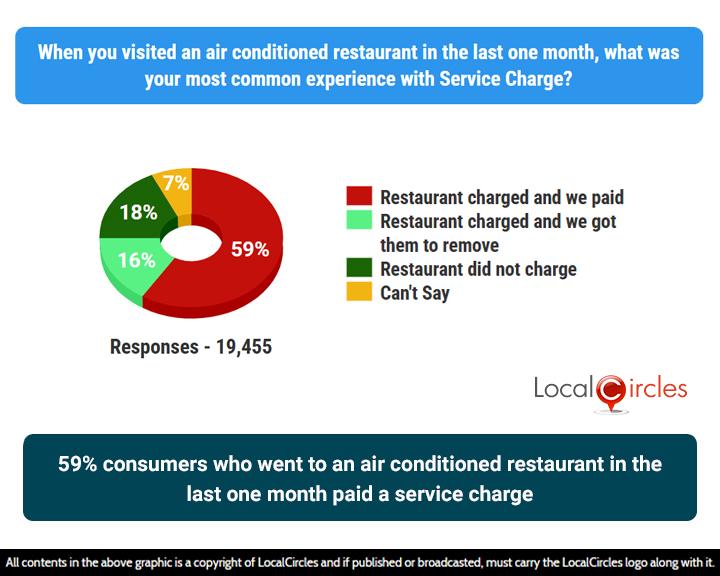
The survey asked restaurant goers, “When you visited an air-conditioned restaurant in the last one month. What was your most common experience with service charge?” Out of 19,455 who responded to the question 59% stated that the “restaurant charged, and we paid”; 16% of respondents stated that the “restaurant charged, and we got them to remove” the service charge; 18% of respondents however stated that the “restaurant did not charge” for services; and 7% of respondents did not give a clear answer. To sum up, 59% of consumers who went to an air-conditioned restaurant in the last one month paid a service charge. A comparison between the survey results in 2022 and now shows that the percentage of consumers surveyed who went to an air-conditioned restaurant and paid service charge has risen from 43% to 59% in 2026.
Percentage of consumers surveyed that went to an air conditioned restaurant and paid service charge rose from 43% in 2022 to 59% in 2026
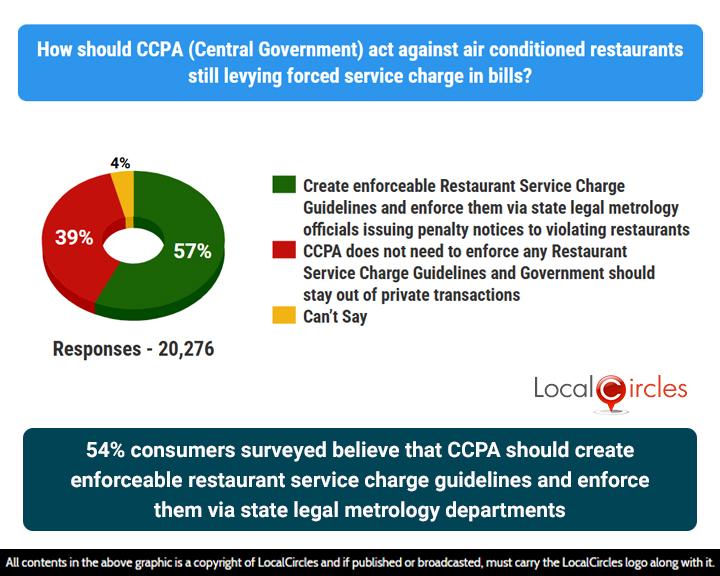
54% of consumers surveyed believe that CCPA should create enforceable restaurant service charge guidelines and enforce them via state legal metrology departments
As the government guidelines have so far had limited impact on air-conditioned restaurants across the country, the survey asked consumers, “How should CCPA (central government) act against air-conditioned restaurants still levying forced service charge in bills?” Out of 20,276 who responded to the question 57% stated that the CCPA should “create enforceable Restaurant Service Charge Guidelines and enforce them via state legal metrology”; 39% of respondents stated that the “CCPA does not need to enforce any Restaurant Service Charge Guidelines and Government should stay out of private transactions”; and 4% of respondents did not give a clear answer. To sum up, 54% of consumers surveyed believe that CCPA should create enforceable restaurant service charge guidelines and enforce them via state legal metrology departments. The Government expectation that, consumers will fight the service charge battle when dining with family or friends is faulty and it is the regulator CCPA and related state Government departments like legal metrology that have to ensure compliance and not the consumer.
In summary, the percentage of consumers surveyed who went to an air-conditioned restaurant and paid service charge has risen from 43% in 2022 to 59% in 2026 with 59% paying it just within the last month indicating that the Government advisory has not had much impact. Given that, 54% of consumers surveyed believe that CCPA should create enforceable restaurant service charge guidelines and enforce them via state legal metrology departments. In the light of the Delhi High Court ruling and the survey findings, it appears that the punishment for flouting the CCPA guidelines needs to be enforced firmly. The Government expectation that the consumer will fight the service charge battle when visiting a restaurant for a meal with friends and family is faulty and the onus needs to be on CCPA and state legal metrology departments to ensure compliance. Till that happens, not much is likely to change for the consumer.
Survey Demographics
The survey received over 39,000 responses from consumers located in over 288 districts of the country. 63% respondents were men while 37% respondents were women. 45% respondents were from tier 1, 29% from tier 2 and 26% respondents were from tier 3 and 4 districts. The survey was conducted via LocalCircles platform, and all participants were validated citizens who had to be registered with LocalCircles to participate in this survey.
About LocalCircles
LocalCircles, India’s leading Community Social Media platform enables citizens and small businesses to escalate issues for policy and enforcement interventions and enables Government to make policies that are citizen and small business centric. LocalCircles is also India’s # 1 pollster on issues of governance, public and consumer interest. More about LocalCircles can be found on https://www.localcircles.com
For more queries - media@localcircles.com, +91-8585909866
All content in this report is a copyright of LocalCircles. Any reproduction or redistribution of the graphics or the data therein requires the LocalCircles logo to be carried along with it. In case any violation is observed LocalCircles reserves the right to take legal action.
Enter your email & mobile number and we will send you the instructions.
Note - The email can sometime gets delivered to the spam folder, so the instruction will be send to your mobile as well


