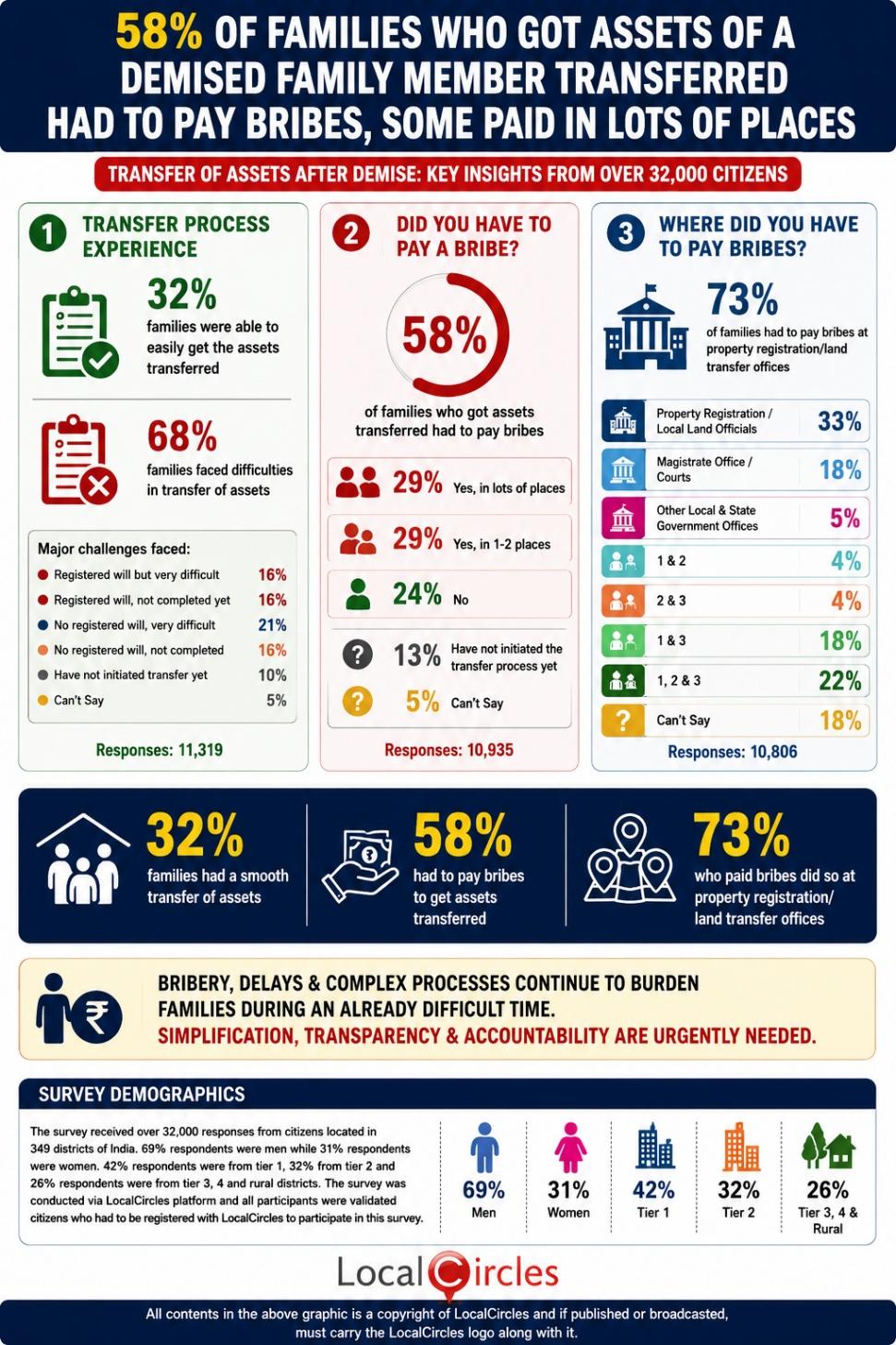
58% of families who got assets of a demised family member transferred had to pay bribes, some paid in lots of places
- ● 73% of the families surveyed indicated bribes had to be paid at the property registration/ land transfer office
- ● Only 32% of families surveyed were easily able to get the assets of a deceased family member transferred
September 7, 2026, New Delhi: India has not introduced any across-the-board change in inheritance laws in recent times. The principal succession frameworks—including the Hindu Succession Act, Indian Succession Act and Muslim personal law—continue to govern inheritance. Daughters continue to enjoy equal coparcenary rights under Hindu law, following the 2005 amendment and subsequent Supreme Court clarification. The Waqf (Amendment) Act, 2025 also introduced provisions affecting inheritance rights in certain waqf-alal-aulad arrangements. On July 14, 2026, in Mahinder & Others vs. Puran Singh, the Supreme Court held that the preferential right of Class-I heirs under Section 22 of the Hindu Succession Act extends to agricultural land as well, treating it as an incident of succession rather than a right of pre-emption. What has changed over the last 18 months is not the law of succession but the machinery around it. A draft Registration Bill, 2025 proposes to replace the 117-year-old Registration Act, 1908 with an online, paperless registration system. A Securities and Exchange Board of India (SEBI) framework effective March 1, 2025 permits up to 10 nominees for demat accounts and mutual fund folios and allows transmission on a self-attested death certificate and updated KYC. The nomination provisions of the Banking Laws (Amendment) Act, 2025, in force from November 1, 2025, allow up to four nominees for a bank deposit account. Inheritance rights, in short, remain governed by existing personal laws with no comprehensive overhaul in 2026, even as the government reworks the machinery through which assets actually change hands.
Claiming inheritance in India is no easy task. It is ironic that for the common man it is a herculean task even when there is a signed, witnessed, and registered will by the deceased, who was fit during the process of writing it. The inevitable outcome in the event of rightful claimants not reaching an understanding is that the inheritance dispute lands in court, sometimes taking more than a decade before a resolution is reached or a court order settles the case. Even when there is no dispute, going by people’s experience, the cases can take a long time to be resolved if property papers are not in order or there are debts to be cleared, or anyone makes false claims or there are other issues.
In India, most property documents must compulsorily be registered under the Registration Act, 1908, failing which they cannot be admitted in court as evidence in case of a dispute. The registration process still relies on outdated physical mode of registration, requiring parties to a transaction to appear physically at the sub-registrar’s office, submit physical copies of documents, use physical fingerprints and photographs, and obtain physical registration certificates. In effect, it remains a time-consuming process, often taking several days apart from necessitating physical presence in the registration office nearest to the property. Going by what is witnessed in the land registration offices and people’s experience, in most cases money exchanges hands to smoothen the process even if it is a straightforward case of transfer of property within the immediate family. The government has itself acknowledged this. On May 27, 2025, the Department of Land Resources under the Ministry of Rural Development placed a draft Registration Bill, 2025 in the public domain, proposing to replace the Registration Act, 1908 with a modern, online, paperless and citizen-centric system. The draft provides for electronic submission and admission of documents, appearance of parties and witnesses through electronic means, Aadhaar-based verification on an optional basis with alternative identification for those who decline it, issuance of electronic registration certificates and digital maintenance of records. It also proposes to make several documents compulsorily registrable, including agreements to sell, powers of attorney, sale certificates and equitable mortgages. Public consultation on the draft closed on June 25, 2025, but more than a year later the Bill is yet to be enacted, leaving the 1908 Act and its physical processes in force.
Several states have moved ahead on their own. Maharashtra’s Inspector General of Registration launched an e-registration facility on September 4, 2025 that allows property agreements to be registered fully online through Aadhaar-based e-KYC and biometric verification, without a visit to the sub-registrar’s office, though it began with select projects rather than as a state-wide default. In Delhi, the government announced on May 24, 2026 an overhaul of sub-registrar offices with online appointments, pre-verification of documents, live application tracking, AI-based face verification, blockchain-secured records and Passport Seva Kendra-style facilities, with the Chief Minister stating that the system would help stop the role of middlemen and reduce revenue leakage. These are welcome steps, but they remain state-specific and, for a family transferring assets after a death, largely untested at scale.
Over the last decade India has strived to take steps to digitize land records under the Digital India Land Records Modernisation Programme (DILRMP) to create an integrated land management system. One such step is the Bhu-Aadhaar or the Unique Land Parcel Identification Number (ULPIN) project which seeks to assign a 14-digit alpha-numeric number to land parcels in India based on the geo-coordinates of the land parcel. It is expected to bring transparency in land dealings and mitigate the huge pendency of court cases involving land disputes. Progress, however, has been uneven. As per the Department of Land Resources, 98.5% of rural records of rights have been digitized, covering 6.47 lakh of 6.57 lakh villages, and 89% of sub-registrar offices have integrated registration with revenue records. But only 11 states and union territories have completed digitization of cadastral maps, 72% of villages have those maps linked to records of rights, and only about 30% of land parcels, or 8.4 crore, had been assigned a ULPIN. The programme, launched in 2008, has had its deadline extended more than once and currently runs to March 2026. Land and property matters continue to account for roughly two-thirds of all civil cases in India.
When it comes to transfer of stocks and shares, the matter becomes more complex. In December 2023, the Supreme Court ruled that succession laws will override the Companies Act 2013 in deciding a person’s right over property and securities in instances where a deceased shareholder has left behind a nominee.
The Companies Act 1956 does not deal with succession, nor does it override the laws of succession such as the Indian Succession Act, 1925, or the Hindu Succession Act, 1956, the apex court ruled. In effect, if a company shareholder dies leaving behind a nominee, the latter is not automatically entitled to the legacy of the deceased shareholder in the form of shares, mutual funds, securities, debentures and bonds.
Regulators have since tried to reduce the paperwork, even if they cannot change who inherits. Under a SEBI framework effective March 1, 2025, an investor may register up to 10 nominees for a demat account or a mutual fund folio, and a nominee can have holdings transmitted on the strength of a self-attested copy of the death certificate along with completed KYC, with the option of continuing jointly or splitting the holding. The nominee, however, remains a custodian and not the owner, and must hand over the assets to those entitled under succession law or a valid will, which is consistent with the Supreme Court’s 2023 ruling. On the banking side, the nomination provisions of the Banking Laws (Amendment) Act, 2025 came into force on November 1, 2025 and allow a depositor to name up to four nominees, either simultaneously with a specified percentage share for each or successively, while safe deposit lockers and articles in safe custody may carry successive nominations only.
What happens when families do not complete these formalities is visible in the stock of unclaimed money. Under the “Aapki Poonji, Aapka Adhikar” or Your Money Your Right campaign run between October and December 2025, the Reserve Bank of India, SEBI, IRDAI, PFRDA and the Investor Education and Protection Fund Authority held camps in 748 districts to help citizens and legal heirs trace forgotten deposits, insurance proceeds, mutual fund folios and unpaid dividends. Approximately ₹78,000 crore lay unclaimed with banks, ₹14,000 crore with insurers, ₹9,000 crore in unpaid dividends and ₹3,000 crore with mutual funds. By February 28, 2026, ₹5,777 crore had been returned across 22.95 lakh claims, and the RBI’s Depositor Education and Awareness Fund still held ₹60,518 crore as on January 31, 2026. A significant part of this is money that families never claimed after a death, either because they did not know it existed or because the transfer process defeated them.
4 years after its original survey on this subject, LocalCircles has again strived to find out whether the process has become less cumbersome. The survey received over 32,000 responses from citizens located in 349 districts of India. 69% respondents were men while 31% respondents were women. 42% respondents were from tier 1, 32% from tier 2 and 26% of respondents were from tier 3, 4 and rural districts.
Only 32% indicated that their families were able to easily get the assets of a deceased family member transferred while the majority struggled
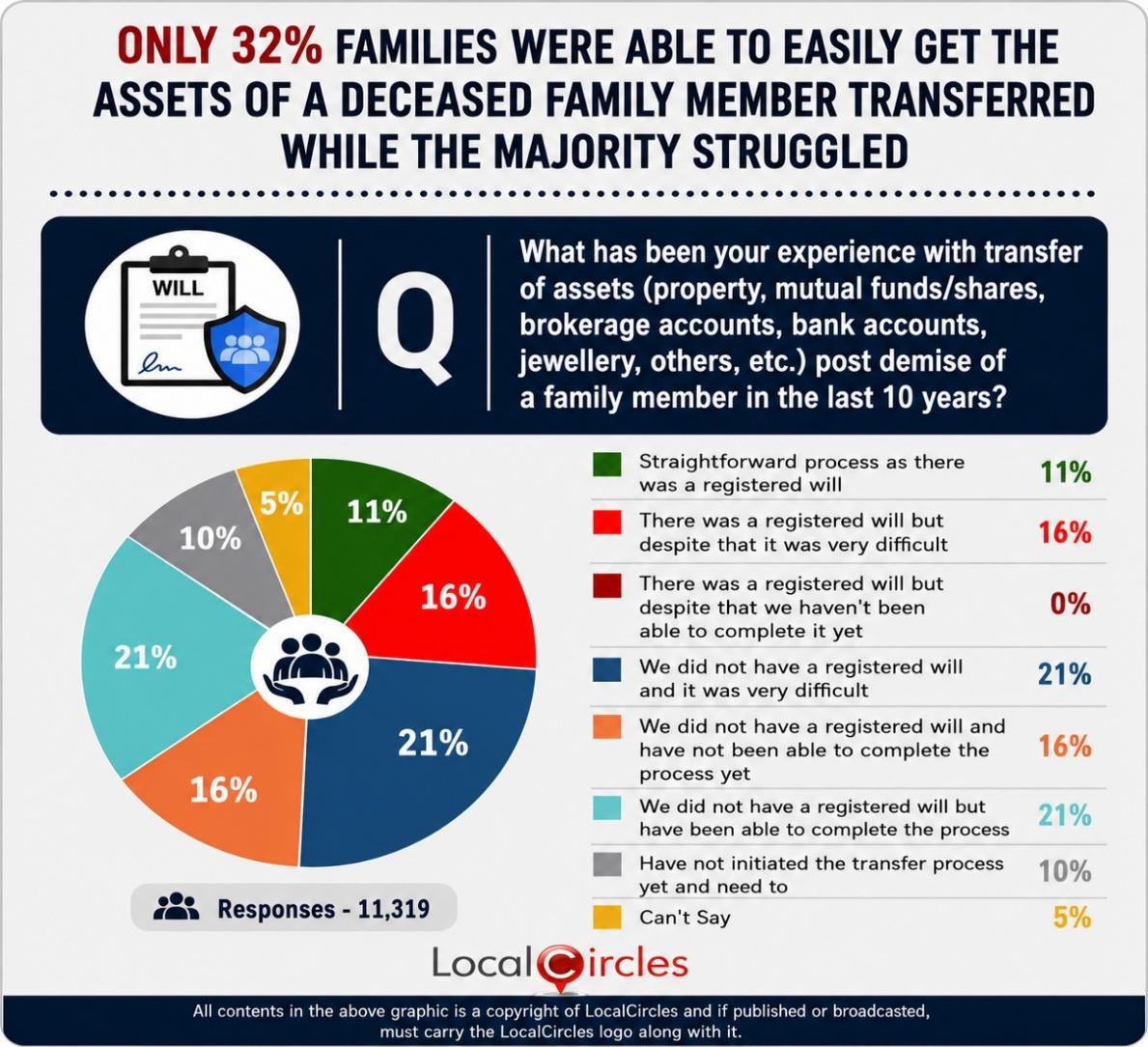
With the digitization of land and other assets having been initiated in many states over the last decade, the survey sought to know “what has been your experience with the transfer of assets (property, mutual funds/shares, brokerage accounts, bank accounts, jewelry, etc.) post demise of a family member in the last 10 years? Out of 11,319 respondents to this query only 32% indicated that their families were able to easily get the assets of a deceased family member transferred while the majority struggled. The data shows that 11% of families surveyed had no difficulty as it was a “straightforward process as there was a registered will” while 21% “did not have a registered will but have been able to complete the process”. Among the remaining, 16% indicated that though “there was a registered will but despite that we haven’t been able to complete it (the process) yet”; 21% indicated “we did not have a registered will and it was very difficult”; 16% of respondents shared that “we did not have a registered will and have not been able to complete the process”; 10% of the respondents shared that they “have not initiated the transfer process yet and need to do so”. In addition, 5% of the respondents failed to give a clear response, opting for “can’t say”. To sum up, only 32% indicated that their families were able to easily get the assets of a deceased family member transferred while the majority struggled.
58% of the families surveyed indicated that they had to pay bribes, some in more than one place, to get the assets transferred after demise of a family member
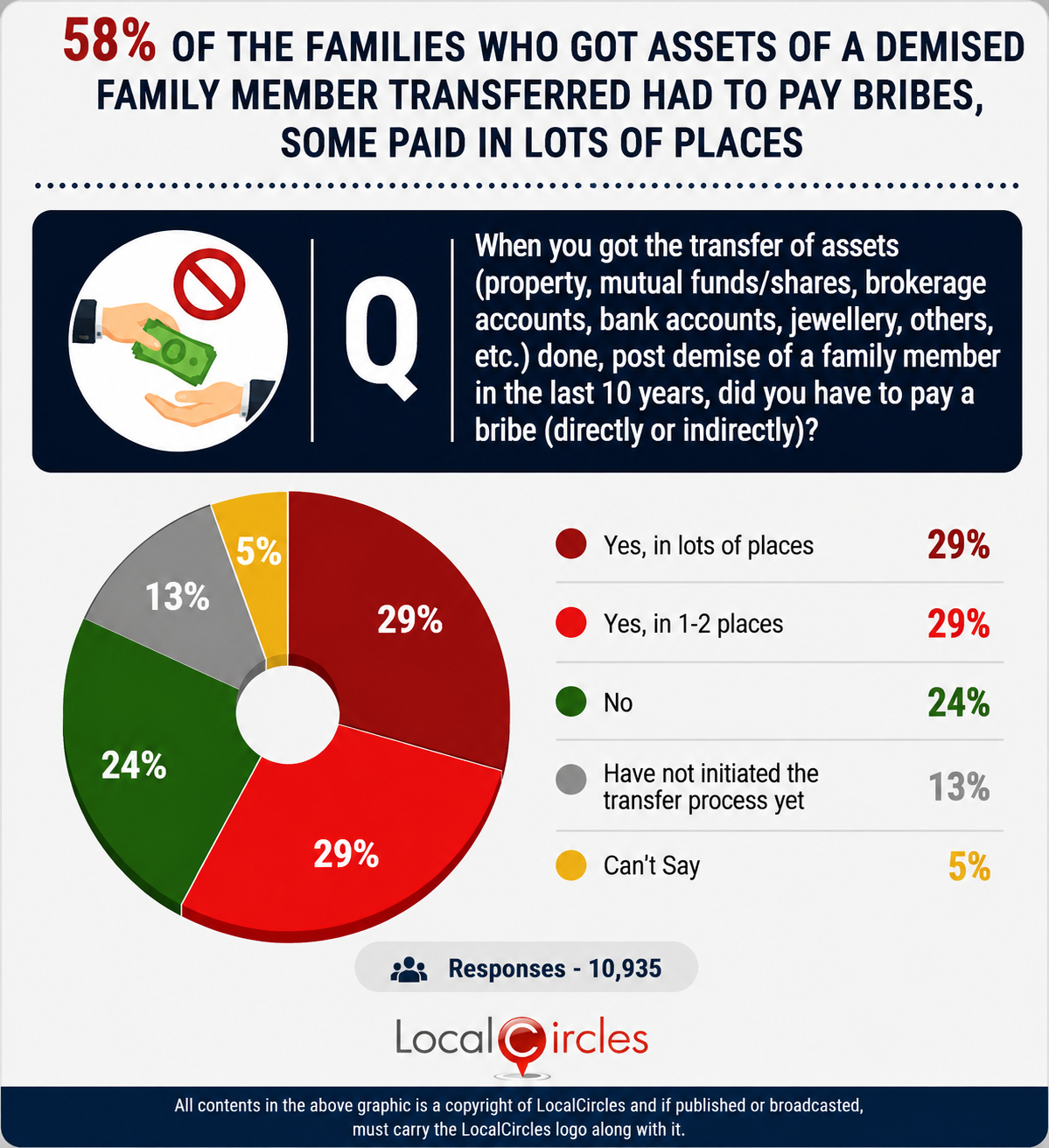
Going by the experience of people, legal experts and media reports, land and property matters most often involve graft if any paperwork through any court or government department (village patwari to village office and city land department) is involved. The survey asked, “When you got the transfer of assets (property, mutual funds/shares, brokerage accounts, bank accounts, jewelry, etc.) done, post demise of a family member in the last 10 years, did you have to pay a bribe (directly or indirectly)?” Unfortunately, 58% of the families out of 10,935 who responded to this query indicated that they had to pay bribes, some in more than one place, to get the assets transferred. Data shows that while 24% of the families faced no such situation of having to pay bribes, and 10% have not initiated the transfer process yet, 29% of the families surveyed had to pay bribes “in lot of places” and 29% paid bribes in “1-2 places”. In addition, 5% gave no clear response, opting for “can’t say”. It is unfortunate that despite having the requisite documents people are forced to pay bribes to either complete a normal process or speed it up despite the government claiming to have digitized most processes. To sum up, 58% of the families surveyed indicated that they had to pay bribes, some in more than one place, to get the assets transferred after demise of a family member.
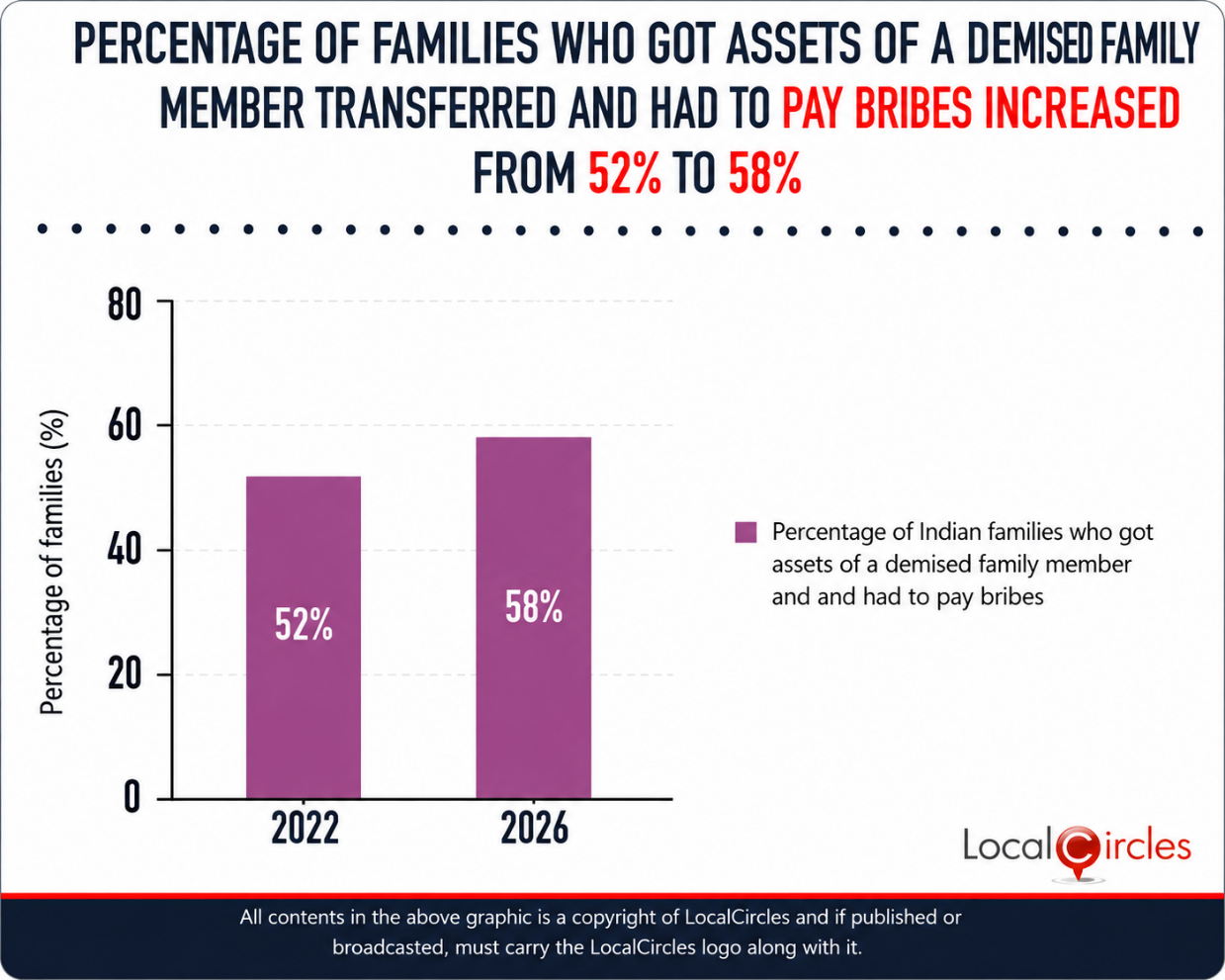
It is ironic that instead of having to pay bribes coming down post digitization of many processes, as against 52% families having had to pay bribes in 2022 to get properties and assets of a demised family member transferred, the percentage has increased to 58% of the families surveyed in the last 48 months.
73% of the families surveyed indicated that they had to pay a bribe at the property registration/ land transfer office to get assets of a demised family member transferred
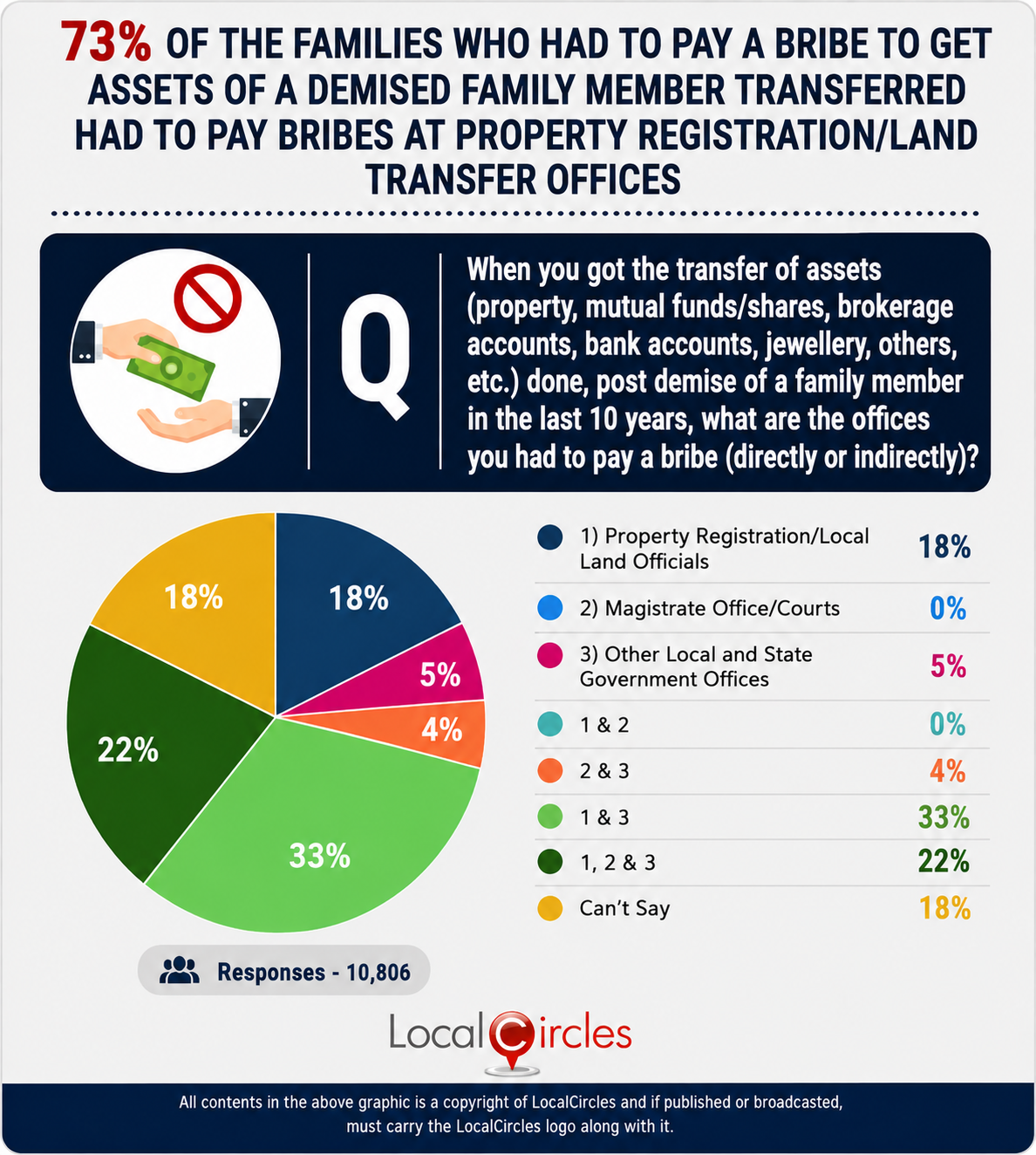
The government would like to believe that the systems for asset transfer have been eased or even cleansed of bribes with the reforms including digitization. But is this true? The survey asked, “When you got the transfer of assets (property, mutual funds/shares, brokerage accounts, bank accounts, jewelry, etc.) done, post demise of a family member in the last 10 years, what are the offices where you had to pay a bribe?” This query received 10,806 responses with 73% of the families surveyed indicating that they had to pay bribes at the property registration/ land transfer office to get assets of a demised family member transferred. The data shows that 18% of those surveyed paid bribes only at (1) the property registration/ local land office; 5% paid bribes only at (3) other local and state government offices; 4% paid bribes at (2) the magistrate office/ courts and (3); 33% paid bribes at (1) and (3); 22% had to pay bribes at all three levels; and 18% gave no clear response, opting for “can’t say”. In essence, 73% of the families surveyed indicated that they had to pay a bribe at the property registration/ land transfer office to get assets of a demised family member transferred.
In summary, only 32% of families surveyed indicated that they were easily able to get the assets of a deceased family member transferred while the majority struggled. What is noteworthy is that as against 52% families which had to pay bribes in 2022 to get properties and assets of a demised family member transferred, the percentage has increased in 4 years to 58% of the families surveyed. Those who had to pay bribes indicated that this was required in more than one place. In the case of 73% of the families surveyed, the bribe had to be paid at the property registration/ land transfer office to get assets of a demised family member transferred. Is this because there is a need for physical presence in most cases? Since digitization of the registration process is a key part of the DILRMP, there is a need to replace the Registration Act, 1908 with standardized remote online registration practices and to ensure their adoption throughout the country. The draft Registration Bill, 2025 already contains most of what is required, including online submission of documents and online appearance of parties and witnesses with provision for the electronic verification of parties, online exchanges between parties and the registrar, and the issue of electronic registration certificates with a digital backup of such records. What is needed now is that the Bill be finalized and enacted rather than allowed to lapse, and that states be given a firm timeline to move to end-to-end online registration.
The current system of courts deciding on the validity of a will, claims by family members challenging the will, establishing the value of the property left behind by the deceased are some of the issues that drag for months and even years even in routine cases where there is no dispute. In case of dispute, the process takes even longer as courts rarely help settle the case within a short period. It would help citizens both within the country and those overseas if the government could set up a special department to probe at least the land and property related issues, to help settle it without hassle when there is no justification or suspicion of fraud. Much more needs to be done with political, judicial and administrative support to tackle and make the complex issues involving inheritance much simpler and free of corruption. What this survey also makes clear is that digitization by itself has not reduced the incidence of bribes. Unless the citizen’s physical appearance before an official is eliminated and every step of the transfer is trackable online, the discretion that creates the demand for a bribe will remain.
Survey Demographics
The survey received over 32,000 responses from citizens located in 349 districts of India. 69% respondents were men while 31% respondents were women. 42% respondents were from tier 1, 32% from tier 2 and 26% of respondents were from tier 3, 4 and rural districts. The survey was conducted via LocalCircles platform, and all participants were validated citizens who had to be registered with LocalCircles to participate in this survey.
About LocalCircles
LocalCircles, India’s leading Community Social Media platform enables citizens and small businesses to escalate issues for policy and enforcement interventions and enables Government to make policies that are citizen and small business centric. LocalCircles is also India’s # 1 pollster on issues of governance, public and consumer interest. More about LocalCircles can be found on https://www.localcircles.com
For more queries - media@localcircles.com, +91-8585909866
All content in this report is a copyright of LocalCircles. Any reproduction or redistribution of the graphics or the data therein requires the LocalCircles logo to be carried along with it. In case any violation is observed LocalCircles reserves the right to take legal action.
Enter your email & mobile number and we will send you the instructions.
Note - The email can sometime gets delivered to the spam folder, so the instruction will be send to your mobile as well


