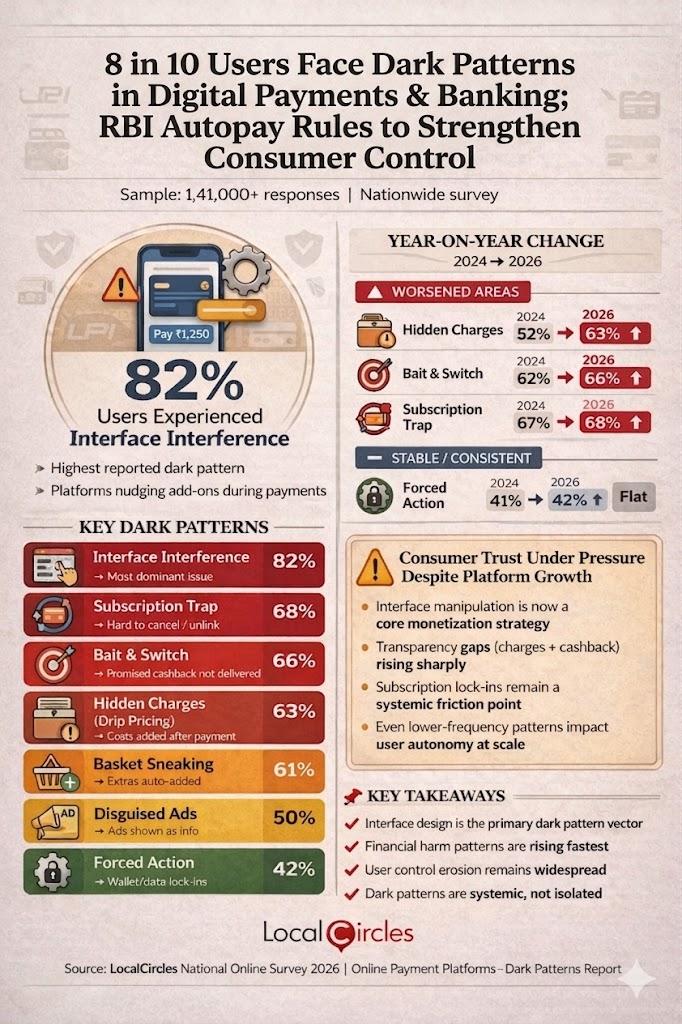
8 in 10 Users Face Dark Patterns in Digital Payments & Banking; RBI Autopay Rules to Strengthen Consumer Control
- ● Interface Manipulation, Subscription Traps, Hidden Charges Persist; RBI Measures likely to Improve Transparency, Alerts and User Consent
- ● RBI’s provision allowing users to pause or cancel mandates anytime is expected to significantly reduce such subscription traps by making exit mechanisms simple and accessible
- ● RBI’s mandatory pre-debit alerts under the new e-mandate framework are expected to address hidden charges by giving users advance visibility before funds are deducted
April 24, 2026, New Delhi: India's digital revolution, led by Unified Payments Interface (UPI), continues to reinforce its role in everyday micro-transactions. The steady decline in average ticket size highlights UPI's increasing adoption for small-value payments, particularly evident in the sustained growth of person-to-merchant (P2M) transactions.
Mobile payments remain the cornerstone of India’s financial ecosystem. In 2025, UPI processed over 228 billion transactions, with a total value approaching ₹300 lakh crore, reflecting continued high double-digit growth and deepening mobile-first financial behavior. By early 2026, monthly volumes have stabilized above 21–22 billion transactions, with January 2026 alone recording 21.7 billion transactions worth ₹28.33 lakh crore, underscoring both scale and consistency.
UPI now accounts for over 80% of retail digital payment transactions in India, firmly establishing itself as the backbone of the country’s payments infrastructure. On a global scale, India contributes nearly 49% of real-time digital payment transactions, reinforcing its leadership in the fintech landscape.
This rapid expansion—especially in P2M transactions—continues to drive seamless, low-cost digital payments. The deployment of over 65 crore UPI QR codes has significantly enhanced merchant acceptance, particularly among small and micro businesses, accelerating financial inclusion across urban and rural markets.
As digital adoption accelerates, emerging technologies such as Software Point of Sale (SoftPOS) are reshaping financial accessibility and merchant onboarding. SoftPOS enables NFC-enabled smartphones and tablets to function as secure, contactless payment terminals, eliminating the need for dedicated hardware. The technology is projected to grow at a CAGR of around 17–18% through the next decade, driven by demand for low-cost acceptance infrastructure among small merchants.
India’s digital payments infrastructure has also expanded significantly. Point of Sale (POS) terminals have surpassed the 10-million mark, reflecting deeper penetration across the country. Combined with the exponential rise in QR-based payments, this demonstrates the widespread adoption of digital payments across metropolitan cities, tier-2 and tier-3 towns, and rural regions.
In the physical retail segment, sectors such as grocery stores, restaurants, fuel stations, apparel outlets, pharmacies, and government services account for a large share of transaction volumes. In the online ecosystem, e-commerce, gaming, utilities, government services, and financial services continue to dominate digital payment usage.
At the same time, regulatory oversight has strengthened to address emerging risks. The Central Consumer Protection Authority (CCPA), under the Ministry of Consumer Affairs, has formally identified and prohibited 13 “dark patterns” in digital platforms. These deceptive interface practices—such as false urgency, basket sneaking, confirm shaming, and forced actions—can manipulate users into unintended purchases or financial decisions.
As digital payments scale further, addressing such risks remains critical to maintaining user trust and ensuring a transparent, user-centric digital economy. LocalCircles survey in 2024 revealed that 52% of consumers surveyed had experienced one or more dark patterns with online payment platforms. They had experienced hidden charges associated with payment transactions and not disclosed upfront but debited from their account later. Many other dark patterns have been experienced by many online payment platform users. RBI’s mandatory pre-debit alerts under the new e-mandate framework are expected to directly address such hidden charges by giving users advance visibility before funds are deducted.
While consumers have the option of taking their grievances to the Consumer Protection Authority (CCPA), which can act against unfair trade practices, not everyone likes to approach it. LocalCircles through a new survey has strived to find out what has changed in the last 24 months. The survey received over 141,000 responses from users of online payment platforms located in 386 districts of India. 63% respondents were men while 37% respondents were women. 42% respondents were from tier 1, 29% from tier 2 and 29% respondents were from tier 3, 4, 5 and rural districts.
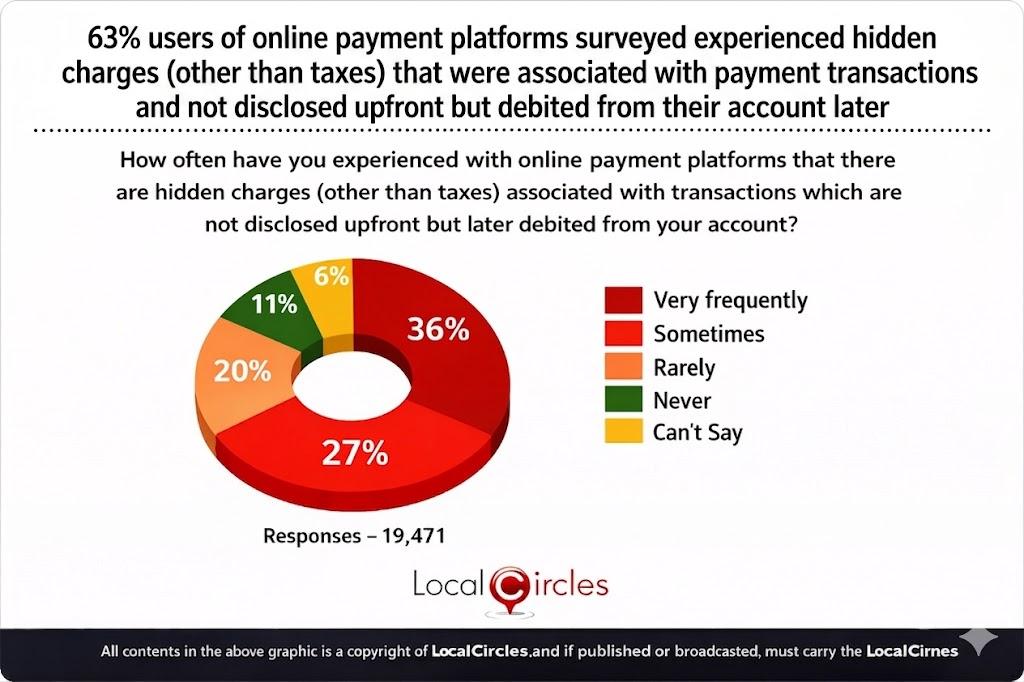
63% of users of online payment platforms surveyed experienced hidden charges (other than taxes) that were associated with payment transactions and not disclosed upfront but debited from their account later
Hidden charges rather than upfront charges are what leaves online payment platform users feeling cheated. The survey asked online payment platform users, “How often have you experienced with online payment platforms that there are hidden charges (other than taxes) that are associated with payment transactions which are not disclosed upfront, but they are debited from your account?” Out of 19,471 who responded to the question 36% stated that hidden charges have been experienced “very frequently”; 27% of respondents stated it has happened “sometimes”, 20% of respondents stated it has “rarely” happened; 11% of respondents stated it has “never” happened; and 6% of respondents did not give a clear answer. To sum up, 63% of users of online payment platforms surveyed experienced hidden charges (other than taxes) that were associated with payment transactions and not disclosed upfront but debited from their account later.
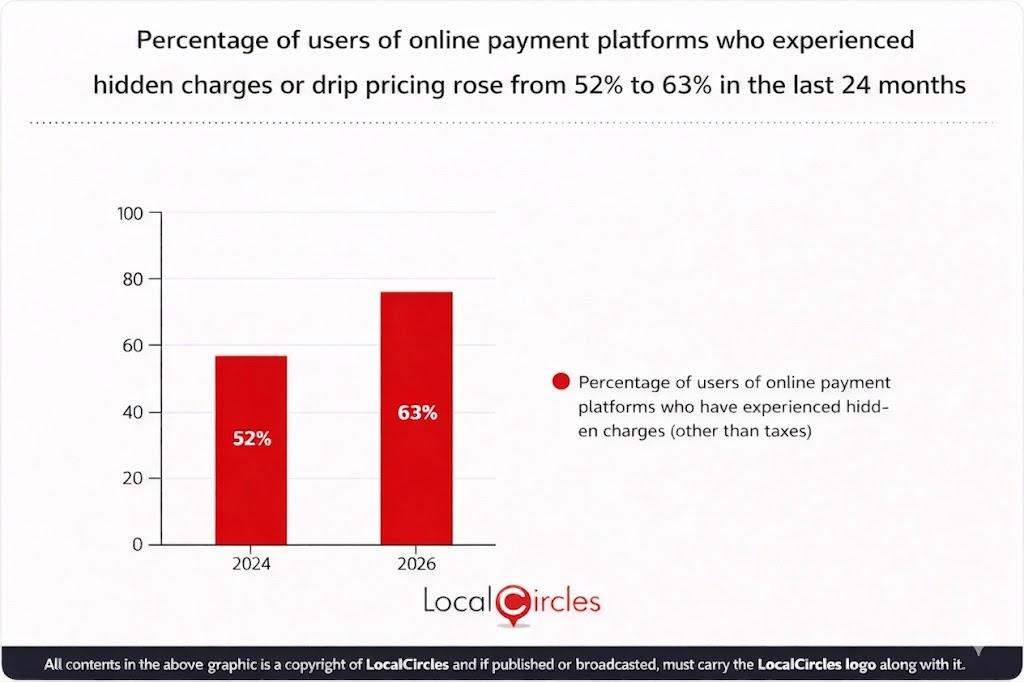
Percentage of users of online payment platforms who experienced hidden charges or drip pricing rose from 52% to 63% in the last 24 months
In the last 24 months, the percentage of users of online payment platforms who experienced hidden charges or drip pricing has risen from 52% to 63%, indicating that the government actions so far have had no impact.
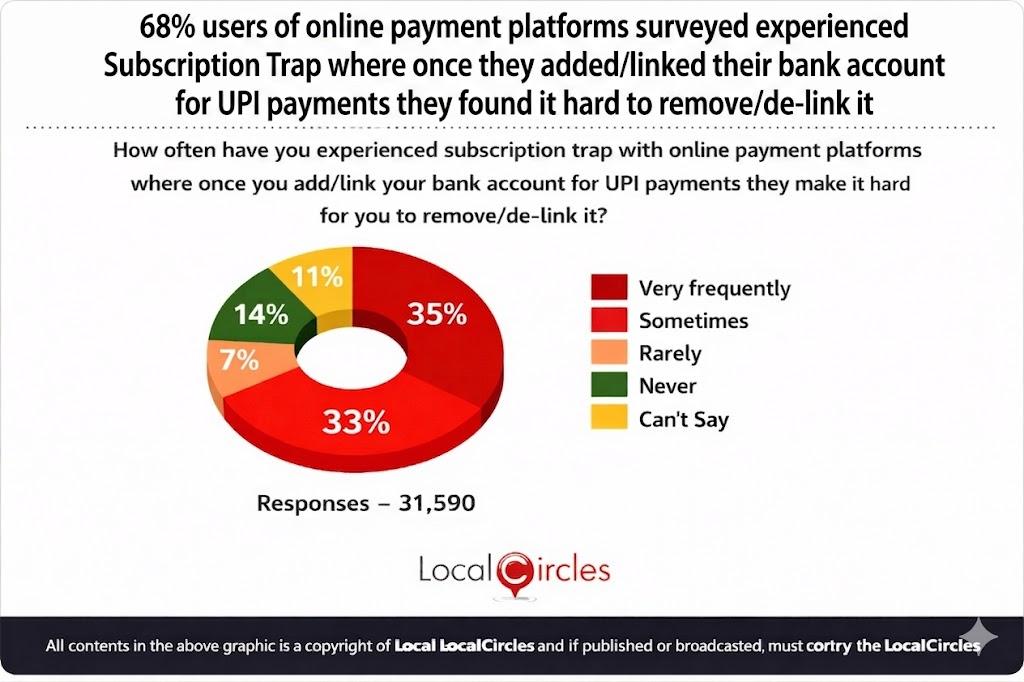
68% of users of online payment platforms surveyed experienced Subscription Trap where once they added/linked their bank account for UPI payments they found it hard to remove/delink it
Subscription trap, through attractive offers, is one of the most common dark patterns on the online platforms. The survey asked online payment platform users, “How often have you experienced subscription trap with online payments platforms where once you add/link your bank account for UPI payments they make it hard for you to remove/ delink it?” Out of 31,590 who responded to the question 35% stated that they have faced this problem “very frequently”; 33% of respondents stated that they have “sometimes” faced this problem; 7% of respondents stated it has happened “rarely”; 14% of respondents stated it has “never” happened and 11% of respondents did not give a clear answer. To sum up, 68% of users of online payment platforms surveyed experienced Subscription Trap where once they added/linked their bank account for UPI payments they found it hard to remove/delink it.
RBI’s provision allowing users to pause or cancel mandates anytime is expected to significantly reduce such subscription traps by making exit mechanisms simple and accessible.
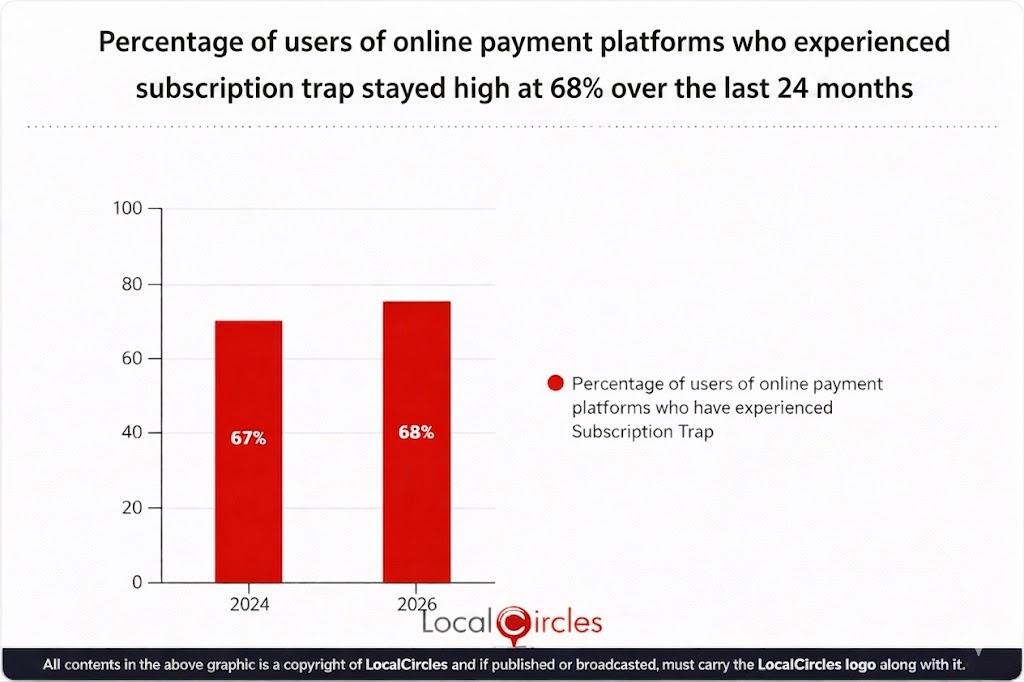
Percentage of users of online payment platforms who experienced subscription traps stayed high at 68% over the last 24 months
When comparing the survey results to the same question in 2024 and now, in the last 24 months, the percentage of online payment platforms users who have experienced subscription traps stayed high at 68%.
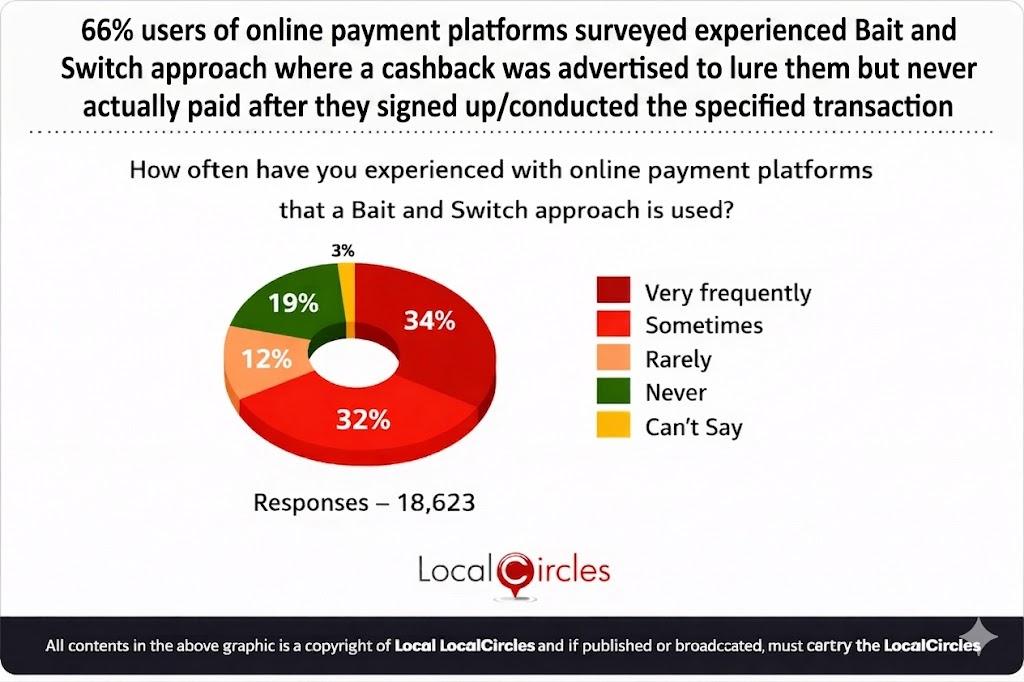
66% of users of online payment platforms surveyed experienced Bait and Switch approach where a cashback was advertised to lure them but never actually paid after they signed up/conducted the specified transaction
Bait and Switch is a form of retail sales fraud that manipulates consumers into making unwanted purchases or decisions. The survey next asked users of online payment platforms, “How often have you experienced with online payment platforms that a Bait and Switch approach is used?” Out of 18,623 who responded to the question 34% stated they have experienced Bait and Switch approach “very frequently”;32% of respondents stated they have experienced it “sometimes”; 12% of respondents stated they have experienced it “rarely”; 19% of respondents stated “never” and 3% of respondents did not give a clear answer. To sum up, 66% of users of online payment platforms surveyed experienced a Bait and Switch approach where cashback was advertised to lure them but never actually paid after they signed up/conducted the specified transaction.
Enhanced authentication and notification requirements can help mitigate risks arising from misleading offers and bait-and-switch practices by requiring clearer user confirmation.
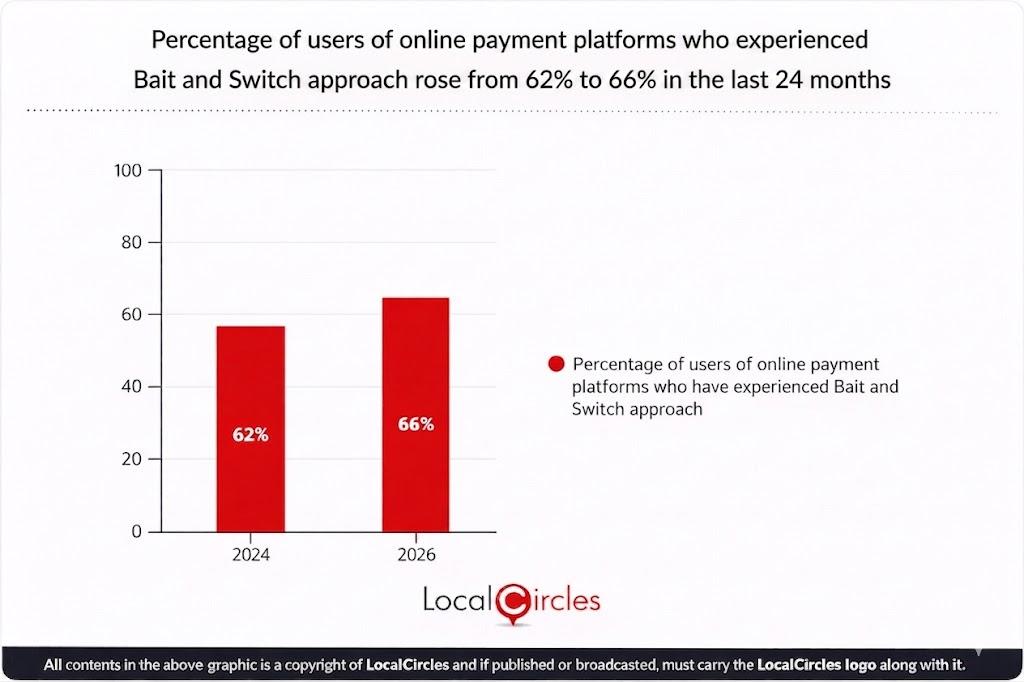
The percentage of users of online payment platforms who experienced Bait and Switch approach rose from 62% to 66% in the last 24 months
In the last 24 months, despite government directives, the percentage of online payment platform users who experienced Bait and Switch approach has risen from 62% to 66%.
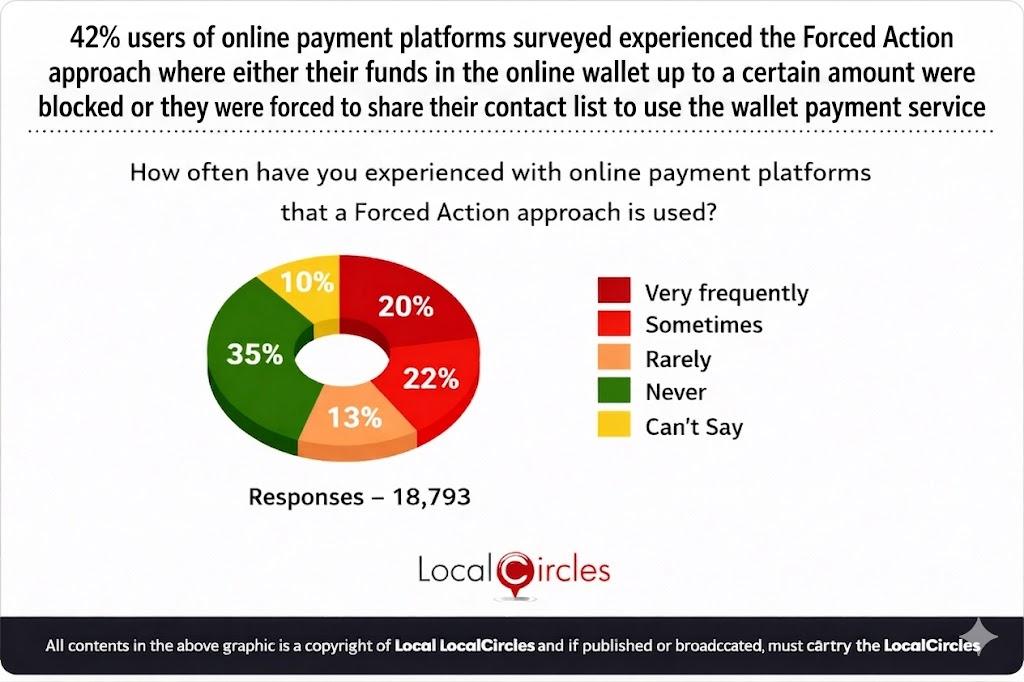
42% of users of online payment platforms surveyed experienced the Forced Action approach where either their funds in the online wallet up to a certain amount were blocked or they were forced to share their contact list to use the wallet payment service
Forced Action is a Dark Pattern used for coercing or tricking a person for financial gains as in scams like online gambling, phishing, or fake investment schemes. The survey asked online payment platform users, “How often have you experienced with online payment platforms that a Forced Action approach is used?” Out of 18,793 who responded to the question 20% stated that they had experienced Forced Action approach “very frequently”; 22% of respondents stated they have experienced it “sometimes”; 13% of respondents stated they have “rarely” experienced it; 35% of respondents stated they have “never” experienced it; and 10% of respondents did not give a clear answer. To sum up, 42% of users of online payment platforms surveyed experienced the Forced Action approach where either their funds in the online wallet up to a certain amount were blocked or they were forced to share their contact list to use the wallet payment service.
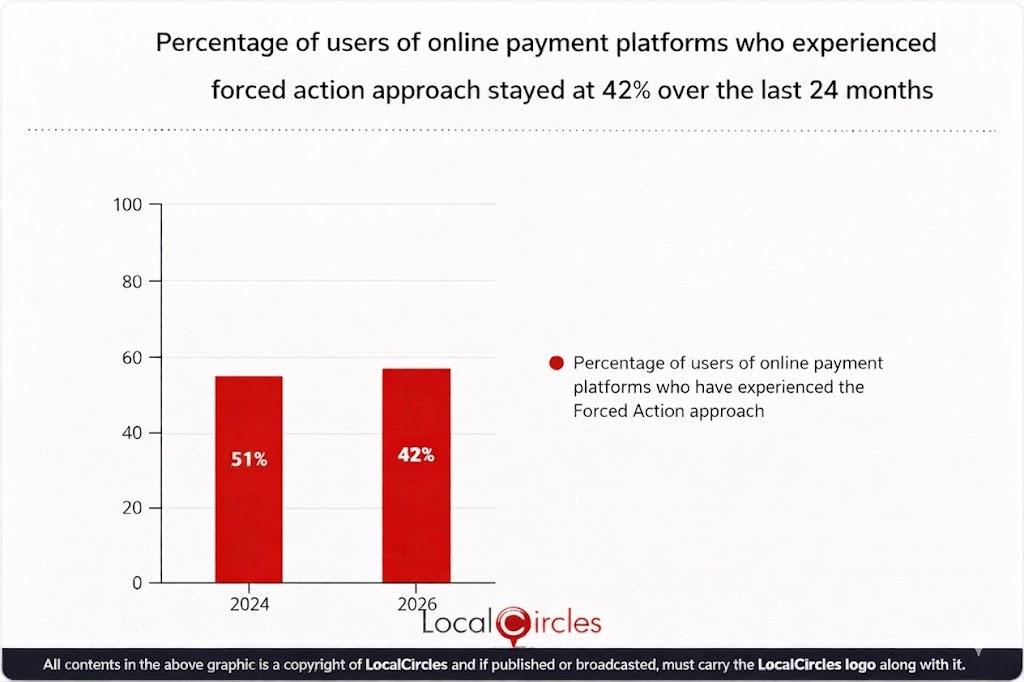
Percentage of users of online payment platforms who experienced Forced Action approach stayed at 42% over the last 24 months
Over the last 24 months, the percentage of users of online payment platforms who experienced Forced Action approach has stayed unchanged at 42%.
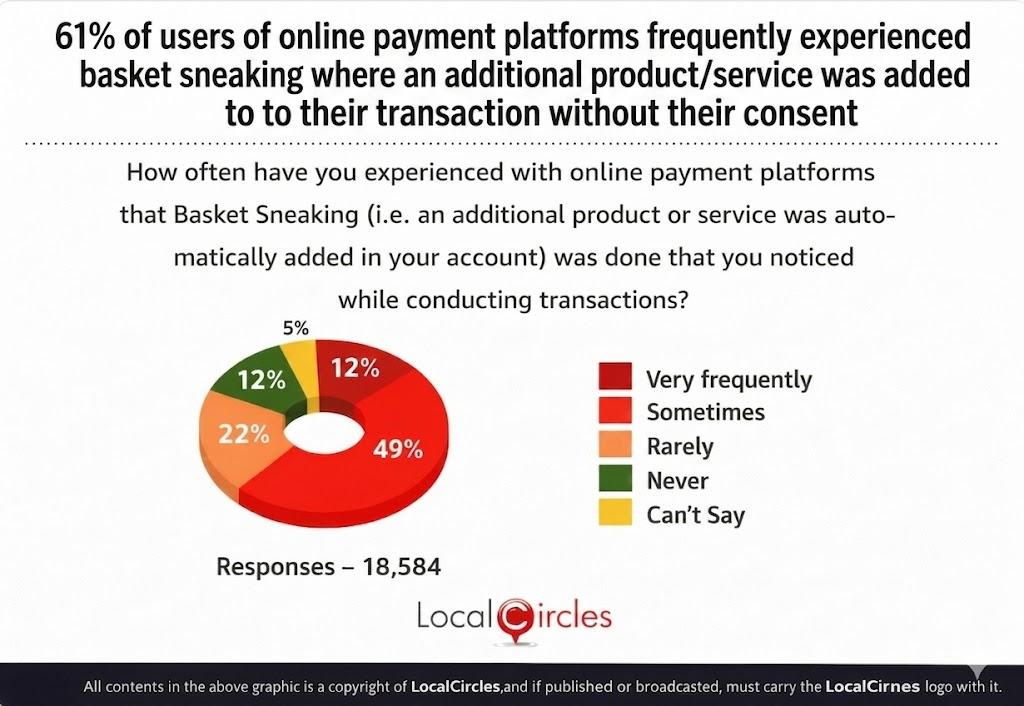
61% of users of online payment platforms frequently experienced basket sneaking where an additional product/service was added to their transaction without their consent
Forcing people to take insurance, pay donations, or pay a tip are some of the Basket Sneaking dark pattern consumers experience. The survey asked online payment platforms users, “How often have you experienced with online payment platforms that Basket Sneaking (i.e. an additional product or service was automatically added in your account) was done that you noticed while conducting transactions?” Out of 18,584 who responded to the question 12% stated they had experienced Basket Sneaking “very frequently”; 49% stated they had experienced it “sometimes”; 22% stated they had experienced it “rarely”; 12% stated they have “never” experienced it; and 5% of respondents did not give a clear answer. To sum up, 61% of users of online payment platforms frequently experienced basket sneaking where an additional product/service was added to their transaction without their consent.
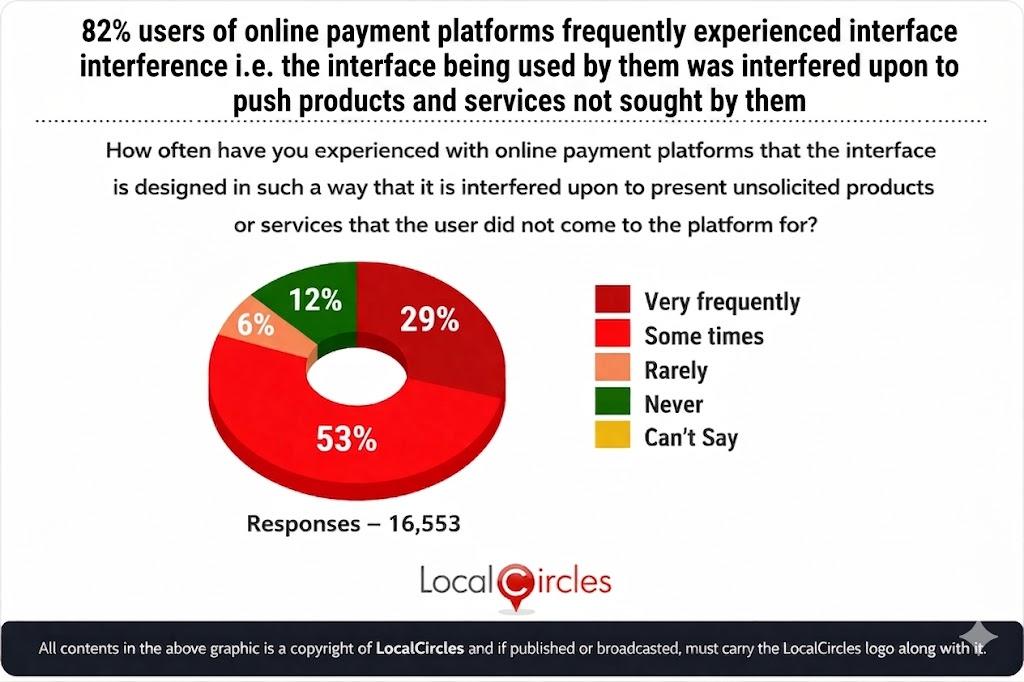
82% of users of online payment platforms frequently experienced interface interference i.e. the interface being used by them was interfered upon to push products and services not sought by them
Interface interference dark patterns can involve making certain choices appear more prominent or easier to make, burying crucial details, or creating a sense of urgency or pressure to manipulate users into unintended actions. The survey asked online payment platform users, “How often have you experienced with online payment platforms that the interface is designed in such a way that it is interfere upon to present unsolicited products of services that the user did not come to the platform for?” Out of 16,553 who responded to the question 29% stated they have experienced interface interference “very frequently”; 53% of respondents stated they have experienced it “sometimes”; 6% of respondents stated they have experienced it “rarely”; and 12% of respondents stated they have “never” experienced such fraud. To sum up, 82% of users of online payment platforms frequently experienced interface interference i.e. the interface being used by them was interfered with by pushing products and services not sought by them.
Given widespread interface-driven nudging, RBI’s alert and consent framework introduces an independent verification layer beyond the app interface, helping users make more informed decisions.
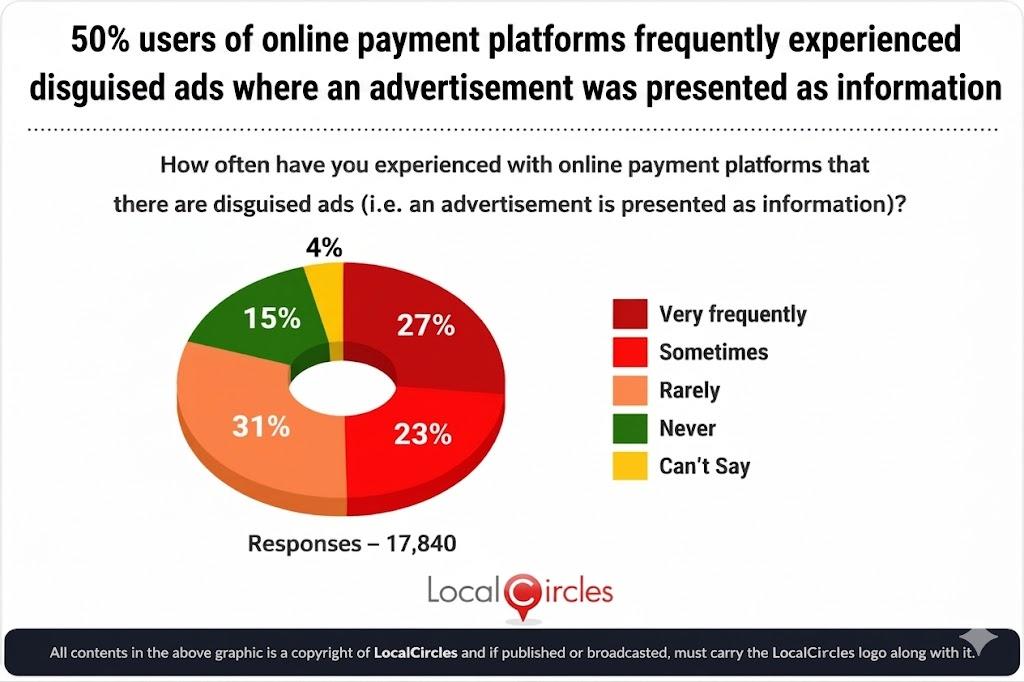
50% of users of online payment platforms frequently experienced disguised ads where an advertisement was presented as information
Disguised Advertisement fraud involves blurring the lines between advertising and genuine content, using fake ads that impersonate brands, or redirecting users to malicious websites. The survey asked users of online payment platforms, “How often have you experienced with online payment platforms that there are disguised ads (i.e. an advertisement is presented as information)?” Out of 17,840 who responded to the question 27% stated that they have experienced disguised advertisements “very frequently”; 23% of respondents stated they have experienced them “sometimes”; 31% of respondents stated they experienced them “rarely”; 15% said they “never” experienced them and 4% of respondents did not give a clear answer. To sum up. 50% of users of online payment platforms frequently experienced disguised ads where an advertisement was presented as information.
In summary, the survey reveals that while online payment platforms are a boon for carrying out small and big transactions they are not without problems or dark patterns like Drip Pricing, Subscription Traps, Bait and Switch, or Forced Action. The survey data shows 63% of users of online payment platforms surveyed experienced hidden charges (other than taxes) that were associated with payment transactions and not disclosed upfront but debited from their account later. The percentage of users of online payment platforms who experienced hidden charges or drip pricing has risen from 52% to 63% in the last 24 months, indicating that the government actions so far have had no impact. In terms of dark patterns, 68% of users of online payment platforms surveyed experienced Subscription Trap where once they added/linked their bank account for UPI payments they found it hard to remove/delink it. Over the last 24 months, the percentage of users of online payment platforms who experienced subscription traps stayed high at 68%, same as in 2024.
In the case of Bait and Switch approach, where a cashback was advertised to lure them but never actually paid after they signed up/conducted the specified transaction, 66% users of online payment platforms surveyed admitted to being impacted. In fact, the percentage of users of online payment platforms who experienced Bait and Switch approach rose from 62% to 66% in the last 24 months. In the case of another dark pattern, 42% of users of online payment platforms surveyed experienced the Forced Action approach where either their funds in the online wallet up to a certain amount were blocked or they were forced to share their contact list to use the wallet payment service. There has been no change in the last 24 months.
The survey found that three more dark patterns are being used by online payment platforms that were not detected earlier by consumers. These are Basket Sneaking, Interface Interference and Disguised Advertisements. This usage by platforms is impacting many as 61% users of online payment platforms frequently experienced basket sneaking where an additional product/service was added to their transaction without their consent. It gets worse as 82% of users of online payment platforms frequently experienced interface interference i.e. the interface being used by them was interfered with, pushing products and services not sought by them. Misleading consumers, 50% of users of online payment platforms stated that they frequently experienced disguised ads where an advertisement was presented as information. All these dark patterns are deceptive practices that can impact consumers if not aware of risks.
LocalCircles has escalated the survey findings with RBI and other stakeholders like NPCI and CCPA and it welcomes the latest E-Mandate guidelines by RBI. It believes that the central bank needs to issue a mandate to all digital platforms to ensure they are free of dark patterns on the same lines as it has done for the online platforms of banks.
Survey Demographics
The survey received over 141,000 responses from users of online payment platforms located in 386 districts of India. 63% respondents were men while 37% respondents were women. 42% of respondents were from tier 1, 29% from tier 2 and 29% respondents were from tier 3, 4, 5 and rural districts. The survey was conducted via LocalCircles platform, and all participants were validated citizens who had to be registered with LocalCircles to participate in this survey.
Survey Methodology
This survey has been conducted using the proprietary LocalCircles stratified sampling methodology. With a minimum target of 30% participation of each gender and a minimum target of 25% participation from three location groups (Tier 1, Tier 2 and Tier, 3-5 & rural districts) on each poll, all polls were run. After the minimum participation criteria were met, all polls were run till they achieved steady state. Post achievement of steady state, the LocalCircles system using the bootstrapping technique drew additional samples to test for the margin of error. All polls were found to have a margin of error under 4% and a confidence level of 96%.
About LocalCircles
LocalCircles, India’s leading Community Social Media platform enables citizens and small businesses to escalate issues for policy and enforcement interventions and enables Government to make policies that are citizen and small business centric. LocalCircles is also India’s # 1 pollster on issues of governance, public and consumer interest. More about LocalCircles can be found on https://www.localcircles.com
For more queries - media@localcircles.com, +91-8585909866
All content in this report is a copyright of LocalCircles. Any reproduction or redistribution of the graphics or the data therein requires the LocalCircles logo to be carried along with it. In case any violation is observed LocalCircles reserves the right to take legal action.
Enter your email & mobile number and we will send you the instructions.
Note - The email can sometime gets delivered to the spam folder, so the instruction will be send to your mobile as well


