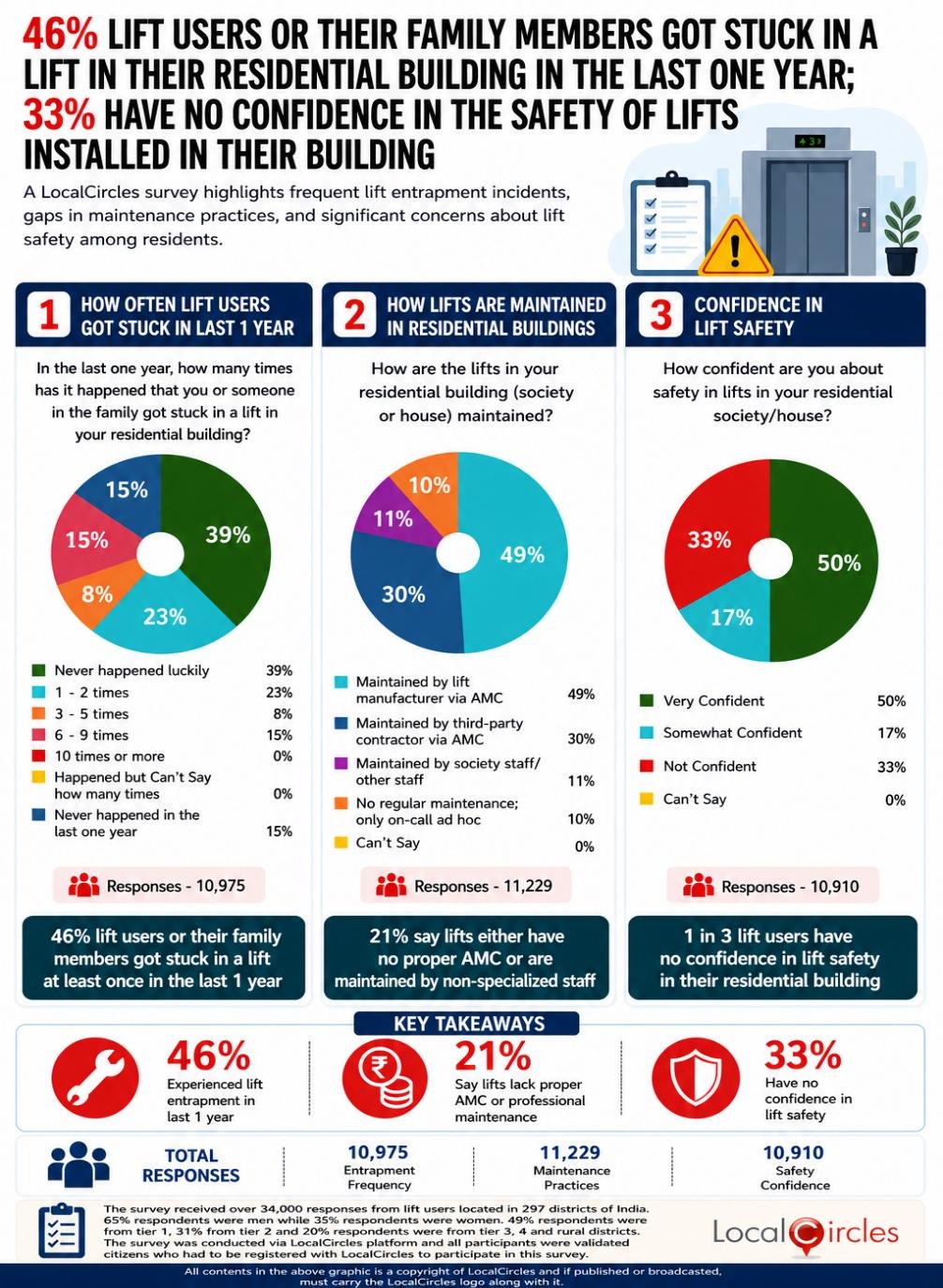
46% lift users or their family members got stuck in a lift in their residential building in the last one year; 33% have no confidence in the safety of lifts installed in their building
- ● 21% of surveyed say there is no proper AMC for the lift they are using in their residential building
- ● 10% indicated that “no one maintains other than on call on ad hoc basis in case of issues”
- ● Supreme Court in a landmark ruling of July 29, 2026 holds that an elevator is a “common carrier” and that the manufacturer, the maintenance agency and the owner of the premises are jointly and severally liable for the safety of lift users
August 03, 2026, New Delhi: In a landmark judgment delivered on July 29, 2026 in Otis Elevator Company (India) Ltd vs Rashmi Handa, the Supreme Court has held that an elevator must be treated as a “common carrier” and that the manufacturer, the maintenance agency and the owner of the premises are jointly and severally liable for the safety of lift users. The ruling comes against the backdrop of lift mishaps being reported across the country with worrying regularity. In Nashik, a 50-year-old hospital worker died after her head was trapped in a descending equipment lift, while other residential lift failures in the city pointed to poor maintenance and weak inspection. In Nagpur, several people were trapped for nearly 30 minutes in a government building lift due to a power failure and non-functional backup, highlighting serious lapses in emergency preparedness.
A Bench of Justices PS Narasimha and Alok Aradhe reasoned that a person entering a lift surrenders all control over their movement and safety to an automated system and cannot independently guard against mechanical failure. It held that a victim’s family need not first apportion blame before seeking compensation – compensation can be awarded first, with the liable parties settling their shares later. Significantly for housing societies, a party undertaking comprehensive maintenance owes a heightened duty of care, while the owner’s statutory obligation continues because the lift remains part of the building under its control.
The judgment upheld a 2014 National Consumer Disputes Redressal Commission order awarding approximately Rs 3.01 crore plus applicable interest to the family of a Research and Analysis Wing officer crushed to death in March 2003 when a lift at the RAW complex in New Delhi stalled between floors and moved suddenly during the rescue. The Court upheld the apportionment of 70 per cent liability to the lift manufacturer Otis, 25 per cent to the maintenance and engineering agency and 5 per cent to the government department managing the building, finding that Otis had been repeatedly informed of breakdowns and had itself recommended a voltage stabiliser yet neither ensured it was installed nor declined to certify the lift as safe. The implication for high-rise societies is direct: an owner cannot outsource responsibility by signing an AMC, and a manufacturer or maintenance agency cannot escape liability by blaming building staff.
While accidents have driven policy action to strengthen lift safety regulations particularly given the rising dependence on elevators in high rise buildings, the situation remains uneven, with some states tightening laws while others lag in implementation.
In Maharashtra, a spike in incidents in cities like Pune and Nashik has exposed serious gaps in inspection, with only a fraction of lifts undergoing mandatory annual checks due to staff shortages and administrative delays. This has prompted legislative amendments to decentralise inspections and proposals for third-party audits, although enforcement remains weak.
In Telangana, repeated fatal lift accidents led the High Court earlier this year to question delays in enacting a comprehensive lift safety law and push the government to fast-track the proposed Telangana Lifts Act.
In Uttar Pradesh, the government moved more decisively. The Uttar Pradesh Lift and Escalator Act 2024 and its rules mandate registration of all lifts within a fixed timeline, automatic rescue devices, maintenance contracts and inspections, and penalties including shutdown for non-compliance. However, compliance remains uneven – while Noida has achieved high registration rates, many districts still lag.
Across India, the regulatory landscape is fragmented. Around 17 states have lift laws, but enforcement varies widely. Delhi, Tamil Nadu and Karnataka have relatively stronger compliance systems, while others rely on outdated rules – in Maharashtra, lift safety is still partly governed by rules dating back to 1958.
At the national level, the Bureau of Indian Standards introduced a major upgrade with IS 17900, a modern safety code aligned with global standards which, from December 22, 2025, supersedes older codes and prescribes safeguards such as automatic rescue devices, door sensors and emergency communication. Yet it is not automatically mandatory, and India still lacks a uniform, enforceable national framework, leaving lift safety dependent on state capacity and implementation. The Supreme Court’s ruling partly bridges this gap, laying down a single nationwide standard of accountability irrespective of the state a lift is installed in.
Keeping in view the lack of compliance on the safety aspect, and in the light of the Supreme Court holding the manufacturer, the maintenance agency and the building owner jointly answerable for lift safety, LocalCircles has conducted a survey to find out consumers' awareness about safety aspects of lift installation and maintenance and whether their housing society is following the rules. The survey received over 34,000 responses from lift users located in 297 districts of India.
46% of lift users or their family members got stuck in a lift in their residential building in the last one year
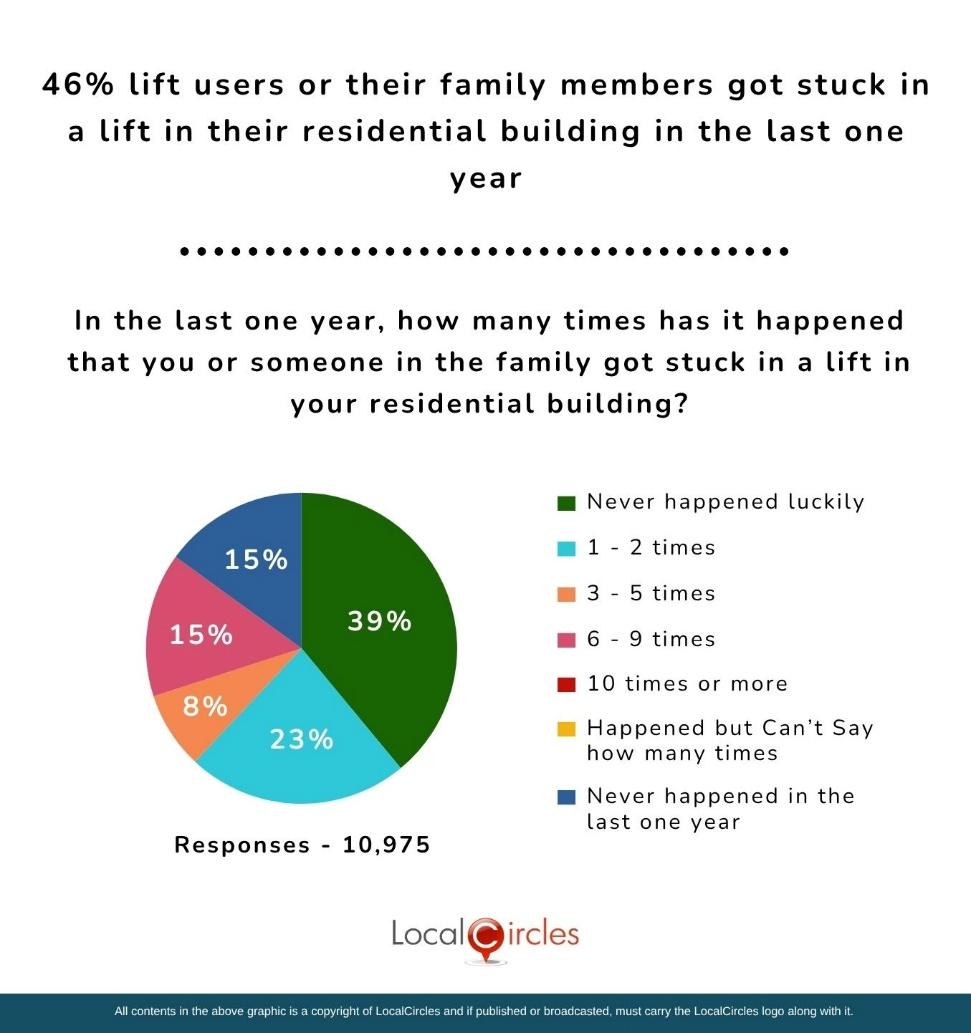
Focusing on the problems many have faced with lifts, the survey asked, “In the last one year, how many times has it happened that you or someone in the family got stuck in a lift in your residential building?” Out of 10,975 who responded to the query 39% indicated that such an incident “never happened luckily” and 15% indicated that it “never happened in the last one year”. However, 23% of respondents indicated that someone in the family got stuck in the lift “1-2 times” in the last one year; 8% indicated it happened “3-5 times”; 15% stated it happened “6-9 times” in the last one year. To sum up, 46% of lift users or their family members got stuck in a lift in their residential building in the last one year. This assumes fresh significance in the light of the Supreme Court holding that ignoring recurring lift problems is in itself negligence – where a lift repeatedly malfunctions and complaints are ignored or met only with temporary fixes, or the lift continues to be operated despite known defects, those responsible can be held liable. With 15% of lift users reporting having got stuck as many as 6-9 times in a single year, such repeat failures are no longer merely an inconvenience but a potential source of civil liability for the society, the maintenance agency and the manufacturer alike.
21% of lift users surveyed say there is no proper AMC for the lift they are using in their residential building
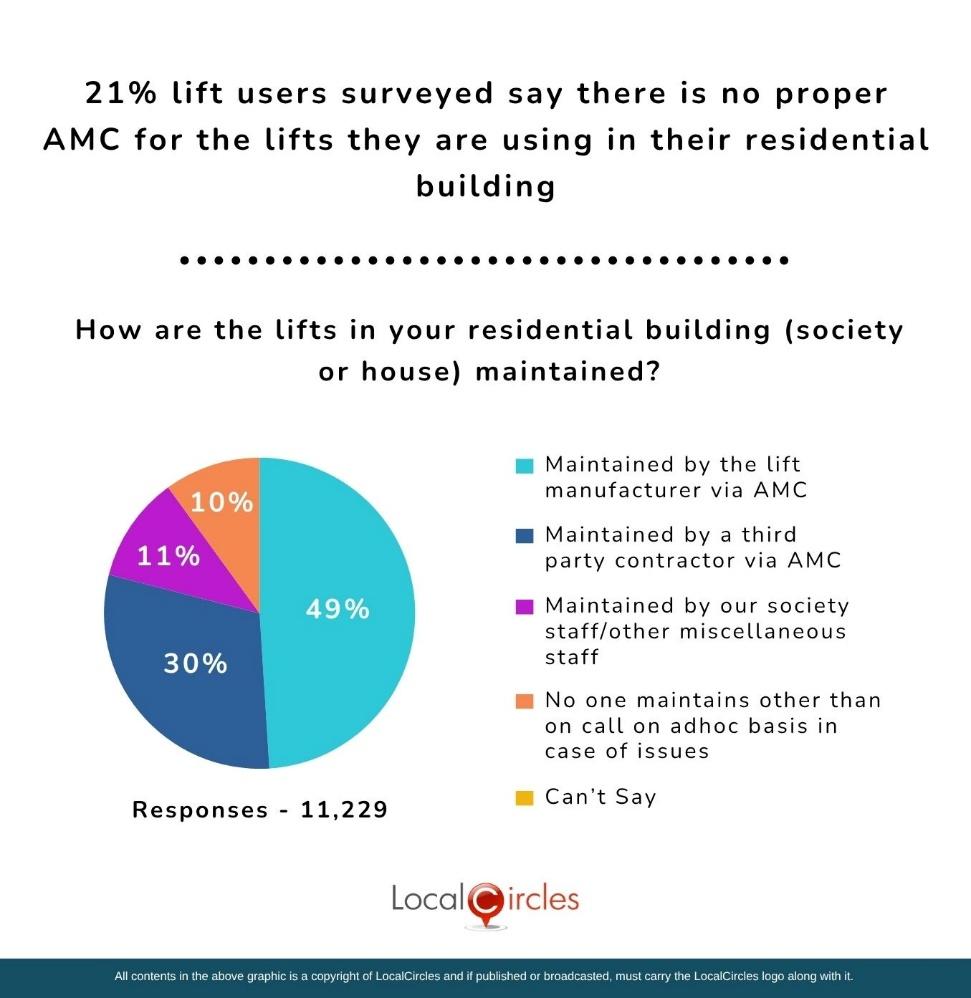
Other than design or structural faults, most lift accidents occur due to lack of proper maintenance. The survey asked, “How are the lifts in your residential building (society or house) maintained?” This query received 11,229 responses with 49% indicating that it is “maintained by the lift manufacturer via AMC; 30% indicating that it is “maintained by a third party contractor via AMC”; 11% indicated that it is maintained by our “society staff/ other miscellaneous staff”; and 10% indicating that “no one maintains other than on call on ad hoc basis in case of issues”. To sum up, 21% of lift users surveyed say there is no proper AMC for the lift they are using in their residential building. The Supreme Court ruling makes the absence of a proper AMC considerably riskier: a party that undertakes comprehensive maintenance owes a heightened duty of care, while the building owner’s own statutory obligation continues regardless, because the lift remains part of the building under the owner’s control. Societies relying on ad hoc, call-based repairs would therefore do well to move to a documented arrangement covering periodic inspection, preventive maintenance and proper maintenance logs.
1 in 3 lift users surveyed have no confidence in the safety of lifts installed in their residential society/ house
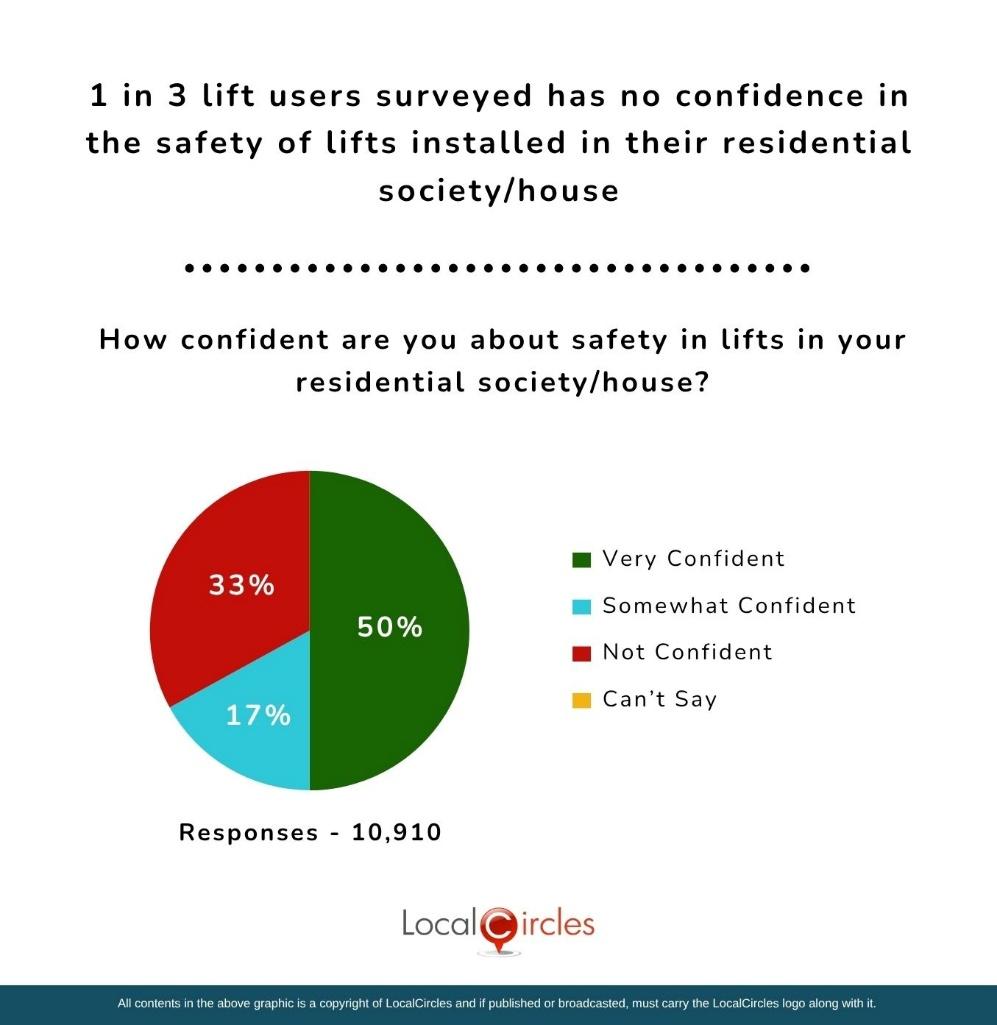
Given the many media reports about lift mishaps and awareness about the need for proper maintenance, the survey asked, “How confident are you about safety in lifts in your residential society/ house?” The query received 10,910 responses with 50% of respondents indicating “very confident” and 17% indicating “somewhat confident”. However, 33% stated that they are “not confident” about the safety of the lift in their residential society/ house. This brings to fore the fact that 1 in 3 lift users surveyed have no confidence in the safety of lifts installed in their residential society/ house. The Supreme Court ruling should, over time, help address this trust deficit, as it gives users a clear route to compensation without having to first establish which party in the chain was at fault.
In summary, the fact that 46% of lift users surveyed or their family members have got stuck in a lift in their residential building in the last one year is alarming. Equally worrying is the fact that 21% of lift users surveyed say there is no proper AMC for the lift they are using in their residential building. No wonder 1 in 3 lift users surveyed have no confidence in the safety of lifts installed in their residential society/ house. It is high time the central government steps in to nudge the states to put in place more stringent rules for safety of lift users including installation and maintenance. The local bodies should be made to ensure that all safety measures are complied with, and the manufacturer is held accountable for any technical or manufacturing flaws. As the survey shows, a large percentage of societies get the maintenance done through AMC with the manufacturer, which should make them more accountable. The Supreme Court’s July 2026 ruling now settles the question of accountability: an elevator is a common carrier, the manufacturer, the maintenance agency and the building owner or manager all owe passengers a heightened duty of care and are jointly liable, and none of them can escape liability by blaming another. Consumers no longer have to establish who exactly was negligent before claiming compensation – they may recover from any liable party, and those parties can settle their respective shares among themselves later. Housing societies, RWAs, builders and lift companies must therefore treat lift registration, a valid AMC, periodic third-party inspection and staff training in emergency rescue as legal obligations rather than discretionary expenses.
The judgment raises the standard of care expected not only of RWAs and housing societies but also of commercial buildings, hospitals, hotels, malls and office complexes. They should now ensure periodic inspections, preventive maintenance, proper maintenance logs, immediate repair of reported defects, and the taking of unsafe lifts out of service until they are repaired; failure to do so may expose them to substantial civil liability if an accident occurs. LocalCircles will be sharing the findings of this survey with the Ministry of Housing and Urban Affairs, the Bureau of Indian Standards and state urban development departments so that the principle of joint accountability laid down by the Supreme Court is translated into enforceable rules on lift registration, mandatory maintenance contracts, third-party audits and periodic inspection across India.
Survey Demographics
The survey received over 34,000 responses from lift users located in 297 districts of India. 65% respondents were men while 35% respondents were women. 49% respondents were from tier 1, 31% from tier 2 and 20% respondents were from tier 3, 4 and rural districts. The survey was conducted via LocalCircles platform, and all participants were validated citizens who had to be registered with LocalCircles to participate in this survey.
About LocalCircles
LocalCircles, India’s leading Community Social Media platform enables citizens and small businesses to escalate issues for policy and enforcement interventions and enables Government to make policies that are citizen and small business centric. LocalCircles is also India’s # 1 pollster on issues of governance, public and consumer interest. More about LocalCircles can be found on https://www.localcircles.com
For more queries - media@localcircles.com, +91-8585909866
All content in this report is a copyright of LocalCircles. Any reproduction or redistribution of the graphics or the data therein requires the LocalCircles logo to be carried along with it. In case any violation is observed LocalCircles reserves the right to take legal action.


