LocalCircles urges Government to ban use of Privacy Zuckering dark pattern in India; 77% consumers surveyed confirm experiencing it on insurance platforms
- ● Privacy Zuckering does not figure in the 13 dark patterns identified by the Central Consumer Protection Authority (CCPA), leaving insurance platforms that deploy it outside the ambit of enforcement
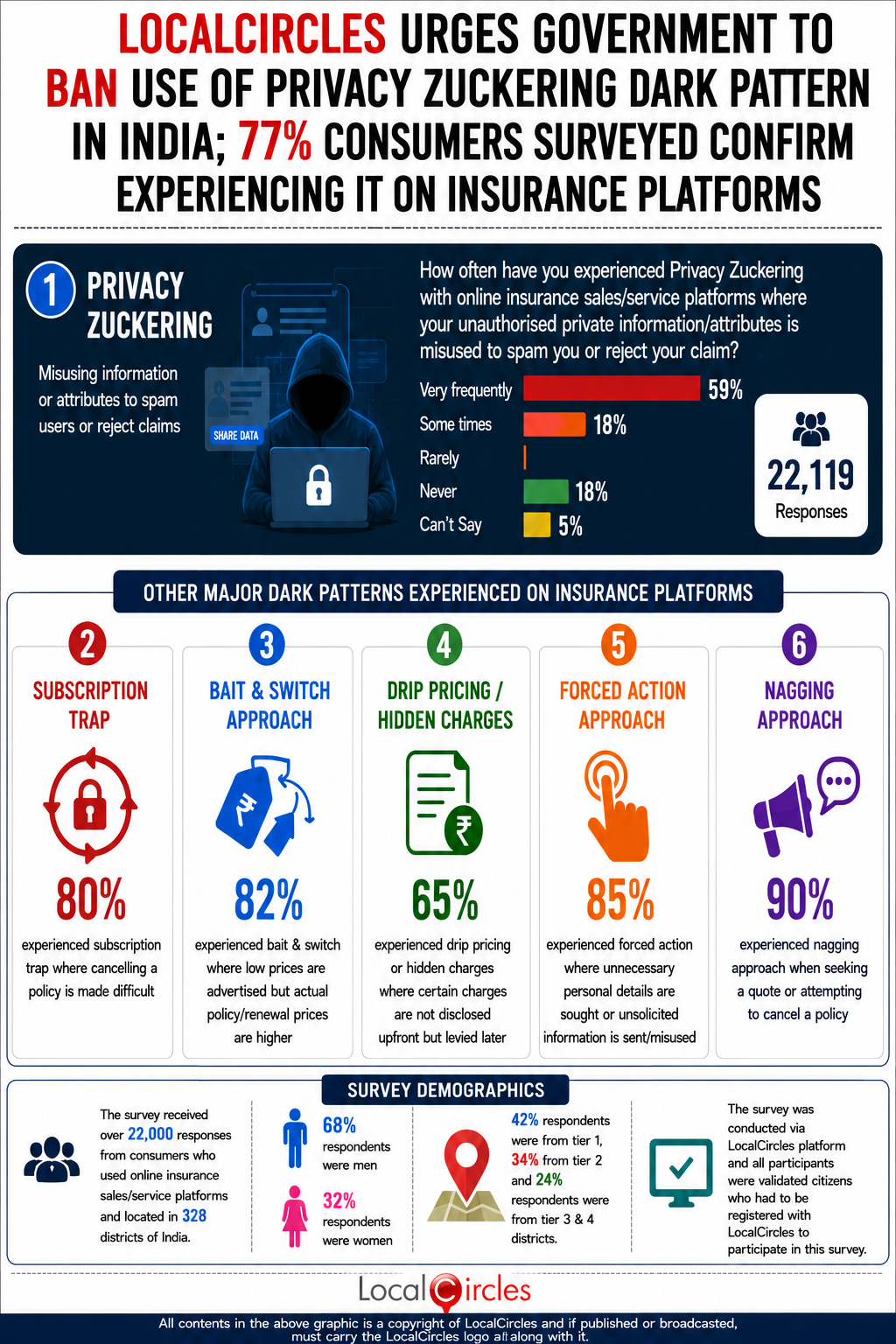
- ● Other dark patterns continue to run high on insurance platforms – nagging at 90%, forced action at 85%, bait & switch at 82%, subscription trap at 80% and drip pricing/hidden charges at 65%
- ● LocalCircles demands that IRDAI and CCPA identify Privacy Zuckering as a dark pattern in their guidelines and rules and mandate that platforms be free of it
August 03, 2026, New Delhi: Last week, Insurance Regulatory and Development Authority of India (IRDAI) Chairman Ajay Seth told insurers at an event in New Delhi that there is an urgent need to eliminate dark patterns from the insurance ecosystem to preserve consumer trust and improve access to insurance products, and that insurers must undertake an honest assessment of their own organisations. “The expectation is very clearly that the public needs full transparency; the dark patterns must not be there in our system,” Seth said.
The example the IRDAI Chairman cited goes to the heart of the dark pattern that this LocalCircles study examines. He pointed out that users visiting insurance websites are routinely asked for personal information that has no bearing on buying an insurance policy or checking its price. “If somebody wants to buy a product, they should be able to go to the website and check the product and its price. Instead, the website first asks for your name, mobile number and consent to be contacted, even before telling you the price,” he said. On informed consent, Seth added that insurers must ensure policyholders understand the terms and conditions before providing consent, and that seeking consent should not be treated merely as a legal formality but as an important trust-building exercise.
This regulatory attention follows action IRDAI took earlier this year on a LocalCircles representation. On March 18, 2026, LocalCircles formally wrote to IRDAI highlighting the widespread use of dark patterns across insurance platforms and sought immediate regulatory intervention. The submission was based on consumer complaints, survey findings and an audit of over 20 insurance platforms, which revealed the prevalence of nagging, forced action, bait & switch, privacy zuckering and interface interference. Acting on this, IRDAI on April 2, 2026 directed all regulated entities offering insurance products on digital platforms to conduct a self-assessment of compliance with the CCPA dark pattern guidelines within 15 days, submit a report to the regulator, and provide a time-bound action plan within one month to eliminate any identified dark patterns.
The self-assessment exercise produced a telling outcome. Insurers reported back to the regulator that they had found no dark patterns on their platforms – a claim that sits in direct contradiction to what consumers report experiencing every day. IRDAI has since partnered with the Institute of Public Auditors of India (IPAI), a statutory body, to independently identify and monitor dark patterns in the insurance sector over the next nine months.
The gap between self-declaration and reality is not unique to insurance. A LocalCircles study published earlier in July 2026, based on consumer complaints received over the past year, public social media posts and the platform’s AI-powered dark pattern detection tool which analysed more than 310 digital platforms, found that nearly 95% of the top 300 publicly listed companies with consumer-facing online platforms use at least one dark pattern. Of the 23 companies that had completed self-audits and declared themselves dark pattern free, only seven were actually found to be clean. SEBI has since proposed a Common Advertisement Code (CAC) 2026, which explicitly prohibits dark patterns in advertisements and investor communications by regulated entities. Earlier, post LocalCircles escalation, the Reserve Bank of India issued the “Responsible Business Conduct Amendment Directions, 2026” mandating that by July 2026 all banks must ensure their online banking apps and platforms are free of dark patterns.
Privacy Zuckering is the practice of using deceptive and manipulative interfaces to trick users into disclosing more personal, health or financial data than they intended or agreed to, and then using that data for purposes the user never authorised. On insurance platforms, consumers report two distinct harms flowing from it. The first is relentless spam. Once a quote request or even a partially filled form hands over a mobile number, email ID and health or vehicle details, the data travels to intermediaries, telecallers and cross-sell teams, generating calls, SMS, WhatsApp messages and emails that continue for months and survive every opt-out attempt. The second and more damaging harm surfaces at claim stage, where information the consumer never knowingly volunteered – details typed into a pre-quote health questionnaire or a wellness app, disclosures made casually to a telecaller, or attributes inferred from earlier quote journeys – reappears as evidence of “non-disclosure” or “misrepresentation” and becomes the basis for repudiating the claim.
The scale of claim repudiation makes this consequential. IRDAI data shows that health policy claims worth approximately INR 26,000 crore were disallowed or repudiated by insurers in the year ending March 2024, a 19.10% increase over the previous year, with roughly one in twelve health insurance claims still being rejected. From July 1, 2026, insurers failing to meet the 95% claim settlement compliance threshold face penalties of up to INR 2 lakh per violation. Where a rejection rests on data the consumer was manipulated into parting with, the policyholder is left fighting a case built on their own unauthorised disclosure.
Privacy Zuckering also cuts against India’s data protection framework. Under the Digital Personal Data Protection Act, 2023 and the DPDP Rules, 2025, consent must be free, specific, informed and unambiguous, and personal data may be processed only for the purpose for which it was collected – a photograph or health record collected for claim assessment cannot be repurposed for marketing. Long-standing insurance practices around consent, profiling, data sharing and retention now fall squarely within this perimeter, and sensitive health data such as diagnoses, procedures, discharge summaries, chronic disease indicators, mental health information and claims history attracts heightened scrutiny under the Act’s harm-based penalty framework. Registration of consent managers becomes mandatory from November 13, 2026, while the penalty regime becomes enforceable from May 14, 2027. Yet the CCPA list of 13 dark patterns notified as unfair trade practices does not include Privacy Zuckering, which means a platform deploying it faces no specific consequence under consumer protection law even as its conduct offends data protection law.
Through this new nationwide study, LocalCircles has strived to establish how frequently consumers actually experience Privacy Zuckering on online insurance sales and service platforms, and whether their unauthorised private information or attributes are being misused to spam them or to reject their claims. The survey received over 22,000 responses from consumers who used online insurance sales/service platforms and located in 328 districts of India. 68% respondents were men while 32% respondents were women. 42% respondents were from tier 1, 34% from tier 2 and 24% respondents were from tier 3 & 4 districts.
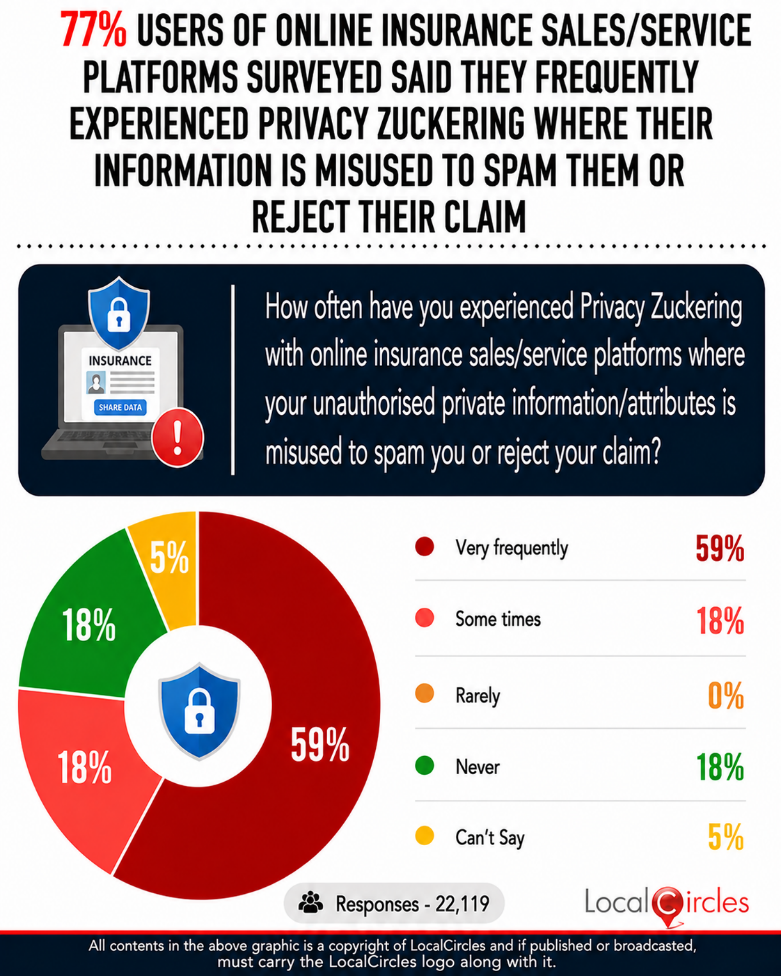
77% users of online insurance sales/service platforms surveyed said they frequently experienced Privacy Zuckering where their information is misused to spam them or reject their claim
The survey asked users of online insurance sales/service platforms, “How often have you experienced Privacy Zuckering with online insurance sales/service platforms where your unauthorised private information/attributes is misused to spam you or reject your claim?” Out of 22,119 who responded to the question, 59% stated they have experienced it “very frequently”; 18% of respondents stated it has happened “some times”; 0% of respondents stated they have “rarely” experienced it; 18% of respondents stated they have “never” experienced it and 5% of respondents did not give a clear answer. To sum up, 77% of users of online insurance sales/service platforms surveyed said they frequently experienced Privacy Zuckering where their unauthorised private information or attributes are misused to spam them or reject their claim.
In summary, the study establishes that Privacy Zuckering is now a mainstream practice on India’s online insurance platforms, with 77% of users surveyed confirming that their unauthorised private information or attributes have been misused to spam them or to reject their claim, and 59% saying this happens very frequently. The finding sits alongside the other dark patterns LocalCircles has documented on the same platforms – 90% of users experiencing nagging when they seek a quote or attempt to cancel a policy, 85% experiencing forced action where unnecessary personal details are sought or misused, 82% experiencing bait & switch where low prices are advertised but actual policy or renewal prices are higher, 80% experiencing subscription trap where cancelling a policy is made difficult, and 65% experiencing drip pricing or hidden charges that are not disclosed upfront but levied later.
Read together, these numbers show a sector where data collected under one pretext is used for another, and where the consumer’s own information is turned against them at the moment they need their policy most. The IRDAI Chairman’s call to eliminate dark patterns and the appointment of IPAI to monitor compliance are welcome, but insurers’ own self-assessments reporting zero dark patterns demonstrate that self-declaration cannot be the basis of enforcement. LocalCircles plans to share these survey results with IRDAI, CCPA and the Ministry of Consumer Affairs, and urges that compliance be verified through independent third-party audits of user interface flows, consent mechanisms and data collection and sharing practices, backed by penalties for non-compliance, public disclosure of violations and a consumer reporting mechanism.
Over the last 36 months, LocalCircles has done extensive work in researching dark patterns basis consumer inputs, validation via its AI powered dark pattern detection engine and then manually, and has escalated the same to various regulators in India. Dark Patterns are practices that mislead consumers into taking certain actions that they did not intend to take. Post LocalCircles escalation, the CCPA has identified 13 dark patterns and classified them as unfair trade practices, the RBI has mandated that banks make their online platforms free of dark patterns, IRDAI has directed insurers to assess and ensure compliance, and SEBI has proposed prohibiting dark patterns in advertisements and investor communications by regulated entities.
The new dark pattern Privacy Zuckering has been identified by LocalCircles and given its presence on insurance platforms, LocalCircles demands that IRDAI as well as CCPA identify it as a dark pattern in their guidelines and rules and mandate that platforms be free of it.
Survey Demographics
The survey received over 22,000 responses from consumers who used online insurance sales/service platforms and located in 328 districts of India. 68% respondents were men while 32% respondents were women. 42% respondents were from tier 1, 34% from tier 2 and 24% respondents were from tier 3 & 4 districts. The survey was conducted via LocalCircles platform and all participants were validated citizens who had to be registered with LocalCircles to participate in this survey.
About LocalCircles
LocalCircles, India’s leading Community Social Media platform enables citizens and small businesses to escalate issues for policy and enforcement interventions and enables Government to make policies that are citizen and small business centric. LocalCircles is also India’s # 1 pollster on issues of governance, public and consumer interest. More about LocalCircles can be found on https://www.localcircles.com
For more queries - media@localcircles.com, +91-8585909866
All content in this report is a copyright of LocalCircles. Any reproduction or redistribution of the graphics or the data therein requires the LocalCircles logo to be carried along with it. In case any violation is observed LocalCircles reserves the right to take legal action.


