As adulteration concerns mount with dairy products, 6 in 10 urban households lack confidence in purity and quality of Ghee
- ● Over 18,000 urban Indian households across 293 districts share their experiences with Ghee
July 14, 2026, New Delhi: The Food Safety and Standards Authority of India (FSSAI) in December 2025 directed all States and Union Territories to launch a special enforcement drive against adulteration and misbranding of milk and milk products, including paneer, khoya, and ghee. The move, issued under Section 16(5) of the Food Safety and Standards Act, 2006, came after repeated reports and intelligence inputs indicating widespread circulation of unsafe and illegally manufactured dairy products in several parts of India. According to official sources, the enforcement campaign focuses on identifying and eliminating adulterated dairy products that pose serious public health risks. Food safety authorities have intensified inspections, sample testing, and market surveillance to curb the sale of counterfeit and substandard products. The action reflects growing concern over food adulteration in India’s rapidly expanding dairy sector, particularly during periods of high demand.
This enforcement push has widened significantly in mid-2026 to target expired and fake products across the food chain. In early July 2026, FSSAI’s Northern Regional Office seized over 50,000 pieces of food and non-food items from a firm in South-West Delhi for fraudulent re-labelling and improper storage, and registered an FIR. The action came alongside the Delhi Police busting an organised syndicate in the Okhla Industrial Area that bought near-expiry and expired branded products, used chemical thinners and printing machines to erase and reprint manufacturing and expiry dates, and supplied the re-labelled stock to retail and e-commerce markets across India; seven people were arrested and tampered products worth over INR 20 lakh were seized. FSSAI has also issued a series of notices to quick-commerce platforms, including Swiggy Instamart in July 2026, over consumer complaints of expired and spoiled items being delivered.
One major case that highlighted the seriousness of the issue emerged in November 2025, when police in Bengaluru uncovered a large, adulterated ghee racket operating under the well-known Nandini brand name. Authorities seized assets worth approximately INR 1.26 crore, including more than 8,000 liters of fake ghee valued at nearly INR 57 lakh. Investigators also recovered machinery used for manufacturing counterfeit ghee and large quantities of coconut and palm oil allegedly used for adulteration. The case was registered under the Central Crime Branch Special Investigation Division, and forensic testing was initiated to determine the extent of contamination.
The problem is not limited to a single brand or city. In a major inter-state operation on 17 June 2026, FSSAI’s Northern Regional Office busted a counterfeit ghee network spanning Delhi and Haryana, seizing more than 6,500 litres of suspected adulterated ghee along with the raw materials used to manufacture it. The action was triggered by online advertisements promoting premium-quality ghee without mandatory FSSAI licence details; a decoy purchase and subsequent laboratory testing found that the samples did not conform to the standards prescribed for ghee and contained a mixture of vegetable oils and other non-dairy constituents. Inspectors raided two ‘desi ghee’ manufacturing units — one in Delhi’s Dwarka and another in Haryana’s Sonipat — recovering roughly 2,500 and 4,000 litres of spurious ghee respectively, and an FIR was registered.
Despite recurring incidents of adulteration, consumer demand for ghee in India continues to rise strongly. Increasing health consciousness, the popularity of keto and traditional diets, and beliefs regarding the digestive and immunity benefits of ghee are driving higher consumption. Demand for premium categories such as organic and A2 ghee is also growing among urban consumers. Modern retail chains and e-commerce and quick commerce platforms are further encouraging sales of hygienically packaged and branded products over loose, unpackaged alternatives.
India’s ghee market is expected to maintain strong long-term growth. Per capita consumption is projected to rise steadily over the next decade, while the market itself is forecast to expand at a CAGR of around 8–9%. Although ghee prices increased during 2025 due to higher milk cream and production costs, the reduction in GST from 12% to 5% has provided partial relief to consumers. Cow ghee continues to dominate the market, while buffalo ghee is gradually emerging as a premium segment.
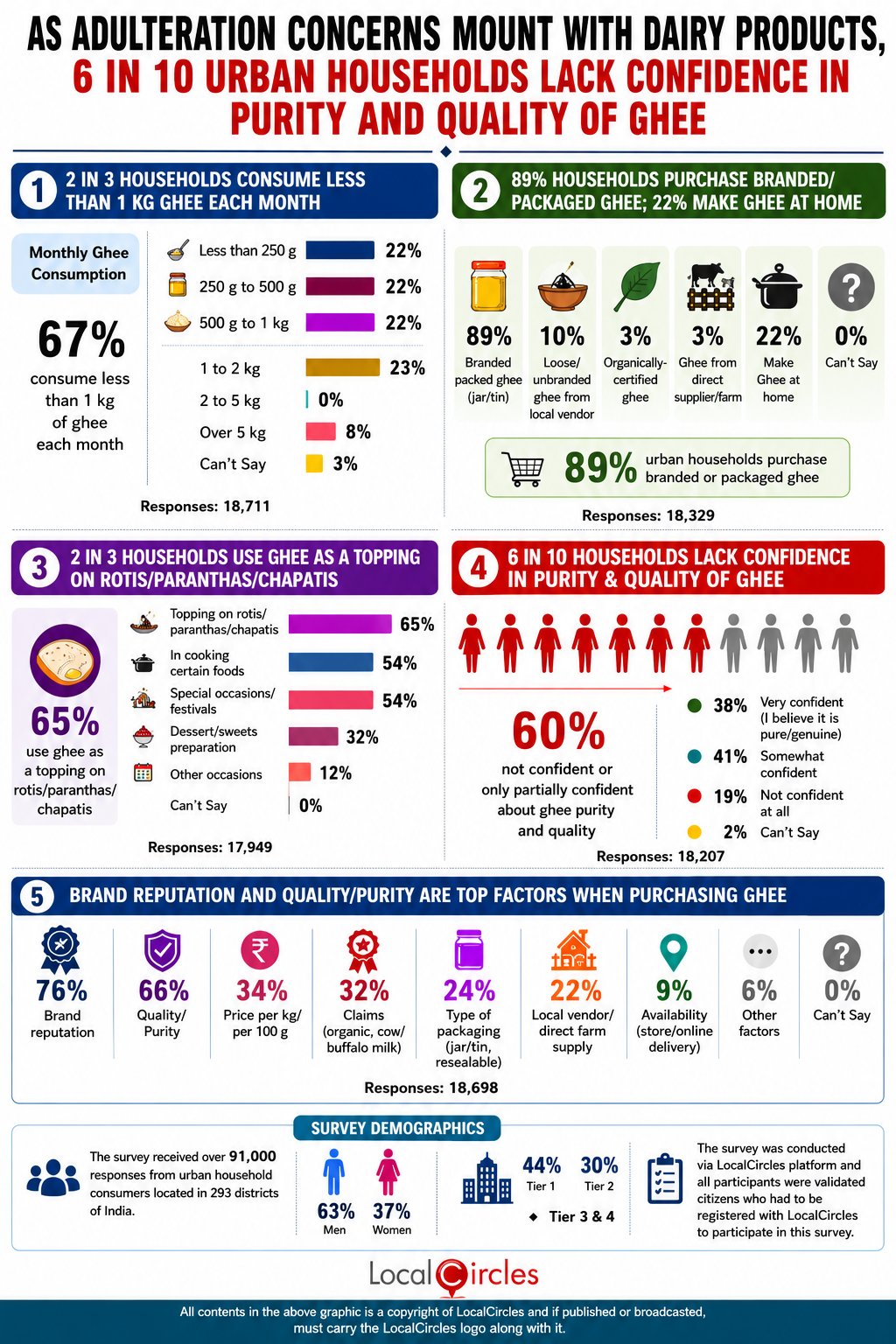
LocalCircles through a survey has strived to find out how much ghee does an average household consume every month, the type of ghee preferred, what sort of packaging do they seek when buying ghee from both offline stores and online platforms. The survey received over 91,000 responses from over 18,000 unique urban household consumers located in 293 districts of India. 63% respondents were men while 37% respondents were women. 44% respondents were from tier 1, 30% from tier 2 and 26% respondents were from tier 3, & 4 districts.
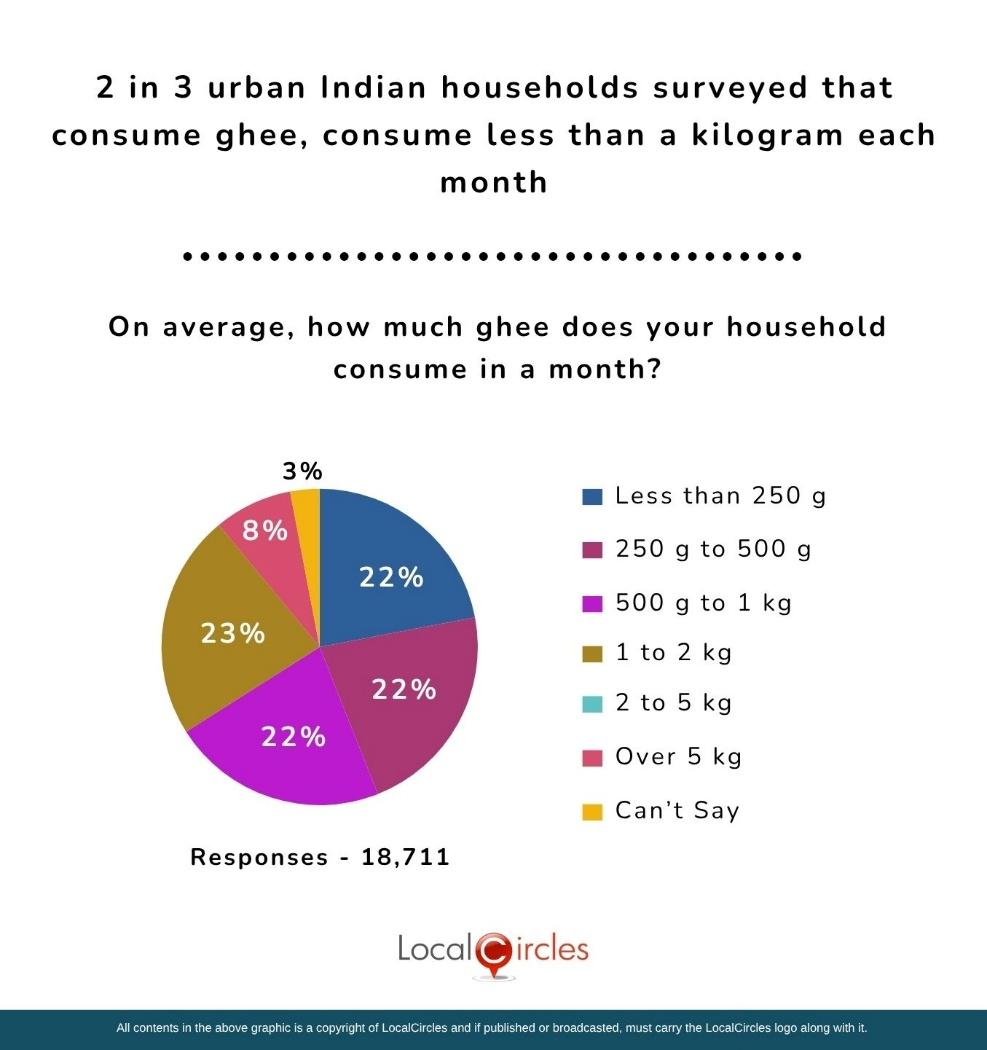
2 in 3 urban Indian households surveyed that consume ghee, consume less than a kilogram each month
Ghee being more expensive than edible oil, it is not extensively used for cooking daily by most households in India. The survey asked consumers, “On average how much ghee does your household consume in a month?” Out of 18,711 urban households which responded to the question 22% indicated that they consumer “less than 250g” in a month; 22% of households indicated “250g to 500g”; 22% of households indicated "500g to 1 kg”; 23% of households indicated "1 to 2 kg”; 8% of households indicated " “over 8kg” and 3% of households did not give a clear answer. To sum up, 2 in 3 urban Indian households surveyed that consume ghee, consume less than a kilogram each month.
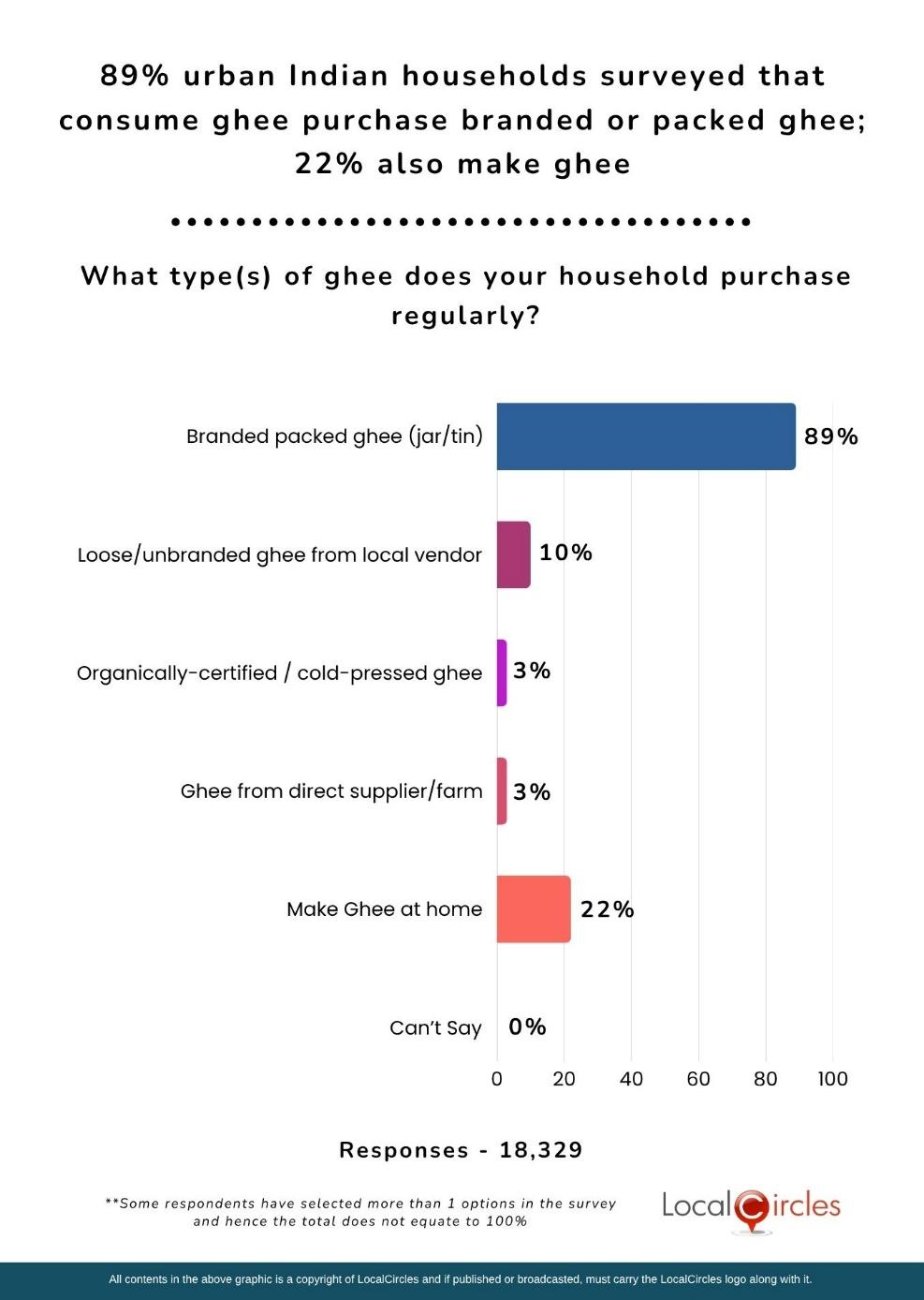
89% urban Indian households surveyed that consume ghee purchase branded or packed ghee; 22% also make ghee
Traditionally, Indian household have been making ghee at home using creamy film that forms after boiling the milk or buying cream from milk dairies. While many households, even in cities and towns, still make ghee at home, others buy it from other sources. The survey asked urban households, “What type(s) of ghee does your household purchase regularly?” Some among 18,329 urban households which responded to the question indicated more than one source. The largest group or 89% of respondents indicated “branded packed ghee (jar/ tin); 22% of respondents indicated that they “make ghee at home”; 10% of respondents indicated that they buy “loose/ unbranded ghee from local vendor”; 3% of respondents indicated that they buy “organically- certified/ cold pressed ghee”; and 3% of respondents indicated that they buy “ghee from direct suppliers/ farm”. To sum up, 89% of urban Indian households surveyed that consume ghee purchase branded or packed ghee; 22% also make ghee at home.
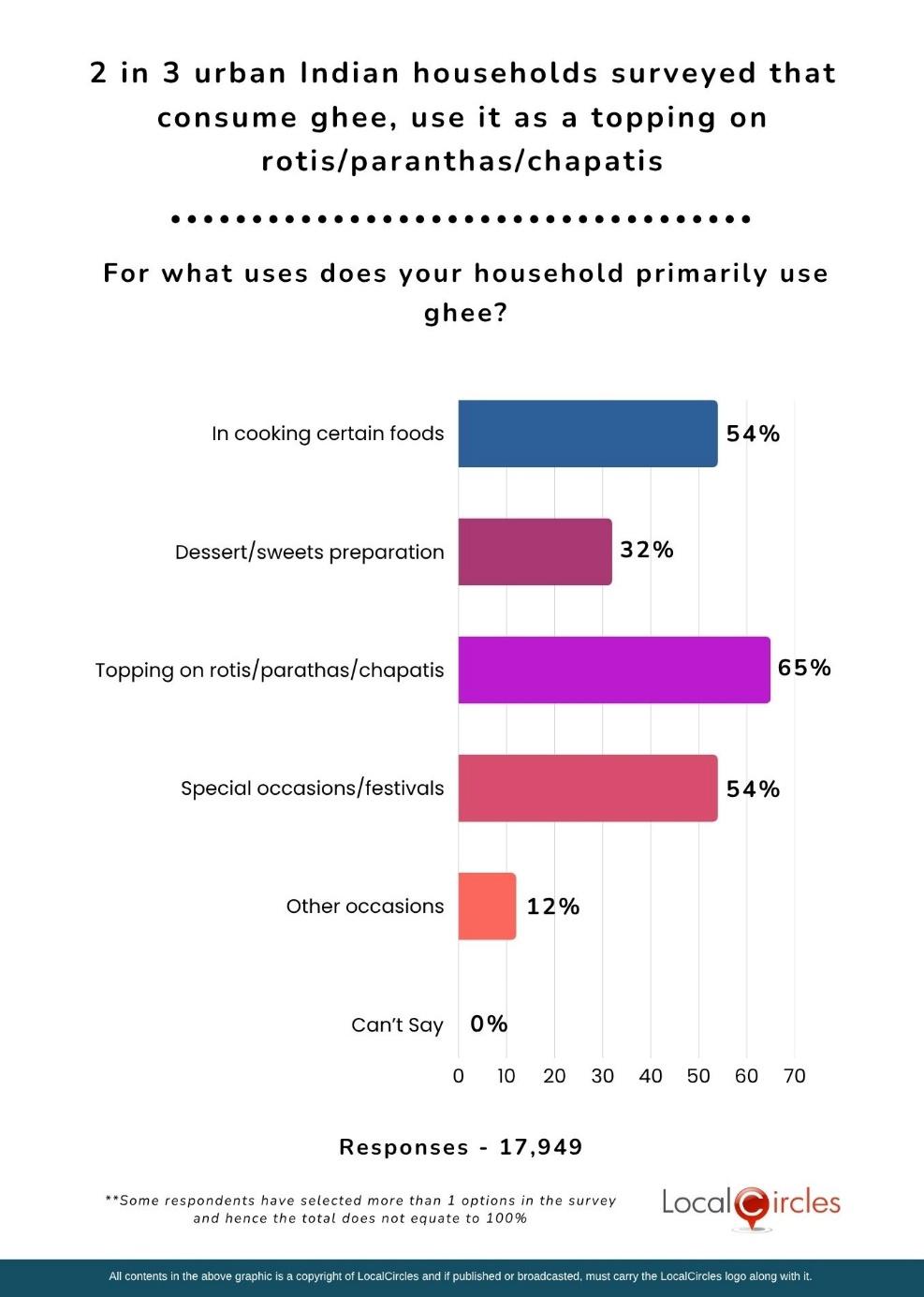
2 in 3 urban Indian households surveyed that consume ghee, use it as a topping on rotis/paranthas /chapatis
Affordability and taste often influence how households use ghee. The survey asked urban consumers, “For what uses does your household primarily use ghee?” Some among 17,949 consumers who responded to the question indicated more than one use. The largest group or 65% indicated “topping on rotis/ paranthas/ chapatis”; 54% of respondents indicated that they use it “in cooking certain foods”; 54% of respondents indicated that they use it for cooking on “special occasions/ festivals”; 32% of respondents indicated that they use it for “dessert/ sweets preparations”; and 12% of respondents indicated that they use it on "other occasions” not mentioned above. To sum up, 2 in 3 urban Indian households surveyed that consume ghee, use it as a topping on rotis/paranthas /chapatis.
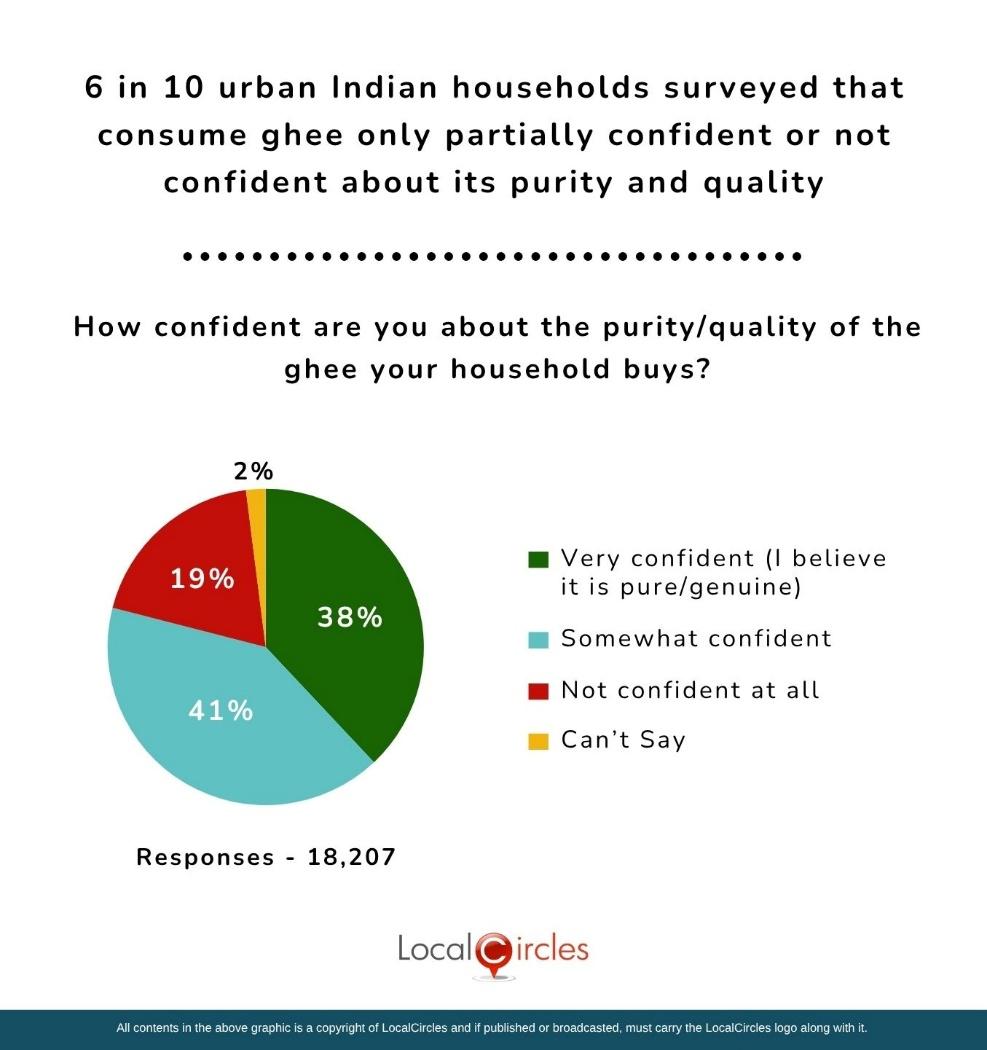
6 in 10 urban Indian households surveyed that consume ghee only partially confident or not confident about its purity and quality
Quality is often a concern particularly when bought loose or unbranded ghee from shop/ vendor. The survey next asked urban consumers, “How confident are you about the purity/ quality of the ghee your household buys?” Out of 18,207 urban households which responded to the question 38% indicated that they are “very confident (I believe it is pure / genuine)”; 41% of respondents indicated that they were "somewhat confident”; 19% of respondents indicated that they were “not confident at all’; and 2% of respondents did not give a clear answer. To sum up, 6 in 10 urban Indian households surveyed that consume ghee only partially confident or not confident about its purity and quality.
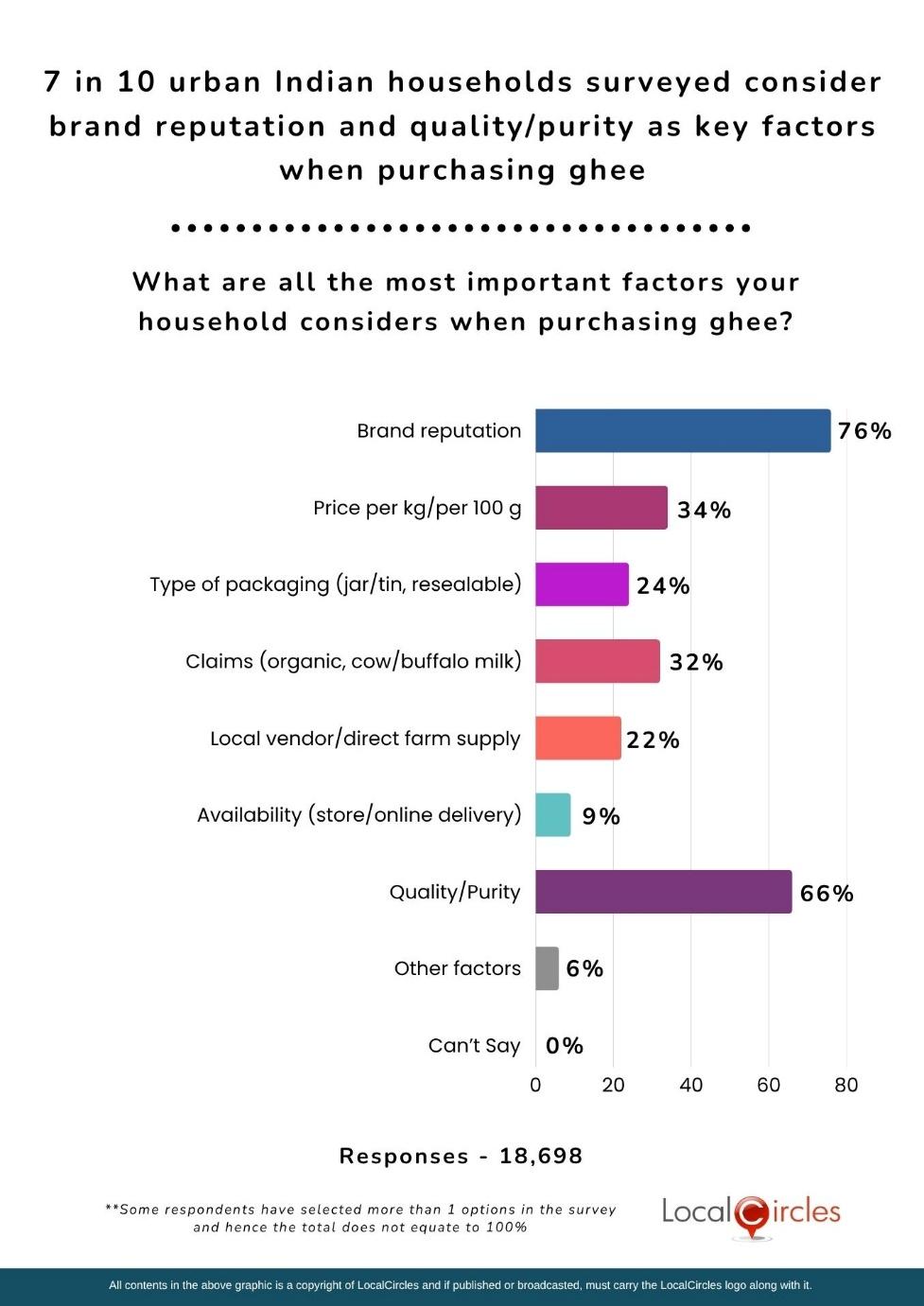
7 in 10 urban Indian households surveyed consider brand reputation and quality/purity as key factors when purchasing ghee
Brand reputation and consumer loyalty often drives sales of a product, particularly food products including ghee. The survey asked urban consumers, “What are all the most important factors your household considers when purchasing ghee?” Some among 18,698 households which responded to the question indicated more than one reason. The largest group or 76% indicated “brand reputation”; 66% of respondents indicated “quality and purity”; 34% of respondents indicated "price per kg/ per 100grams”; 32% of respondents indicated "claims (organic, cow/ buffalo milk)”; 24% of respondents indicated “type of packaging (jar/ tin, resealable”; 22% of respondents indicated “local vendor/ direct farm supply”; 9% of respondents indicated “availability (store/ online delivery)”; and 6% of respondents indicated “other factor” not mentioned. To sum up, 7 in 10 urban Indian households surveyed consider brand reputation and quality/purity as key factors when purchasing ghee.
In summary, the study shows that 2 in 3 urban Indian households surveyed that consume ghee, consume less than a kilogram each month. Interestingly, 89% urban Indian households surveyed that consume ghee purchase branded or packed ghee while 22% make ghee at home. When it comes to eating habits, 2 in 3 urban Indian households surveyed that consume ghee, use it as a topping on rotis/paranthas/chapatis besides for other food products. When it comes to purity of the product that they buy, 6 in 10 urban Indian households surveyed stated that they consume ghee only partially confident or not confident about its purity and quality. Thus, 7 in 10 urban Indian households surveyed consider brand reputation and quality/purity as key factors when purchasing ghee.
As many of the packaged food products including ghee pass through various hands from the manufacturing and packaging company before it reaches the consumers there is considerable anxiety about the quality of ghee, which is an expensive purchase for most households. Thus, the trust on branded products which pass through fewer hands or is sold through official or company owned channels. Given past instances of adulteration, the food authorities need to be very vigilant and conduct frequent checks so that only quality products reach the consumers. Recent enforcement actions — from the June 2026 seizure of over 6,500 litres of fake ghee across Delhi and Haryana to the July 2026 crackdowns on expired and re-labelled products — indicate that regulators have begun to act more aggressively; even so, the scale and frequency of these rackets underline why sustained vigilance and frequent checks remain essential to rebuild consumer confidence.
Survey Demographics
The survey received over 91,000 responses from over 18,000 unique urban household consumers located in 293 districts of India. 63% respondents were men while 37% respondents were women. 44% respondents were from tier 1, 30% from tier 2 and 26% respondents were from tier 3, & 4 districts. The survey was conducted via LocalCircles platform, and all participants were validated citizens who had to be registered with LocalCircles to participate in this survey.
About LocalCircles
LocalCircles, India’s leading Community Social Media platform enables citizens and small businesses to escalate issues for policy and enforcement interventions and enables Government to make policies that are citizen and small business centric. LocalCircles is also India’s # 1 pollster on issues of governance, public and consumer interest. More about LocalCircles can be found on https://www.localcircles.com
For more queries - media@localcircles.com, +91-8585909866
All content in this report is a copyright of LocalCircles. Any reproduction or redistribution of the graphics or the data therein requires the LocalCircles logo to be carried along with it. In case any violation is observed LocalCircles reserves the right to take legal action.
Enter your email & mobile number and we will send you the instructions.
Note - The email can sometime gets delivered to the spam folder, so the instruction will be send to your mobile as well


