As world’s largest cryptocurrency exchange experiences heist, the confidence of Indians on it dips further; 82% express low or zero trust
- ● 59% of those surveyed want the Government to ban cryptocurrency completely
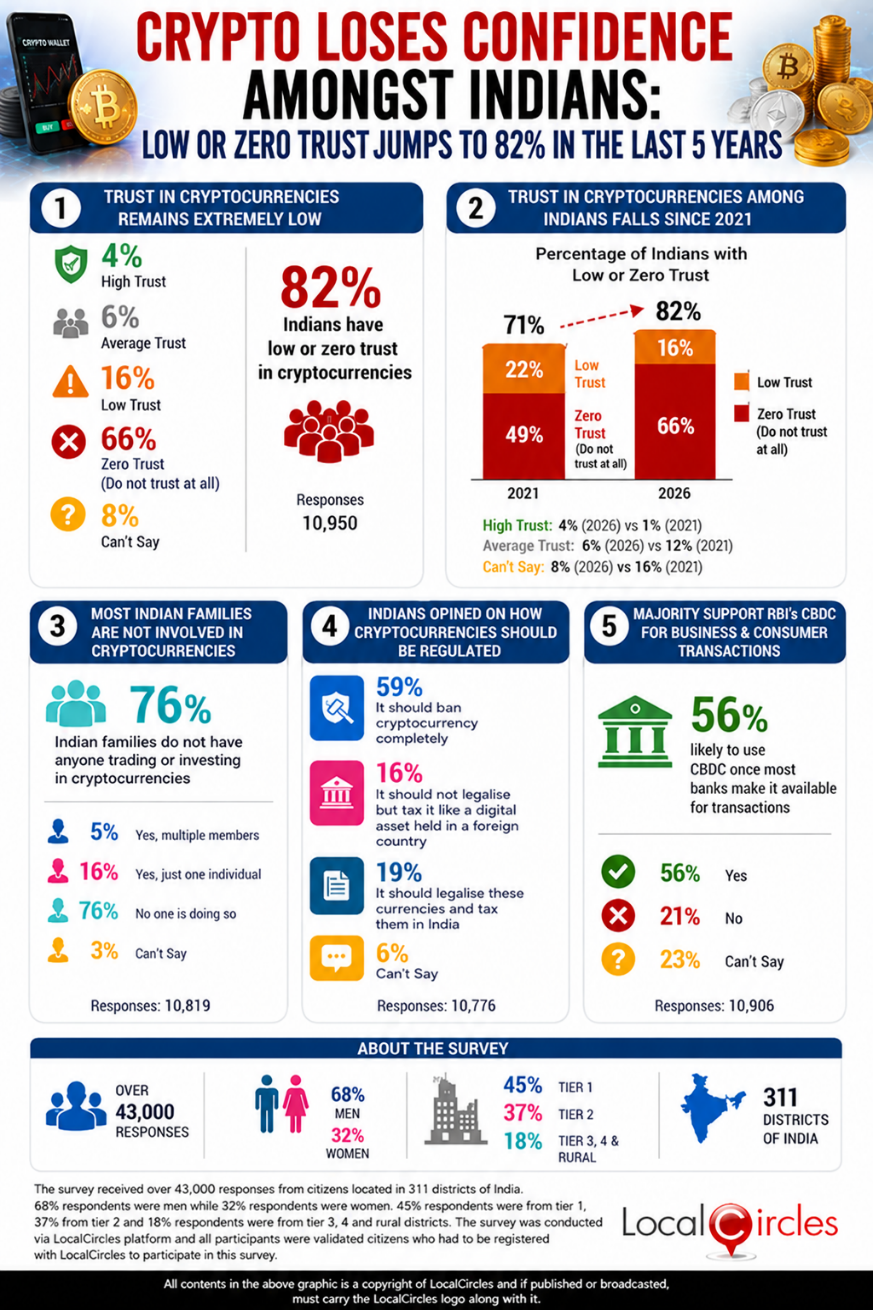
- ● 76% had no or low trust in cryptocurrency in 2021 as compared to 82% in 2026
- ● Nationwide LocalCircles survey gathers 43,000 responses from citizens across 311 districts
October 31, 2026, New Delhi: Binance, the world’s largest cryptocurrency exchange, was hit on October 29, 2026 by what is likely the biggest crypto theft on record, after attackers drained its hot wallets across multiple blockchains. Blockchain analytics firm Chainalysis estimates that about US$5.9 billion was stolen, nearly four times the US$1.5 billion stolen from Bybit in 2025, while Binance has put the total impact at about US$6.3 billion, of which around US$3 billion has been frozen on-chain, including stablecoins frozen by issuers Tether and Circle. Binance suspended deposits and withdrawals on multiple networks, said user funds are safe and committed to cover all losses from its Secure Asset Fund for Users (SAFU) and company funds. Early on-chain analysis indicates that the attacker used a compromised hot-wallet key and Ethereum’s EIP-7702 feature to take control of a Binance wallet, with gas money routed through the Tornado Cash mixer, while Binance has linked the breach to a compromised DevOps laptop. There is no official attribution yet, although some analysts suspect North Korea’s Lazarus Group. The news triggered a sharp sell-off, with Bitcoin falling below US$77,000 and around US$628 million of crypto derivatives positions liquidated within an hour.
The Binance breach caps a string of high-value attacks on crypto platforms. On September 24, 2026, global exchange Bitget lost about US$387.5 million from its hot and warm wallets, helping make September the costliest month for crypto hacks in 2026, with losses of over US$766 million across 55 major incidents, according to blockchain security firm PeckShield. Closer home, Indian exchange CoinDCX confirmed in late October 2026 that about US$16 million (15.99 million USDT) had been drained from wallets it had retired after a US$44 million hack in July 2025, days after its CEO had dismissed the alerts as a false alarm; the exchange said it absorbed the loss and that customer funds were safe. These incidents revive memories of the July 2024 WazirX hack, in which about US$230 million was stolen and users got back 85% of their funds only when the exchange resumed operations in October 2025 after a court-approved restructuring. With no statutory investor protection scheme for crypto assets in India, compensation after such incidents depends entirely on the platform’s own reserves.
The Reserve Bank of India (RBI) has consistently maintained a cautious stance on private cryptocurrencies, citing concerns relating to financial stability, consumer protection, money laundering, terrorism financing, cyber risks, and tax evasion. Although cryptocurrencies are not illegal to own or trade in India, they are not recognised as legal tender and remain outside the formal monetary system.
The RBI has repeatedly emphasised that cryptocurrencies are highly volatile, lack intrinsic value, and are not backed by any sovereign authority, making them inherently risky for investors. It has also warned that widespread adoption of private digital currencies could undermine monetary policy transmission, financial stability, and the integrity of the regulated financial system.
Although India has one of the world's largest crypto user bases, with an estimated 119 million users as of late 2025, policymakers continue to favour a cautious regulatory approach that seeks to mitigate financial crime, tax evasion, and systemic risks while encouraging innovation through regulated digital payment infrastructure and the Digital Rupee.
More recently, the regulatory debate has intensified. In views submitted to the Union Government in July 2026, the RBI has reiterated its support for prohibiting private cryptocurrencies, while the Income Tax Department has separately flagged the serious tax-evasion risks posed by Virtual Digital Assets. In a significant development, the Parliamentary Standing Committee on Finance, in its 36th Report on the proposed Securities Markets Code, 2025 — presented to Parliament on July 23, 2026 — recommended an interim regulatory framework for cryptocurrencies and virtual digital assets through recognised Self-Regulatory Organisations (SROs) operating under the supervision of a designated regulator, with minimum standards for governance, transparency, disclosures, investor protection and grievance redressal. The panel also urged the Government to clearly classify VDAs across securities, derivatives and other financial categories, and to clarify whether tokenised securities and crypto investment products should fall under the proposed Securities Markets Code. Separately, the Committee concluded the final oral evidence session of its year-long study, ‘A Study on Virtual Digital Assets (VDAs) and Way Forward’, on September 16, 2026, with Chairperson Bhartruhari Mahtab observing that the Government is neither accepting VDAs nor regulating them, which leaves greater scope for misuse; the reconstituted Committee has since listed VDAs among the 46 subjects it will examine in 2026-27. Meanwhile, the Department of Economic Affairs’ long-awaited crypto discussion paper remains pending after being deferred several times. As of mid-2026, 54 virtual digital asset service providers stood registered with the Financial Intelligence Unit–India (FIU-IND). On September 9, 2026, FIU-IND issued non-compliance notices under Section 13 of the Prevention of Money Laundering Act to 15 unregistered offshore VDA service providers, including Weex, Blofin, Bitunix, DigiFinex, XT.com, Pionex, ChangeNow, WhiteBIT and Guardarian, along with directions to block their apps and websites.
Tax authorities have also moved to tighten oversight. In July 2026, the Central Board of Direct Taxes (CBDT) issued a detailed guidance note operationalising crypto reporting under the Income-tax Act, 2025 which — without imposing any new tax — shifts the primary compliance burden onto Reporting Crypto-Asset Service Providers (RCASPs), requiring Indian and foreign exchanges operating in the country to track and report all user transactions rather than leaving disclosure to individual investors. India has also aligned with the OECD’s Crypto-Asset Reporting Framework (CARF) and, following a March 2026 amendment classifying crypto assets and CBDCs as reportable financial assets, will begin automatic cross-border exchange of crypto-transaction data with other jurisdictions from April 2027.
India’s crypto market has also undergone a significant structural shift. Despite one of the world’s strictest tax regimes — a flat 30% tax on gains and a 1% Tax Deducted at Source (TDS) on transfers — futures and other derivatives now account for more than 80% of trading volume on domestic exchanges, while spot trading volume has fallen by as much as 85%. Analysts attribute this migration largely to tax arbitrage, as derivatives are taxed as business income and currently escape the 1% TDS that applies to spot trades. With Indian exchanges offering leverage of 10x to 100x, an estimated 70% to 80% of retail derivatives traders are sitting on losses, and roughly 72% of India’s crypto trading volume has moved to offshore platforms since the tax regime took effect in 2022. Meanwhile, the RBI’s own Digital Rupee has processed more than 175 million transactions worth close to Rs 40,000 crore but has only about 12 million users, as per the RBI’s Annual Report 2025-26, a small fraction of the UPI base.
Even as policymakers move towards a structured framework for the virtual digital asset ecosystem, and repeated exchange hacks expose the custody risks borne by investors, citizen confidence in cryptocurrencies continues to erode, as the findings of the LocalCircles survey detailed below demonstrate.
To gauge citizens’ awareness about the cryptocurrencies and their appetite for investing in it, LocalCircles conducted a survey which received over 43,000 responses from citizens located in 311 districts of India. 68% respondents were men while 32% respondents were women. 45% respondents were from tier 1, 37% from tier 2 and 18% respondents were from tier 3, 4 and rural districts.
The key findings of the survey are detailed below.
82% of respondents have little or no trust in cryptocurrencies but 4% are greatly attracted by them
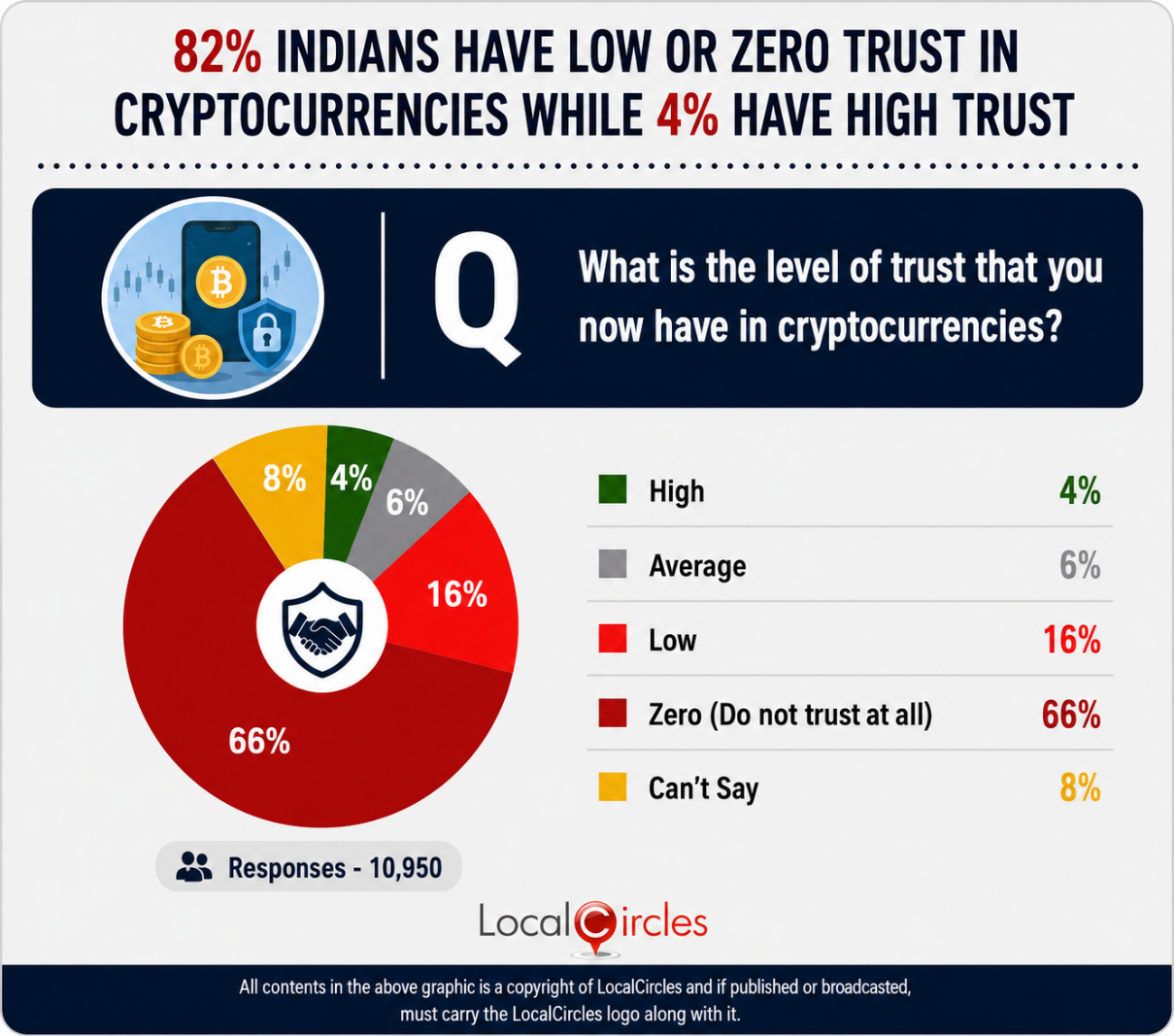
The survey first asked “what is the level of trust you now have in cryptocurrencies?” The responses from nearly 11,000 citizens showed 82% have little or no trust in these digital currencies but 4% are greatly attracted by them. The data shows that while 4% have “high” level of trust in cryptocurrencies; 6% have “average” confidence in them; 16% have “low” trust; 66% or majority repose “Zero” trust in them. There are also 8% of respondents who are undecided. To sum up, 82% of respondents have little or no trust in cryptocurrencies but 4% are greatly attracted by them.
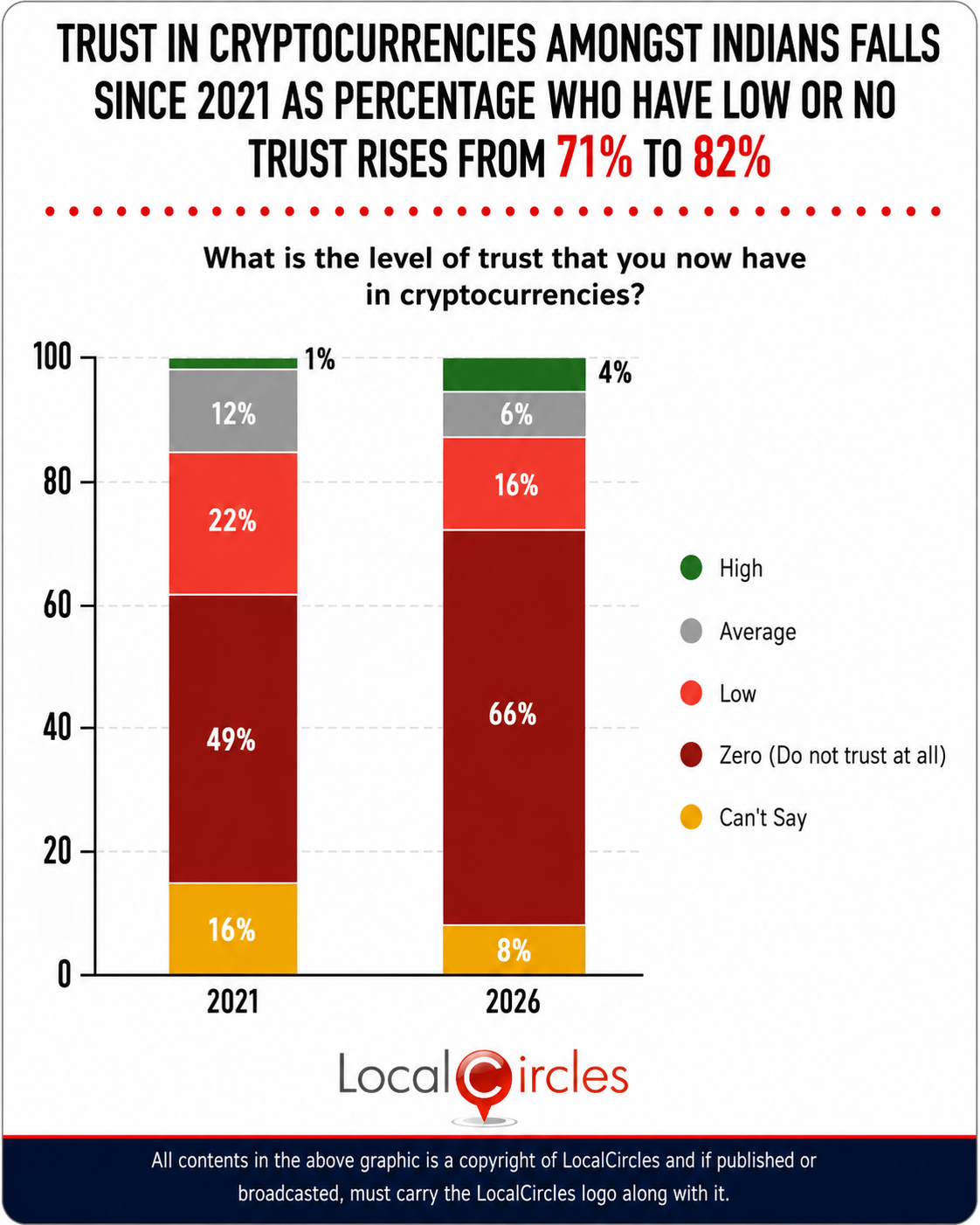
Percentage of those in the zero-confidence group has risen from 49% in 2021 to 66% this year
Compared to 2021, there has been a considerable shift in the perception about crypto currencies. As against 1% who were attracted to digital currencies in 2021, the percentage has risen to four. On the other hand, the volatility in the traded value of these currencies has brought down the confidence level from 12% to 6% in the average category; from 27% to 16% in the low category and raised the percentage of those in the zero-confidence group from 49% to 66%, thereby bringing down those in the undecided group from 16% in 2021 to 8%. Going by the survey data, it appears more citizens are becoming wary of investing in cryptocurrencies, which could be why there was no hue and cry in India over the losses witnessed due to FTX bankruptcy and its ripple effect on scores of companies and individuals.
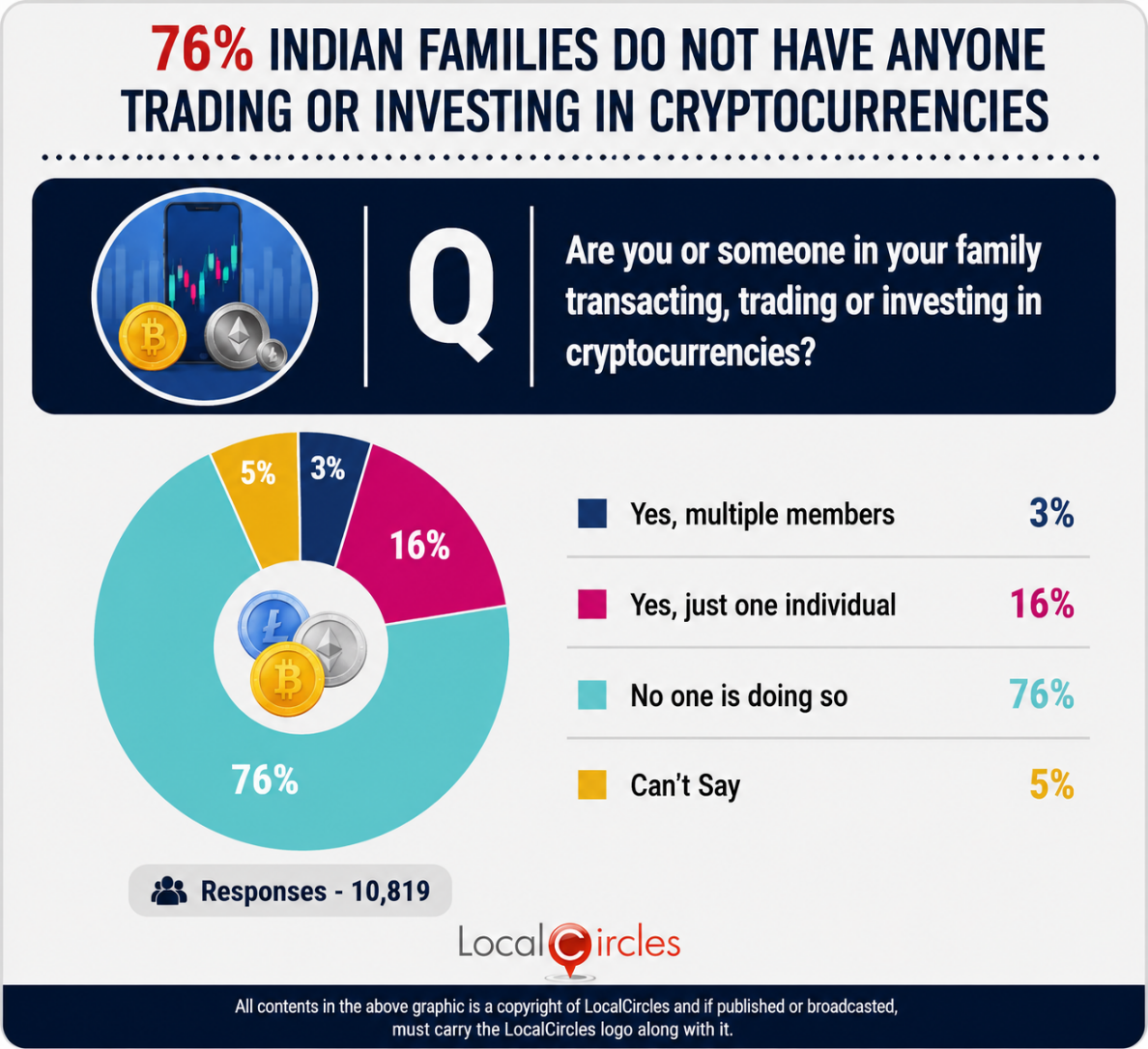
76% Indian families do not have anyone trading or investing in cryptocurrencies
LocalCircles survey strived to find out how many of the registered members or their family members have been investing in digital currencies. The question “are you or someone in your family transacting, trading or investing in cryptocurrencies” yielded 10,819 responses out of which 76% or the majority indicated “No one is doing so”; 16% indicated “Yes, just one individual”; 5% stated “Yes, multiple members” and 3% gave no clear reply.
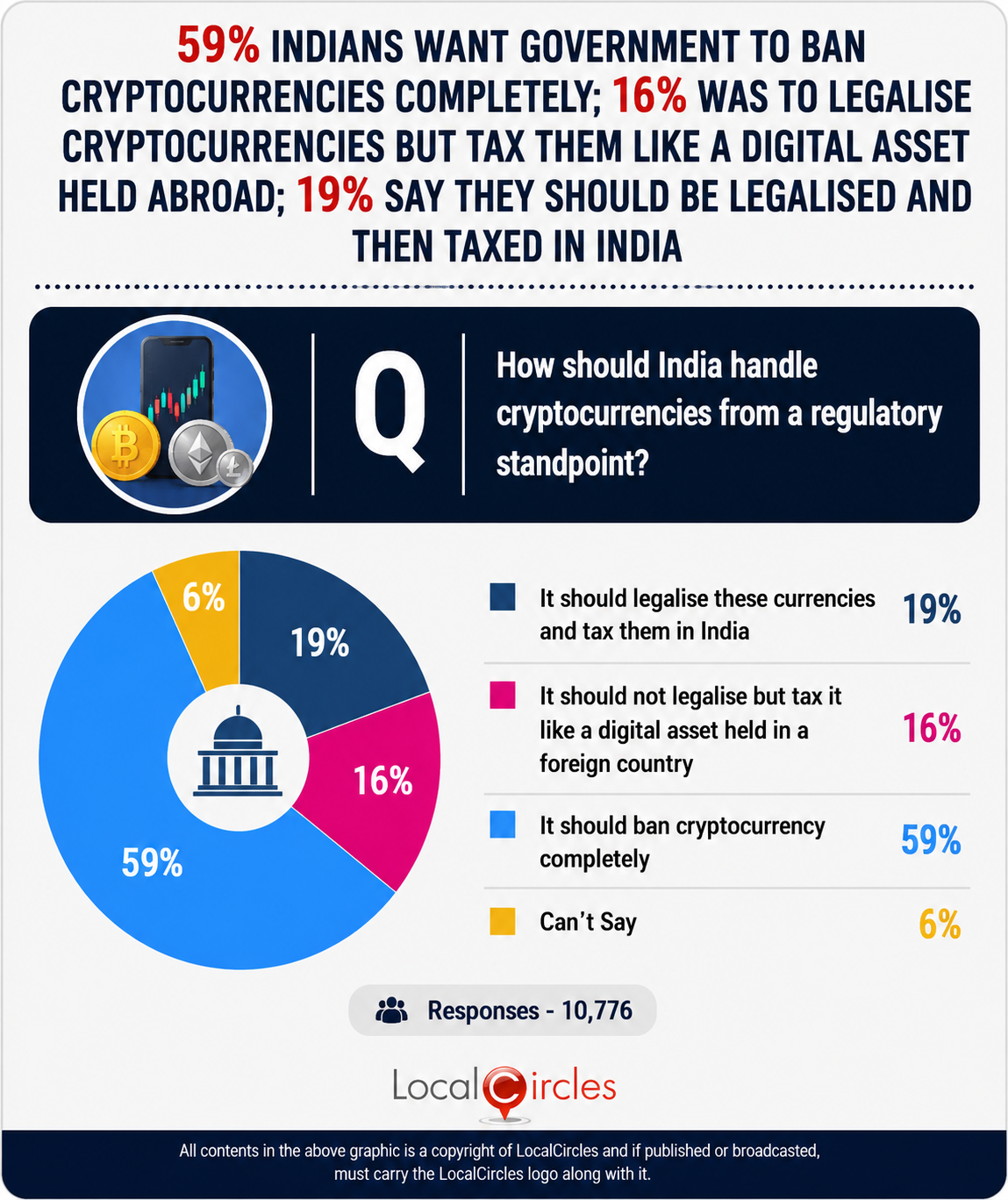
59% of respondents indicated that the government “should ban cryptocurrency completely”
Given the rising low trust in the cryptocurrencies, LocalCircles sought to know “how should India handle cryptocurrencies from a regulatory standpoint?” Out of 10,776 respondents to this query, 59% indicated that the government “should ban cryptocurrency completely”; 16% supported government action this year to state “it should not legalise but tax it like a digital asset held in a foreign country”. Nearly 2 in 10 or 19% of the respondents, however, indicated that the authorities "should legalise these currencies and tax them in India” and 6% have no clear answer. To sum up, 59% of respondents indicated that the government “should ban cryptocurrency completely”.
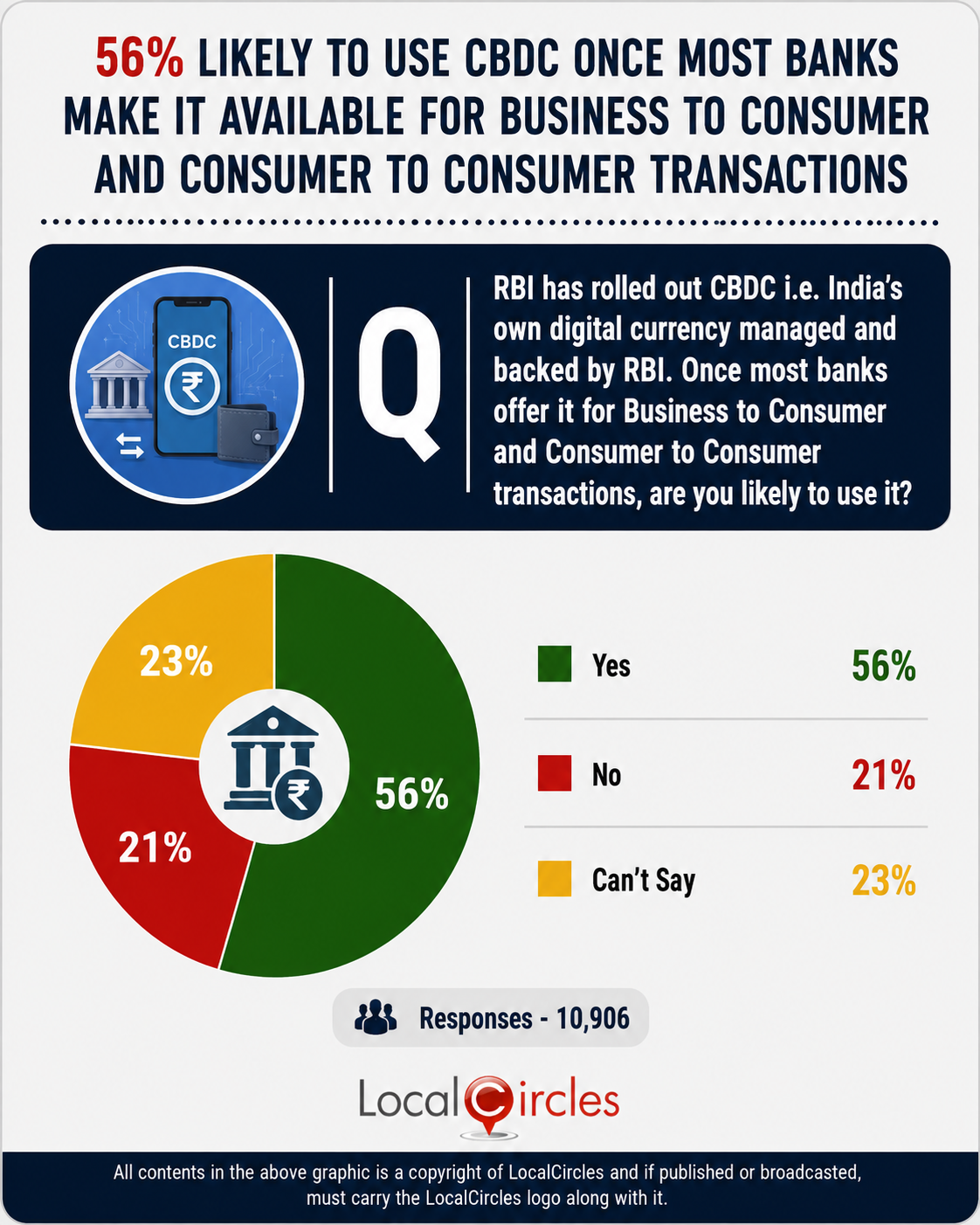
56% of respondents are willing to use the official digital currency or CBDC for transactions
Many countries are developing, and some have implemented Central Bank Digital Currency (CBDC), which are digital tokens, like cryptocurrency, issued by a central bank. They are pegged to the value of that country's fiat currency. The RBI too launched the CBDC programme in 2022. Also known as digital rupee, it represents a tokenised version of the Indian rupee, issued and regulated by the RBI. Since the launch, all participating banks have taken action to activate the interoperability between CBDC and Unified Payments Interface (UPI) enabling customers to scan a single QR code to pay through the CBDC wallet or UPI. LocalCircles in the survey sought citizens’ views on how receptive they are to the official digital currency. The query “RBI has rolled out CBDC i.e. India’s own digital currency managed and backed by the central bank. Once most banks offer it for business to consumer and consumer to consumer transactions, are you likely to use it?” The majority of 10,906 citizens who responded to the query “once CBDC becomes available for business to consumer and consumer to consumer transactions, are you likely to use it” with a resounding “Yes”. The survey data shows that while 56% of respondents are willing to use the official digital currency, 21% are not in favour and 23% are undecided about using CBDC.
In Summary
In summary, there is increasing awareness among citizens about the risks involved in investing and trading in cryptocurrencies, reflected in the sharp decline in trust since 2021 — the zero-trust group alone has risen from 49% to 66%. The record-breaking Binance hack of October 29, 2026, coming within weeks of the Bitget and CoinDCX breaches, shows that even the largest and most widely used platforms cannot guarantee the safety of investors’ assets, lending weight to the caution expressed by citizens. A clear majority of 59% want the Government to ban cryptocurrencies completely, while a further 16% would tax them as a foreign-held digital asset without legalising them, and only 19% favour legalising and taxing them within India. This citizen sentiment aligns with the current policy direction, as the RBI has backed prohibiting private cryptocurrencies and Parliament examines a framework for Virtual Digital Assets. With the bulk of trading having shifted to high-leverage, largely offshore derivatives where most retail traders are losing money, the case for caution has only strengthened. Going forward, it will be important to watch how adoption of the RBI’s CBDC for B2C and C2C transactions — which 56% of respondents say they are willing to use — supports greater financial transparency. Notably, even as the Parliamentary Standing Committee’s latest report recommends a structured, SRO-led framework for virtual digital assets under a designated regulator, this survey shows citizen confidence continuing to decline — underscoring the widening gap between an emerging regulatory architecture and public trust in these assets. This resolve is being matched by a tightening compliance architecture — with the CBDT shifting transaction-reporting duties onto crypto platforms and India set to begin automatic cross-border data-sharing under the OECD’s CARF from 2027 — leaving progressively less room for undisclosed or offshore activity.
Recent international developments offer important lessons for Indian cryptocurrency investors. The record US$5.9 billion theft from Binance in October 2026, the US$387.5 million Bitget hack in September 2026, the collapse of major crypto exchanges such as FTX, the failure of several crypto lending platforms, and the de-pegging of certain stablecoins have demonstrated that even large and widely used crypto platforms can be vulnerable to governance failures, liquidity crises, cyberattacks, and market manipulation. These events have highlighted the risks of investing in unregulated or lightly regulated digital assets and reinforced the importance of conducting due diligence before investing. Investors should recognise that cryptocurrencies remain highly speculative assets, with prices capable of experiencing extreme volatility over short periods. They should also ensure compliance with applicable tax and reporting obligations, use regulated and compliant exchanges where available, avoid unrealistic promises of guaranteed returns, and maintain adequate cybersecurity measures for safeguarding digital wallets and private keys. The recent hacks also show that exchanges routinely suspend withdrawals after a breach, leaving users unable to access their funds for days, so investors should avoid holding large balances on exchanges and prefer platforms that publish proof of reserves. The global experience underscores that while blockchain technology offers significant opportunities for innovation, investments in private cryptocurrencies carry substantial financial, legal, and operational risks that require careful assessment and prudent risk management. For Indian investors specifically, these lessons are reinforced by the domestic environment, where regulators favour a cautious, prohibition-leaning stance and the bulk of trading has migrated to lightly regulated, largely offshore derivatives platforms.
Survey Demographics
The survey received over 43,000 responses from citizens located in 311 districts of India. 68% respondents were men while 32% respondents were women. 45% respondents were from tier 1, 37% from tier 2 and 18% respondents were from tier 3, 4 and rural districts. The survey was conducted via LocalCircles platform, and all participants were validated citizens who had to be registered with LocalCircles to participate in this survey.
About LocalCircles
LocalCircles, India’s leading Community Social Media platform enables citizens and small businesses to escalate issues for policy and enforcement interventions and enables Government to make policies that are citizen and small business centric. LocalCircles is also India’s # 1 pollster on issues of governance, public and consumer interest. More about LocalCircles can be found on https://www.localcircles.com
For more queries - media@localcircles.com, +91-8585909866
All content in this report is a copyright of LocalCircles. Any reproduction or redistribution of the graphics or the data therein requires the LocalCircles logo to be carried along with it. In case any violation is observed LocalCircles reserves the right to take legal action.


