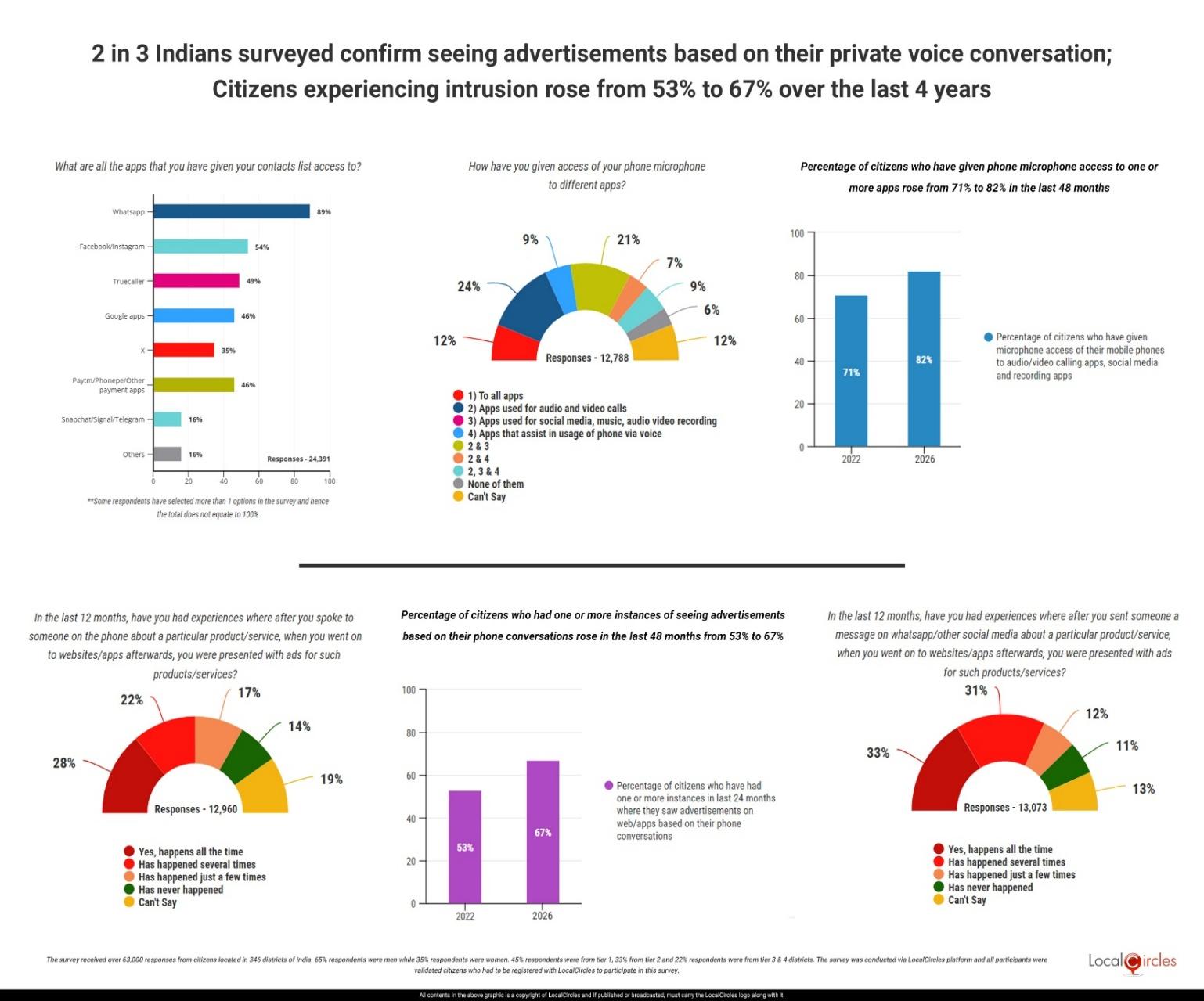
2 in 3 citizens surveyed confirm seeing advertisements based on their private voice conversations; Citizens experiencing intrusion rose from 53% to 67% over the last 4 years
- ● 89% surveyed have given their contact list access to Whatsapp; 54% surveyed have given it to Facebook/ Instagram
- ● Google just agreed to pay $68 million in a Class Action Lawsuit over allegations its voice assistant eavesdropped on users; Class Action also filed in US District Court against Meta for WhatsApp violating chat privacy
January 27, 2026, New Delhi: Google has agreed to pay $68 million to settle a class-action lawsuit that alleged the technology giant’s voice assistant had illegally recorded users and then shared their private conversations with advertisers. Separately, an international group of plaintiffs which includes users from India have sued Meta Platforms, Inc alleging the company made false claims about the privacy and security of WhatsApp chats. The lawsuit filed last Friday in the US District Court in San Francisco says that Meta and WhatsApp can access virtually all of WhatsApp users purportedly “private communications”.
In India, a growing number of users have reported that certain mobile applications appear to be “listening” to phone conversations, as users are subsequently shown highly relevant advertisements. While many apps seek permission to access device microphones, users are often not clearly informed about why such access is required, how long the data is retained, or with whom it is shared beyond the immediate service being offered.
At the same time, intrusive digital advertising practices are resurging. Pop-up advertisements, once largely mitigated by browser blockers, are making a comeback as advertisers adopt advanced techniques to bypass such safeguards—further eroding user experience and trust. Reports from early 2025 indicate heightened scrutiny of advertising practices across major platforms. X (formerly Twitter) has faced complaints in the European Union over its alleged use of sensitive personal data for targeted advertising. In July 2025, complaints were filed with EU regulators alleging violations of the General Data Protection Regulation (GDPR) and the Digital Services Act.
The intensified focus on advertising revenue has led to widespread user frustration, especially due to reports of “unskippable” and intrusive ads. Since last year, Meta-owned WhatsApp has also begun rolling out sponsored content within its Status and Channels features, marking a notable shift from its long-standing ad-free ethos. These advertisements appear in the Updates tab and closely resemble Instagram or Facebook Stories, appearing between updates from friends and family. Meta has stated that private messages, calls, and group activity will not be used to target ads, nor will users’ phone numbers be shared with advertisers. The company has positioned these ads as a “non-intrusive” monetisation strategy. However, promoted channels are now interspersed with organic recommendations when users explore new content, raising concerns about subtle behavioural profiling. Further complicating privacy concerns, WhatsApp has introduced features allowing AI systems to read chats under certain conditions. Users added to group chats may be particularly vulnerable unless they enable Advanced Chat Privacy, which restricts how messages and media can be shared outside the platform.
Beyond social media, several mobile applications including fintech, gaming and shopping apps—seek access to device microphones. In some cases, these apps have been accused of recording users’ voices without explicit or informed consent, constituting a serious violation of privacy rights. In the absence of a robust and fully enforced data protection regime, some platforms exploit regulatory loopholes to manipulate personal data for advertising and profiling purposes. For example, users have alleged that caller identification app Truecaller reveals personally identifiable information—such as names linked to mobile numbers, occupation, email addresses, and even employer details at times—without the individual’s consent. This data is often sourced from another user who has shared their contact list with the app, inadvertently exposing third parties who never agreed to such disclosure.
The Digital Personal Data Protection Rules, 2025, aim to address these concerns by strengthening transparency and accountability. Under the rules, a data fiduciary—defined as an entity that determines how personal data is processed—must provide individuals with a summary of the personal data being processed and the purposes for which it is used. Importantly, data fiduciaries are also required to disclose the identities of other data fiduciaries and data processors with whom personal data has been shared, along with the categories of data involved.
These provisions empower individuals facing spam calls, emails, or intrusive advertisements to seek explanations from service providers—such as telecom operators—regarding data-sharing practices and to take informed action against misuse.
In the absence of such safeguards, individuals often remain vulnerable to data breaches and their consequences. Reflecting growing regulatory pushback, the Competition Commission of India (CCI) in 2024 imposed a penalty of INR213.14 crore on Meta for anti-competitive practices linked to WhatsApp’s 2021 Privacy Policy update. The CCI ordered that Meta must not share WhatsApp user data with other Meta entities, including Facebook, for advertising purposes for a period of five years.Similarly, in November 2023, the European Data Protection Board (EDPB) adopted a binding decision prohibiting Meta from using personal data for targeted advertising on Facebook and Instagram. The EDPB clarified that the ban applies across the European Economic Area and disallows the use of personal data for behavioural advertising based on contract or “legitimate interest” grounds.
Together, these developments signal a global shift towards stricter oversight of digital advertising practices and reaffirm the urgent need for meaningful data protection frameworks that prioritise user consent, transparency, and accountability.
LocalCircles has been receiving thousands of posts and comments over the past 12 months on people’s data being shared without their consent and in several cases, people even complained about seeing advertisements based on their voice conversations. To understand the magnitude of this issue, LocalCircles conducted a survey, which received over 63,000 responses from citizens located in 346 districts of India. 65% respondents were men while 35% respondents were women. 45% respondents were from tier 1, 33% from tier 2 and 22% respondents were from tier 3 & 4 districts.
The survey understood the magnitude of the issue of voice conversations leading to targeted ads and attempted to understand the aggregate percentage of users who have given their smartphone’s microphone access to different apps.
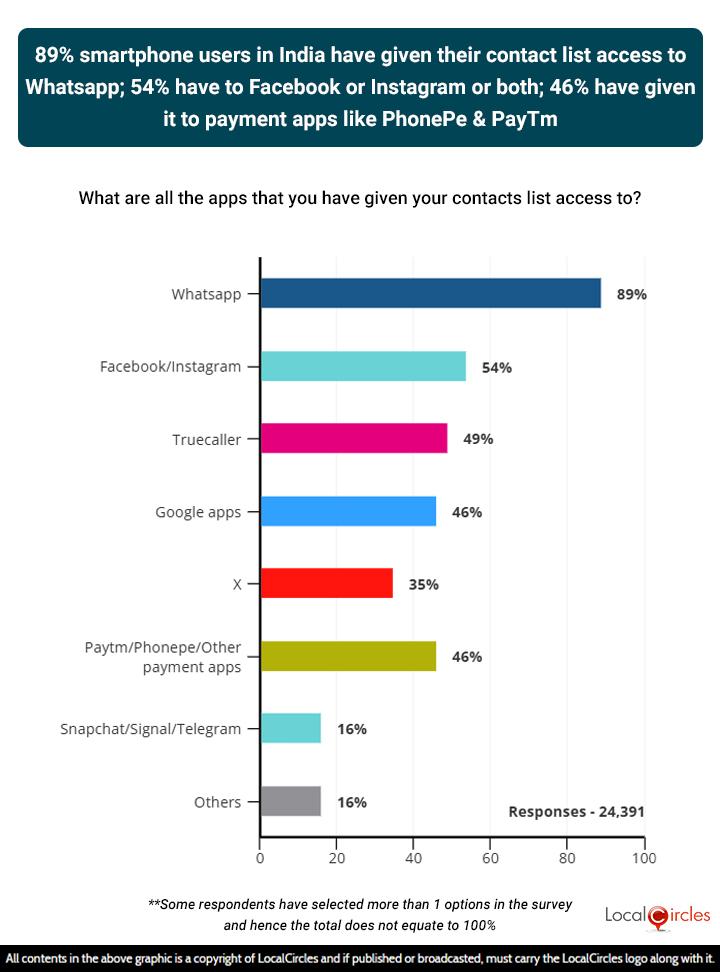
89% of smartphone users in India have given their contact list access to WhatsApp; 54% have given it to Facebook or Instagram or both; 31% have given it to payment apps like PhonePe and Paytm
The survey first sought to find out “What are all the apps that you have given your contacts list access to”. The query received responses from 24,391 smartphone users with some choosing more than one option. The largest group or 89%, indicated that they have given WhatsApp access to their contact list; 54% have given Facebook/ Instagram access to their contact list; 49% have given Truecaller access; 46% to Google Apps; 35% ‘X”; 46% to Paytm/ Phonepe/ other payment apps; 16% to Snapchat/ Signal / Telegram; 19% to other unidentified apps. To sum up, 89% of smartphone users in India have given their contact list access to WhatsApp; 54% have given it to Facebook or Instagram or both; 31% have given it to payment apps like PhonePe and Paytm.
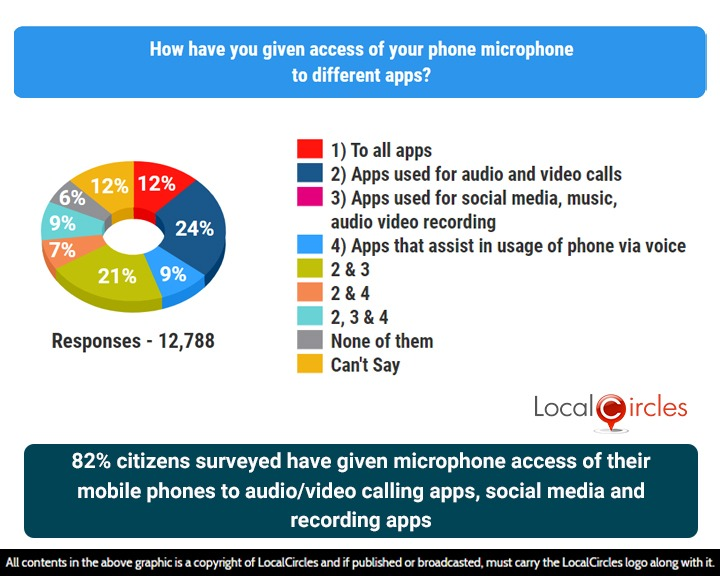
82% of citizens surveyed indicated that they have given phone microphone access to audio/ video calling apps, social media and recording apps
The next survey question asked consumers, “How have you given access to your phone microphone to different apps”. This query received 12,788 responses with 82% of citizens surveyed stating that they have given phone microphone access to audio/ video calling apps, social media and recording apps. The data shows 12% of those surveyed have given microphone access (1) to all apps; 24% to (2) apps used for audio and video calls; 9% to apps (4) that assist in usage of phone via voice; 21% to apps for audio and video calls and apps used for social media, music, audio video recording; 7% for 2 & 4; while 9% use if for apps used required to make audio and video calls and apps used for social media, music, audio video recording and also those used for social media, music, audio video recording. Only 6% stated that they don’t use any such apps and 12% gave no clear response.
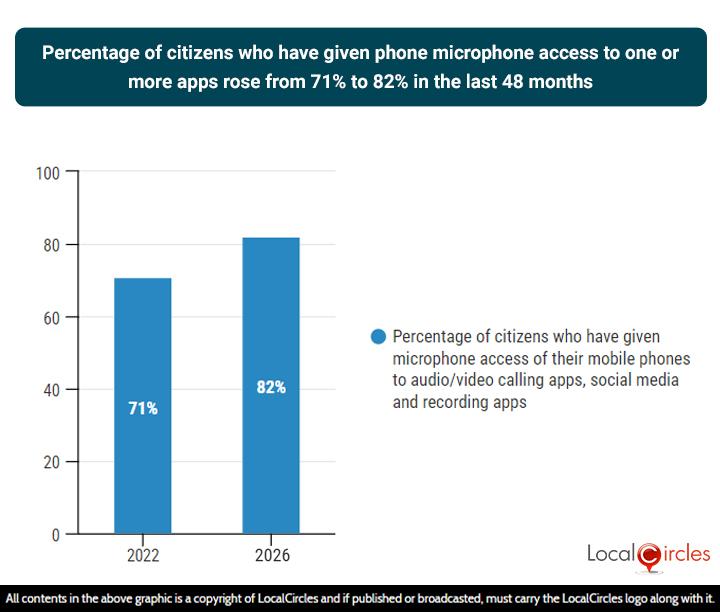
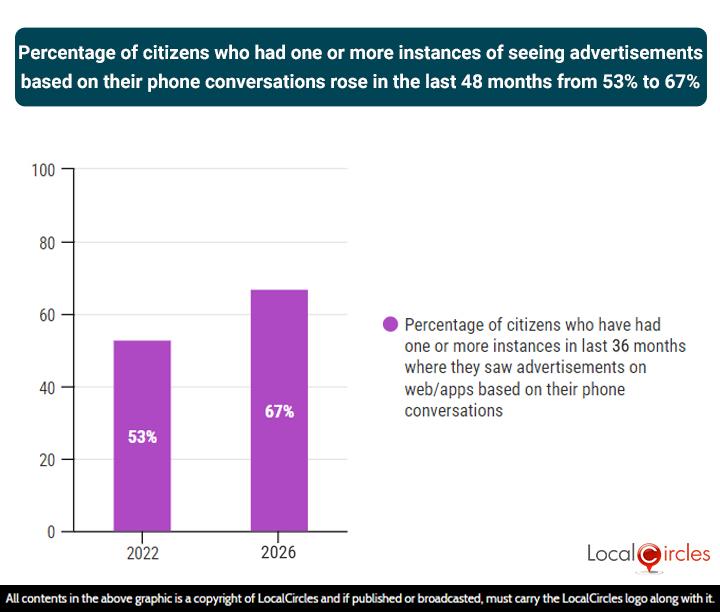
Percentage of citizens who have given phone microphone access to one or more apps rose from 71% to 82% in the last 48 months
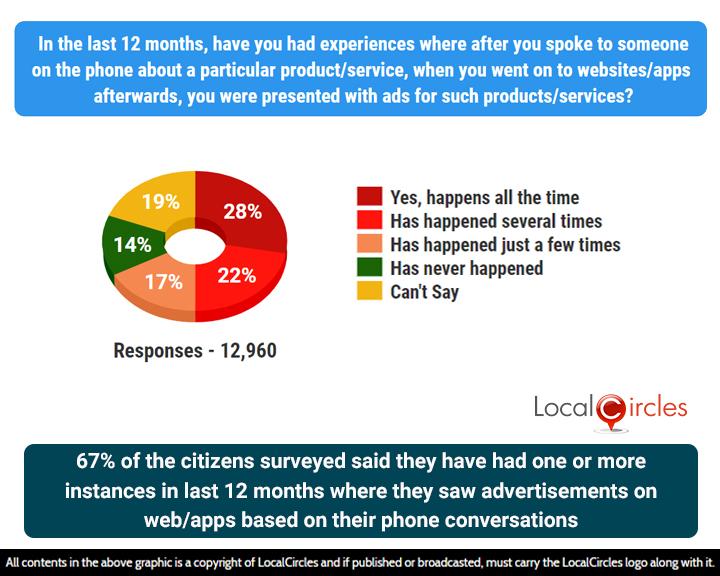
Two-thirds of respondents indicated they have had one or more such instances in the last 12 months where they saw advertisements on websites/ apps based on their phone conversations
The next survey question was “In the last 12 months, have you had experiences where after you spoke to someone on the phone about a particular product/ service, and later when you went on to websites/ apps you were presented with ads for such products/ services”. Two-thirds of 12,960 respondents to the question indicated that they have had one or more such instances in the last 12 months where they saw advertisements on websites/ apps based on their phone conversations. The data breakdown shows 28% indicated this “happens all the time”; 22% indicated it “happened several times”; 17% said it has “happened just a few times”. The remaining 14% indicated it has never happened and 19% of respondents were uncertain. To sum up, 67% of citizens surveyed said that they have had one or more instances in the last 12 months where they saw advertisements on web/apps based on their phone conversations.
Percentage of citizens who had one or more instances of seeing advertisements based on their phone conversations rose in the last 48 months from 53% to 67%
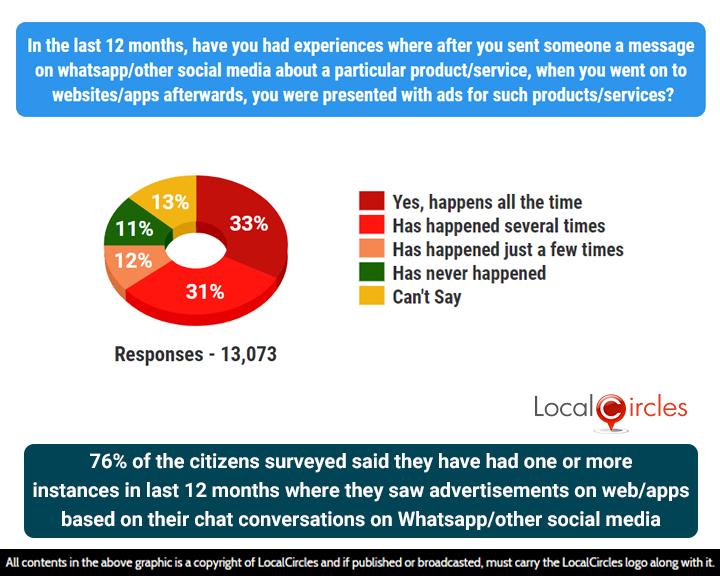
76% of the citizens surveyed said they have had one or more instances in last 12 months where they saw advertisements on web/apps based on their chat conversations on WhatsApp/other social media
The last survey question sought to know if the experience was the same “where after you sent someone a message on WhatsApp / other social media about a particular product / service, when you went on to the websites/ apps afterwards, you were presented with ads for the same products/ services”. Out of over 13,000 respondents, 76% indicated that over the last 12 months they have had one or more such experiences. One in three of the respondents indicated that this “happens all the time”; 31% indicated it “happens several times”; 12% stated it “happened just a few times” but 11% denied it ever happened and 13% were uncertain on the issue. In aggregate, 76% of the citizens surveyed said that they have had one or more instances in the last 12 months where they saw advertisements on web/apps based on their chat conversations on WhatsApp/ other social media.
In summary, data protection and individual privacy are related. If a person has the right to privacy, she/he also has the right to data protection. Most citizens in the survey accepted that they have given access to their phone’s microphone to several apps, especially audio/video calling apps, social media, and audio recording apps. Audio and video-based social networks like Spaces in ‘X’, as well as video calling apps like WhatsApp, Zoom, Google Meet, etc. all require microphone access. One can only hope that any apps that have taken user’s consent to their phone’s microphone aren’t recording the verbal conversations and sharing them with 3rd parties.
These apps and sites only take secondary consent and do not make users aware of where or how this information will be used. The key for sites and apps that are using verbal conversations of users is to comply and ensure the usage is clearly defined in the terms and conditions of their app and the key for the Government is to ensure that if there is a breach reported or Suo moto, take penal action against the violators.
With Google paying up and the privacy breach class action against Meta on, the need of the hour is accurate and transparent disclosure by platforms so the consumer can make informed choice of whether to use a particular voice platform. Similarly, the Government needs to conduct spot checks and surveys to understand the reality and ensure that any platforms violating the personal data protection norms are subject to enforcement action including penalties and restrictions.
Survey Demographics
The survey received over 63,000 responses from citizens located in 346 districts of India. 65% respondents were men while 35% respondents were women. 45% respondents were from tier 1, 33% from tier 2 and 22% respondents were from tier 3 & 4 districts. The survey was conducted via LocalCircles platform, and all participants were validated citizens who had to be registered with LocalCircles to participate in this survey.
About LocalCircles
LocalCircles, India’s leading Community Social Media platform enables citizens and small businesses to escalate issues for policy and enforcement interventions and enables Government to make policies that are citizen and small business centric. LocalCircles is also India’s # 1 pollster on issues of governance, public and consumer interest. More about LocalCircles can be found on https://www.localcircles.com
For more queries - media@localcircles.com, +91-8585909866
All content in this report is a copyright of LocalCircles. Any reproduction or redistribution of the graphics or the data therein requires the LocalCircles logo to be carried along with it. In case any violation is observed LocalCircles reserves the right to take legal action.
Enter your email & mobile number and we will send you the instructions.
Note - The email can sometime gets delivered to the spam folder, so the instruction will be send to your mobile as well


