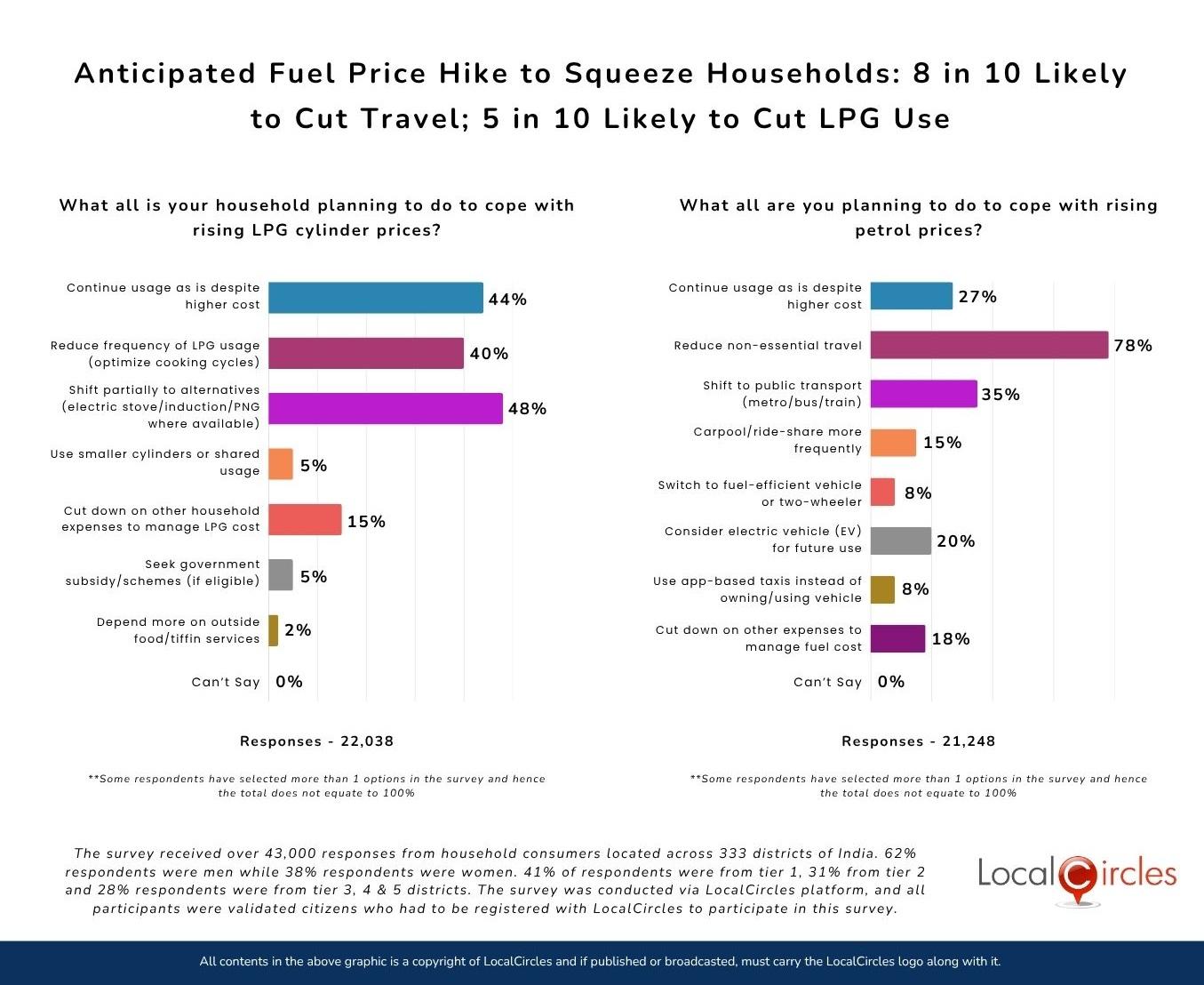
Anticipated Fuel Price Hike to Squeeze Households: 8 in 10 Likely to Cut Travel; 5 in 10 Likely to Cut LPG Use
- ● 35% of respondents indicated that they would shift to public transport (metro/ bus/ train) in case there is hike in price of petrol
May 5, 2026, New Delhi: Renewed escalation of conflict in the Middle East—home to major producers like Saudi Arabia, Iraq, and Iran—could significantly disrupt global energy supplies and critical shipping routes such as the Strait of Hormuz. For India, which imports over 80% of its crude oil requirements, such disruptions translate into higher import bills, possible delays in shipments, and tighter availability of LPG. Additionally, freight and insurance costs are likely to rise sharply in a conflict scenario, pushing up domestic fuel prices. Reduced supply stability may also strain refinery operations and contribute to inflationary pressures, ultimately affecting transportation, cooking fuel costs, and overall household budgets across the country.
In the aftermath of recent state elections, there are renewed concerns about a likely increase in retail fuel prices—covering both cooking fuel (LPG) and transport fuels such as petrol and diesel. While retail petrol and diesel prices have largely remained stable so far, prevailing market signals and ongoing policy discussions suggest that this period of price stability may be temporary rather than sustained.
A sharp increase in commercial LPG prices has already set the tone for what may follow. Earlier this month, the price of a 19-kg commercial LPG cylinder surged by around ₹993, pushing costs above ₹3,000 in cities like Delhi. This represents one of the steepest hikes in recent years and comes after cumulative increases of more than ₹1,300 within a span of just three months. Although domestic LPG cylinder prices have not yet been revised, there are growing indications that they could rise by ₹40–₹50 per cylinder soon, adding to household expenses.
Petrol and diesel prices, meanwhile, have remained largely frozen for nearly four years despite fluctuations and increases in global crude oil prices. However, analysts now suggest that a post-election price correction—estimated in the range of ₹4–₹10 per litre—may be imminent, primarily due to mounting financial pressures and losses faced by oil marketing companies. The prolonged pause in revising fuel prices has often been attributed to political sensitivities during election cycles, but with the conclusion of polls, that restraint may no longer apply.
The impact of rising fuel costs on household budgets is both immediate and far-reaching. On the direct front, any increase in LPG prices raises the cost of cooking, which disproportionately affects middle- and lower-income households that depend on subsidised or affordable gas for daily needs. India’s heavy reliance on imported LPG further heightens its vulnerability to global price volatility and geopolitical tensions.
Indirectly, the effects are even more widespread and persistent. Higher commercial LPG prices have already prompted restaurants and small businesses to consider increasing food prices by 10–15%, passing on the burden to consumers. Similarly, any rise in petrol and diesel prices increases transportation costs, which in turn makes vegetables, groceries, and other essential commodities more expensive. Economists note that even modest increases in fuel prices can have a multiplier effect on inflation, eroding purchasing power and squeezing disposable incomes.
The timing of these potential price increases—soon after elections—is not expected to go down well with the general public. Regardless, the broader economic reality remains unchanged: rising fuel prices tend to have a cascading effect across sectors, amplifying costs throughout the economy and placing sustained pressure on household finances.
As the combination of LPG price hikes and the likely jump in petrol rates threatens to significantly strain household budgets, LocalCircles has just concluded a natiowide survey to find out how households are planning to cope with this anticipated strain on their budgets. The survey received over 43,000 responses from households located across 333 districts of India. 62% respondents were men while 38% respondents were women. 41% of respondents were from tier 1, 31% from tier 2 and 28% respondents were from tier 3, 4 & 5 districts. The survey was conducted between April 1, 2026 – May 4, 2026.
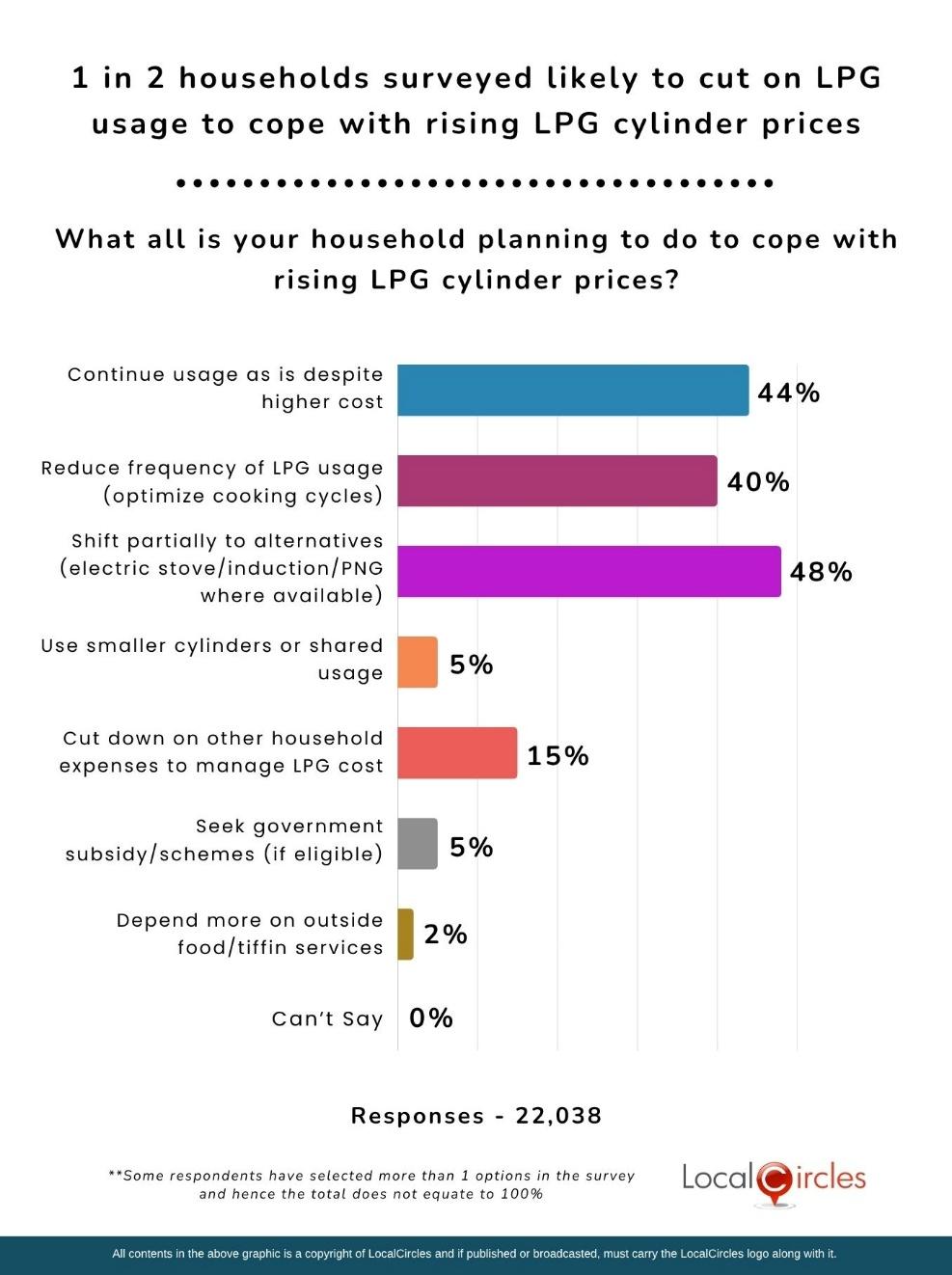
1 in 2 households surveyed are likely to cut LPG usage to cope with rising LPG cylinder prices
Rise in price of cooking gas or LPG cylinder may not affect some households but it makes a considerable difference to low and middle-income household budgets. The survey asked household consumers, “What all is your household income planning to do to cope with rising LPG cylinder prices?” Some among 22,038 households which responded to the question indicated more than one option. The largest group of 48% households indicated that they will “shift partially to alternatives (electric stove/ induction/ PNG where available)”; 44% of respondents indicated that they will “continue usage as is despite higher cost”; 40% of respondents indicated that they would "reduce frequency of LPG usage (optimize cooking cycles)”; 15% of respondents indicated that they would “cut down on other household expenses to manage LPG cost”’; 5% of respondents indicated that they would “use smaller cylinders or shared usage”; 5% of respondents indicated that they would “seek government subsidy / schemes (if eligible)”; and 2% of respondents indicated that they would “depend more on outside food/ tiffin services”. To sum up, 1 in 2 households surveyed are likely to cut LPG usage to cope with rising LPG cylinder prices.
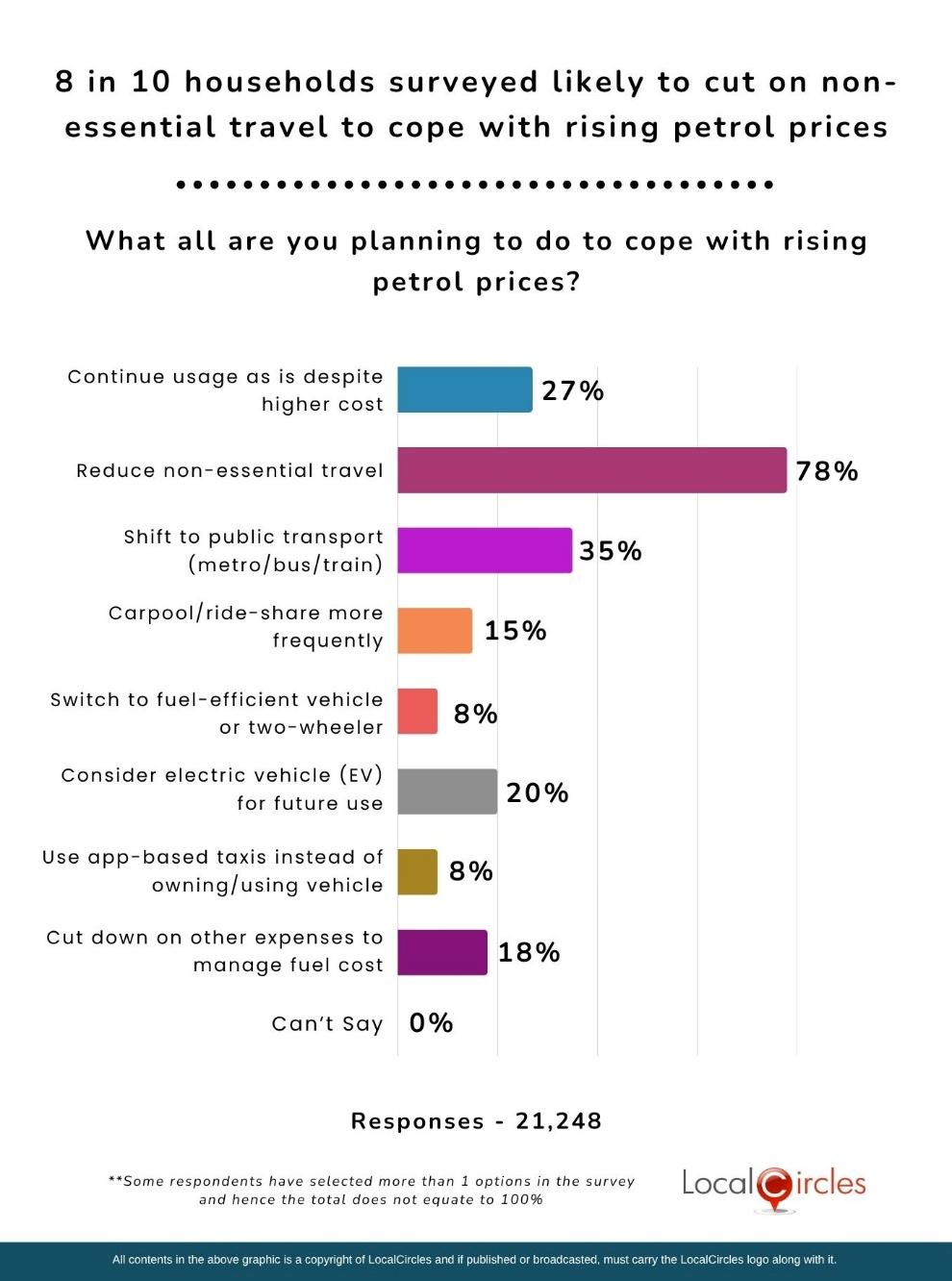
8 in 10 households surveyed are likely to cut on non-essential travel to cope with rising petrol prices
Cushioned by government, consumers who depend on their own vehicles to commute, have been uncaring about the volatility in crude oil prices in the last few years, particularly since February 28 when US-Israel- Iran war started. With no accord in sight, crude oil, petroleum products and LPG prices continue to hurt India. The emerging scenario is of a sharp hike in transport fuel prices. As majority of the households rely on petrol vehicles, the survey asked consumers, “What all are you planning to do to cope with rising petrol prices?” Some among 21,248 who responded to the question indicated more than one option. 78% of respondents indicated that they would “reduce non-essential travel’; 35% of respondents indicated that they would “shift to public transport (metro/ bus/ train)”; 27% of respondents indicated that they would “continue usage (of vehicles) as is despite higher cost”; 20% of respondents indicated that they would “consider electric vehicle for future use”; 18% of respondents indicated that they would “cut down on other expenses to manage fuel cost”’; 15% of respondents indicated that they would opt for “carpool/ ride-sharing more frequently”; 8% of respondents indicated that they would use opportunity to “switch to fuel efficient vehicle or two-wheeler”; and 8% of respondents indicated that they would ‘use app-based taxis instead of owing / using vehicle”. To sum up, 8 in 10 households surveyed are likely to cut down on non-essential travel to cope with rising petrol prices.
In summary, as prospects of a hike in price of LPG cylinder for domestic use and transport fuels – petrol and diesel looms, the study shows that 1 in 2 households surveyed are likely to cut on LPG usage to cope with rising LPG cylinder prices and in the case of transport fuel, 8 in 10 households surveyed are likely to cut on non-essential travel. What is interesting to note is that 35% of those surveyed indicated that they are likely to shift to public transport to cope with rising petrol prices.
LocalCircles will be sharing the findings of this survey with the relevant Government stakeholders, so any price increase decisions are taken keeping the household budget impact in mind. A 5-10% increase will not only have direct impact but a significant indirect impact in the form of increased prices of products and services thereby making the situation worse for the average Indian household.
Survey Demographics
The survey received over 43,000 responses from household consumers located across 333 districts of India. 62% respondents were men while 38% respondents were women. 41% of respondents were from tier 1, 31% from tier 2 and 28% respondents were from tier 3, 4 & 5 districts. The survey was conducted via LocalCircles platform, and all participants were validated citizens who had to be registered with LocalCircles to participate in this survey.
About LocalCircles
LocalCircles, India’s leading Community Social Media platform enables citizens and small businesses to escalate issues for policy and enforcement interventions and enables Government to make policies that are citizen and small business centric. LocalCircles is also India’s # 1 pollster on issues of governance, public and consumer interest. More about LocalCircles can be found on https://www.localcircles.com
For more queries - media@localcircles.com, +91-8585909866
All content in this report is a copyright of LocalCircles. Any reproduction or redistribution of the graphics or the data therein requires the LocalCircles logo to be carried along with it. In case any violation is observed LocalCircles reserves the right to take legal action.
Enter your email & mobile number and we will send you the instructions.
Note - The email can sometime gets delivered to the spam folder, so the instruction will be send to your mobile as well


