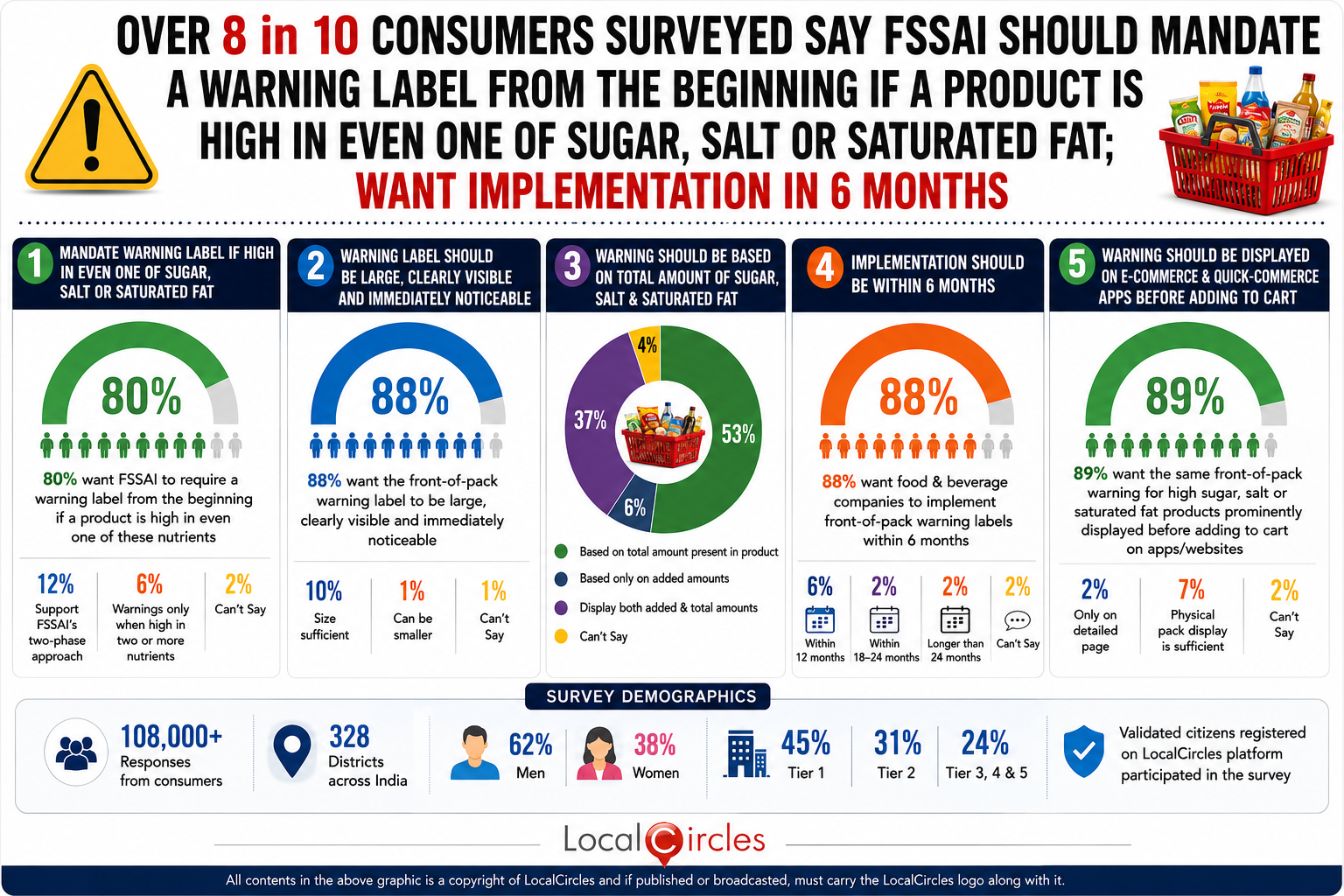
Over 8 in 10 consumers surveyed say FSSAI should mandate a warning label from the beginning if a product is high in even one of sugar, salt or saturated fat; Want implementation in 6 months
- ● 8 in 10 consumers surveyed want the warning label to be large, clearly visible and immediately noticeable
- ● 9 in 10 consumers surveyed want the warning to reflect the total amount of sugar, salt and saturated fat in a product rather than only the added amount
- ● 9 in 10 consumers surveyed want food and beverage companies to implement front-of-pack warning labels within 6 months, and want the same warning shown on online platforms
September 8, 2026, New Delhi: After nearly four years of delay, India finally has a front-of-pack warning label on the table. On August 28, 2026, FSSAI told the Supreme Court that it proposes a red hexagonal warning on packaged foods and beverages, carrying declarations such as "High Sugar", "High Salt", "High Fat" or "Highly Sweetened Beverage". The proposal came as a compliance affidavit in a public interest petition filed by the Kerala-based non-profit 3S and Our Health Society. It marks the first time the regulator has moved away from a rating-style label towards a direct warning. The design of that warning, however, is now the subject of sharp debate.
The dispute is about how much the proposed label will actually warn. FSSAI has proposed a two-phase rollout. In the first phase, the red warning would apply only to products that are high in two or more of added sugar, salt and added saturated fat, along with certain sweetened beverages. Products high in only one of these nutrients would carry no warning until a later phase, for which no date has been fixed. FSSAI has said the phasing is meant to aid consumer acceptability and give industry time to reformulate. Under this design, a biscuit or a soft drink loaded with sugar alone could stay warning-free indefinitely.
Two other elements of the proposal have drawn criticism. The thresholds are drawn from the ICMR-NIN Dietary Guidelines for Indians, 2024, but the warning is triggered by added sugar and added saturated fat, while the guidelines themselves are framed around total sugar and total fat per 100 grams. A product can therefore be high in total sugar and still escape a warning. The warning text is also proposed to be printed just one point larger than the nutrition information table on the back of the pack, which is typically set in six to eight point type. Single-ingredient foods and products naturally rich in these nutrients, such as ghee, edible oil, salt, sugar, jaggery and honey, are proposed to be exempt.
Nutrition advocacy group NAPi has called the two-nutrient trigger a "massive loophole" and wants a binding commitment to the second phase within 12 months. The Supreme Court has pressed the regulator for over a year: in April 2025 it told the FSSAI expert committee to finalise recommendations in three months, and in February 2026 it rejected the idea of merely printing daily consumption limits. On August 13, 2026, a bench of Justices J.B. Pardiwala and K. Vinod Chandran gave FSSAI two weeks to place the final decision on record, with Justice Pardiwala remarking, "If you can't do it, we will." The matter is listed next on September 10, 2026.
Since the affidavit, the dispute has sharpened on both sides. On September 7, 2026, the petitioner, 3S and Our Health Society, filed the first formal objection in court, calling the two-nutrient trigger an industry-friendly loophole. Meanwhile the packaged food industry, estimated at over USD 100 billion, is pushing back, with firms telling Reuters they want the warning based on a single serve rather than per 100 grams and the thresholds relaxed. The competing positions make the September 10 hearing a closely watched one.
Parliament has pushed the same way. On July 24, 2026, the Standing Committee on Consumer Affairs, Food and Public Distribution, chaired by Kanimozhi Karunanidhi, told FSSAI to notify front-of-pack rules without further delay, calling existing labels hard to read and asking for interpretive tools such as warning labels and colour codes. It also sought tighter monitoring of packaged foods sold online. Separately, on July 29, 2026, the Maharashtra FDA barred the sale of high fat, sugar and salt foods within 50 metres of all schools in the State.
The urgency comes from the health data. India is now among the largest markets for ultra-processed foods, and their sale has grown steeply over the past two decades. Rising obesity, diabetes and hypertension have been linked to the shift, and the Prime Minister has publicly urged a cut in oil and sugar consumption. FSSAI has also begun pushing oil and sugar boards in public institutions. Yet at the point of purchase, a consumer picking a packet off a shelf or a quick commerce app still has no simple signal of what is inside.
Against this backdrop, LocalCircles conducted a national survey to understand what consumers want from the front-of-pack warning label: whether the warning should apply from the beginning to products high in even one nutrient, how prominent it should be, whether it should be based on total or added amounts, how quickly it should be implemented, and whether it should also appear on eCommerce and quick commerce apps. The survey received over 108,000 responses from household consumers located across 328 districts of India. The findings show that 80% of consumers surveyed want a warning from the beginning if a product is high in even one of sugar, salt or saturated fat, 88% want the label to be large and immediately noticeable, and 88% want implementation within 6 months. The key findings of the survey are detailed below.
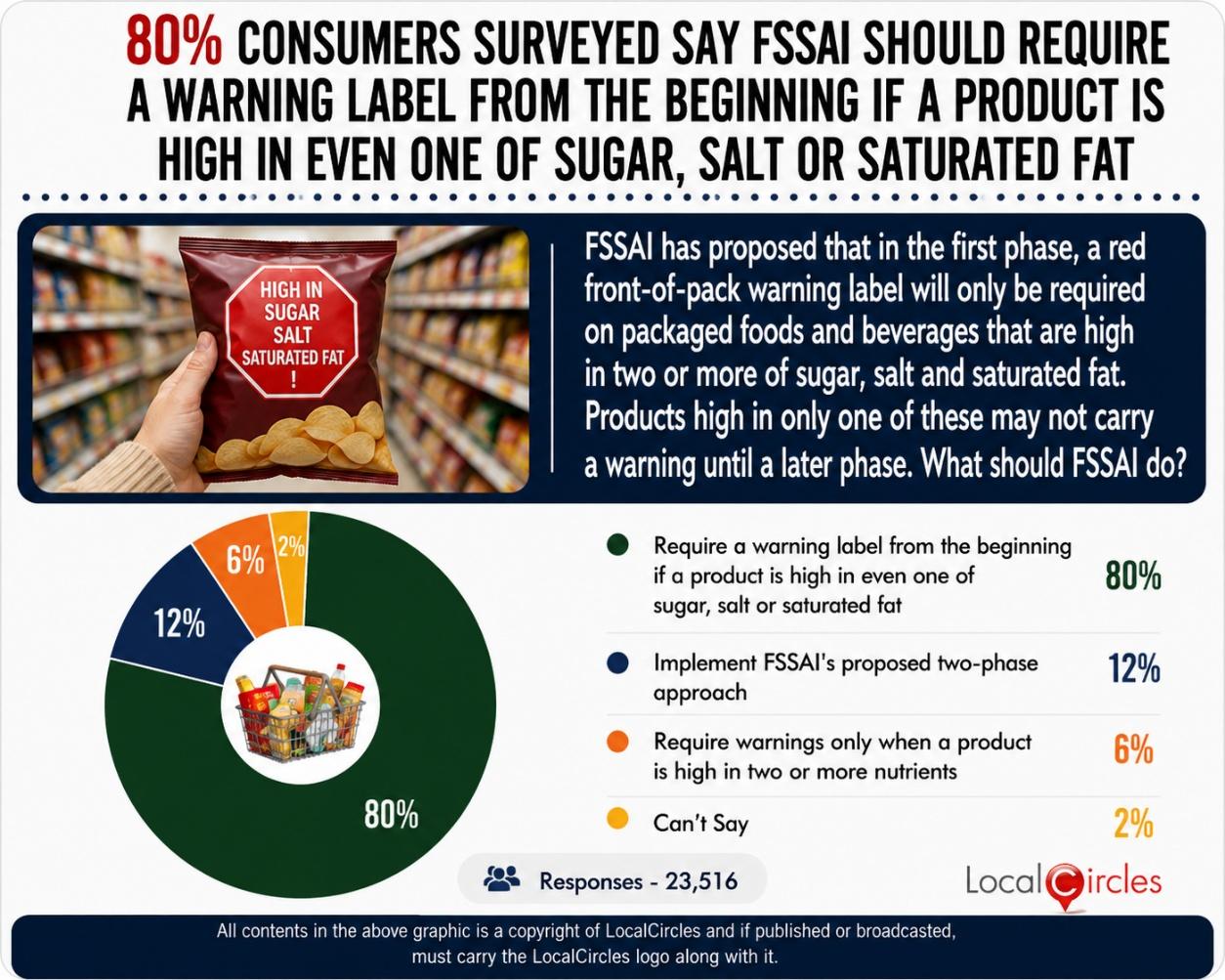
80% consumers surveyed say FSSAI should require a warning label from the beginning if a product is high in even one of sugar, salt or saturated fat
To test consumer support for the two-phase design, the survey first explained the proposal and asked, "FSSAI has proposed that in the first phase, a red front-of-pack warning label will only be required on packaged foods and beverages that are high in two or more of sugar, salt and saturated fat. Products high in only one of these may not carry a warning until a later phase. What should FSSAI do?" This question received 23,516 responses. In response, 80% said FSSAI should require a warning label from the beginning if a product is high in even one of sugar, salt or saturated fat. Only 12% backed the proposed two-phase approach and just 6% said warnings should apply only when a product is high in two or more nutrients, while 2% could not say. Consumer support for the phased design is therefore in single digits once the trade-off is made explicit. The finding matters because most of the products consumers buy most often, such as sweetened beverages, biscuits and breakfast cereals, tend to be high in one nutrient rather than two.
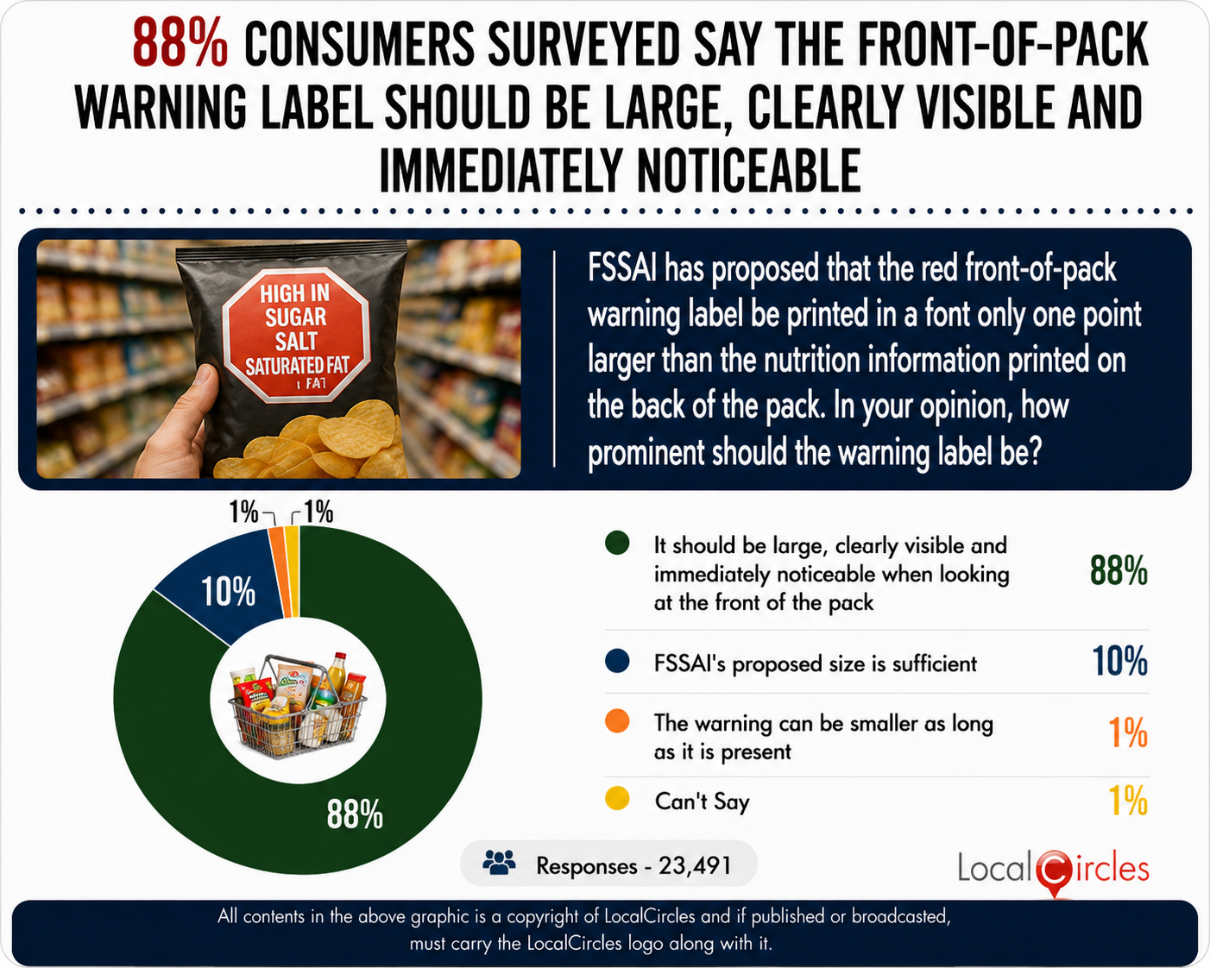
88% consumers surveyed say the Front-Of-Pack warning label should be large, clearly visible and immediately noticeable
A warning only works if it is read, so the survey next examined the size of the label. It explained that FSSAI has proposed printing the red warning in a font only one point larger than the nutrition information on the back of the pack, and asked, "In your opinion, how prominent should the warning label be?" This question received 23,491 responses. In response, 88% said it should be large, clearly visible and immediately noticeable when looking at the front of the pack. Only 10% said the size FSSAI has proposed is sufficient, 1% said the warning can be smaller as long as it is present and 1% could not say. Back-of-pack nutrition tables are typically printed in six to eight point type. A warning set one point above that would sit at the smallest end of what is legible on a retail shelf. Countries that have adopted warning labels generally size them as a share of the front panel rather than against the back-of-pack text.
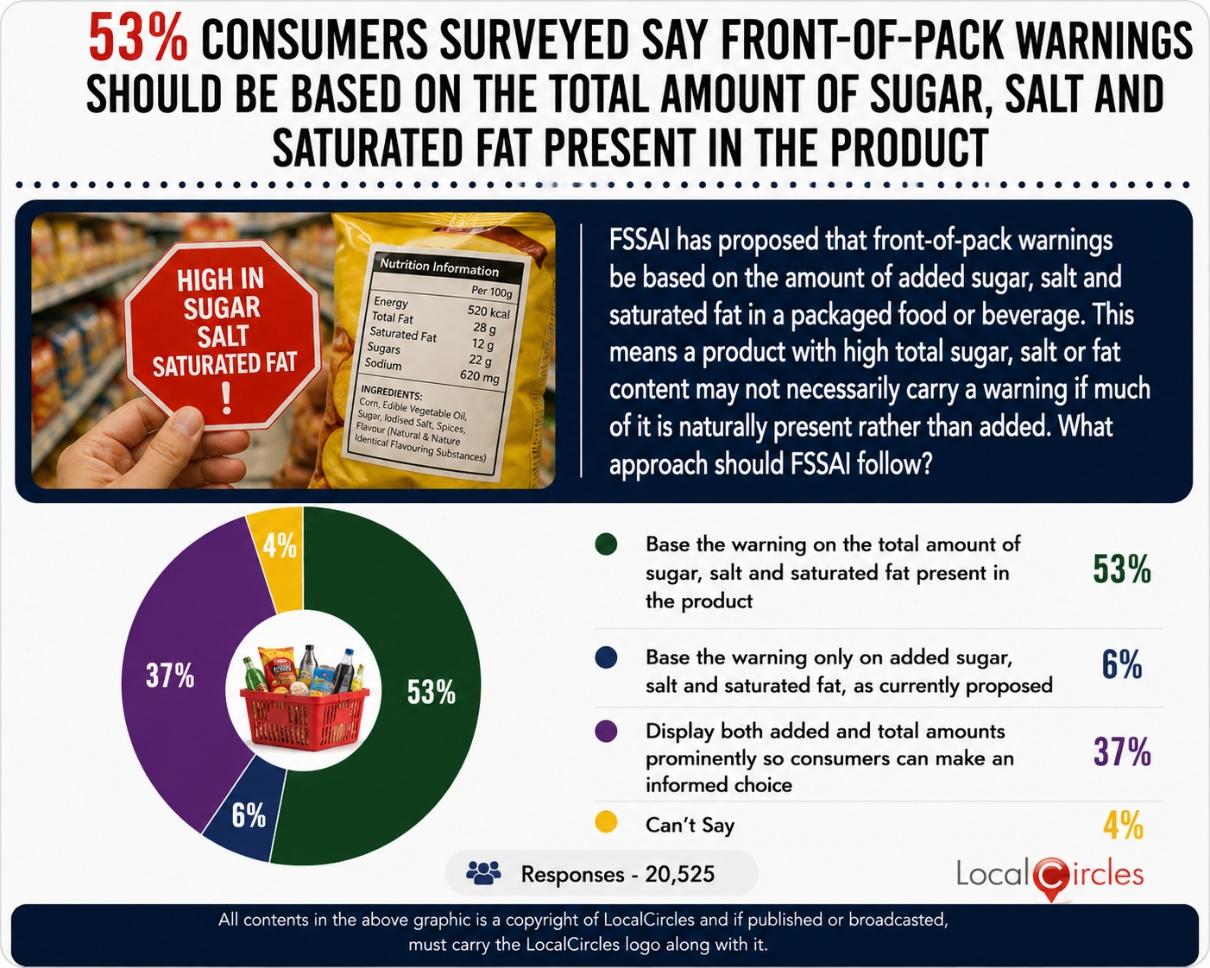
53% consumers surveyed say Front-Of-Pack warnings should be based on the total amount of sugar, salt and saturated fat present in the product
The survey then turned to what the warning should measure. It explained that FSSAI has proposed basing warnings on added sugar, salt and added saturated fat, which means a product high in total sugar, salt or fat may carry no warning if much of it is naturally present rather than added. The survey asked, "What approach should FSSAI follow?" This question received 20,525 responses. In response, 53% said the warning should be based on the total amount of sugar, salt and saturated fat present in the product. Another 37% said both added and total amounts should be displayed prominently so consumers can make an informed choice. Only 6% supported basing the warning on added amounts alone as currently proposed, while 4% could not say. Taken together, 90% of consumers surveyed want the total amount reflected in the label. That aligns with the ICMR-NIN Dietary Guidelines for Indians, 2024, which are framed around total sugar and total fat per 100 grams, and it is the gap critics have flagged in the current proposal.
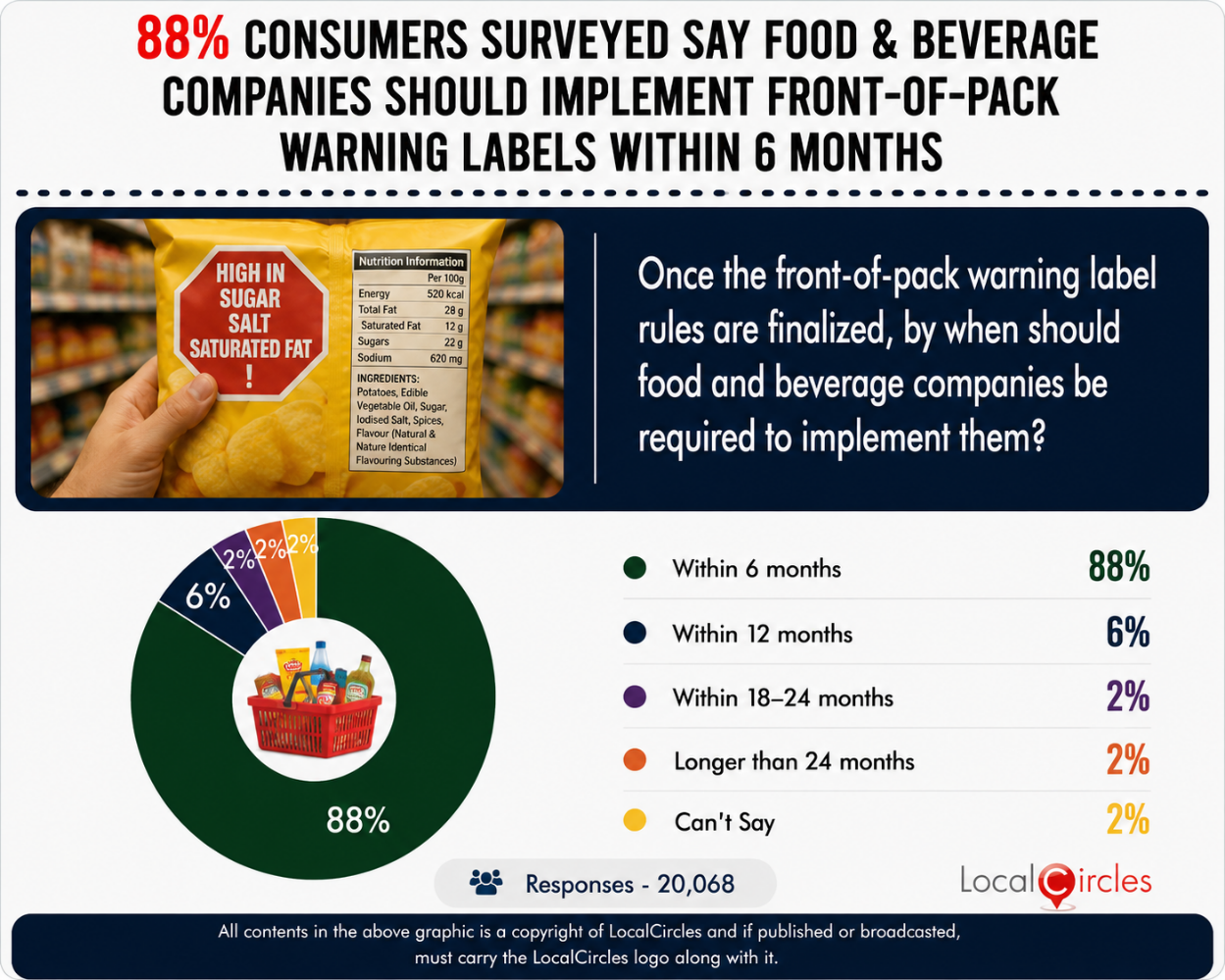
88% consumers surveyed say food & beverage companies should implement Front-Of-Pack warning labels within 6 months
With the rules yet to be notified, the survey sought to establish how much time industry should get, asking, "Once the front-of-pack warning label rules are finalized, by when should food and beverage companies be required to implement them?" This question received 20,068 responses. In response, an overwhelming 88% said implementation should happen within 6 months. Only 6% were willing to allow 12 months, 2% suggested 18 to 24 months and another 2% supported longer than 24 months, while 2% could not say. Fewer than 1 in 20 consumers surveyed is prepared to wait beyond a year. The impatience is understandable. The first draft on front-of-pack labelling was notified in September 2022, and consumers have now watched the process run for four years without a label reaching a single pack.
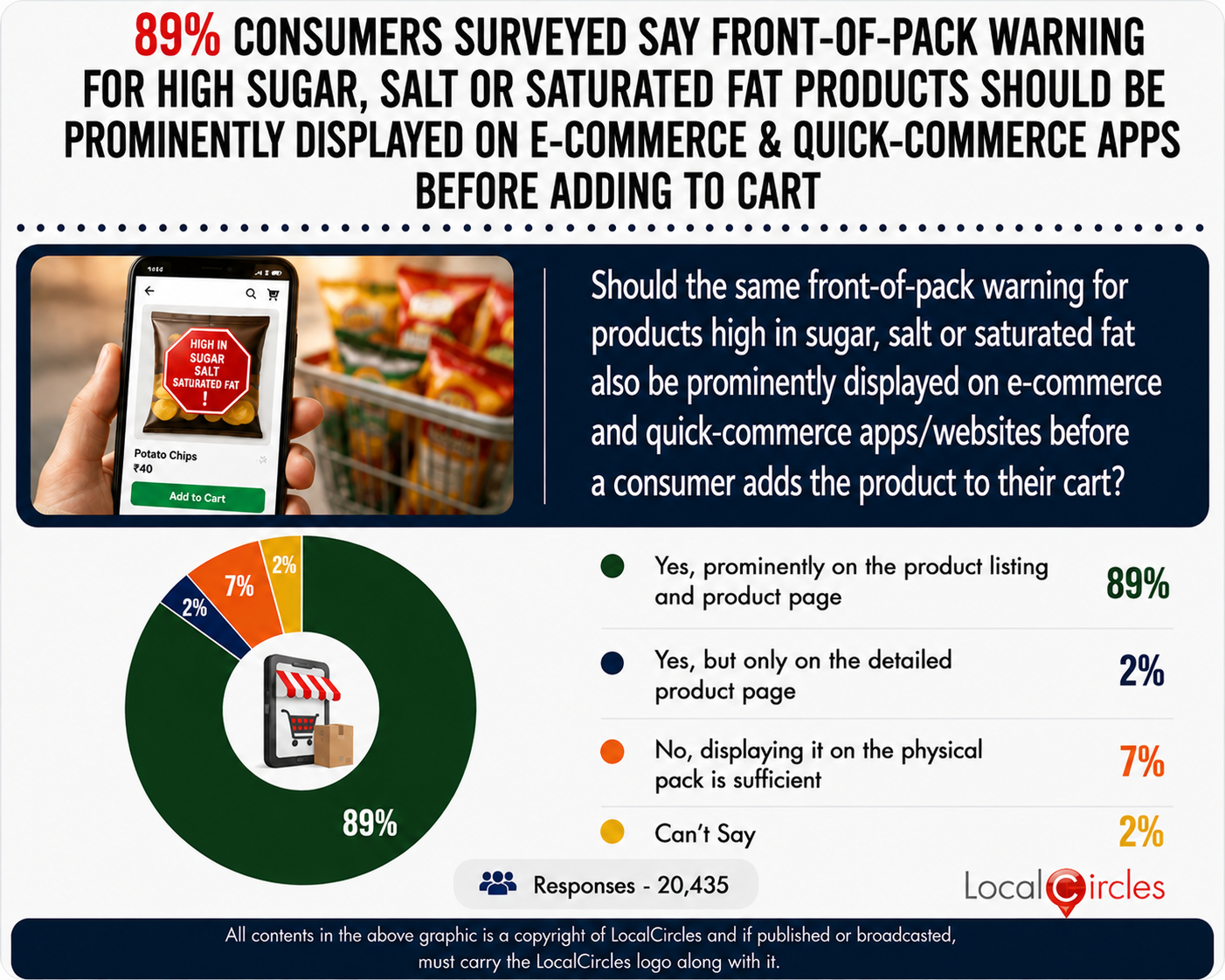
89% consumers surveyed say Front-Of-Pack warning for high sugar, salt or saturated fat products should be prominently displayed on eCommerce & Quick Commerce apps before adding to cart
A growing share of packaged food is now bought on a screen rather than off a shelf, so the survey finally asked, "Should the same front-of-pack warning for products high in sugar, salt or saturated fat also be prominently displayed on eCommerce and quick commerce apps or websites before a consumer adds the product to their cart?" This question received 20,435 responses. In response, 89% said yes, prominently on both the product listing and the product page. Another 2% said yes but only on the detailed product page, taking total support for online display to 91%. Only 7% said displaying the warning on the physical pack is sufficient and 2% could not say. On quick commerce apps, a purchase is often completed in under a minute from a small product thumbnail, and the pack itself is seen only after delivery. Unless the warning is carried on the listing, the label will simply not reach a large and fast-growing share of buyers. The parliamentary panel has already asked for closer monitoring of packaged food sold online.
In summary, the survey findings indicate that consumers want a front-of-pack warning label that is more comprehensive, more prominent and implemented sooner than the approach currently proposed by FSSAI. Consumers do not accept the two-phase design: 80% want a warning from the beginning if a product is high in even one of sugar, salt or saturated fat, against 12% who back the phased approach. They do not accept the proposed size either, with 88% asking for a label that is large and immediately noticeable rather than one point larger than back-of-pack text. And they do not accept the added-only basis, with 90% wanting the total amount of sugar, salt and saturated fat reflected in the warning. On timing, 88% want implementation within 6 months, and 89% want the warning displayed on eCommerce and quick commerce apps before a product is added to the cart. Across the design choices tested, the survey indicates a strong consumer preference for a more comprehensive and prominent warning.
These findings provide an indication of consumer expectations for FSSAI and the Ministry of Health and Family Welfare as the front-of-pack warning framework is considered. LocalCircles will be sharing these findings with FSSAI, the Ministry of Health and Family Welfare and the Parliamentary Standing Committee on Consumer Affairs, Food and Public Distribution for consideration as the front-of-pack warning label is finalised and notified. Based on the survey findings, LocalCircles recommends that the warning apply from the first phase to any product high in even one of sugar, salt or saturated fat, that it be sized as a defined share of the front panel instead of against back-of-pack text, and that it be triggered by total rather than only added amounts in line with the ICMR-NIN Dietary Guidelines for Indians, 2024, that industry be given a fixed six-month window to comply, and that the same warning be made mandatory on product listings across eCommerce and quick commerce platforms.
Survey Demographics
The survey received over 108,000 responses from household consumers located across 328 districts of India. 62% respondents were men while 38% respondents were women. 45% respondents were from tier 1, 31% from tier 2 and 24% respondents were from tier 3, 4 & 5 districts. The survey was conducted via LocalCircles platform, and all participants were validated citizens who had to be registered with LocalCircles to participate in this survey.
Survey Methodology
This survey has been conducted using the proprietary LocalCircles stratified sampling methodology. With a minimum target of 30% participation of each gender and a minimum target of 20% participation from three location groups (Tier 1, Tier 2 and Tier, 3-5 & rural districts) on each poll, all polls were run. After the minimum participation criteria were met, all polls were run till they achieved steady state. Post achievement of steady state, the LocalCircles system using the bootstrapping technique drew additional samples to test for the margin of error. All polls were found to have a margin of error under 4% and a confidence level of over 96%.
About LocalCircles
LocalCircles, India’s leading Community Social Media platform enables citizens and small businesses to escalate issues for policy and enforcement interventions and enables Government to make policies that are citizen and small business centric. LocalCircles is also India’s # 1 pollster on issues of governance, public and consumer interest. More about LocalCircles can be found on https://www.localcircles.com
For more queries - media@localcircles.com, +91-8585909866
All content in this report is a copyright of LocalCircles. Any reproduction or redistribution of the graphics or the data therein requires the LocalCircles logo to be carried along with it. In case any violation is observed LocalCircles reserves the right to take legal action.
Enter your email & mobile number and we will send you the instructions.
Note - The email can sometime gets delivered to the spam folder, so the instruction will be send to your mobile as well


