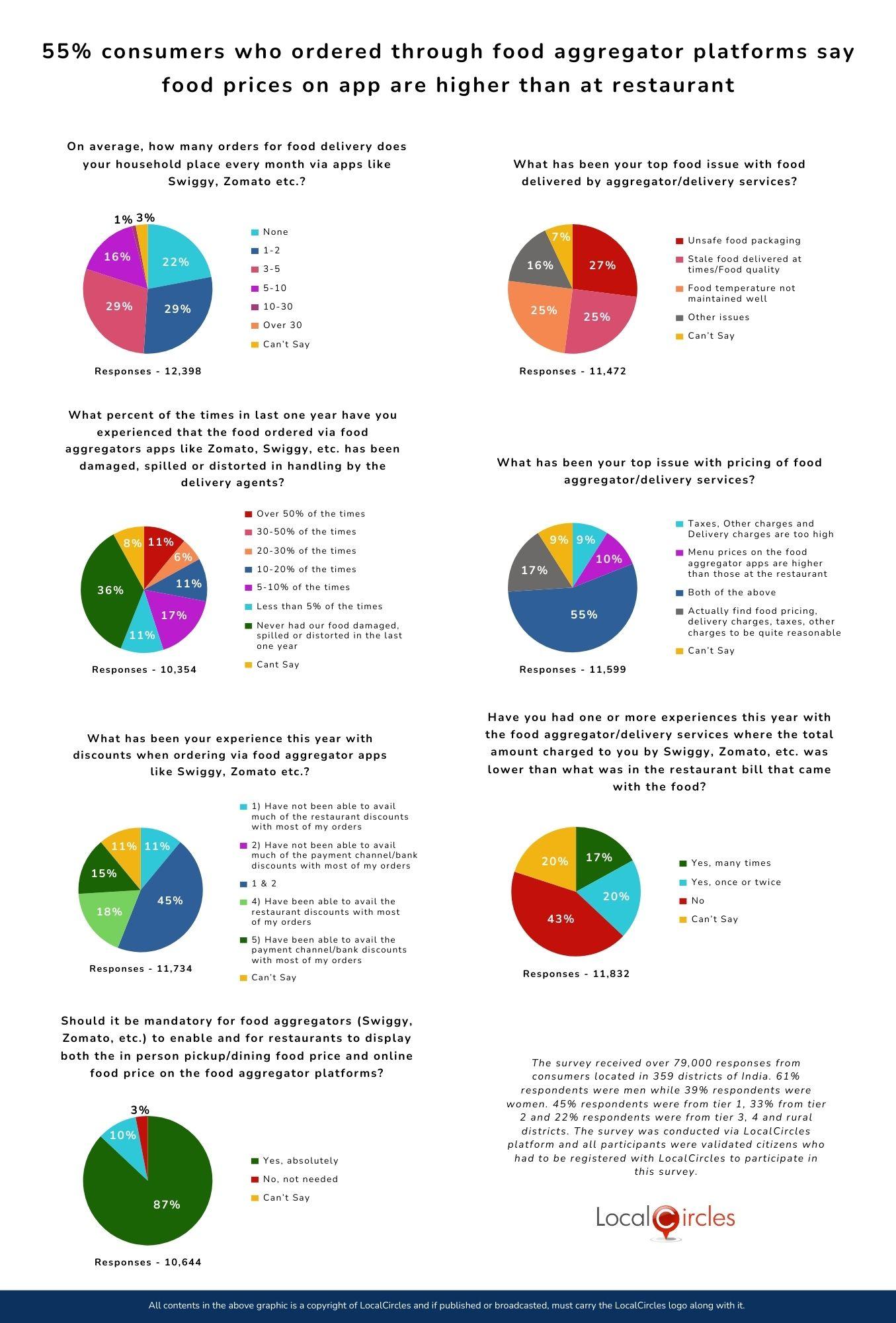
55% consumers who ordered through food aggregator platforms say food prices on app are higher than at restaurant
- ● Over 90% have had issues with packaging, and quality of food delivered
- ● 56% indicated they had received damaged, spilled or distorted food due to poor handling
- ● 87% want restaurants to display pickup/ dine in / online food price on the food aggregator’s platform
- ● India’s largest consumer survey on the sector receives 79,000 responses from consumers across 359 districts of India
January 06, 2026, New Delhi: Recent gig worker strikes—especially nationwide actions by delivery and platform workers across India—have brought visibility to long-standing issues like low pay, unsafe delivery targets (e.g., 10-minute delivery), unpredictable income and lack of legal protection.
Unions such as the Gig and Platform Services Workers Union (GIPSWU), Indian Federation of App-Based Transport Workers (IFAT), and others mobilised thousands in protests, submitted detailed demands to the Labour Ministry, and highlighted systemic exclusions from labour rights. However, the immediate impact of these strikes has been mixed. Platforms like Zomato, Swiggy, Blinkit and quick-commerce firms deployed higher incentives and surge payouts on key days (e.g., New Year’s Eve) to keep workers logged in and avoid service disruption, meaning business continued largely as usual in many cities. This suggests limited strike effectiveness in forcing structural change so far.
On the policy front, India’s updated labour codes now formally recognise gig and platform workers and include contributions toward social security funds—offering long-term relief on welfare. Some state governments are also pushing for dedicated welfare laws. Despite these steps, workers argue that real improvements in pay, safety, and working conditions still require sustained negotiation and enforcement.
Apart from workers, consumers increasingly complain that food delivery apps inflate prices because high commissions (20–30 %+) charged to restaurants are reflected in menu prices seen online, with savings not passed back to customers. Restaurants sometimes charge much higher prices on apps than in-house, leading to perceptions of unfair overpricing. Users also report hidden fees like high packaging or platform charges that make orders cost far more than expected, and poor transparency about total costs before checkout.
Additional issues include inaccurate delivery fees, refunds denied for wrong or missing items, and weak customer support responses. Over 7,000 grievances against delivery apps were registered in 2024-25, showing persistent dissatisfaction.
The Food Safety and Standards Authority of India (FSSAI, which undertakes regular surveillance, monitoring, inspection and random sampling of food products from manufacturers/sellers, hotels and restaurant, etc., sold online through e-commerce platforms, throughout the year, received 21,042 complaints in the last five fiscal years, Minister of State for Food and Consumer Affairs BL Verma informed the Rajya Sabha last year.
An investigation by the Competition Commission of India (CCI) in 2024 had found evidence of anti-competition practices by two of the food delivery giants Swiggy and Zomato, according to a media report. Both the app-based food delivery firms were reported to have been found favouring select restaurants in return for lower commission or for those promising exclusive listing on their platform. These are not the only charges consumers have against the two companies.
Concerns about carcinogenic substances in spices and other edible products, use of harmful substances for preservation and extension of shelf life of packaged food or recycling of stale products are the many complaints being reported from across the country. Some of these instances are reported to have resulted in the death of consumers. The scenario is such that instead of relying on the food regulator, the FSSAI, which has not lived up to expectations of consumers, local authorities right down to the district level need to step in to ensure proper safety standards are followed by all linked in the food chain down right from home food suppliers, restaurants to the food delivery aggregators.
The food delivery aggregator, who is a crucial link between food suppliers and the consumer, should be made to ensure that the food they collect to deliver to consumers is not just packed hygienically but also meets the health and safety standards set for food packaging materials used. For instance, the food is often delivered in black plastic containers which can contain harmful chemicals like phthalates, flame retardants, and heavy metals like lead, cadmium, nickel, chromium, and mercury. These chemicals can leach into food and cause serious health problems, including cancer.
The food delivery business for long was mostly concentrated in the metros, but now it has expanded to other markets with good response. India’s online food delivery market was valued at roughly USD 31.8 billion in 2024, driven by increasing smartphone and internet use, changing lifestyles, and rapid urbanisation. By 2030, the market is forecast to be worth anywhere from USD 100 billion to over USD 140 billion, depending on the source and growth assumptions.
The 2021 September LocalCircles report had brought out the fact that many consumers had been receiving stale, expired or poorly packaged food when they ordered food via food aggregator apps. Several reports had suggested that despite reporting a bad experience, the standard customer service response was to deal with the food, there was no provision for a refund or credit. In most cases, consumers could only rate the restaurant poorly on the specific food aggregator’s platform.
The new survey received over 79,000 responses from consumers located in 359 districts of India. 61% respondents were men while 39% were women. 45% respondents were from tier 1, 33% from tier 2 and 22% respondents were from tier 3, 4 and rural districts. The survey was conducted via LocalCircles platform, and all participants were validated citizens who had to be registered with LocalCircles to participate in this survey.
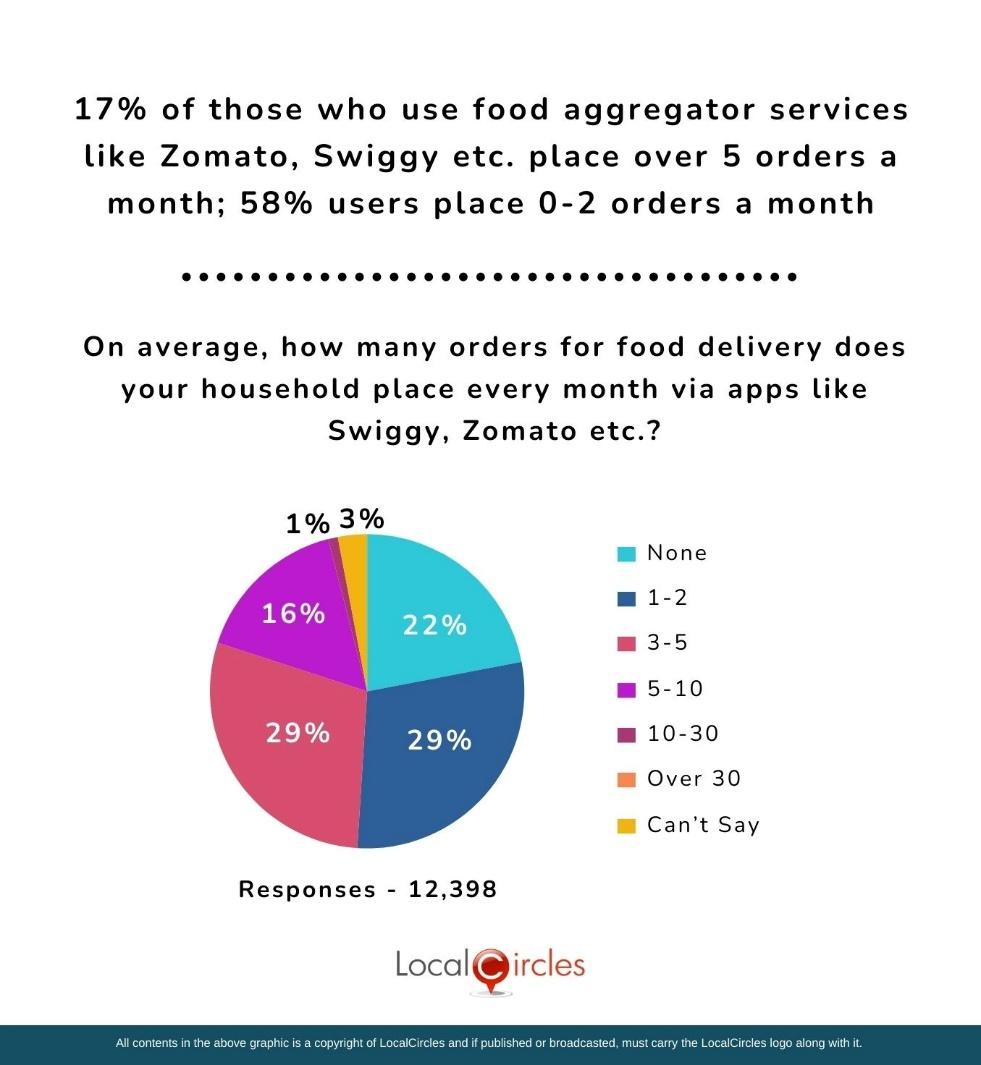
75% of respondents are users of food delivery service apps; 58% use it 1-5 times a month; 1% use it 10-30 times a month
LocalCircles survey revealed that three out of four households order food at least once a month using mobile apps. To the survey question “on an average how many order for food delivery does your household place every month via apps like Swiggy, Zomato, etc.”29% out of 12,398 respondents revealed that they did so at least once or twice a month, while another 29% availed the freedom of ordering food from outside three to five times, 16% used food delivery app to buy food of their choice 5-10 times a month but 1% used the service between 10-30 times or the whole month. On the other hand, 22% of the respondents indicated that they preferred to eat home cooked meals and never used the services of food aggregators. To sum up, 75% of respondents are users of food delivery service apps; 58% use it 1-5 times a month; 1% use it 10-30 times a month
Online food delivery works on two delivery types, i.e. Aggregator & Cloud Kitchen. The Food Aggregators allow consumers to compare and order their meals from different restaurants through a single app. It is more prevalent in India than Cloud kitchens as cloud kitchens are commercial facilities purpose-built to produce food specifically for delivery, according to researchandmarkets.com, which has projected a CAGR of 28.94% during 2020-2026 for the Indian online food delivery industry.
IMARC Group, which also expects high growth in this service sector, in a report states, “Although the players are mainly concentrated in the urban regions of the country, with Bangalore, Delhi and Mumbai representing the three largest markets, vendors are now also targeting smaller cities, as they have strong growth potential. Moreover, the rising trend of on-the-go food items and quick home delivery models that offer convenience, ready-to-eat (RTE) and cheaper food delivery options are escalating the demand for online food delivery services in the country.”
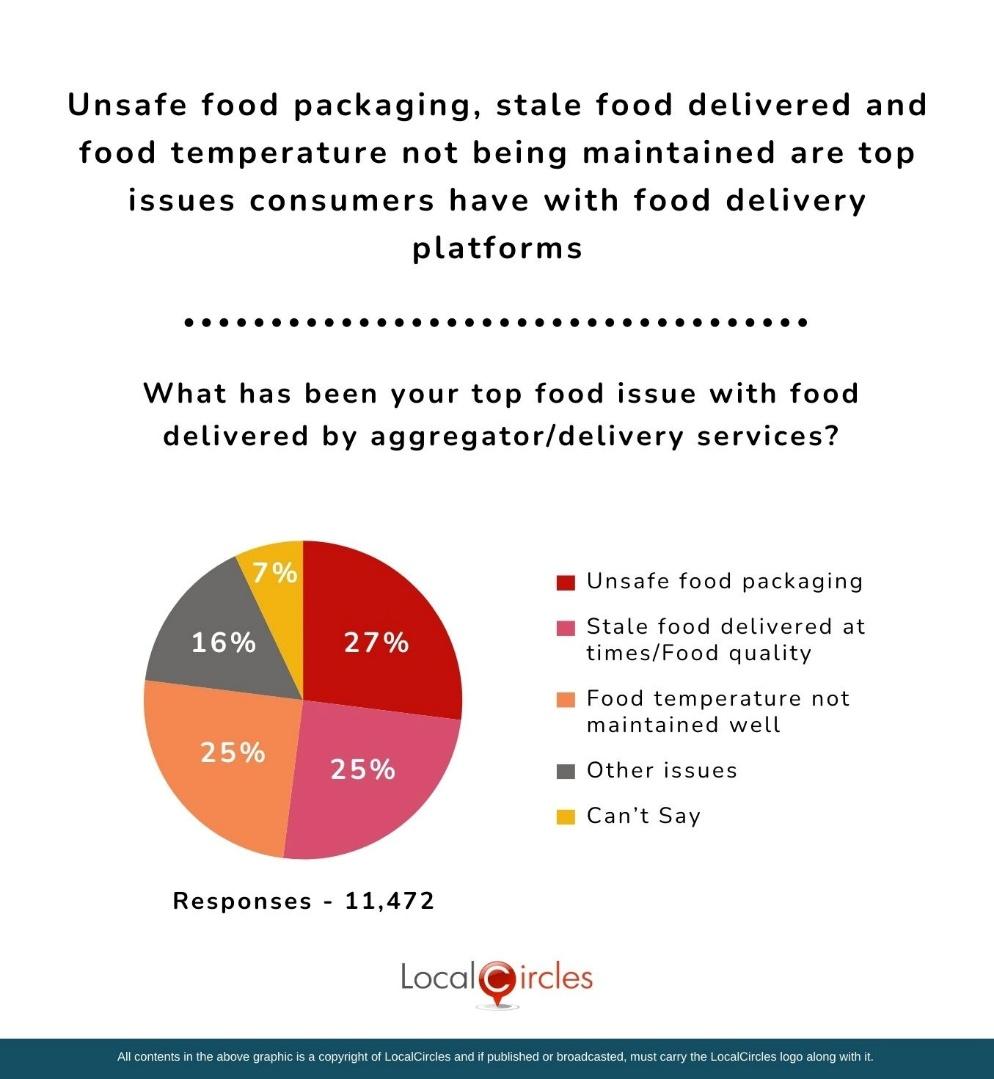
Over 95% of respondents had some complaints to share about the quality of packaging and food delivered, leaving them disappointed
Users of app food delivery were found to have other concerns besides higher charges. These relate to the issue of unsafe containers in which the food is delivered. LocalCircles survey question on “What has been your top food issues with food delivered by aggregator/delivery services” found 27% consumers had concerns about “unsafe food packaging”, 25% complained about “stale food delivered at times/food quality”, 25% had issues about “food temperature not maintained well” while 16% had “other issues”, another 7% out of 11,472 respondents did not clarify. The survey reveals that food quality and delivery of food at the right temperature are top issues that could hinder the growth of this service industry in the medium to long term. To sum up, over 95% of respondents had some complaints to share about the quality of packaging and food delivered, leaving them disappointed.
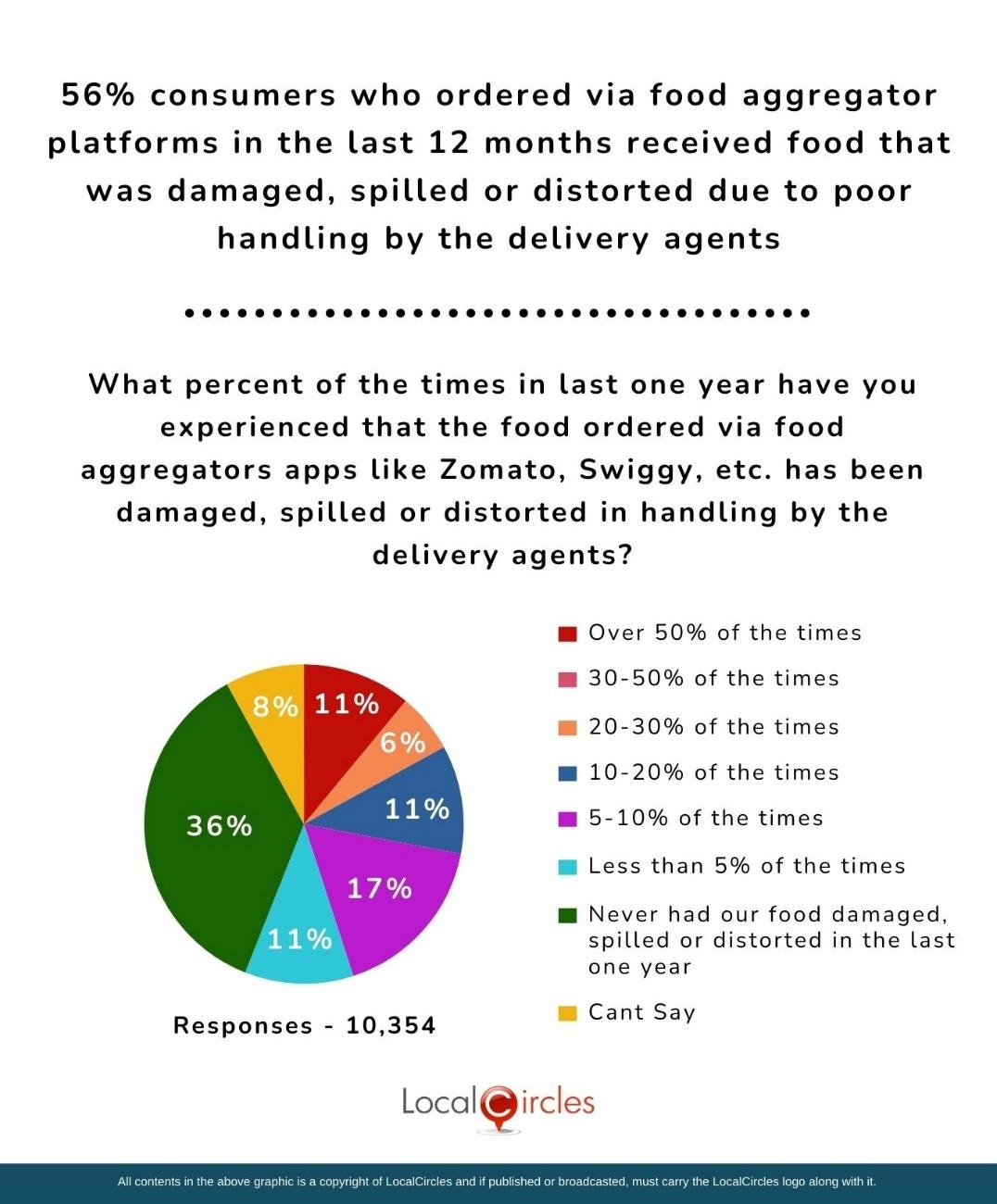
56% indicated they received damaged, spilled or distorted food due to poor handling by the delivery agents more than once during that last one year
The next survey question focused on “what percent of the times in the last one year have you experienced that the food ordered has been damaged, spilled or distorted in handling by the delivery agents?” Out of 10, 354 who responded to this query, 56% indicated that they had such an experience while 36% stated “never had out food damaged, spilled or distorted in the last one year, while 8% gave no clear response. The data shows that 11% had a poor experience over 50% of the times; 6% had such an experience 30-50% times; 11% had such an experience 10-20% times; 17% got spilled/ damaged/ distorted food 5-10% of times and 11% had such bad experience less than 5% of times. To sum up, much more training and care needs to be taken when delivering food as it is not enough to get a timely delivery but also proper delivery so that it does not distort the special eating experience as 56% of consumers indicated they received damaged, spilled or distorted food due to poor handling by the delivery agents more than once during that last one year.
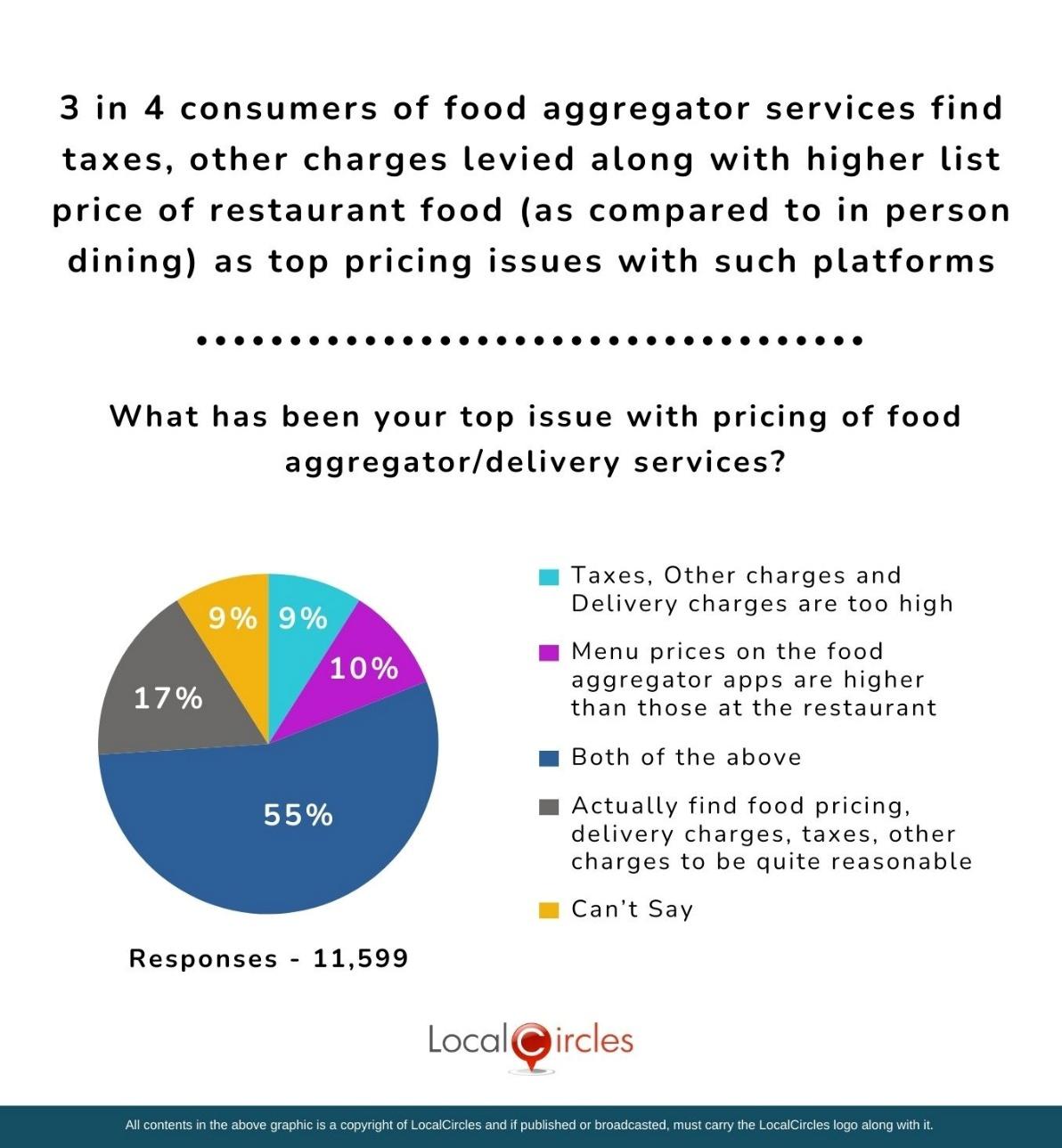
3 in 4 consumers of food aggregator services find taxed, other charges levied along with higher list price of restaurant food (as compared to in person dining) as top pricing issues with such platforms
LocalCircles survey question, “What has been your top issues with pricing of food aggregator/delivery services” found three-fourth of the app-users are unhappy with either higher listed prices and taxes or both, only 26% respondents had no such complaint or did not want to share it. Out of those with complaints, 9% stated that “taxes and other charges and delivery charges are too high”; 10% said the “menu prices on the food aggregator apps are higher than those at the restaurant while 55% had issues on both the fronts. To sum up, 3 in 4 consumers of food aggregator services find taxed, other charges levied along with higher list price of restaurant food (as compared to in person dining) as top pricing issues with such platforms.
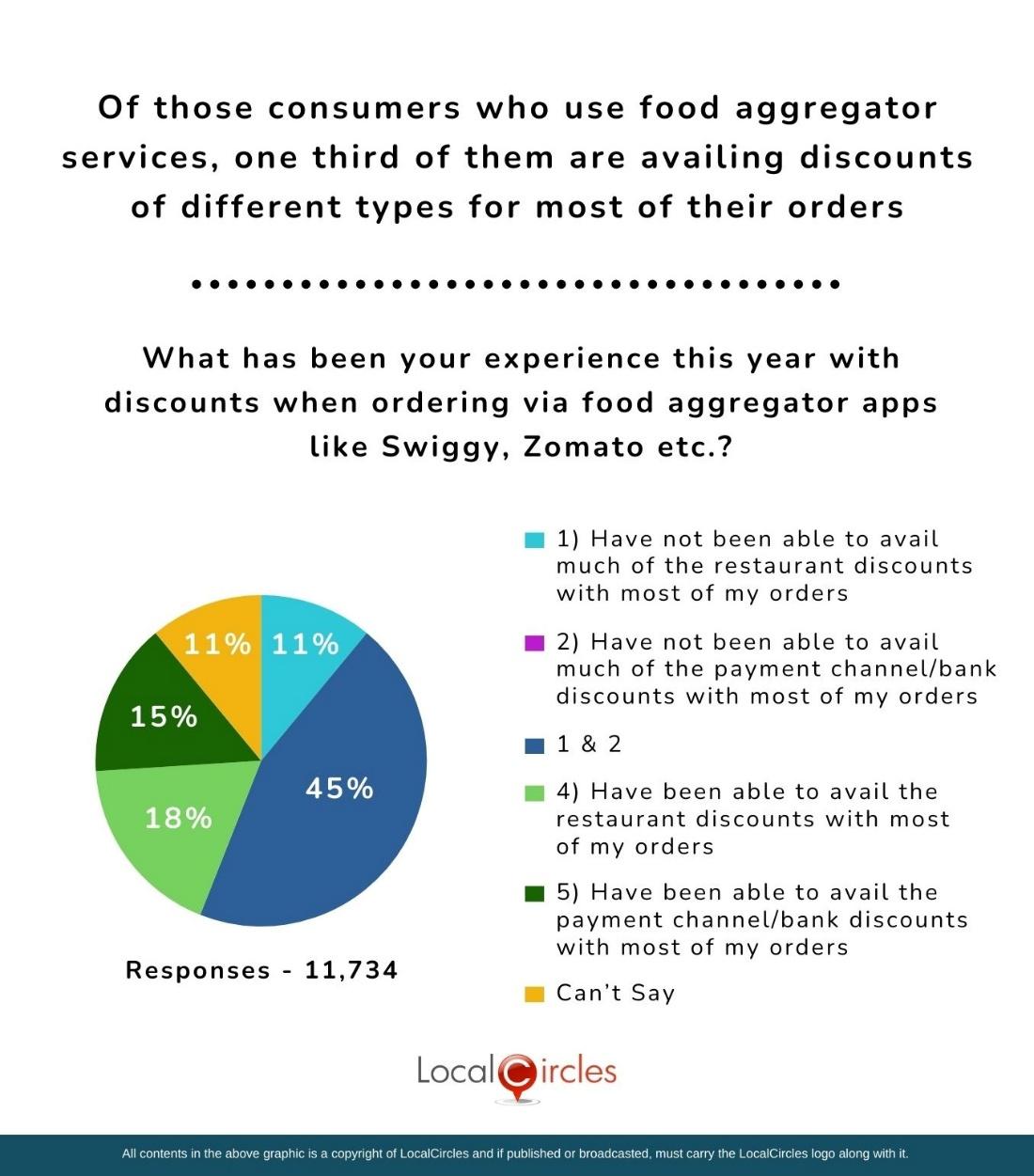
One-third of the respondents shared that they were able to avail themselves of restaurant or payment channel/ bank discounts with most of their orders
To the survey question on the “experience this year with discounts when ordering via food aggregator apps”, one-third of the respondents shared that they were able to avail discounts with most of their orders. Of them 15% were able to avail the payment channel/bank discounts with most orders and another 18% benefitted from restaurant discounts with most of the orders. The survey data shows that 11% respondents “have not been able to avail much of the restaurant discounts with most of my orders” while 45% food aggregator app users have not benefited much either from restaurant discounts or payment channel/bank discounts during most of their food orders. Out of 11,734 respondents to this question, 11% declined to comment. To sum up, One-third of the respondents shared that they were able to avail restaurant or payment channel/ bank discounts with most of their orders
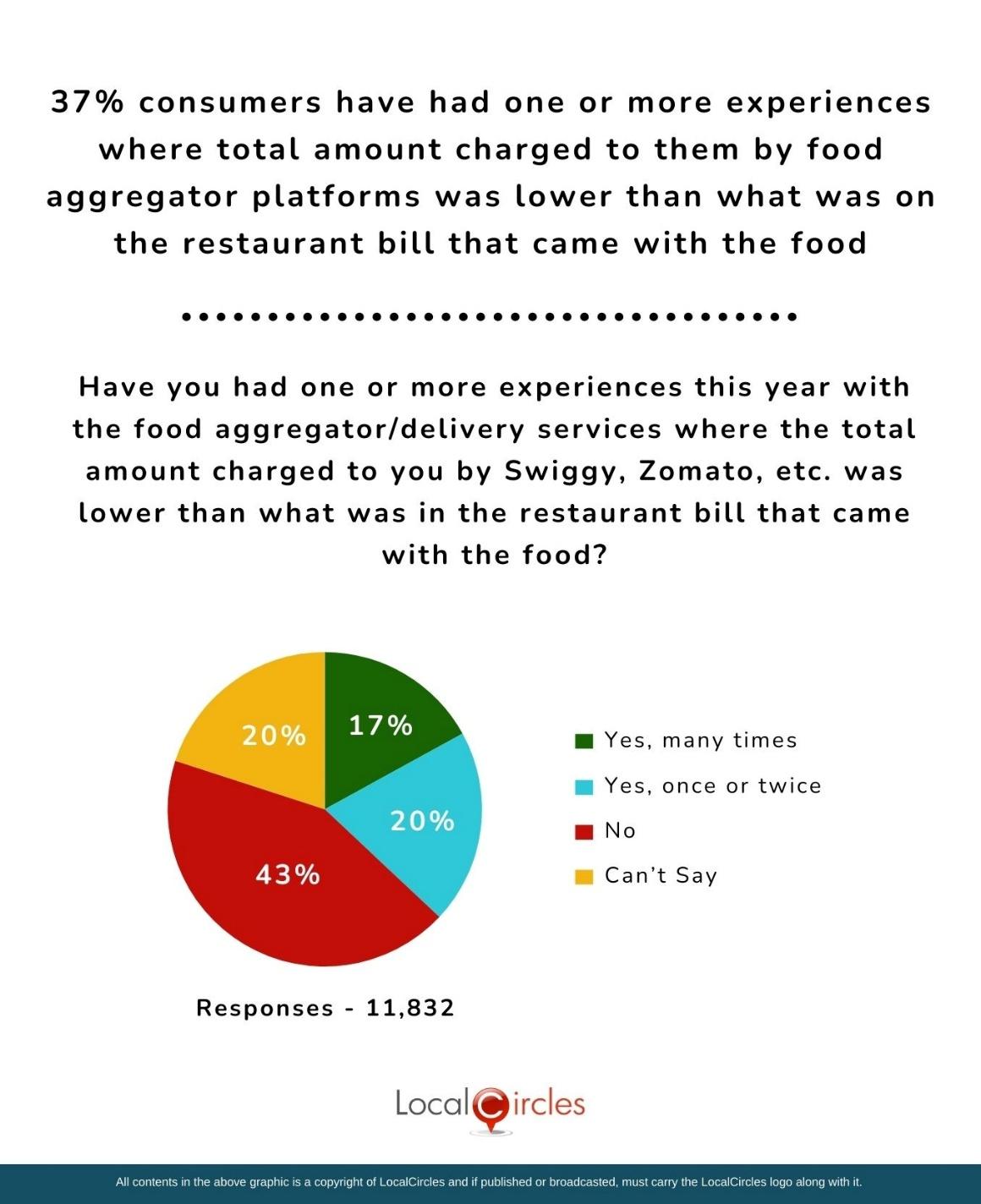
37% of consumers have had one or more experiences where total amount charge to them by food aggregator platforms was lower than what was on the restaurant bill that came with the food
On the other hand, the survey question on “have you had one or more experience this year with the food aggregator/delivery services where the total amount charged to you by Swiggy, Zomato, etc., was lower than what was in the restaurant bill that come with the food” 37% out of 11,832 respondents said they had benefited on one or more occasions. The break-up of data revealed 20% were beneficiaries on one or two occasions while 17% had benefitted several times. However, a large majority of 43% had reaped no such benefit while 20% were uncertain on this count. To sum up, 37% of consumers have had one or more experiences where total amount charge to them by food aggregator platforms was lower than what was on the restaurant bill that came with the food.
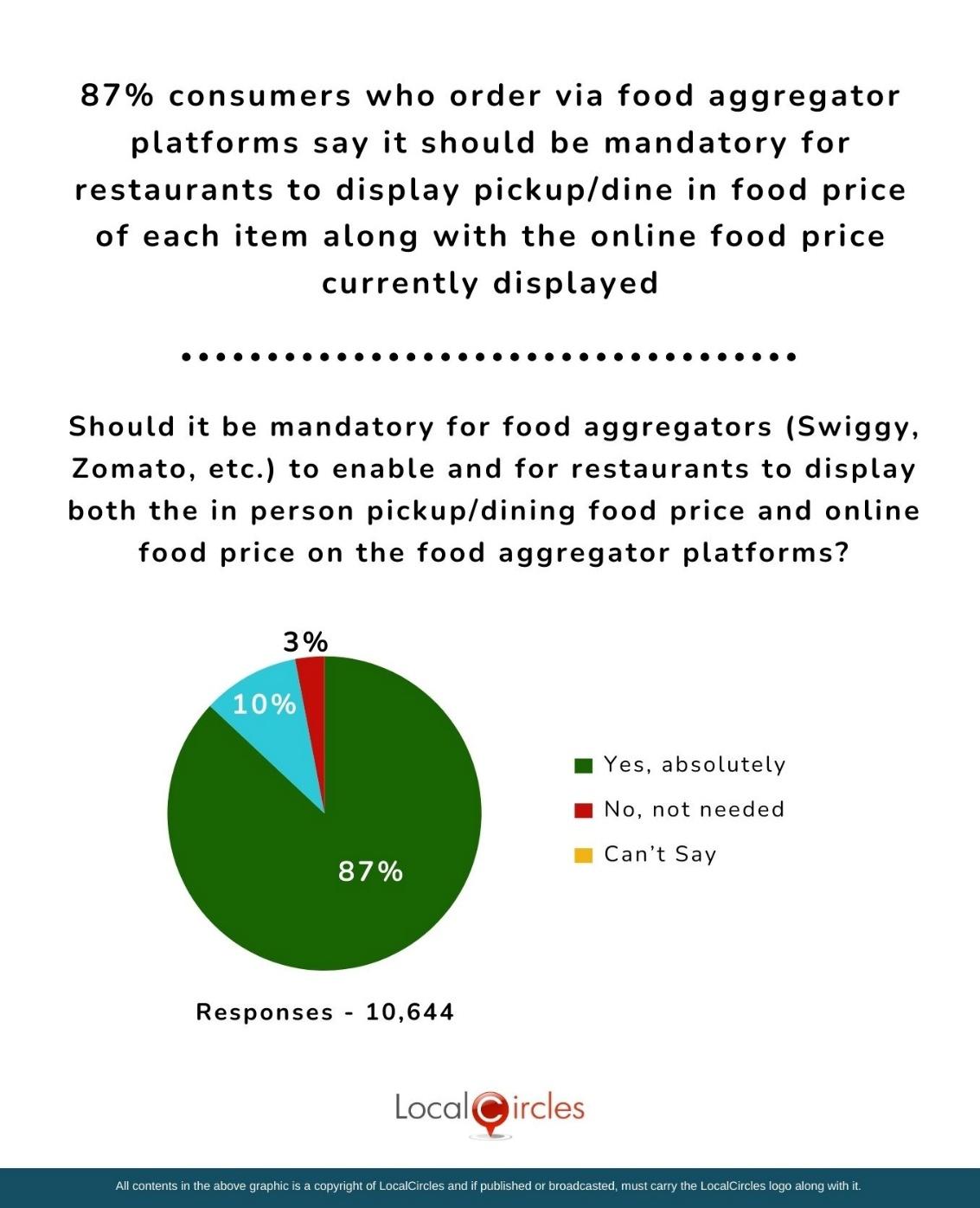
87% of consumers want restaurants to display pickup/ dine in food price and online food price on the food aggregator’s platform
The last survey question sought to know “should it be mandatory for food aggregators (Swiggy, Zomato, etc.) to enable and for restaurants to display both the in-person pickup/ dining food price and online food price on the food aggregator platforms” to which an overwhelming 87% responded “Yes, absolutely”. Of the 10,644 respondents to this query, only 10% responded that there was no such need, while 3% were undecided. To sum up, 87% of consumers want restaurants to display pickup/ dine in food price and online food price on the food aggregator’s platform.
In summary, it seems that the growth in the usage of app-based food delivery business is not necessarily resulting in improvement of any kind whether in the quality of service or quality of food delivered as over 95% out of 11,472 respondents had some complaint to share about the quality of food and food packaging delivered, leaving them disappointed. The survey also brings to fore that 55% of consumers surveyed who ordered through food aggregator platforms say food prices displayed and charged on the app are higher as compared to what is charged at the restaurant. This issue needs to be addressed as consumers feel dissatisfied when they are charged more for home delivery.
Food authorities need to step in to check the quality of food being delivered at consumers’ homes and offices as poor-quality food holds risk for their health. It is pointless setting standards for street vendors when even restaurants don’t follow healthy practices and deliver stale or badly packaged food to consumers. Lack of transparency in prices on dine-in, home delivery and online orders is also an unhappy experience for consumers. An off-putting experience more than 50% of respondents shared was receiving spilled, damaged or distorted food due to poor handling by delivery agents. This, many complained, has happened too many times in the last one year. There should be a proper mechanism for consumer complaints to be redressed, or no remedial action will be taken by either the food aggregator or the food outlet.
Survey Demographics
The survey received over 79,000 responses from consumers located in 359 districts of India. 61% respondents were men while 39% respondents were women. 45% respondents were from tier 1, 33% from tier 2 and 22% respondents were from tier 3, 4 and rural districts. The survey was conducted via LocalCircles platform, and all participants were validated citizens who had to be registered with LocalCircles to participate in this survey.
About LocalCircles
LocalCircles, India’s leading Community Social Media platform enables citizens and small businesses to escalate issues for policy and enforcement interventions and enables Government to make policies that are citizen and small business centric. LocalCircles is also India’s # 1 pollster on issues of governance, public and consumer interest. More about LocalCircles can be found on https://www.localcircles.com
For more queries - media@localcircles.com, +91-8585909866
All content in this report is a copyright of LocalCircles. Any reproduction or redistribution of the graphics or the data therein requires the LocalCircles logo to be carried along with it. In case any violation is observed LocalCircles reserves the right to take legal action.
Enter your email & mobile number and we will send you the instructions.
Note - The email can sometime gets delivered to the spam folder, so the instruction will be send to your mobile as well


