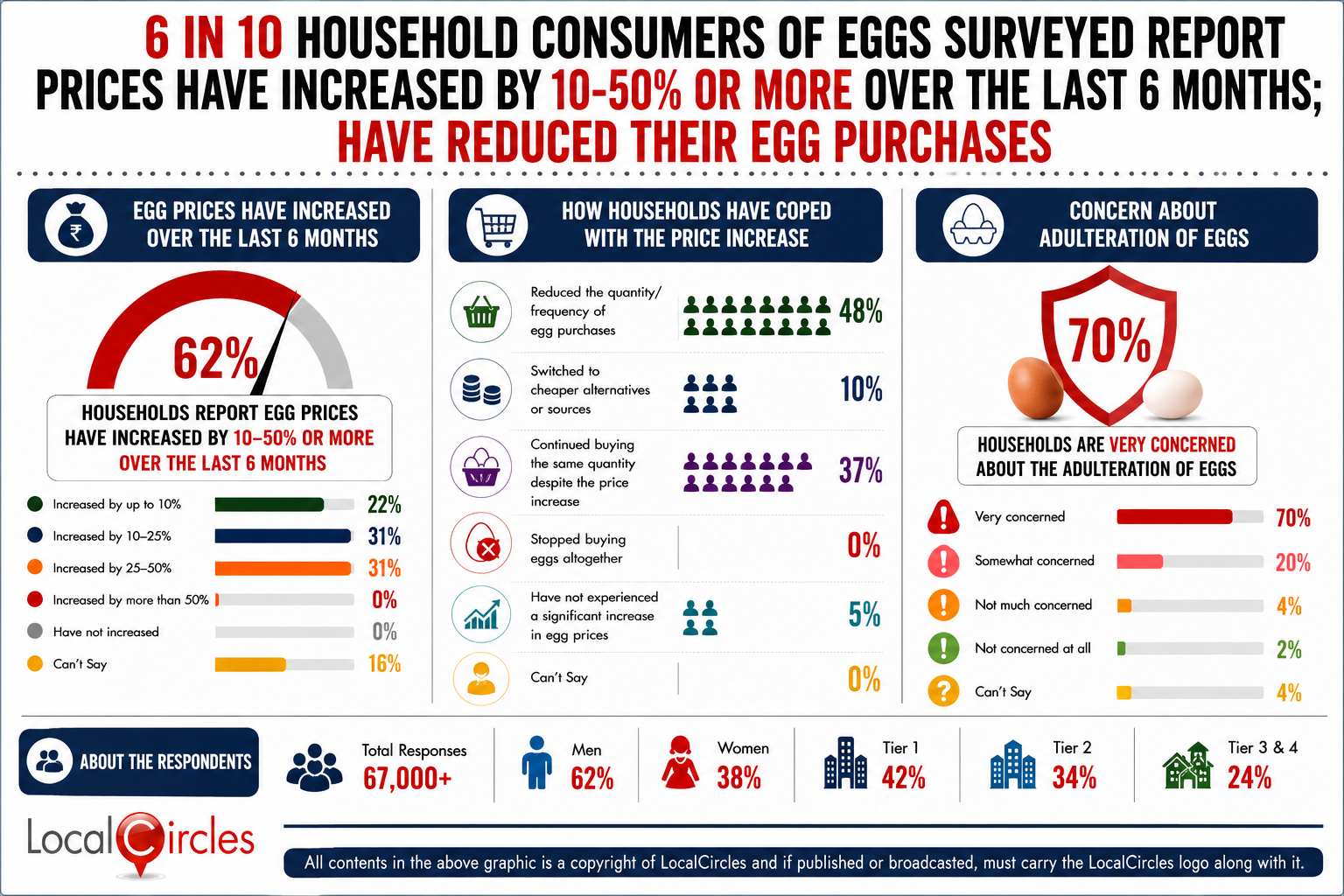
6 in 10 household consumers of eggs surveyed report prices have increased by 10-50% or more over the last 6 months; Have reduced their egg purchases
- ● 48% of household consumers of eggs surveyed have cut the quantity or frequency of egg purchases and 10% have switched to cheaper alternatives or sources
- ● 70% are very concerned about the adulteration of eggs in India
- ● Survey receives 67,000 responses from household consumers across 287 districts of India
September 3, 2026, New Delhi: The egg is India's cheapest source of animal protein and, for a large number of households, the only one that fits the monthly budget. Over the last six months that has begun to change. Farm-gate egg prices have touched an all-time high, retail rates in many cities have crossed levels households have not seen before, and the egg has moved from the kitchen table to the centre of a national debate on food, fuel and feed.
Ex-farm egg prices have risen to around Rs 7 per egg, a record, against roughly Rs 4.94 a year earlier. Retail prices now range between Rs 8.50 and Rs 9 per egg in most markets and have touched nearly Rs 14 per egg on some online platforms. That is a rise of 35-40% in a year. The National Egg Co-ordination Committee (NECC) declared rate had already climbed from Rs 558 per 100 eggs in September 2025 to Rs 686 per 100 eggs in December 2025, with retail rates in major consumption centres crossing Rs 800 per 100 eggs. Retail food inflation rose to 5.52% in July 2026 from 5.32% in June.
The pressure begins with feed, which accounts for 65-70% of the cost of producing an egg. Maize makes up 50-55% of poultry feed and now costs about Rs 26,500 per tonne against roughly Rs 14,000 three years ago, a fifth of that rise coming in the last five months. Soybean meal has moved to Rs 65,000 per tonne from Rs 40,000 and de-oiled rice bran to Rs 22,000 from Rs 12,000. Feed costs in July 2026 were 15% higher than a year earlier.
The reason most often cited for costlier maize is its diversion to ethanol under the Ethanol Blended Petrol programme. Maize allocated to distilleries rose from 8.3 lakh tonnes in 2022-23 to 125.75 lakh tonnes in 2024-25. Roughly 37% of India's 43.4 million tonne maize crop now goes to ethanol, a share projected to keep rising. India, long a maize exporter, shipped out only 5.56 lakh tonnes in 2024-25 against 34.53 lakh tonnes in 2022-23, and imported 9.70 lakh tonnes in the same year. Former Agriculture Secretary Siraj Hussain has argued that blending be held at E20 until its impact is assessed, warning that going beyond 20% could upset the balance between food, fuel and farm needs.
Supply has taken a parallel hit. Summer heat killed over 16.35 lakh birds by official count in the layer belt of coastal Andhra Pradesh and cut daily laying capacity there by close to 30%. The industry expects winter, when egg consumption traditionally rises, to be tighter still. The strain has already reached government feeding programmes. In Odisha, schools and anganwadi centres are buying eggs at Rs 9-10 against a government-fixed rate of Rs 7, with headmasters and cooks in several districts paying the difference themselves out of a mid-day meal allocation of Rs 11.15 per primary and Rs 14.74 per upper-primary child.
Price, however, is only half the story. In December 2025, a laboratory test commissioned by a consumer group reported traces of nitrofuran metabolites in a batch of branded eggs. Nitrofurans are antibiotics banned outright in food-producing animals. Food Safety and Standards Authority of India (FSSAI) ordered a nationwide surveillance and enforcement drive, directing food safety officers to draw egg samples for testing at 10 designated laboratories and to scrutinise marketing and labelling claims. FSSAI later clarified that eggs are safe to consume and called claims linking them to cancer risk misleading and scientifically unsupported. It explained that its extraneous maximum residue limit of 1.0 microgram per kg for nitrofuran metabolites is an enforcement benchmark, not a permission to use these drugs. It clarified that a move to align the standards with the European Union limit of 0.5 microgram per kg is under discussion.
Officials have acknowledged that the harder problem lies with unbranded eggs, where tracing the origin, the seller and the buyer is difficult. Most eggs sold in India are loose and unbranded, and carry no date of lay, no grade and no source label. When prices rise sharply and supply tightens, the incentive to push older or poorly stored stock into the market rises with them, and the consumer cannot tell the difference at the point of purchase.
Against this backdrop, LocalCircles conducted a national survey to understand how much egg prices have risen for households over the last six months, how households have coped with the increase, and how concerned they are about the adulteration of eggs. The survey received over 67,000 responses from household consumers of eggs located in 287 districts of India. The findings show that 62% of household consumers of eggs surveyed report a price rise of 10-50% or more, 48% have cut the quantity or frequency of their egg purchases, and 70% are very concerned about the adulteration of eggs. The key findings of the survey are detailed below.
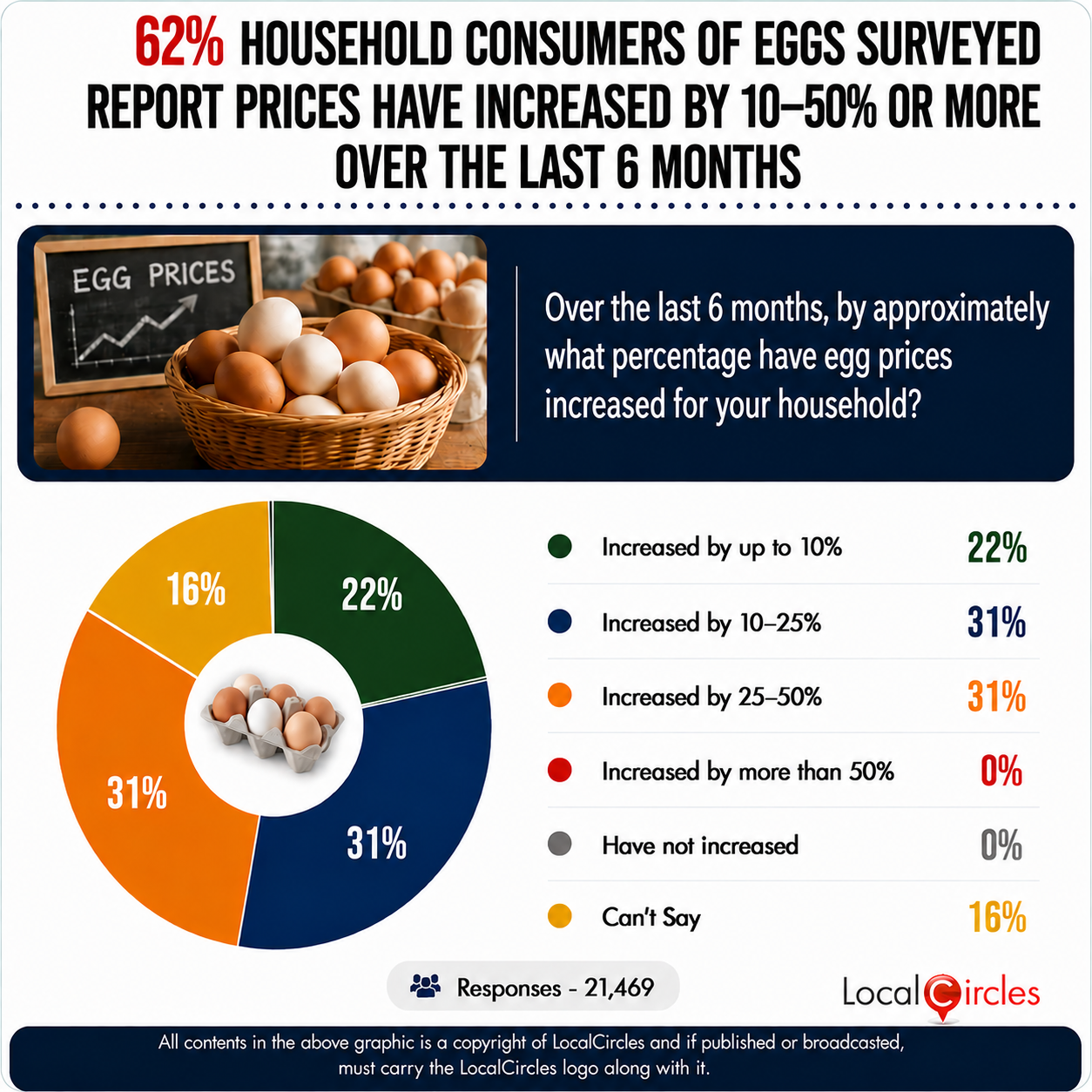
62% household consumers of eggs surveyed report prices have increased by 10-50% or more over the last 6 months
To establish how much of the price rise has actually reached the kitchen, the survey asked, “Over the last 6 months, by approximately what percentage have egg prices increased for your household?” This question received 21,469 responses. In response, 31% said prices had increased by 10-25% and an equal 31% said they had increased by 25-50%. Another 22% reported an increase of up to 10%, while 16% could not say. None reported an increase of more than 50%, and none said prices had not increased at all. Taken together, 62% of household consumers of eggs surveyed report a price rise of 10-50%, and 84% report a price rise of some degree. The findings are significant on two counts. Not a single respondent said egg prices had stayed flat, which makes this a near-universal increase rather than a regional or seasonal one. And the increase households report broadly matches the 35-40% year-on-year rise recorded at the farm gate, indicating that the feed and supply shock has been passed through to the consumer almost in full.
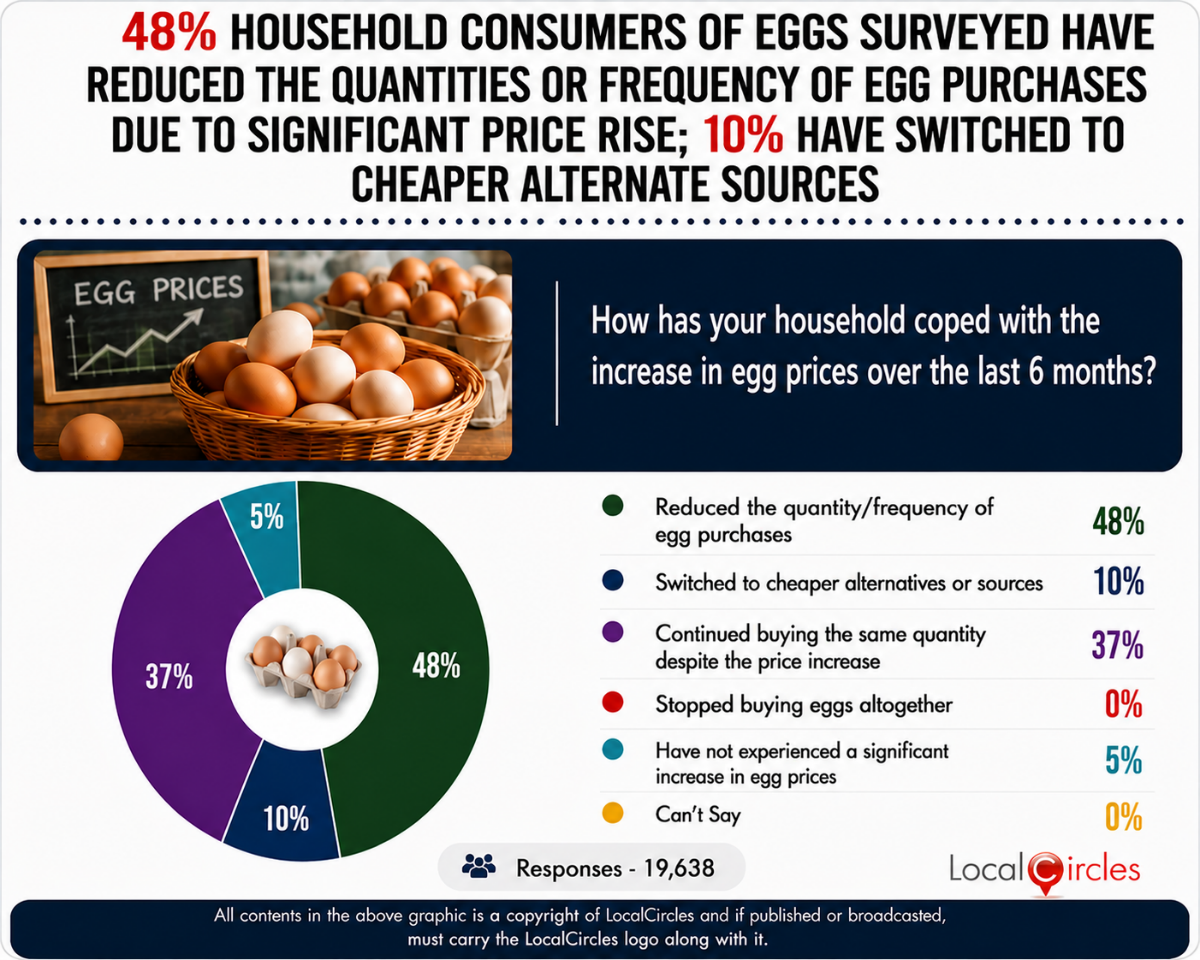
48% household consumers of eggs surveyed have reduced the quantities or frequency of egg purchases due to significant price rise; 10% have switched to cheaper alternate sources
The survey next sought to establish what households have done about it, asking, “How has your household coped with the increase in egg prices over the last 6 months?” This question received 19,638 responses. In response, 48% said they had reduced the quantity or frequency of egg purchases and 10% said they had switched to cheaper alternatives or sources. Another 37% said they had continued buying the same quantity despite the price increase, while 5% said they had not experienced a significant increase. None reported stopping egg purchases altogether.
In effect, 58% of household consumers of eggs surveyed have changed what they buy or where they buy it from because of price. That is a nutrition outcome, not only a household budget one. The egg is the entry-level protein for most Indian families, and a cut in egg purchases is rarely replaced by a costlier protein. The 10% who have moved to cheaper sources are also the group most exposed on quality, since the cheapest eggs in any market are the loose, unbranded and unlabeled ones.
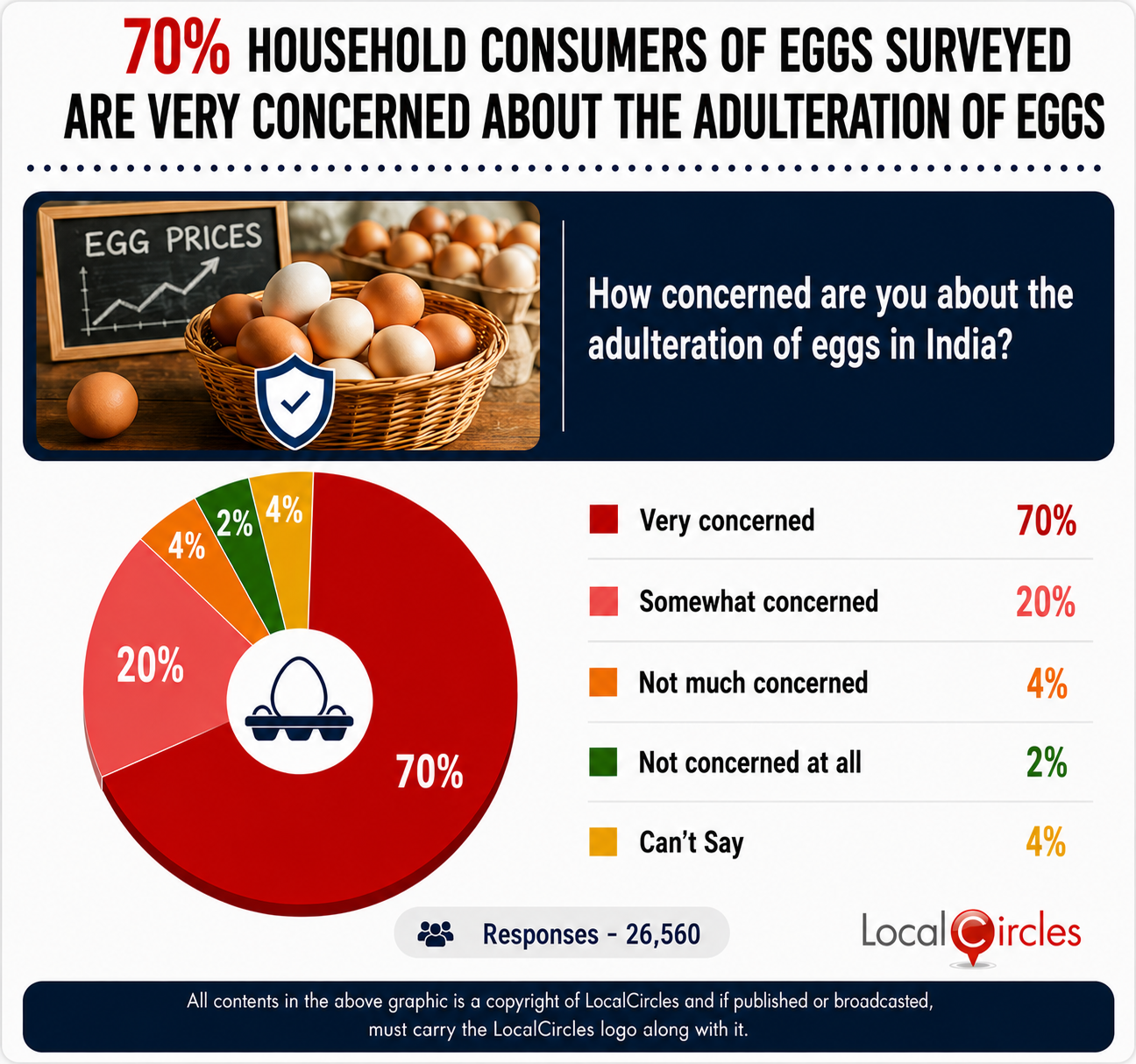
70% household consumers of eggs surveyed are very concerned about the adulteration of eggs
With the FSSAI egg safety drive still under way, the survey finally sought to gauge consumer confidence in what is being sold, asking, “How concerned are you about the adulteration of eggs in India?” This question received 26,560 responses. In response, 70% said they were very concerned and 20% said they were somewhat concerned. Only 4% said they were not much concerned and 2% not concerned at all, while 4% could not say.
A combined 90% of household consumers of eggs surveyed are concerned about the adulteration of eggs, against just 6% who are not. Levels of concern this high are usually seen for milk, spices and edible oil, and their appearance for a product as basic as the egg points to an erosion of trust in the supply chain rather than in any single brand. The gap consumers are responding to is a real one. An egg sold loose carries no date of lay, no grade, no farm identity and no antibiotic-use declaration, so a household has no way to verify what it is buying and no way to trace it back if something is wrong.
In summary, the survey findings indicate that the egg price shock of the last six months has reached almost every household that buys eggs, and it is already changing how much the families eat. 62% of household consumers of eggs surveyed report a price rise of 10-50% over six months and 84% report a rise of some degree, with not one respondent saying prices have held steady. Nearly half have cut the quantity or frequency of their egg purchases and another 10% have moved to cheaper alternatives or sources. Alongside this, 70% are very concerned about the adulteration of eggs and 90% are concerned in some measure. The two findings are connected. When the cheapest protein in the household basket becomes 35-40% costlier in a year, families buy less of it and buy it from wherever it is cheapest, which is precisely where traceability and quality assurance are weakest.
These findings carry an important signal for the Ministry of Consumer Affairs, the Ministry of Fisheries, Animal Husbandry and Dairying, FSSAI and the Ministry of Petroleum and Natural Gas as the debate over maize, ethanol and food prices continues. The citizen pulse is clear that the price of the egg is no longer a poultry-sector matter but a household nutrition one. LocalCircles will be escalating these findings to the concerned Ministries, to FSSAI and to State Food Safety Commissioners so that the citizen pulse can inform how egg prices and egg safety are handled. LocalCircles is urging that the maize requirement of the poultry sector be protected while ethanol blending targets are reviewed and that maize imports be eased as an interim measure.Also, the FSSAI egg safety drive on nitrofuran and other antibiotic residues needs to be completed with the results placed in the public domain. The residue limit needs to be aligned with the stricter European Union standard as being studied, and that date of lay, grade and source be made mandatory on egg trays and cartons so that a household buying eggs knows what it is paying for.
Survey Demographics
The survey received over 67,000 responses from household consumers of eggs located in 287 districts of India. 62% respondents were men while 38% respondents were women. 42% respondents were from tier 1, 34% from tier 2 and 24% respondents were from tier 3 & 4 districts. The survey was conducted via LocalCircles platform, and all participants were validated citizens who had to be registered with LocalCircles to participate in this survey.
About LocalCircles
LocalCircles, India’s leading Community Social Media platform enables citizens and small businesses to escalate issues for policy and enforcement interventions and enables Government to make policies that are citizen and small business centric. LocalCircles is also India’s # 1 pollster on issues of governance, public and consumer interest. More about LocalCircles can be found on https://www.localcircles.com
For more queries - media@localcircles.com, +91-8585909866
All content in this report is a copyright of LocalCircles. Any reproduction or redistribution of the graphics or the data therein requires the LocalCircles logo to be carried along with it. In case any violation is observed LocalCircles reserves the right to take legal action.
Enter your email & mobile number and we will send you the instructions.
Note - The email can sometime gets delivered to the spam folder, so the instruction will be send to your mobile as well


