Using AI in eCommerce: 7 in 10 online shoppers surveyed want to use AI within the next 12 months to check authenticity of products/sellers and get personalised recommendations
- ● 7 in 10 online shoppers say finding the right product/service is most time consuming
- ● 5 in 10 of them also struggle with finding the best price/delivery time/return policy combination
- ● Nationwide survey by LocalCircles gathers 75,000 responses from online shoppers across 332 districts
February 17, 2026, New Delhi: AI platforms, startups, experts and policymakers from around the world have gathered in New Delhi to discuss AI and its impact on business, society, development and economy.
Artificial Intelligence (AI) is fundamentally reshaping e-commerce in India and globally by transforming how consumers discover, evaluate, and purchase products. AI technologies are now embedded across the entire value chain—from product recommendations and search to pricing, logistics, and customer service—making online shopping more personalized, efficient, and data-driven.
One of the most visible applications of AI is personalized recommendation systems. Platforms such as Amazon claim to use machine learning models to analyze browsing behavior, purchase history, and contextual signals to suggest relevant products. These systems significantly improve conversion rates and average order value. Similarly, Indian platforms like Flipkart and Myntra claim to leverage AI to curate personalized homepages, festive collections, and stylist-based recommendations. Myntra claims its AI-powered visual search and virtual try-on tools enhance user engagement, particularly in fashion, where fit and aesthetics are critical.
AI is also redefining search and discovery. Generative AI assistants now allow users to make conversational queries such as "I need a gift under INR 1,500 for someone who likes fitness." Instead of returning thousands of listings, AI generates curated shortlists. This reduces search friction and mirrors the role of a human sales assistant. Globally, AI integration has sparked a strategic shift in the control of the online shopping journey. Technology firms such as Google and AI-native platforms like Perplexity AI are developing systems that can search products, compare prices, summarize reviews, and potentially complete purchases without redirecting users to retailer websites. Google's AI Overviews exemplify this "zero-click shopping" model, where the consumer remains within the search ecosystem. This development creates tension with retailers, who risk becoming back-end inventory providers rather than consumer-facing destinations.
Retailers argue that AI intermediaries should direct traffic to their platforms, where they can manage brand experience, collect first-party data, cross-sell products, and maintain customer relationships. High-profile disputes—such as Amazon's reported conflict with Perplexity over automated purchasing—highlight the growing competition over customer ownership and transaction control.
Beyond front-end experiences, AI plays a crucial role in operations and supply chain management. Companies such as Alibaba Group integrate AI across demand forecasting, warehouse automation, and last-mile logistics through advanced analytics and robotics. AI-powered inventory optimization reduces stockouts and overstocking, while predictive models enhance delivery efficiency during large-scale events like Singles' Day.
AI-driven chatbots and virtual assistants further improve customer service by providing 24/7 support, handling returns, tracking orders, and resolving complaints. Voice shopping and regional language interfaces are particularly impactful in India, expanding access to new digital consumers. Additionally, AI strengthens fraud detection systems by identifying suspicious transaction patterns in real time, protecting both merchants and customers.
Industry studies suggest that AI-driven personalization can increase revenues and conversion rates by high double-digit percentages, depending on implementation. Seasonal data from global markets indicates that AI-influenced recommendations contribute significantly to online sales growth. Thus, AI has become central to modern e-commerce strategy. In India, marketplaces such as Flipkart, Myntra, and Amazon India claim to be deploying AI to enhance personalization, search, and operational efficiency. Globally, the competition between AI platforms and traditional retailers over customer ownership signals a structural transformation. As AI continues to evolve, it will not only optimize transactions but redefine the architecture of digital commerce itself.
Through a nationwide survey, LocalCircles has strived to find out how consumers shop online, what are the aspects they find most difficult or time-consuming. Also, whether and how consumers use AI for online shopping and what they expect from AI tools. The survey received over 75,000 responses from consumers located in 332 districts of India. 67% respondents were men while 33% respondents were women. 44% respondents were from tier 1, 32% from tier 2 and 24% respondents were from tier 3, 4, 5 & rural districts.
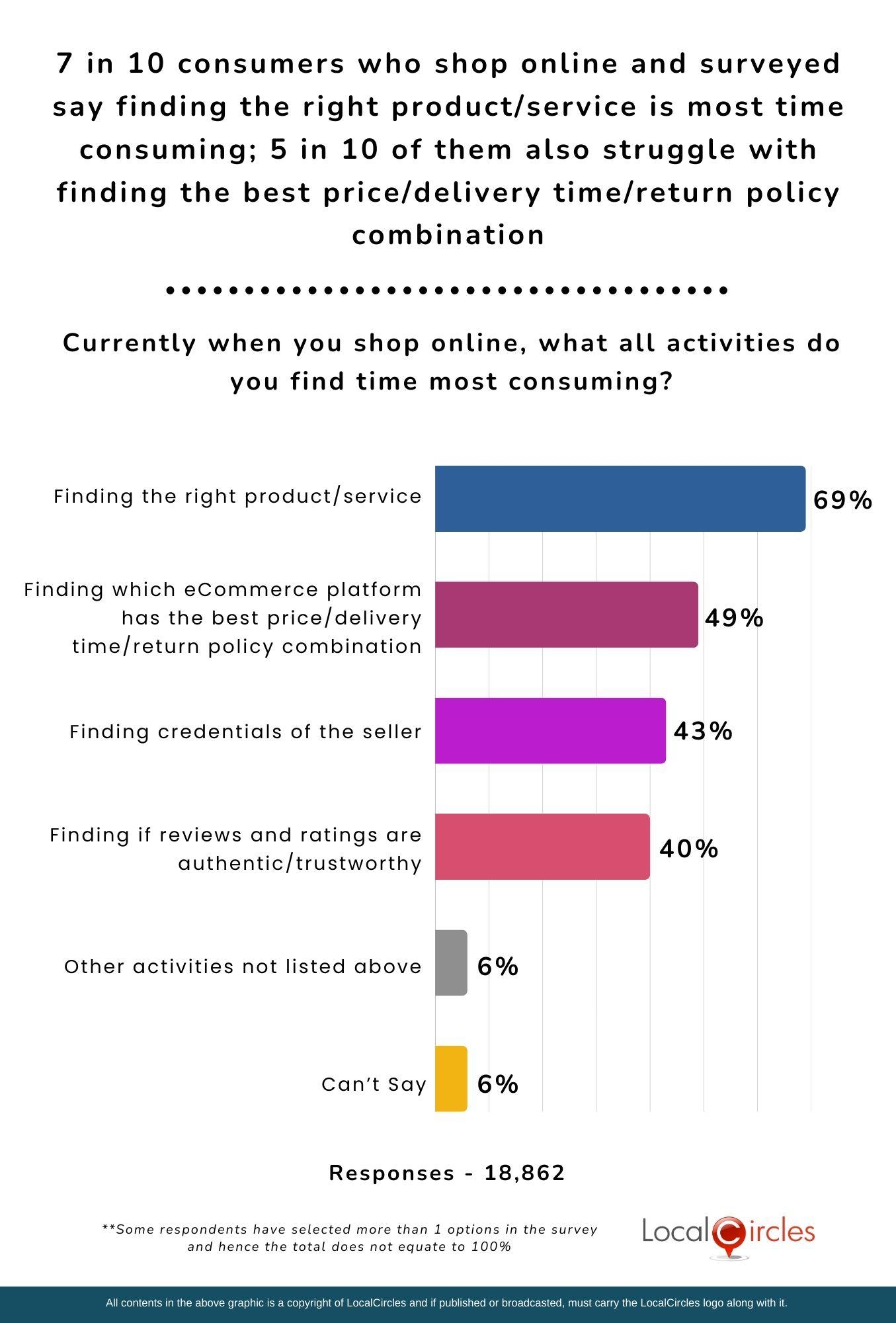
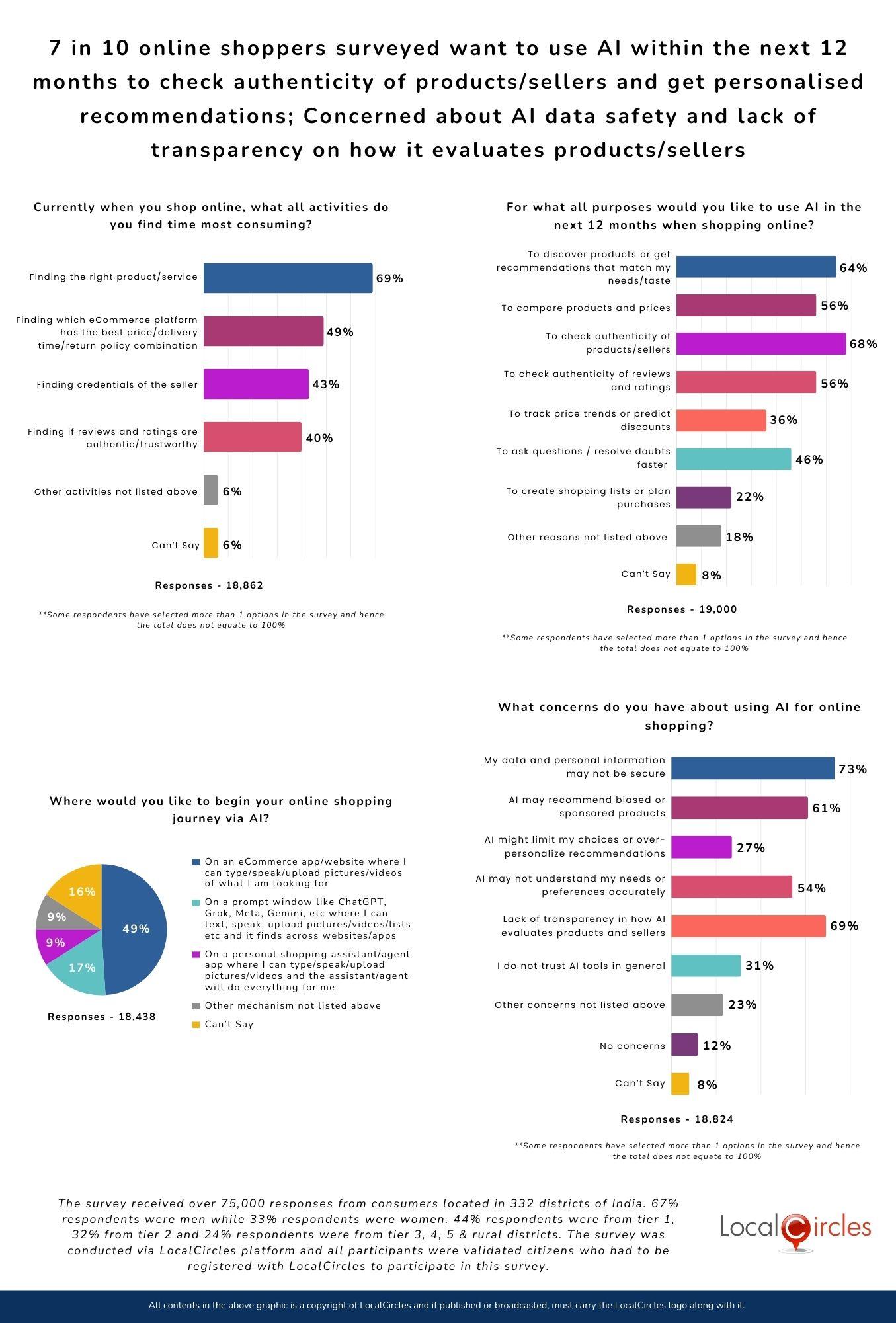
7 in 10 consumers who shop online and surveyed say finding the right product/service is most time consuming; 5 in 10 of them also struggle with finding the best price/delivery time/return policy combination
As not all online shopping platforms offer the same range, brands of products and terms of exchange or cancellation facilities, the survey asked, "Currently when you shop online, what all activities do you find most time consuming?" Some out of 18,862 who responded to the question indicated more than one option. The largest group of 69% respondents indicated "find the right product/service" is most time consuming; 49% of respondents indicated "finding which eCommerce platform has the best price/delivery time/return policy combination"; 43% of respondents indicated "finding credentials of the seller"; 40% of respondents indicated "finding if reviews and ratings are authentic/trustworthy"; 6% of respondents indicated "other activities not listed above"; and 6% of respondents did not give a clear answer. To sum up, 7 in 10 consumers who shop online and surveyed say finding the right product/service is most time consuming; 5 in 10 of them also struggle with finding the best price/delivery time/return policy combination.
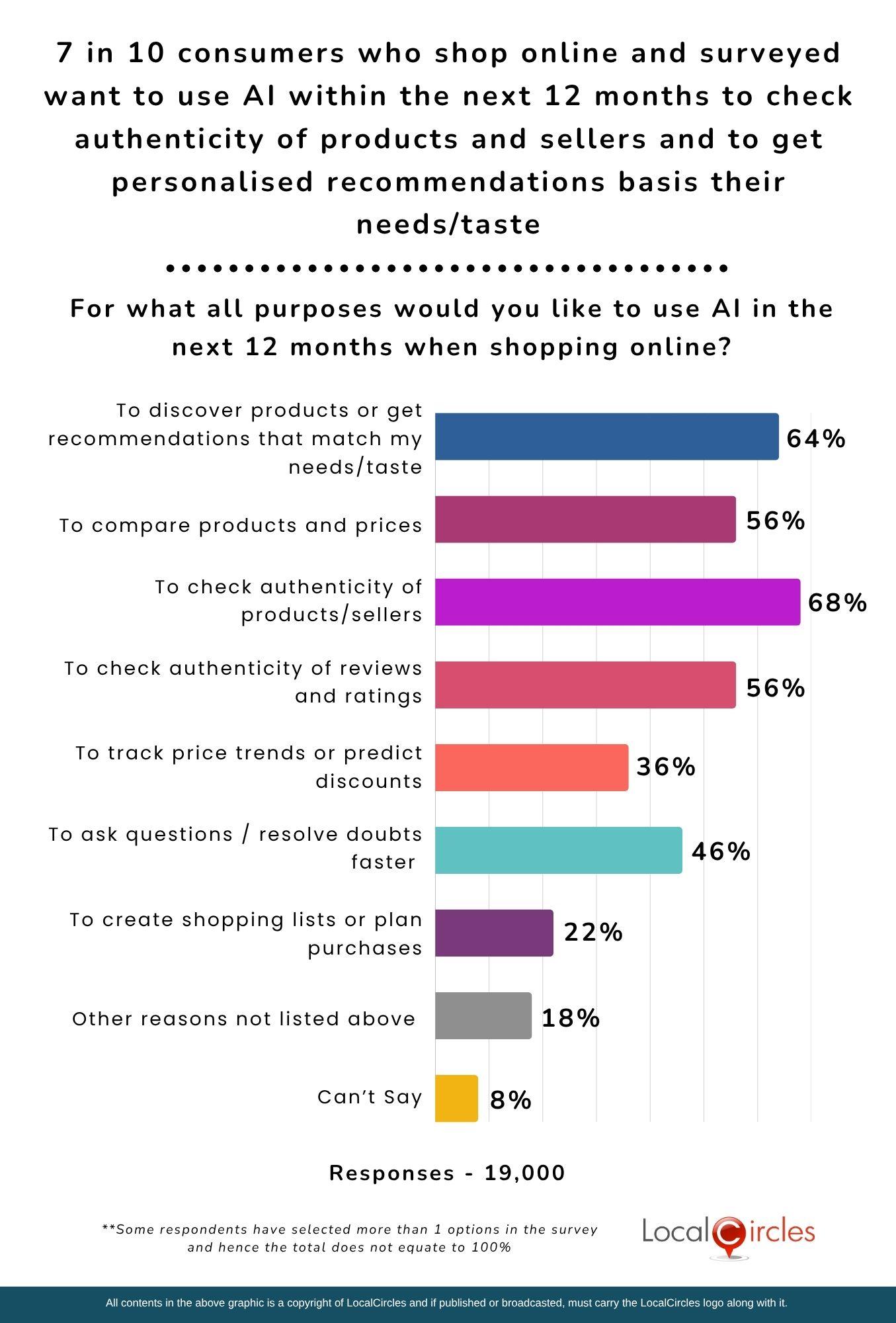
7 in 10 consumers who shop online and surveyed want to use AI within the next 12 months to check authenticity of products and sellers and to get personalised recommendations based on their needs/taste
As mentioned, AI is being used by online shoppers for multiple purposes. The survey asked online shoppers, "For what all purposes would you like to use AI in the next 12 months, when shopping online?" Some among 19,000 respondents to the question indicated more than one option with majority or 68% indicating that they will be using AI "to check authenticity of products/sellers"; 64% of respondents indicated that they will use AI "to discover products or get recommendations that match my needs/taste"; 56% of respondents indicated that they use it "to compare products and prices"; 56% of respondents indicated that they would use AI "to check authenticity of reviews and ratings"; 46% of respondents indicated "to ask questions/resolve doubts faster"; 36% of respondents indicated "to track price trends or product discounts"; 22% of respondents indicated "to create shopping lists or plan purchases"; 18% of respondents indicated "other reasons not listed above" and 8% of respondents did not give a clear answer. To sum up, 7 in 10 consumers who shop online and have been surveyed want to use AI within the next 12 months to check authenticity of products and sellers and to get personalised recommendations based on their needs/taste.
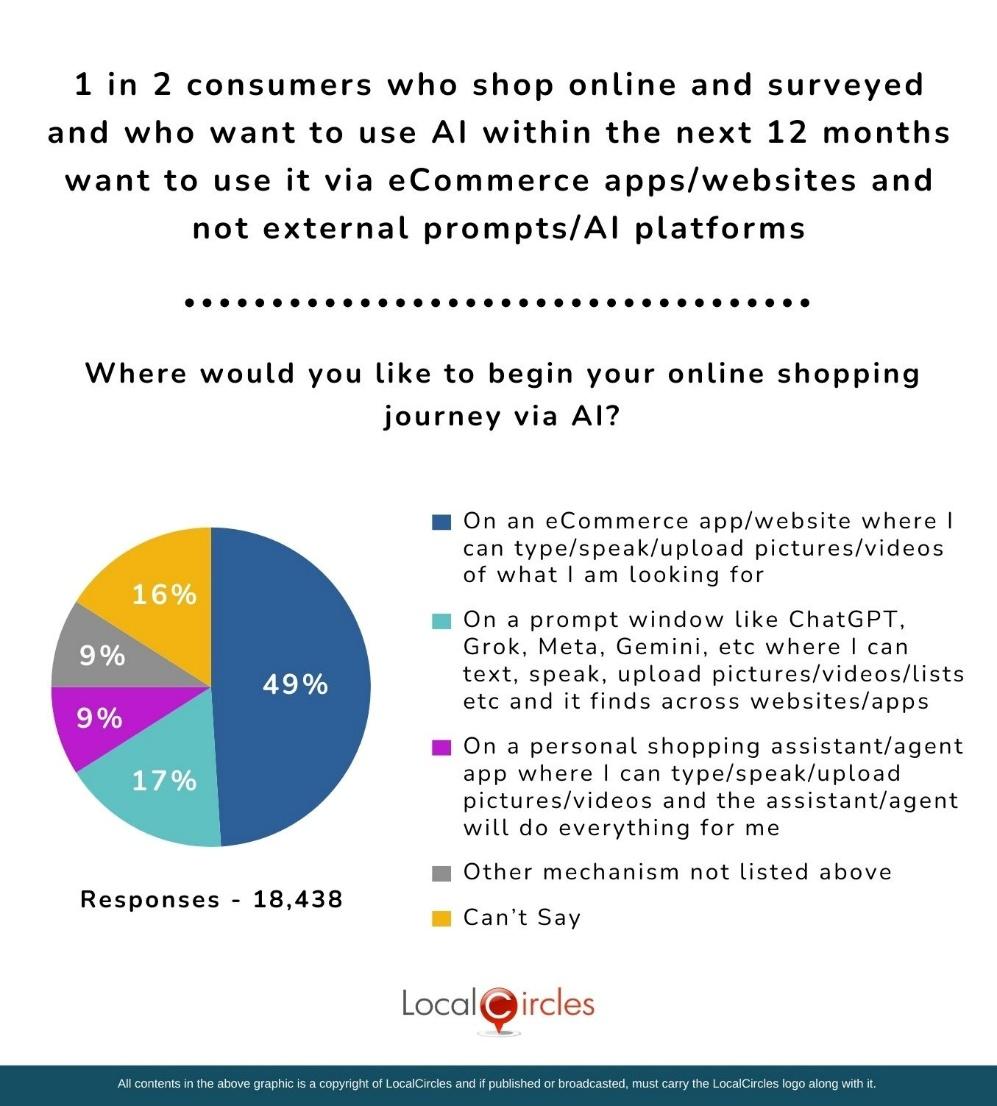
1 in 2 consumers who shop online and surveyed and who want to use AI within the next 12 months want to use it via eCommerce apps/websites and not external prompts/AI platforms
As not everyone is aware of AI use in online shopping, the survey asked consumers, "Where would you like to begin your online shopping journey via AI?" The question received 18,438 responses with 49% indicating "on an eCommerce app/website where I can type/speak/upload pictures/videos of what I am looking for"; 17% of respondents indicated "on a prompt window like ChatGPT, Grok, Meta, Gemini, etc., where I can text, speak, upload pictures/videos/lists, etc., and it finds across websites/apps"; 9% of respondents indicated that "on a personal shopping assistant/agent app where I can type/speak/upload pictures/videos and the assistant/agent will do everything for me"; 9% of respondents indicated "other mechanisms not listed above" and 16% of respondents did not give a clear answer. To sum up, 1 in 2 consumers who shop online and surveyed and who want to use AI within the next 12 months want to use it via eCommerce apps/websites and not external prompts/AI platforms.
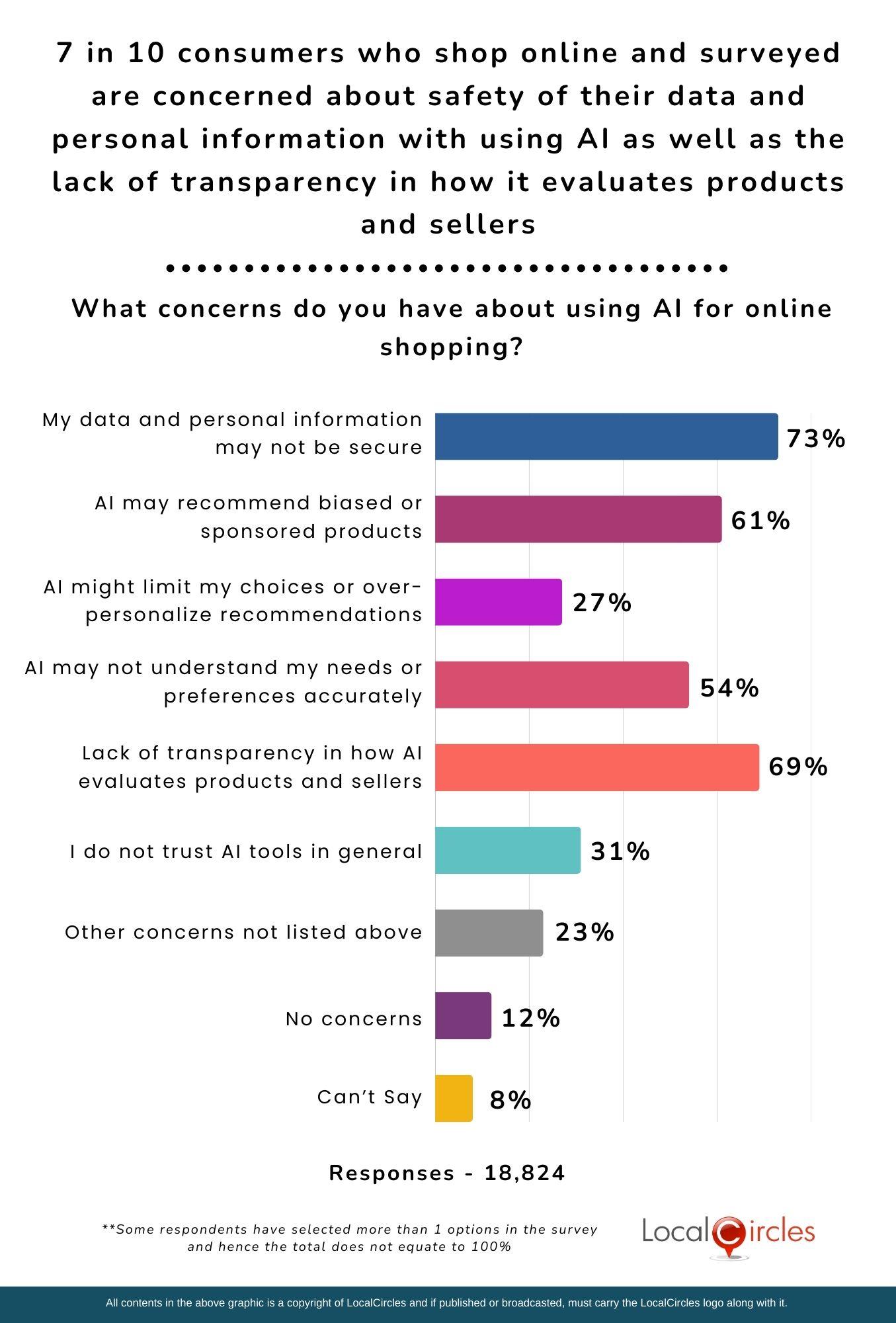
7 in 10 consumers who shop online and have been surveyed, are concerned about safety of their data and personal information using AI as well as the lack of transparency in how it evaluates products and sellers
Given the number of sponsored, influenced or fake reviews and recommendations found on the various platforms, consumers have considerable concerns about how much to rely on use of AI when shopping for products or services online. The survey next asked consumers, “What concerns do you have about using AI for online shopping?” Some among 18,824 indicated more than one option. The largest group or 73% indicated that they fear “my data and personal information may not be secure”; 69% of respondents indicated that “lack of transparency in how AI evaluates products and sellers”; 61% of respondents indicated that “AI may recommend biased or sponsored products”; 54% of respondents indicated that “AI may not understand my needs or preferences accurately”; 31% of respondents indicated “I do not trust AI tools in general”; 27% of respondents indicated that “AI might limit my choices or over personalize recommendations”; 23% of respondents indicated that they have “other concerns not listed above”; 12% of respondents indicated that they have “no concerns”; and 8% of respondents did not give a clear answer. To sum up, 7 in 10 consumers who shop online and surveyed, are concerned about safety of their data and personal information using AI as well as the lack of transparency in how it evaluates products and sellers.
In summary, the study reveals that 7 in 10 of those who shop online and surveyed say finding the right product/service is most time consuming. In fact, 5 in 10 of them also struggle with finding the best price/delivery time/return policy combination. The result is, 7 in 10 consumers who shop online and surveyed, want to use AI within the next 12 months to check authenticity of products and sellers and to get personalised recommendations based on their needs/taste.
However, 1 in 2 consumers surveyed who shop online and want to use AI within the next 12 months, want to use it via eCommerce apps/websites and not external prompts/AI platforms. The study reveals that 7 in 10 consumers who shop online and surveyed, are concerned about safety of their data and personal information using AI as well as the lack of transparency in how it evaluates products and sellers. Interestingly, the study conducted post government notifying rules for implementing the Digital Personal Data Protection Act, shows that consumers still fear that use of AI for online shopping could lead to data and personal information leak. As AI gets integrated into online shopping, all platforms must take into account the consumer preferences highlighted in this study so they solve the right problem and enhance the shopping experience.
Survey Demographics
The survey received over 75,000 responses from consumers located in 332 districts of India. 67% respondents were men while 33% respondents were women. 44% respondents were from tier 1, 32% from tier 2 and 24% respondents were from tier 3, 4, 5 & rural districts. The survey was conducted via LocalCircles platform, and all participants were validated citizens who had to be registered with LocalCircles to participate in this survey.
About LocalCircles
LocalCircles, India’s leading Community Social Media platform enables citizens and small businesses to escalate issues for policy and enforcement interventions and enables Government to make policies that are citizen and small business centric. LocalCircles is also India’s # 1 pollster on issues of governance, public and consumer interest. More about LocalCircles can be found on https://www.localcircles.com
For more queries - media@localcircles.com, +91-8585909866
All content in this report is a copyright of LocalCircles. Any reproduction or redistribution of the graphics or the data therein requires the LocalCircles logo to be carried along with it. In case any violation is observed LocalCircles reserves the right to take legal action.
Enter your email & mobile number and we will send you the instructions.
Note - The email can sometime gets delivered to the spam folder, so the instruction will be send to your mobile as well


