43% prospective vehicle buyers surveyed may defer or avoid vehicle purchases in the next 12 months due to concerns over E20 petrol and upcoming E30 transition
- ● Only 6% of prospective vehicle buyers surveyed plan to buy a new petrol vehicle in the next 12 months, less than half of the 14% who plan to buy a new electric or hybrid vehicle
June 16, 2026, New Delhi: India’s automobile market is, on the surface, in robust health. Vehicle retail sales touched a record 25.31 lakh units in May 2026, up 9.55% year-on-year, with passenger vehicle registrations at an all-time monthly high of over 4 lakh units, per FADA data. Yet beneath this momentum, a fuel-policy overhang is beginning to weigh on purchase decisions. Ever since the nationwide rollout of E20 petrol was completed in April 2025, and more so after the Government notified standards for blends of up to 30% ethanol, citizens across LocalCircles and other social media platforms like X, Reddit, Facebook auto groups and Quora have been raising concerns about reduced mileage, unusual wear & tear, and uncertainty over whether a petrol vehicle bought today will remain fully compatible with the fuel sold at pumps two or three years from now. Online petitions seeking the return of ethanol-free or lower-ethanol petrol continue to gather support, even after the Supreme Court in September 2025 dismissed a PIL seeking continued availability of ethanol-free petrol.
These concerns are not anecdotal alone. The LocalCircles E20 petrol experience survey released earlier this month, which received over 44,000 responses from across 277 districts of India, found that 6 in 10 owners of petrol vehicles purchased in 2023-2024 — the very segment expected to be fully E20-compatible — reported that their vehicle’s fuel efficiency/mileage had reduced by over 10% since early 2025, while 43% confirmed an increase in wear & tear or need for repairs with regards to engine, fuel line, tank, carburettor, fuel pump, injectors, etc. The same research found that a majority of owners of older (pre-2023) vehicles had incurred additional expenditure of ₹5,000-25,000 due to reduced mileage and/or increased repairs.
The Government’s policy direction, meanwhile, is firmly towards higher blends. In May 2026, the Bureau of Indian Standards notified IS 19850:2026, covering technical specifications for E22, E25, E27 and E30 ethanol-petrol blends; the Ministry of Petroleum and Natural Gas has mandated a minimum Research Octane Number (RON) of 95 for all E20 petrol sold from April 1, 2026; and the Automotive Research Association of India (ARAI) has been asked to study how E25 affects engine life and fuel efficiency in current E10- and E20-compatible vehicles. The Government has committed to E20 until October 2026, with decisions on higher blends to follow further studies and consultations, and a proposal to add isobutane to diesel is also under evaluation. Union Petroleum Minister Hardeep Singh Puri has maintained that ethanol-blended fuel has minimal impact on vehicles; however, with even two-wheeler makers like Hero MotoCorp and TVS advising that older models may require modifications, many prospective buyers remain unconvinced.
The uncertainty is already visible in what buyers are choosing. Electric vehicles crossed an 11% share of total vehicle retail sales in May 2026, with electric cars at a record 7% of car sales; EV sales in FY2026 crossed 2.45 million units, growing 25% year-on-year; and hybrid car sales more than doubled in the first quarter of FY2026, as buyers look to hedge fuel-cost and fuel-policy risk. Against this backdrop, LocalCircles conducted a fresh national survey to understand what kind of vehicle, if any, prospective buyers are likely to purchase in the next 12 months given the E20 petrol situation and the announced migration to E30.
The vehicle purchase intent survey received over 28,000 responses from prospective vehicle buyers located across 311 districts of India. 66% respondents were men while 34% respondents were women. 42% of respondents were from tier 1, 31% from tier 2 and 27% respondents were from tier 3, 4, 5 & rural districts.
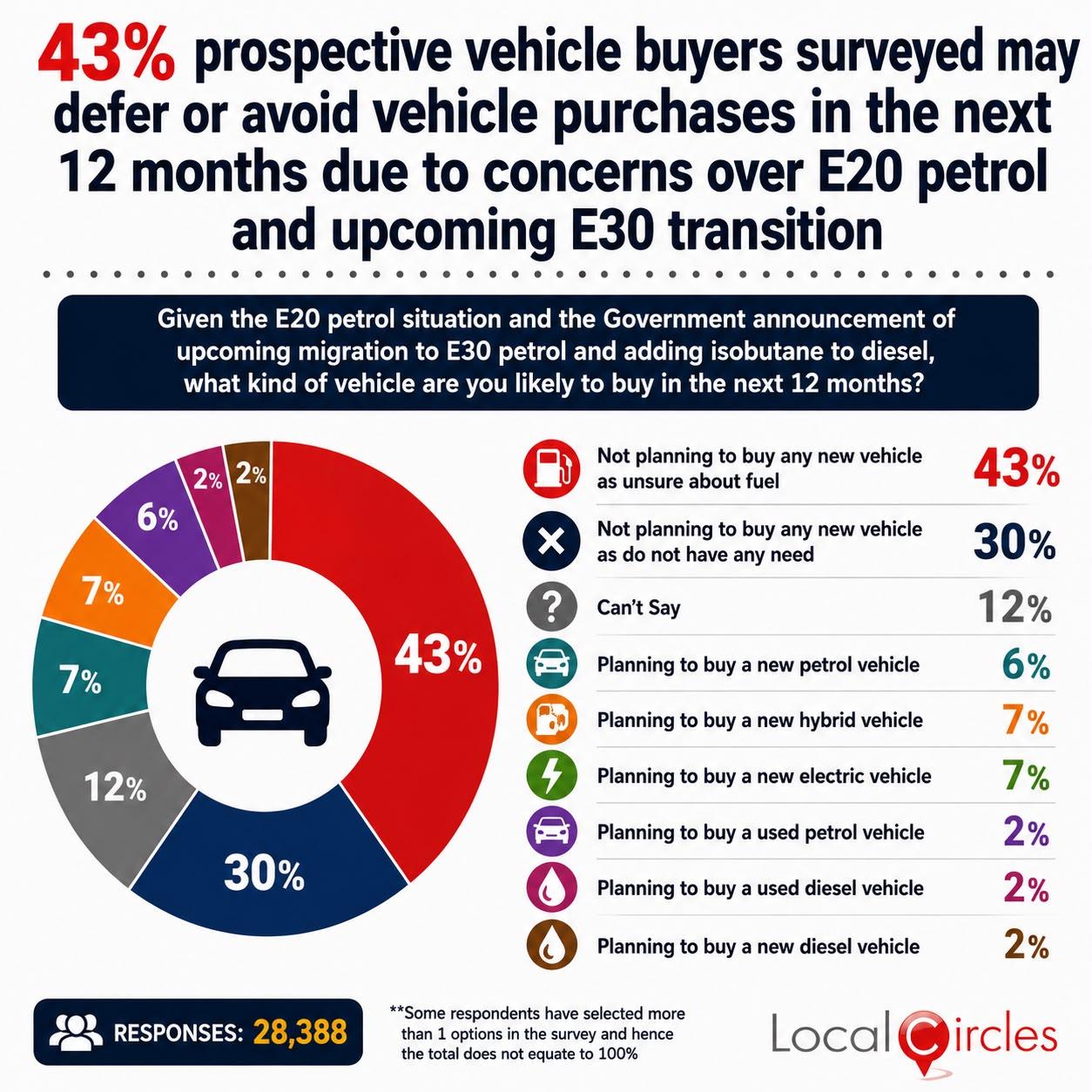
43% prospective vehicle buyers surveyed may defer or avoid vehicle purchases in the next 12 months due to concerns over E20 petrol and upcoming E30 transition
The survey asked prospective vehicle buyers, “Given the E20 petrol situation and the Government announcement of upcoming migration to E30 petrol and adding isobutane to diesel, what kind of vehicle are you likely to buy in the next 12 months?” Out of 28,388 who responded to the question, 43% stated that they are “not planning to buy any new vehicle as unsure about fuel” while 30% are “not planning to buy any new vehicle as do not have any need”; 2% are “planning to buy a used petrol vehicle”; 2% are “planning to buy a used diesel vehicle”; 7% are “planning to buy a new electric vehicle”; 7% are “planning to buy a new hybrid vehicle”; 6% are “planning to buy a new petrol vehicle”; 3% are “planning to buy a new diesel vehicle”; and 12% couldn’t say. Some respondents selected more than one option in the survey and hence the responses do not equate to 100%. To sum up, 43% of prospective vehicle buyers surveyed may defer or avoid vehicle purchases in the next 12 months due to uncertainty over fuel, amidst E20 petrol concerns and the upcoming E30 transition. Equally telling, only 6% plan to buy a new petrol vehicle — less than half of the 14% who plan to buy a new electric or hybrid vehicle — mirroring the shift visible in retail data, where EVs crossed an 11% share of vehicle sales in May 2026.
In Summary
In summary, the survey indicates that fuel-policy uncertainty has moved from being a vehicle-ownership issue to a vehicle-purchase issue. 43% of prospective vehicle buyers surveyed say they are not planning to buy any vehicle in the next 12 months because they are unsure about fuel, given the E20 petrol experience so far and the announced migration to E30. With only 6% planning to buy a new petrol vehicle as against 14% planning a new electric or hybrid vehicle, the findings suggest that continued ambiguity on the fuel roadmap could soften demand in a market that has otherwise been posting record sales month after month.
The hesitancy is rooted in lived experience. LocalCircles’ E20 petrol experience survey released earlier this month found 6 in 10 owners of newer (2023-24) petrol vehicles reporting a mileage reduction of over 10% and 43% reporting increased wear & tear since early 2025, with owners of older vehicles incurring ₹5,000-25,000 in additional costs. If consumers fear that a petrol vehicle bought today may face mileage loss, higher maintenance or compatibility issues once E30 arrives at the pumps, deferring the purchase becomes the rational choice.
There is therefore a clear case for the Government to publish transparent, long-term, real-world testing data on the impact of E20 and the proposed higher blends on vehicles currently on the road and on sale, before the E30 transition is operationalised. A clearly communicated roadmap — which blends will be sold from when, which vehicles are compatible with them, and mandatory display of blend information at fuel pumps — along with automakers clearly certifying E30-readiness of new models, will enable consumers to make informed purchase decisions and restore confidence among the 43% who are currently holding back.
If higher-octane and higher-ethanol blended fuels are found to materially impact fuel efficiency or wear & tear, the Government should consider allowing the sale of a lower ethanol-mix fuel option at an affordable price, so that vehicle owners and buyers are not unfairly taxed for a fuel-policy transition. LocalCircles will continue to track citizen experience and purchase sentiment as the ethanol-blending programme evolves, and will share the findings of this survey with key stakeholders in the Government for consideration and action.
Survey Demographics
The vehicle purchase intent survey received over 28,000 responses from prospective vehicle buyers located across 311 districts of India. 66% respondents were men while 34% respondents were women. 42% of respondents were from tier 1, 31% from tier 2 and 27% respondents were from tier 3, 4, 5 & rural districts. The survey was conducted via the LocalCircles platform, and all participants were validated citizens who had to be registered with LocalCircles to participate in this survey.
About LocalCircles
LocalCircles, India’s leading Community Social Media platform enables citizens and small businesses to escalate issues for policy and enforcement interventions and enables Government to make policies that are citizen and small business centric. LocalCircles is also India’s # 1 pollster on issues of governance, public and consumer interest. More about LocalCircles can be found on https://www.localcircles.com
For more queries - media@localcircles.com, +91-8585909866
All content in this report is a copyright of LocalCircles. Any reproduction or redistribution of the graphics or the data therein requires the LocalCircles logo to be carried along with it. In case any violation is observed LocalCircles reserves the right to take legal action.
Enter your email & mobile number and we will send you the instructions.
Note - The email can sometime gets delivered to the spam folder, so the instruction will be send to your mobile as well


