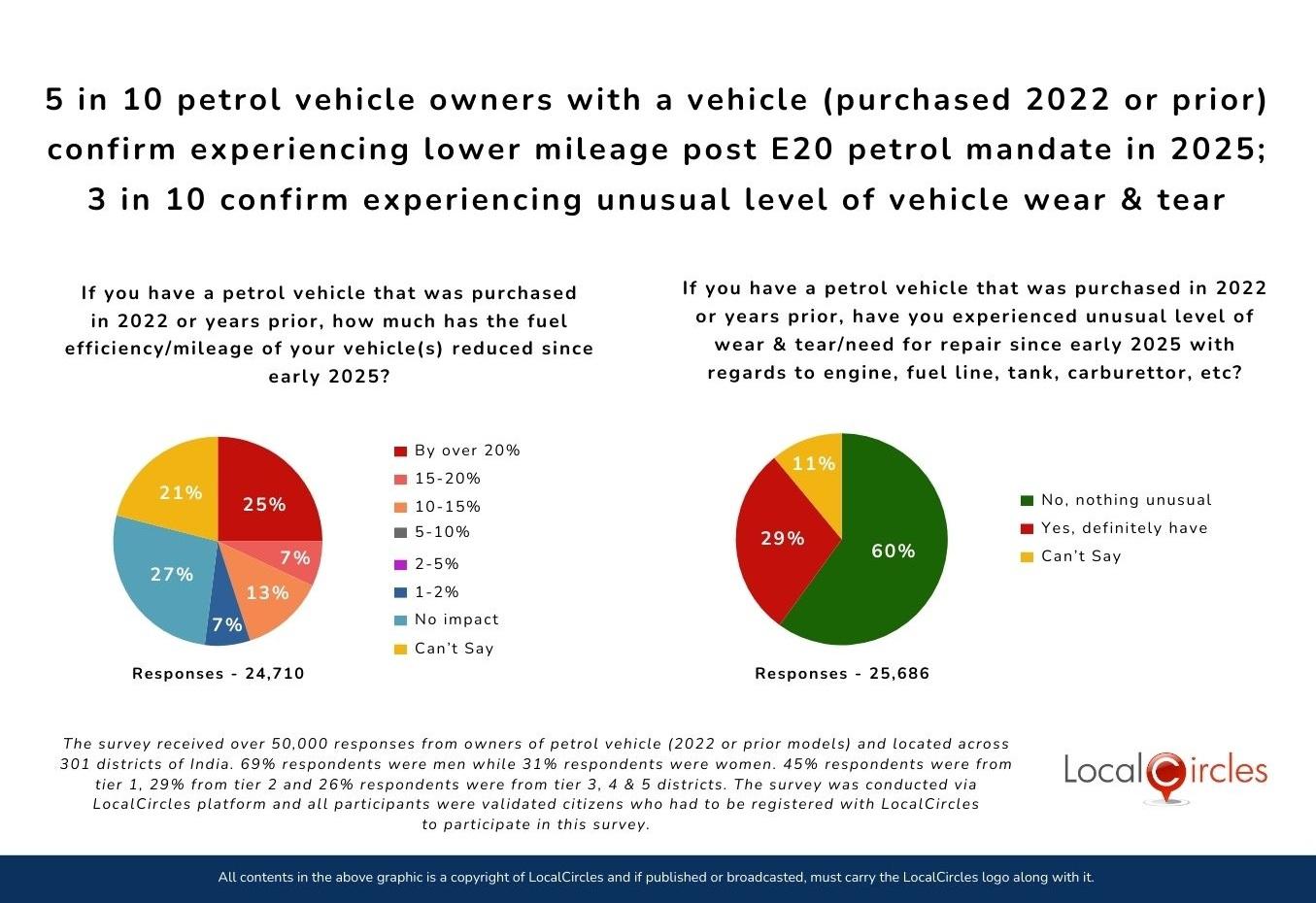
5 in 10 petrol vehicle owners with a vehicle (purchased 2022 or prior) confirm experiencing lower mileage post E20 petrol mandate in 2025; 3 in 10 confirm experiencing unusual level of vehicle wear & tear
May 26, 2026, New Delhi: A little over a year after India formally completed the nationwide rollout of E20 petrol in April 2025 — achieving the 20% ethanol-blending target six years ahead of the original 2030 schedule — concerns among owners of older petrol vehicles around reduced mileage, harder cold starts and unusual engine wear and tear have only intensified. Even as the government accelerates the move to higher ethanol blends, with the Bureau of Indian Standards in May 2026 notifying IS 19850:2026 covering E22 to E30 blends, and the Ministry of Petroleum and Natural Gas mandating that all E20 petrol sold from April 1, 2026 must meet a minimum Research Octane Number (RON) of 95, lakhs of consumers — particularly those whose vehicles were originally engineered for E5 or E10 fuel — say their on-road experience does not match the official Automotive Research Association of India (ARAI) estimate of a 1–6% dip in fuel efficiency. The Government has firmly defended the programme, with Union Petroleum Minister Hardeep Singh Puri publicly maintaining that ethanol-blended fuel has minimal impact on vehicles, and in September 2025 the Supreme Court too dismissed a PIL seeking continued availability of ethanol-free petrol at fuel stations, holding that consumer preference cannot dictate national energy policy. Yet the gap between official assurances and on-ground consumer experience continues to widen. To capture this experience one full year after the E20 mandate, LocalCircles undertook a fresh nationwide survey of owners of petrol vehicles purchased in 2022 or earlier — the findings, detailed in this report, suggest that consumer pain points around mileage and wear & tear are far more widespread than official estimates currently acknowledge.
India has already rolled out E20 petrol across most parts of the country and is now preparing for higher ethanol blends such as E22, E25, E27, E30 and eventually E85 for flex-fuel vehicles. In May 2026, the Bureau of Indian Standards (BIS) formally notified IS 19850:2026 covering E22 to E30 ethanol-petrol blends, creating the regulatory framework for the next phase of India’s ethanol blending programme beyond E20. The development follows the Government’s move to mandate that from April 1, 2026, all E20 petrol sold in India must meet a minimum Research Octane Number (RON) of 95 to improve combustion stability and reduce engine knocking risks.
The newly notified BIS standards define technical specifications for blends of anhydrous ethanol and petrol intended for use in positive ignition engine-powered vehicles. The norms lay down requirements relating to fuel composition, blending procedures, impurity limits, testing protocols, safety parameters, storage compatibility, and quality benchmarks for E22, E25, E27 and E30 fuels.
The government’s move comes after India successfully advanced its E20 target from 2030 to 2025–26. Policymakers now view higher ethanol blending as central to reducing crude oil imports, strengthening energy security, lowering vehicular emissions, and supporting domestic ethanol production from sugarcane and grain-based feedstocks.
To support the nationwide rollout of E20 fuel, the Ministry of Petroleum and Natural Gas has also mandated that from April 1, 2026, all E20 petrol sold in India must meet a minimum Research Octane Number (RON) of 95 under BIS specifications. Higher-octane fuel improves combustion stability and reduces engine knocking risks, especially in engines operating on ethanol-rich fuel blends.
Oil marketing companies are simultaneously upgrading storage, blending, and distribution infrastructure to support higher ethanol blends and specialised fuels for flex-fuel vehicles capable of operating on blends ranging from E20 to E85. Industry groups are also pushing for gradual commercial introduction of E30 and eventually E85-compatible fuel system.
Currently importing nearly 87% of its crude oil requirements, India sees ethanol blending as a strategic intervention to partially substitute imported petroleum. The policy is also intended to support domestic agriculture, strengthen the sugar and grain-based ethanol industries, improve farmer incomes, and enhance long-term energy resilience.
India is now producing more than 1,000 crore litres of ethanol annually, with maize rapidly emerging as a major feedstock as grain-based ethanol production expands. The government has also eased restrictions on sugarcane-based ethanol production to accelerate nationwide E20 adoption and prepare for future higher blends.
For the 2025–26 Ethanol Supply Year, oil marketing companies continue procuring ethanol at differentiated rates depending on the feedstock. C-heavy molasses ethanol is priced at ₹57.97 per litre, B-heavy molasses ethanol at ₹60.73, sugarcane juice-based ethanol at ₹65.61, damaged foodgrain ethanol at ₹64, and FCI rice-based ethanol at ₹60.32 per litre. Maize-based ethanol currently receives the highest effective procurement value at ₹71.86 per litre, including incentives. These are ex-distillery prices excluding GST and transportation costs.
While policymakers present the transition as an economic and environmental success story, concerns among consumers are becoming increasingly visible as higher ethanol blends become mainstream. A significant portion of India’s existing vehicle fleet was never designed for E20 fuel, let alone future E25 or E30 blends. Industry estimates suggest that nearly 80% of vehicles sold over the past 15 years were originally engineered for E5 or E10 petrol. Owners of older vehicles now fear rising maintenance costs, reduced engine life, and lower fuel efficiency.
Among the most common complaints are reports of engines heating up faster, rough idling, harder cold starts, increased vibration, lower pickup, and declining mileage. During periods of intense summer heat, complaints on social media regarding excessive engine heating have become particularly frequent, adding to public concern.
Experts point out that ethanol behaves differently from conventional petrol. It absorbs moisture more readily, has lower energy density, and can gradually degrade rubber and plastic components in vehicles not specifically designed for ethanol-rich fuel. This raises concerns regarding corrosion, deterioration of seals and gaskets, fuel-line damage, injector wear, and long-term engine stress. Owners of older motorcycles, hatchbacks, and commuter vehicles are especially worried because repair and replacement expenses could become a significant financial burden.
Fuel efficiency remains another major concern. Official estimates suggest that E20 petrol may reduce mileage by around 1–6%, but many users claim that real-world losses are higher, particularly in older vehicles operating under congested urban driving conditions. For middle-class households already facing rising living costs, even modest reductions in mileage translate into noticeably higher monthly fuel expenses.
Another issue is the declining availability of lower-ethanol fuel options. Since E20 has effectively become the standard petrol grade across most regions, owners of older vehicles have limited alternatives. Although premium low-ethanol petrol remains available for some high-end vehicles, its substantially higher price makes it impractical for ordinary consumers.
Questions are also emerging regarding warranty protection and accountability. Consumers fear that as ethanol content rises toward E25 and E30, vehicle manufacturers and fuel suppliers may shift responsibility for compatibility-related damage onto vehicle owners. Many drivers argue that clearer guidelines, transparent long-term testing data, and stronger consumer safeguards are necessary before higher ethanol blends are implemented nationwide.
One year after the government mandated to supply only E20 fuel, LocalCircles has conducted a fresh survey to find out if there has been any change in the fuel efficiency or impact on petrol vehicles. The survey received over 50,000 responses from owners of petrol vehicles (2022 or prior models) located across 301 districts of India. 69% respondents were men while 31% respondents were women. 45% of respondents were from tier 1, 29% from tier 2 and 26% respondents were from tier 3, 4 & 5 districts.
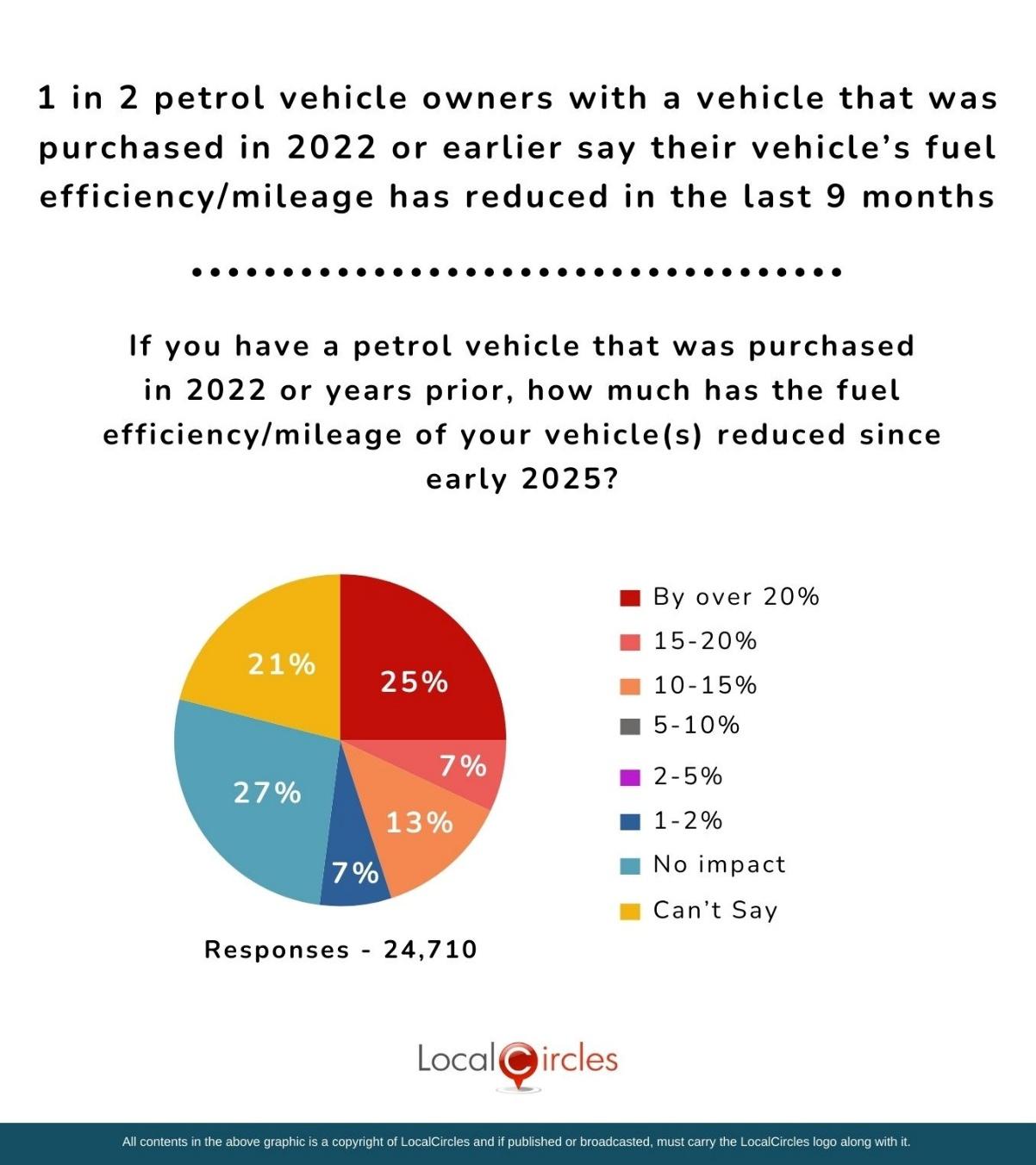
1 in 2 petrol vehicle owners with a vehicle that was purchased in 2022 or earlier say their vehicle’s fuel efficiency/mileage has reduced in the last 9 months
The survey first asked vehicle owners, “If you have a petrol vehicle that was purchased in 2022 or years prior, how much has the fuel efficiency / mileage of your vehicle(s) reduced since early 2025?” Out of 24,710 who responded to the question 25% indicated that the fuel efficiency has dipped “by over 20%”; 7% of respondents indicated a dip of “15-20%” in fuel efficiency; 13% of respondents indicated “10-15%” dip in efficiency; 7% of respondents indicated “1-2%” dip in efficiency; 27% of respondents indicated “no impact”; and 21% of respondents did not give a clear answer. To sum up, 1 in 2 petrol vehicle owners with a vehicle that was purchased in 2022 or earlier say their vehicle’s fuel efficiency/mileage has reduced in the last 9 months.
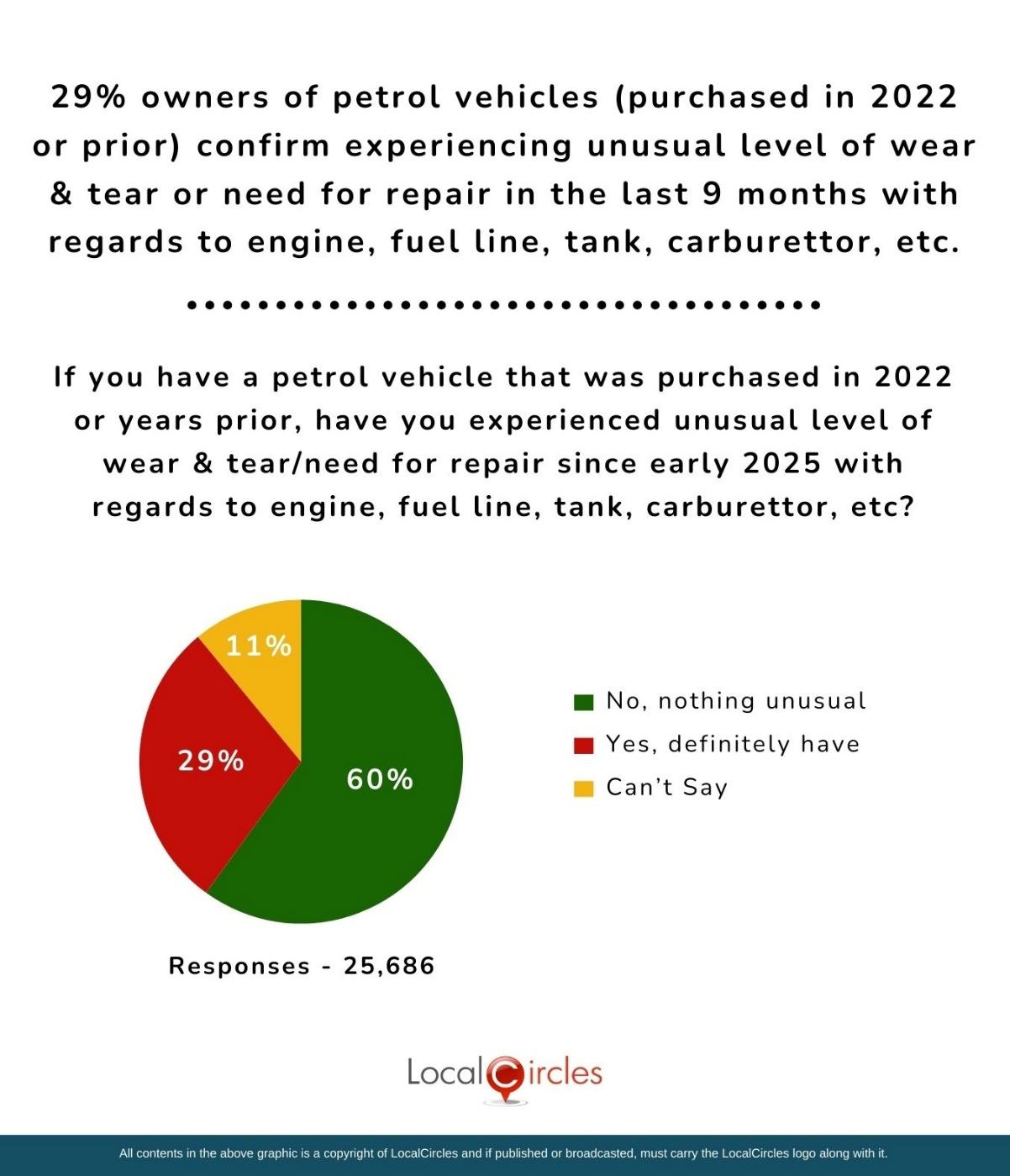
29% of owners of petrol vehicles (purchased in 2022 or prior) confirm experiencing unusual levels of wear & tear or need for repair in the last 9 months with regards to engine, fuel line, tank, carburettor, etc.
As many vehicle owners have complained on social media about more than usual wear and tear of their vehicles post usage of E20 petrol, the survey asked, “If you have a petrol vehicle that was purchased in 2022 or years prior, have you experienced an unusual level of wear & tear/need for repair since early 2025 with regards to engine, fuel line, tank, carburettor, etc.?” Out of 25,686 who responded to the question 60% stated “no, nothing unusual”; 29% of respondents however stated “yes, definitely have”; and 12% of respondents did not give a clear answer. To sum up, 29% of owners of petrol vehicles (purchased in 2022 or prior) confirm experiencing unusual levels of wear & tear, or need for repair in the last 9 months with regards to engine, fuel line, tank, carburettor, etc.
In summary, the study shows that 1 in 2 petrol vehicle owners with a vehicle that was purchased in 2022 or earlier say their vehicle’s fuel efficiency/mileage has reduced in the last 9 months. Similarly, 29% of owners of petrol vehicles (purchased in 2022 or prior) confirm experiencing unusual levels of wear & tear, or need for repair in the last 9 months with regards to engine, fuel line, tank, carburettor, etc.
Whether the new E20 standard will fully address the issues facing owners of older petrol vehicle owners remains to be seen. In the interim, there is a need for policy planners to relook at the ethanol policy as fuel efficiency must be a priority along with environmental concerns as they are interlinked. Also, the fact that more than one-fourth of those surveyed have experienced more than usual wear and tear of their vehicle or need for repair shows that many vehicles will become un-road worthy sooner than 15-year life fixed by the government for petrol vehicles.
If the higher-octane ethanol blended fuel does not address the issues being faced by owners of older petrol vehicles, the government needs to relook at its fuel policy to allow sale of lower ethanol mix fuel for older petrol vehicles so that it does not tax owners of such vehicles. Not all are able to switch vehicles at will as funds remain a big concern in most households in India.
Survey Demographics
The survey received over 50,000 responses from owners of petrol vehicles (2022 or prior models) located across 301 districts of India. 69% respondents were men while 31% respondents were women. 45% of respondents were from tier 1, 29% from tier 2 and 26% respondents were from tier 3, 4 & 5 districts. The survey was conducted via LocalCircles platform, and all participants were validated citizens who had to be registered with LocalCircles to participate in this survey.
About LocalCircles
LocalCircles, India’s leading Community Social Media platform enables citizens and small businesses to escalate issues for policy and enforcement interventions and enables Government to make policies that are citizen and small business centric. LocalCircles is also India’s # 1 pollster on issues of governance, public and consumer interest. More about LocalCircles can be found on https://www.localcircles.com
For more queries - media@localcircles.com, +91-8585909866
All content in this report is a copyright of LocalCircles. Any reproduction or redistribution of the graphics or the data therein requires the LocalCircles logo to be carried along with it. In case any violation is observed LocalCircles reserves the right to take legal action.
Enter your email & mobile number and we will send you the instructions.
Note - The email can sometime gets delivered to the spam folder, so the instruction will be send to your mobile as well


