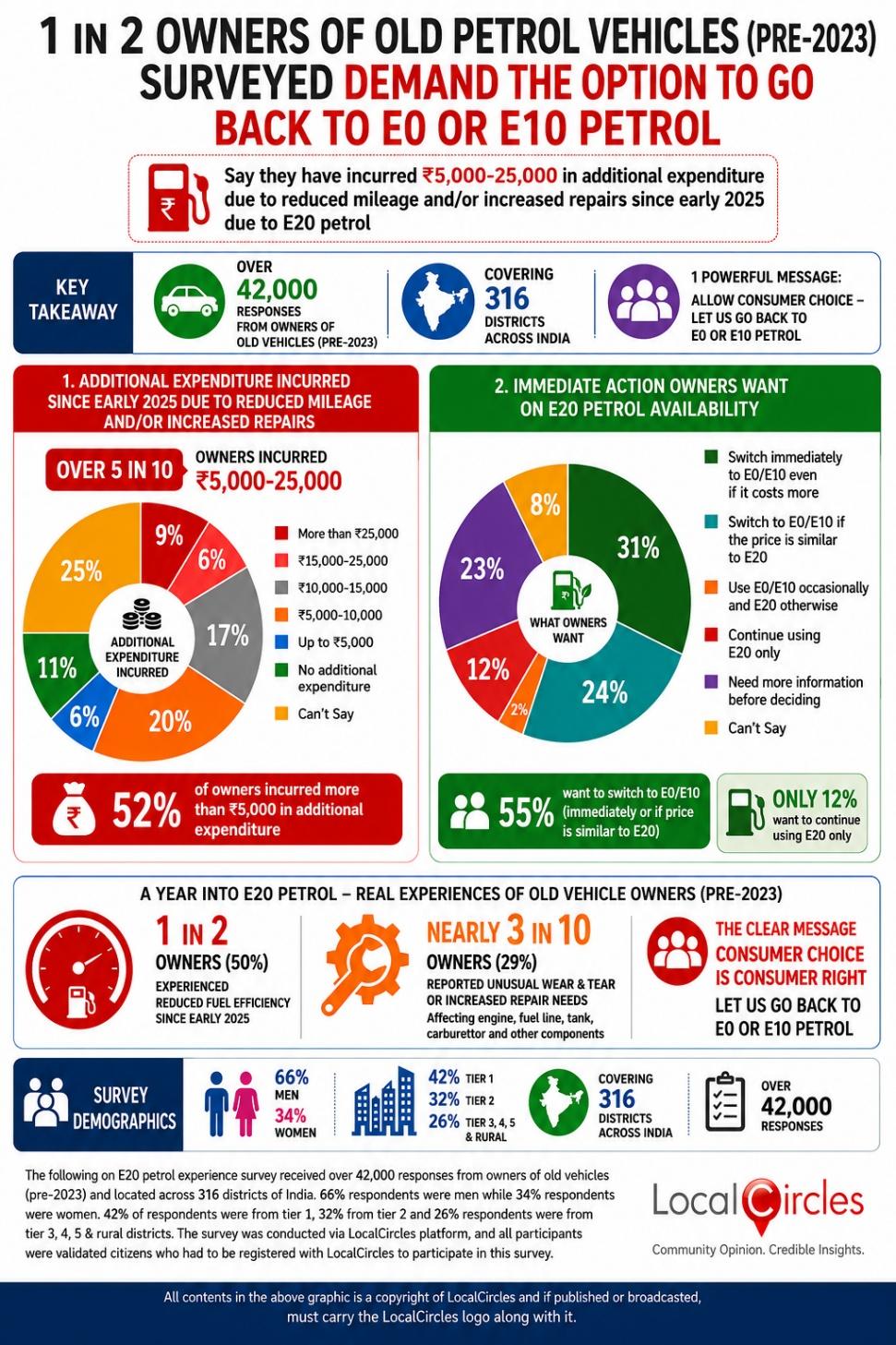
1 in 2 owners of old petrol vehicles (pre-2023) surveyed demand the option to go back to E0 or E10 petrol
- ● Say they have incurred ₹5,000-25,000 in additional expenditure due to reduced mileage and/or increased repairs since early 2025 due to E20 petrol
- ● In the last LocalCircles survey, 5 in 10 such owners had highlighted experiencing the mileage issues and 3 in 10 had indicated experiencing wear & tear issues
Jun 05, 2026, New Delhi: A little over a year after India completed the nationwide rollout of E20 petrol – achieving the 20% ethanol-blending target six years ahead of the original 2030 schedule – the on-road grievances of owners of older petrol vehicles around reduced mileage and unusual wear and tear are increasingly translating into a tangible financial cost. Even as the government accelerates the transition to higher ethanol blends, with the Bureau of Indian Standards notifying IS 19850:2026 (covering E22 to E30 blends) in May 2026 and the Ministry of Petroleum and Natural Gas mandating that all E20 petrol sold from April 1, 2026 must meet a minimum Research Octane Number (RON) of 95, a large section of consumers say the higher fuel and repair bills they are now absorbing do not match the official Automotive Research Association of India (ARAI) estimate of a 1–6% dip in fuel efficiency.
The government has firmly defended the programme, with Union Petroleum Minister Hardeep Singh Puri maintaining that ethanol-blended fuel has minimal impact on vehicles, and in September 2025 the Supreme Court dismissed a public interest litigation seeking continued availability of ethanol-free petrol, holding that consumer preference cannot dictate national energy policy. A fresh petition has since sought availability of ethanol-free (E0) fuel and clear labelling at pumps, citing risks to older vehicles, reduced mileage and engine damage. Yet with E20 now effectively the only petrol grade available across most of the country, owners of vehicles originally engineered for E5 or E10 fuel have limited alternatives – premium low-ethanol petrol remains far too expensive for ordinary consumers.
This experience is not isolated. A year after the nationwide rollout of E20 petrol, concerns among owners of older petrol vehicles continue to grow. A LocalCircles survey of over 50,000 owners of petrol vehicles purchased in 2022 or earlier found that 1 in 2 respondents experienced reduced fuel efficiency since early 2025, while nearly 3 in 10 reported unusual wear and tear or increased repair needs affecting components such as the engine, fuel line, tank and carburettor. The findings suggest that the impact of E20 petrol on older vehicles may be more significant than official estimates indicate, raising questions about vehicle compatibility, operating costs and consumer choice as India moves toward higher ethanol blends.
To quantify the financial burden of this experience and gauge what owners of older vehicles now want, LocalCircles conducted a follow-on survey. The survey received over 42,000 responses from owners of old petrol vehicles (pre-2023 models) located across 316 districts of India. 66% respondents were men while 34% respondents were women. 42% of respondents were from tier 1, 32% from tier 2 and 26% respondents were from tier 3, 4, 5 & rural districts.
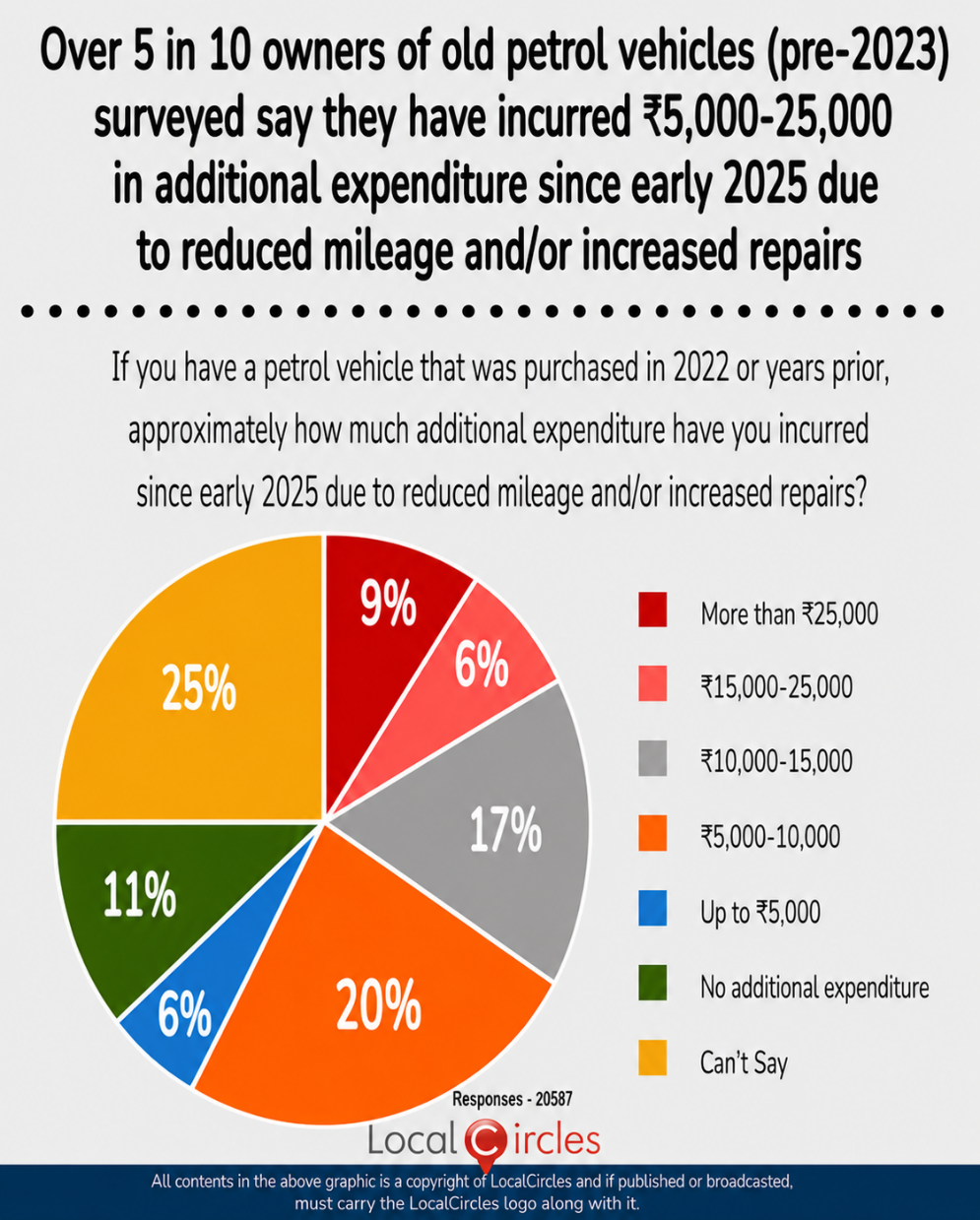
Over 5 in 10 owners of old petrol vehicles (pre-2023) surveyed say they have incurred ₹5,000-25,000 in additional expenditure since early 2025 due to reduced mileage and/or increased repairs
With reduced mileage and increased wear and tear now widely reported, the survey sought to quantify the out-of-pocket impact on owners of older petrol vehicles. It asked, “If you have a petrol vehicle that was purchased in 2022 or years prior, approximately how much additional expenditure have you incurred since early 2025 due to reduced mileage and/or increased repairs?” Out of 20,587 who responded to the question, 9% indicated “more than ₹25,000”; 6% indicated “₹15,000-25,000”; 17% indicated “₹10,000-15,000”; 20% indicated “₹5,000-10,000”; 6% indicated “up to ₹5,000”; 11% reported “no additional expenditure”; and 25% did not give a clear answer. To sum up, over 5 in 10 – 52% – owners of old petrol vehicles say they have incurred ₹5,000-25,000 or more in additional expenditure since early 2025 due to reduced mileage and/or increased repairs linked to E20 petrol.
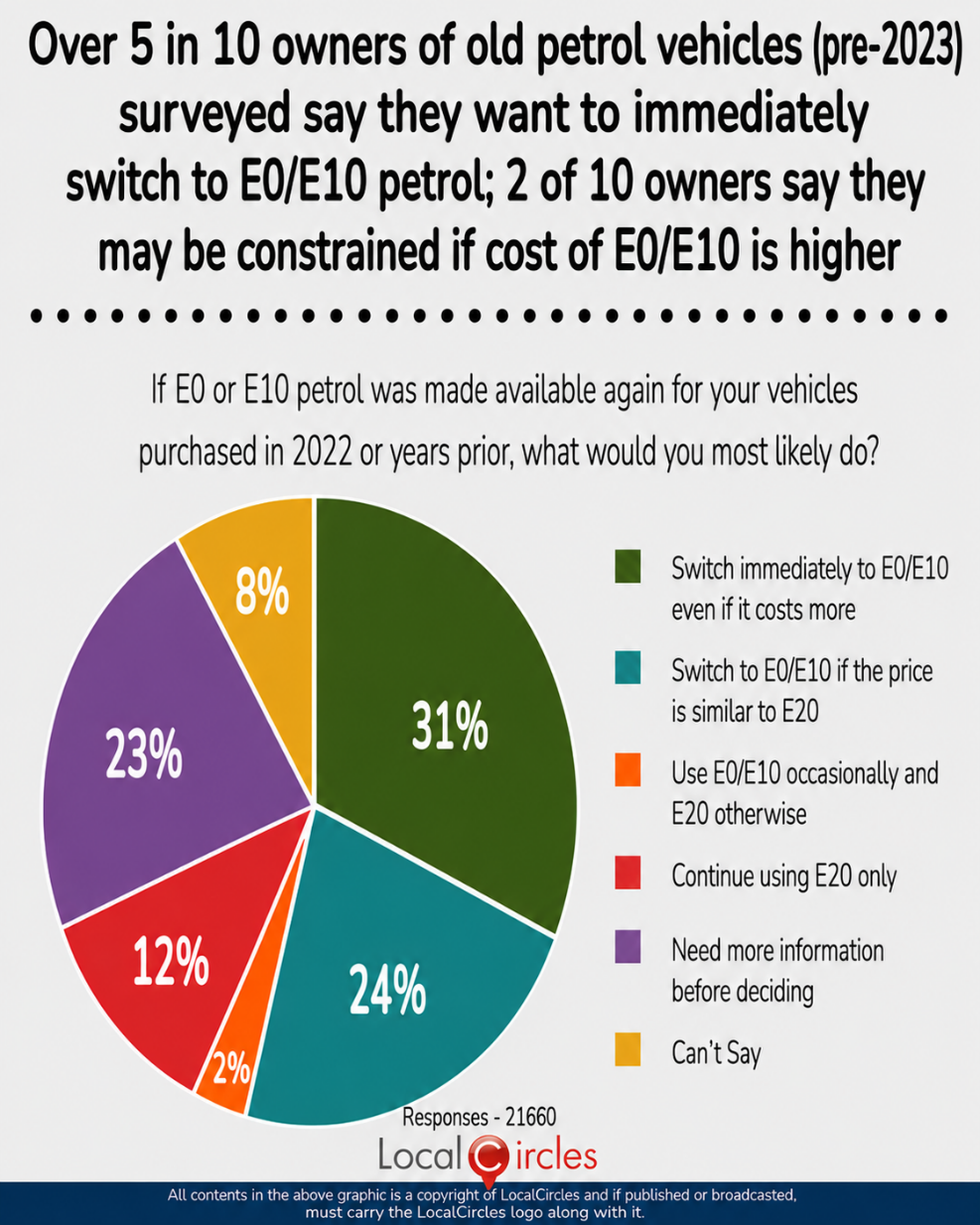
Over 5 in 10 owners of old petrol vehicles (pre-2023) surveyed say they want to immediately switch to E0/E10 petrol; 2 of 10 owners say they may be constrained if cost of E0/E10 is higher
As many vehicle owners have demanded on social media that ethanol-free or lower-ethanol fuel be made available again, the survey asked, “If E0 or E10 petrol was made available again for your vehicles purchased in 2022 or years prior, what would you most likely do?” Out of 21,660 who responded to the question, 31% said they would “switch immediately to E0/E10 even if it costs more”; 24% said they would “switch to E0/E10 if the price is similar to E20”; 2% would “use E0/E10 occasionally and E20 otherwise”; 12% would “continue using E20 only”; 23% said they “need more information before deciding”; and 8% did not give a clear answer. To sum up, over 5 in 10 – 55% – owners of old petrol vehicles want to switch to E0/E10 petrol, either immediately or if the price is similar to E20, while around 2 in 10 indicated they may be constrained if E0/E10 costs more. Notably, only 12% want to continue using E20 petrol.
In summary, the study shows that over 5 in 10 (52%) owners of old petrol vehicles purchased in 2022 or earlier have incurred ₹5,000-25,000 or more in additional expenditure since early 2025 due to reduced mileage and/or increased repairs, and that 55% want the option to go back to E0 or E10 petrol, with only 12% wanting to continue on E20. Taken together with the earlier finding that 1 in 2 such owners experienced reduced fuel efficiency and nearly 3 in 10 reported unusual wear and tear, the results indicate that the real-world burden of E20 on older vehicles is both financial and widespread, and well in excess of official estimates.
Whether the new higher-octane RON 95 E20 standard will address these issues remains to be seen. In the interim, there is a need for policy planners to relook at the ethanol policy, as fuel efficiency and household operating costs must be weighed alongside environmental and energy-security objectives, since they are interlinked. The fact that more than half of those surveyed are now absorbing measurable additional expenditure – and that many report unusual wear and tear – suggests that a number of vehicles may become un-roadworthy well before the 15-year life fixed by the government for petrol vehicles.
Given that consumer choice is a fundamental consumer right, the clear message from owners of older petrol vehicles is that they should be allowed to go back to E0 or E10 petrol and the Government needs to ensure that atleast one of these options are available at every petrol pump.
Survey Demographics
The follow-on E20 petrol experience survey received over 42,000 responses from owners of old petrol vehicles (pre-2023 models) located across 316 districts of India. 66% respondents were men while 34% respondents were women. 42% of respondents were from tier 1, 32% from tier 2 and 26% respondents were from tier 3, 4, 5 & rural districts. The survey was conducted via LocalCircles platform, and all participants were validated citizens who had to be registered with LocalCircles to participate in this survey.
About LocalCircles
LocalCircles, India’s leading Community Social Media platform enables citizens and small businesses to escalate issues for policy and enforcement interventions and enables Government to make policies that are citizen and small business centric. LocalCircles is also India’s # 1 pollster on issues of governance, public and consumer interest. More about LocalCircles can be found on https://www.localcircles.com
For more queries - media@localcircles.com, +91-8585909866
All content in this report is a copyright of LocalCircles. Any reproduction or redistribution of the graphics or the data therein requires the LocalCircles logo to be carried along with it. In case any violation is observed LocalCircles reserves the right to take legal action.
Enter your email & mobile number and we will send you the instructions.
Note - The email can sometime gets delivered to the spam folder, so the instruction will be send to your mobile as well


