E20 fuel is impacting both mileage and maintenance costs of older petrol vehicles; Percentage of those attributing higher maintenance costs near doubles in the last two months
- ● 8 in 10 petrol vehicle owners say fuel efficiency/mileage has reduced in 2025
- ● Owners who confirmed experiencing unusual levels of wear and tear, or need for repair in 2025, rose from 28% in August to 52% in October
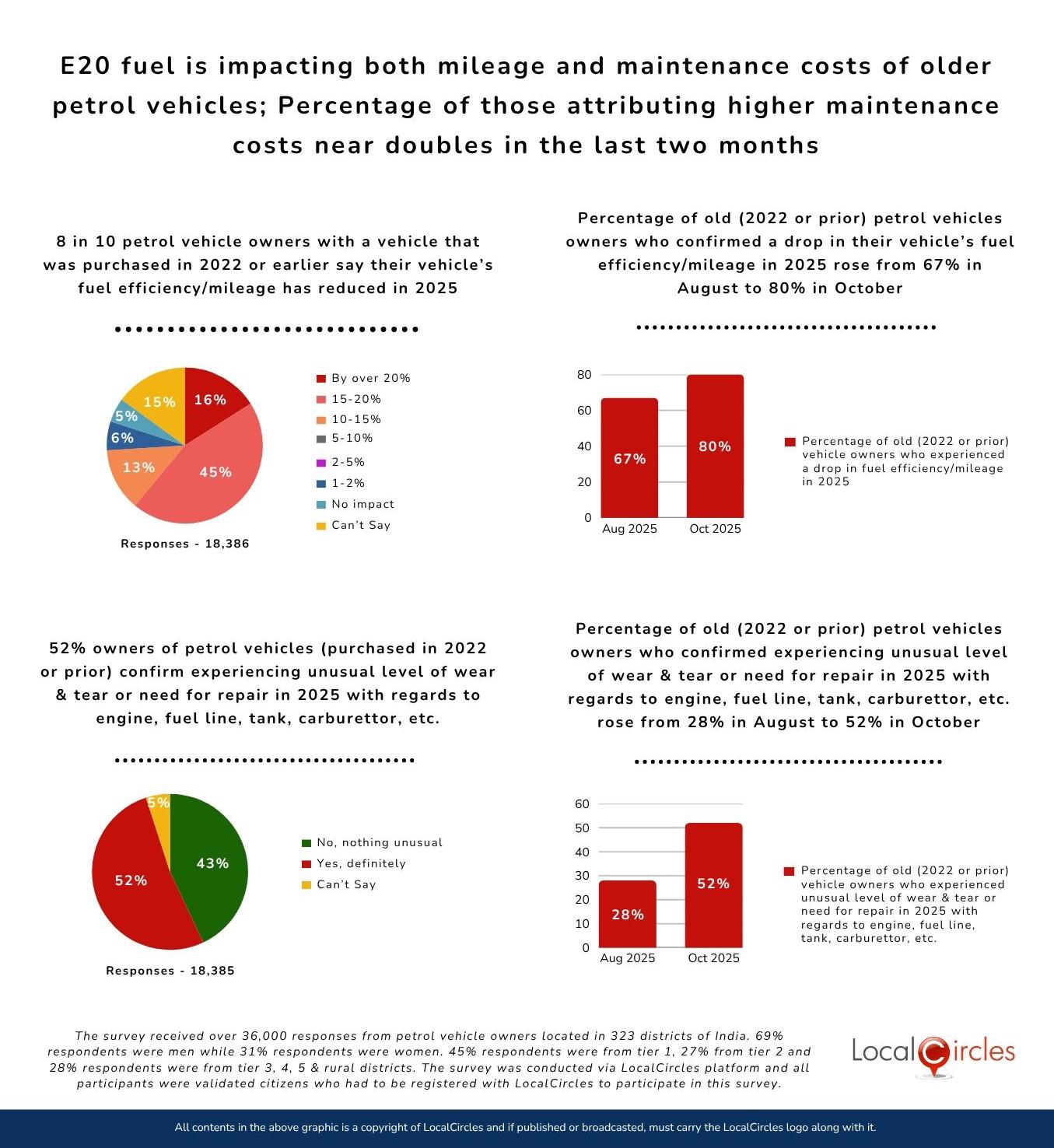
October 13, 2025, New Delhi: Indians are voicing significant frustrations with the nationwide rollout of E20 petrol (20% ethanol blend), which became mandatory in April 2025.
While the government, including Minister Nitin Gadkari, claim no vehicles have been affected and dismisses complaints as "misinformation," users report real-world problems pertaining to reduced mileage and increased maintenance costs, particularly for vehicles purchased in 2022 or years prior. Over 80% of petrol vehicles sold in India between 2011 and 2025 (about 234 million) are only compatible with E5 or E10 blends, leaving many owners vulnerable.
Based on recent discussions on X (formerly Twitter), there is considerable anguish among vehicle owners. An Audi Q7 owner in Chennai has narrated how he paid INR 4 lakh in repairs after water-mixed E20 caused engine failure. In another case, a Ferrari refused to start due to E20-induced phase separation “technicians confirmed fuel damage”.
Turbo petrol vehicles like Toyota Hycross reported 3 injector failures within 5,000 km while two-wheelers face misfiring. According to media reports, mechanics have noted 40% rise in fuel-related issues since rollout. There are also widespread complaints of "massive drop in mileage" across vehicles, with some vehicle owners calling it a "slow poison." Users report 6-20% drops in mileage, increasing fuel costs and consumption despite the "green" intent. NITI Aayog had predicted 6-7% loss for four-wheelers.
The complaints peaked in July-October 2025, with users tagging ministers like @nitin_gadkari and @HardeepSPuri for fixes like regional non-E20 availability. While some posts defend the program for farmer incomes and energy security, the dominant sentiment is one of betrayal, with middle-class owners feeling burdened by higher costs and repairs amid no alternatives.
Globally, ethanol blending accounts for about 5-6% of transportation fuel demand as of 2024, with the market projected to grow from $98.5 billion in 2024 to $205.2 billion by 2035 at a 6.9% CAGR, driven by mandates and incentives.
Ethanol fuel policies have primarily focused on blending ethanol with gasoline to reduce fossil fuel dependence, emissions, and enhance energy security, vary widely by region. The United States and Brazil dominate production (80% of global output), but over 30 countries have mandates or targets, often starting at E5 (5% ethanol) and scaling to E10-E27. These policies stem from the 2000s energy crises and climate goals, but face challenges like feedstock competition (e.g., food vs. fuel) and vehicle compatibility.
LocalCircles survey in August had revealed that 28% of owners of petrol vehicles (purchased in 2022 or prior) were experiencing unusual levels of wear & tear or need for repair with regards to engine, fuel line, tank, carburetor, etc. Given the prospect of a faster wear and tear of vehicles, 52% owners of petrol vehicles purchased in 2022 or prior, stated that if E20 petrol was sold at a 20% lower price and made available on an optional basis, they would support the move. Many of those surveyed shared the view that government should make E20 petrol optional.
Six months after E20 petrol become mandatory and two months after its initial survey, LocalCircles attempted to find out whether there is any change in petrol vehicle owners’ stance and what is the impact on vehicles manufactured in 2022 or years prior. The survey received over 36,000 responses from petrol vehicle owners located in 323 districts of India. 69% respondents were men while 31% respondents were women. 45% respondents were from tier 1, 27% from tier 2 and 28% respondents were from tier 3, 4, 5 & rural districts.
8 in 10 petrol vehicle owners with a vehicle that was purchased in 2022 or earlier say their vehicle’s fuel efficiency/mileage has reduced in 2025
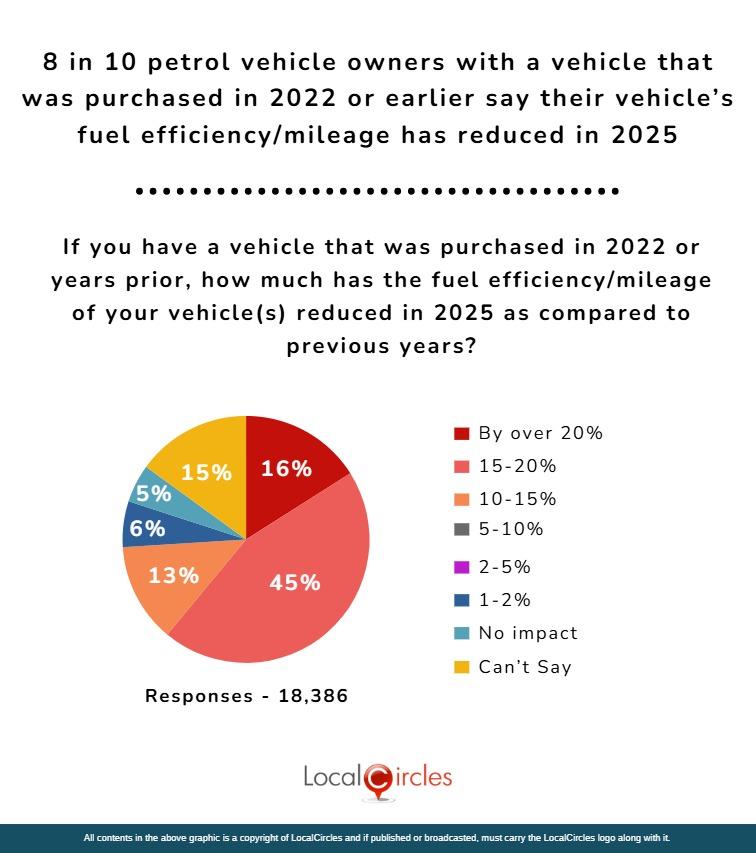
The survey asked petrol vehicle owners, “If you have a vehicle that was purchased in 2002 or years prior, how much has the fuel efficiency / mileage of your vehicle(s) reduced in 2025 compared to previous years?” Out of 18,386 respondents to the question, 16% stated their vehicle efficiency has reduced by over 20% this year; 45% of respondents indicated “15-20%”; 13% of respondents indicated “10-15%”; 6% of respondents indicated "1-2%”; 5% of respondents stated there has been “no impact”; and 15% of respondents did not give a clear answer. To sum up, 8 in 10 petrol vehicle owners with a vehicle that was purchased in 2022 or earlier say their vehicle’s fuel efficiency/mileage has reduced in 2025.
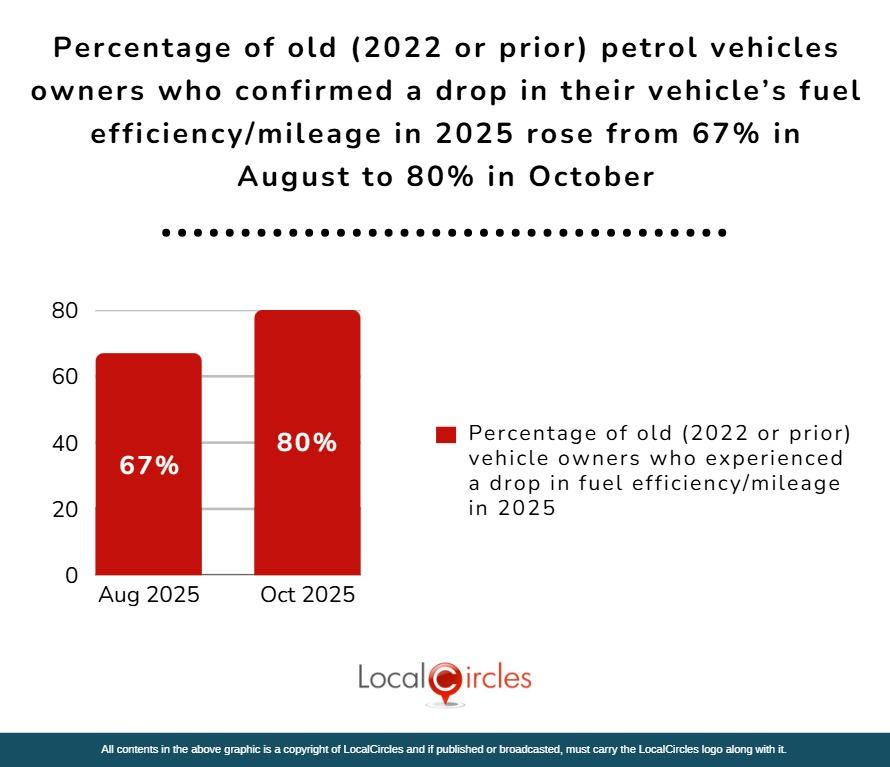
Percentage of old (2022 or prior) petrol vehicles owners who confirmed a drop in their vehicle’s fuel efficiency/mileage in 2025 rose from 67% in August to 80% in October
Compared to survey results in August 2025, when 67% owners of old petrol vehicles (2022 or prior) confirmed a drop in their vehicle’s fuel efficiency/mileage, the new survey shows that now 80% have this complaint.
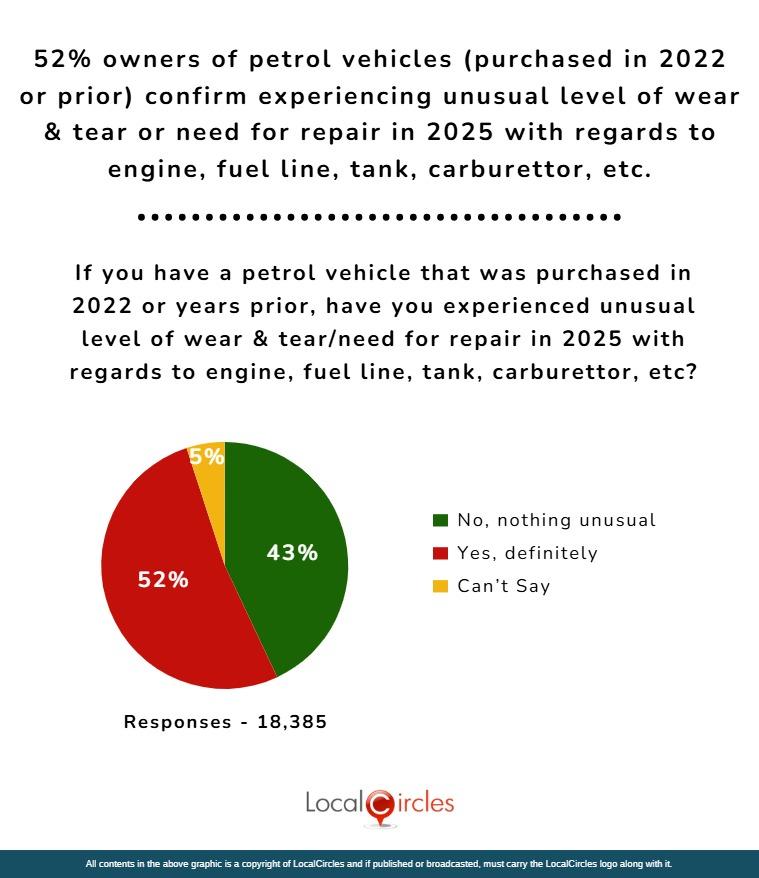
52% owners of petrol vehicles (purchased in 2022 or prior) confirm experiencing unusual level of wear & tear or need for repair in 2025 with regards to engine, fuel line, tank, carburetor, etc.
Coming to the issue of any damage to the older petrol vehicles, the survey asked, “If you have a petrol vehicle that was purchased in 2022 or years prior, have you experienced unusual level of wear and tear/ need for repair in 2025 with regards to engine, fuel line, tank, carburetor, etc.?” Out of 18,385 who responded to the question 43% stated “no, nothing unusual” has been noticed; 52% of respondents stated “yes, definitely” and 5% of respondents did not give a clear answer. To sum up, 52% owners of petrol vehicles (purchased in 2022 or prior) confirm experiencing unusual level of wear and tear, or need for repair in 2025 with regards to engine, fuel line, tank, carburetor, etc.
Percentage of old (2022 or prior) petrol vehicles owners who confirmed experiencing unusual levels of wear and tear, or need for repair in 2025 with regards to engine, fuel line, tank, carburetor, etc. rose from 28% in August to 52% in October
In a matter of two months, the percentage of old (2022 or prior) petrol vehicles owners who confirmed experiencing unusual levels of wear and tear or need for repair in 2025 (beyond regular maintenance and repair) with regards to engine, fuel line, tank, carburetor, etc. rose from 28% in August to 52% in October.
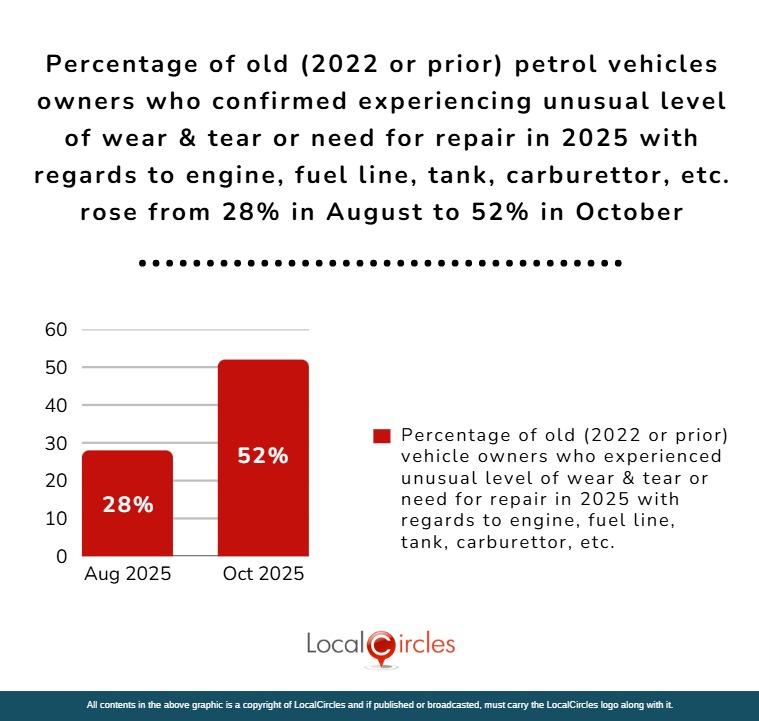
In summary, the study shows that 8 in 10 petrol vehicle owners with a vehicle that was purchased in 2022 or earlier say their vehicle’s fuel efficiency/mileage has reduced in 2025. Compared to August 2025, when 67% owners of old petrol vehicles (2022 or prior) confirmed a drop in their vehicle’s fuel efficiency/mileage, the new survey shows that 80% such vehicle owners are now facing this issue. The study shows that 52% owners of petrol vehicles (purchased in 2022 or prior) are experiencing unusual levels of wear and tear, or need for repair in 2025 with regards to engine, fuel line, tank, carburetor, etc. The percentage of old (2022 or prior) petrol vehicles owners who confirmed experiencing unusual levels of wear and tear or need for repair in 2025 with regards to engine, fuel line, tank, carburetor, etc. has risen from 28% in August to 52% in October.
The study shows that an increasing percentage of petrol vehicle owners, who bought it in 2022 or earlier, are facing multiple problems not only related to mileage but also the health and operation of the vehicle due to use of E20 petrol. The government needs to study the issue in depth and take suitable action like giving old vehicle owners the option to buy petrol with lower levels of ethanol blends.
LocalCircles will be escalating the findings of this study with Ministry of Finance, Ministry of Consumer Affairs, CCPA, Ministry of Petroleum and Ministry of Road Transport & Highways for their consideration and action.
Survey Demographics
The survey received over 36,000 responses from petrol vehicle owners located in 323 districts of India. 69% respondents were men while 31% respondents were women. 45% respondents were from tier 1, 27% from tier 2 and 28% respondents were from tier 3, 4, 5 & rural districts. The survey was conducted via LocalCircles platform, and all participants were validated citizens who had to be registered with LocalCircles to participate in this survey.
About LocalCircles
LocalCircles, India’s leading Community Social Media platform enables citizens and small businesses to escalate issues for policy and enforcement interventions and enables Government to make policies that are citizen and small business centric. LocalCircles is also India’s # 1 pollster on issues of governance, public and consumer interest. More about LocalCircles can be found on https://www.localcircles.com
For more queries - media@localcircles.com, +91-8585909866
All content in this report is a copyright of LocalCircles. Any reproduction or redistribution of the graphics or the data therein requires the LocalCircles logo to be carried along with it. In case any violation is observed LocalCircles reserves the right to take legal action.
Enter your email & mobile number and we will send you the instructions.
Note - The email can sometime gets delivered to the spam folder, so the instruction will be send to your mobile as well


