Dark patterns continue on eCommerce marketplaces in India with Drip Pricing experienced frequently by 75% users, Bait & Switch and Privacy Zuckering also experienced by over 40%
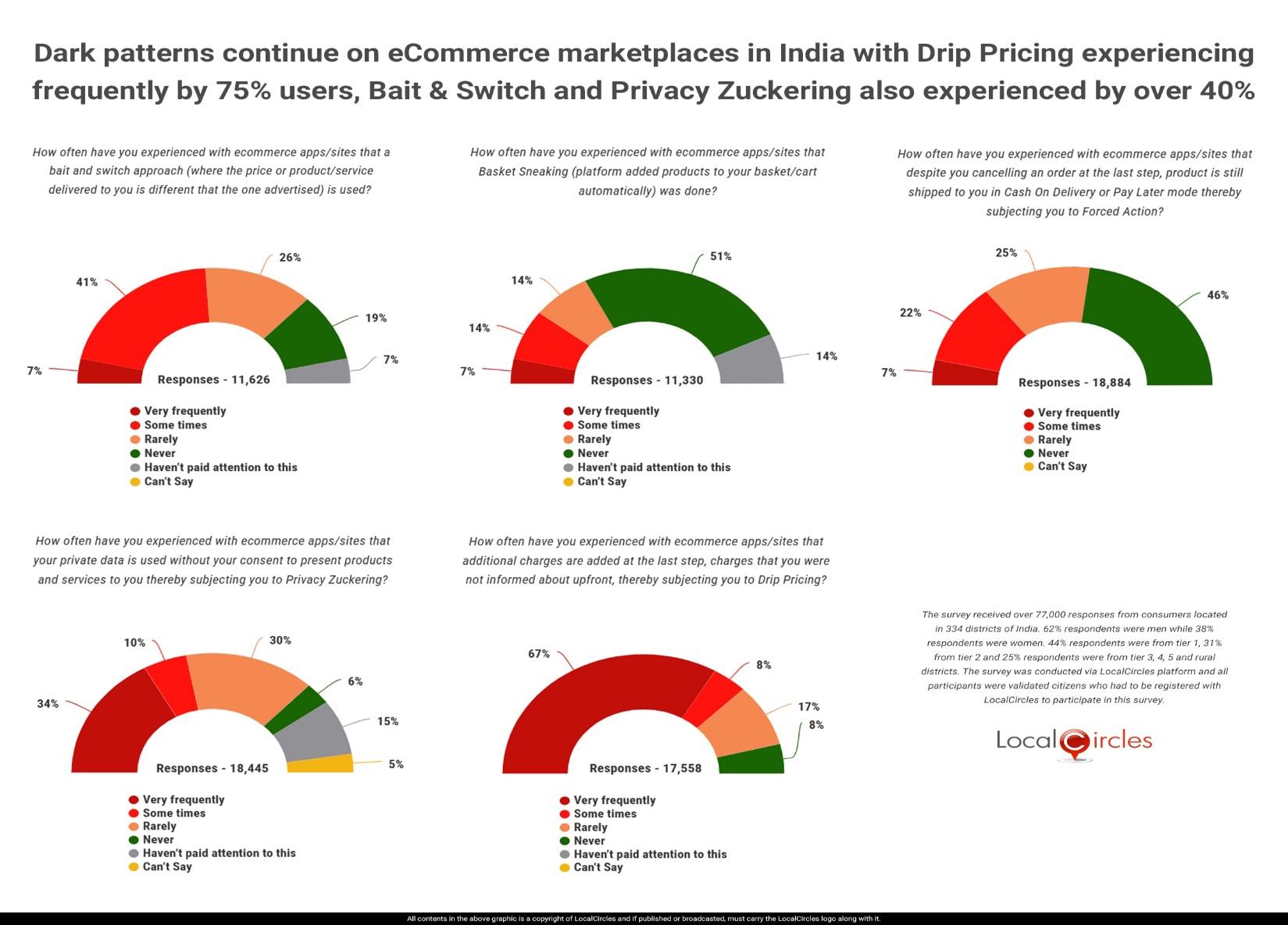
- ● 29% eCommerce users report Forced Action while 21% report Basket Sneaking
- ● Drip Pricing dark pattern constitutes of any charge levied by the platform without upfront disclosure to the consumer i.e. Payment Fee, Platform Fee, Cash on Delivery Fee, Offer Handling Fee etc
- ● LocalCircles audit finds dark patterns on eCommerce marketplaces like Flipkart, Amazon, Tata Neu, Jiomart and Myntra with Meesho found as the only platform free of dark patterns in the sector
- ● Four-month long study concludes with 77,000 responses from eCommerce users located across 334 districts of India
October 12, 2025, New Delhi: Last week, the Consumer Affairs Minister of India, Pralhad Joshi announced on X that his department has received complaints against e-Commerce platforms charging extra for Cash-on-Delivery, a practice classified as a dark pattern and that a detailed investigation has been initiated to scrutinize the platforms. The minister also said “Strict action will be taken against those violating consumer rights to ensure transparency and uphold fair practices in India’s eCommerce sector.” The minister’s response comes a week after LocalCircles released its quarterly audit report indicating that despite Government notification and advisories, 97% of the 290 major online platforms operating in India have dark patterns reported by consumers and validated by LocalCircles.
Though Joshi’s statement of calling out charges for Cash on Delivery (COD) being a dark pattern isn’t necessarily accurate, the COD charges do become a dark pattern if they are imposed without intimating the consumer or are imposed in a hidden manner. However, the Minister’s response is justified as a large number of consumers have been reporting experiencing Drip Pricing or Hidden Charges when transacting on eCommerce platforms in the last 12 months. Drip Pricing in Gazette Notification No. 783 dated November 30, 2023 via File No. CCPA-1/1/2023-CCPA is defined as a dark pattern where elements of prices are not revealed upfront or are revealed surreptitiously within the user experience. In simpler terms, drip pricing refers to design or U/X practices where some components of the total price (e.g. taxes, fees, surcharges, additional mandatory costs) are withheld initially and revealed only later in the purchase process (e.g. at checkout or after confirmation).
Including Drip Pricing, 13 dark patterns have been covered by the notification which include false urgency, basket sneaking, confirm shaming, forced action, subscription trap, interface interference, bait and switch, disguised advertisement, nagging, trick questions, SaaS (software as a service) billing and rogue malwares. In addition to these the notification has provision for identifying new dark patterns as they are reported by consumers. One that has been commonly reported by consumers on LocalCircles is Privacy Zuckering and the platform has escalated a request to CCPA to add it in the notification. Privacy Zuckering involves tricking users into sharing more personal data then they intended to and using it to manipulate prices or soliciting them with products and services. The pattern gets its name from Mark Zuckerberg referring to Facebook’s (now Meta) early reputation for persuading users to share private information without realizing the full extent.
After releasing the aggregate results of the national dark pattern audit of 290 online platforms operating in India, LocalCircles over the course of next several months will make available aggregate dark pattern findings by sector such that these dark patterns can be resolved by platforms as well as to make the consumer more aware of such practices. LocalCircles is doing this with examples such that it is easy for all stakeholders to understand exactly what constitutes a dark pattern in the context of that sector.
The first sector undertaken for dark pattern audit by LocalCircles is eCommerce marketplaces where sellers list their products for sale on platforms like Amazon, Flipkart, Meesho, Myntra, etc. and platforms are responsible for the consumer experience online, order acceptance, order status, return and refund processing as well as in many cases logistics. Sellers define price and availability and are responsible for quality of the goods. To assess eCommerce marketplace platforms for dark patterns, LocalCircles utilized consumer complaints, an in-depth survey on dark patterns reported by consumers and an Artificial Intelligence (AI) powered proprietary dark pattern validation model.
The survey on dark patterns on eCommerce marketplaces received over 77,000 responses from consumers located in 334 districts of India. 62% respondents were men while 38% respondents were women. 44% respondents were from tier 1, 31% from tier 2 and 25% respondents were from tier 3, 4, 5 and rural districts. The AI powered dark pattern validation model of LocalCircles studied platforms over time and adjusted the findings basis any dark pattern resolutions that were done by the platform with the latest validation conducted on October 6th, 2025. eCommerce marketplaces were found to have 10 unique dark patterns at an aggregate level with 5 of them being repetitive across platforms. Those 5 have been covered via the survey below:
Dark Pattern # 1: Bait & Switch
The Bait & Switch dark pattern in the context of eCommerce marketplaces is generally experienced by consumers in terms of pricing or fast delivery of a product or service. For example: a low price is advertised to the user to lure them into coming to an app or platform and once they log in, the prices are found to be higher. Similarly, a product is advertised to users at an exceptionally low price without notifying them that the low price only applies to a limited quantity and unknowingly when they add higher quantities of the product under the impression of low price, they are billed for additional quantities beyond 1 or 2 at a much higher rate. The examples below illustrate the Bait and Switch dark pattern in the context of eCommerce marketplace platforms.
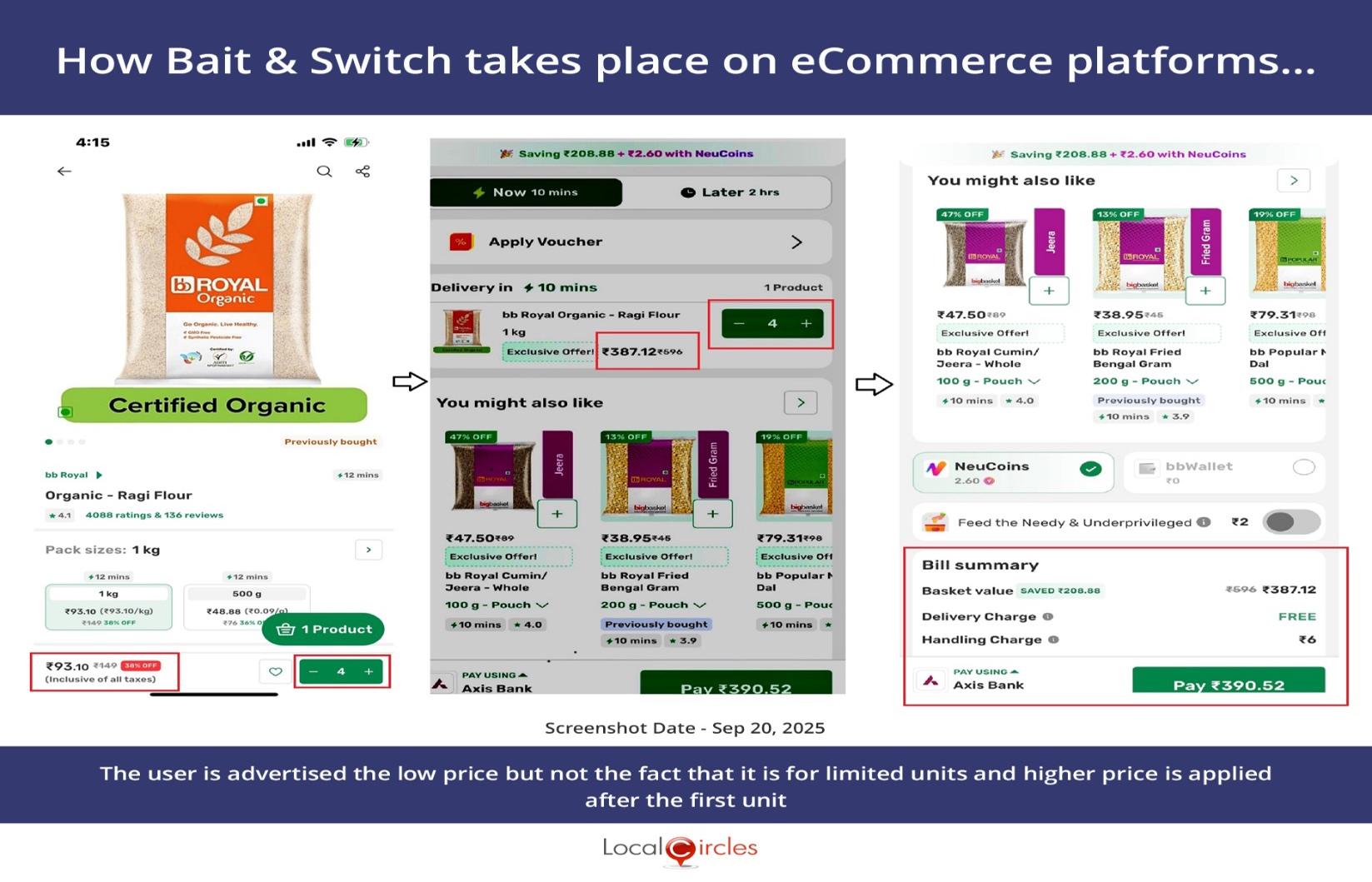
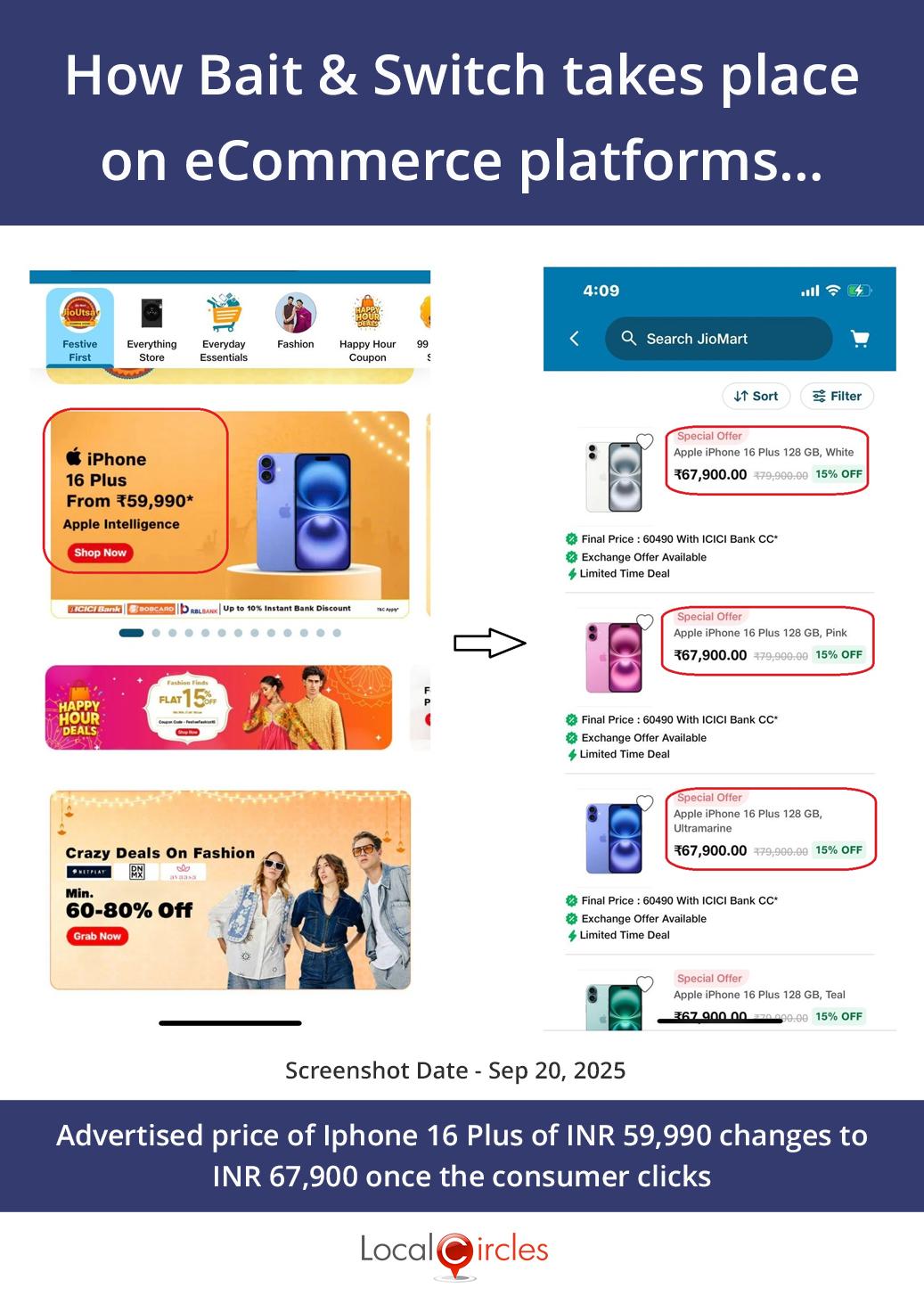
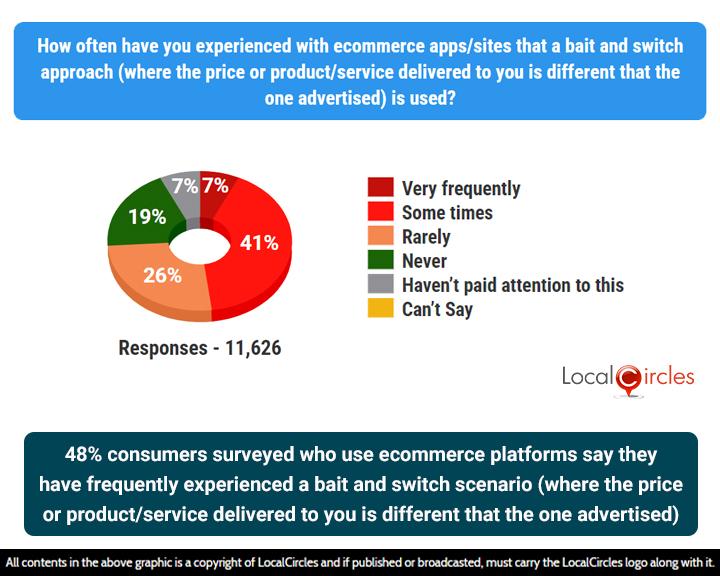
48% of consumers surveyed who use eCommerce platforms say they have frequently experienced a Bait and Switch scenario (where the price or product/service delivered to you is different than the one advertised)
The survey on the Bait & Switch dark pattern asked eCommerce users, “How often have you experienced with eCommerce apps/ sites that a bait and switch approach (where the price or product/service delivered to you is different than the one advertised) is used?” The query received 11,626 responses with 7% of those surveyed indicating “very frequently”; 41% of respondents indicated “sometimes”; and 26% indicated “rarely”. In addition, 19% of respondents stated “never” and 7% admitted “haven’t paid attention to this”. To sum up, 48% of consumers surveyed who use eCommerce platforms say they have frequently experienced a bait and switch scenario (where the price or product/service delivered to you is different than the one advertised).
Dark Pattern # 2: Basket Sneaking
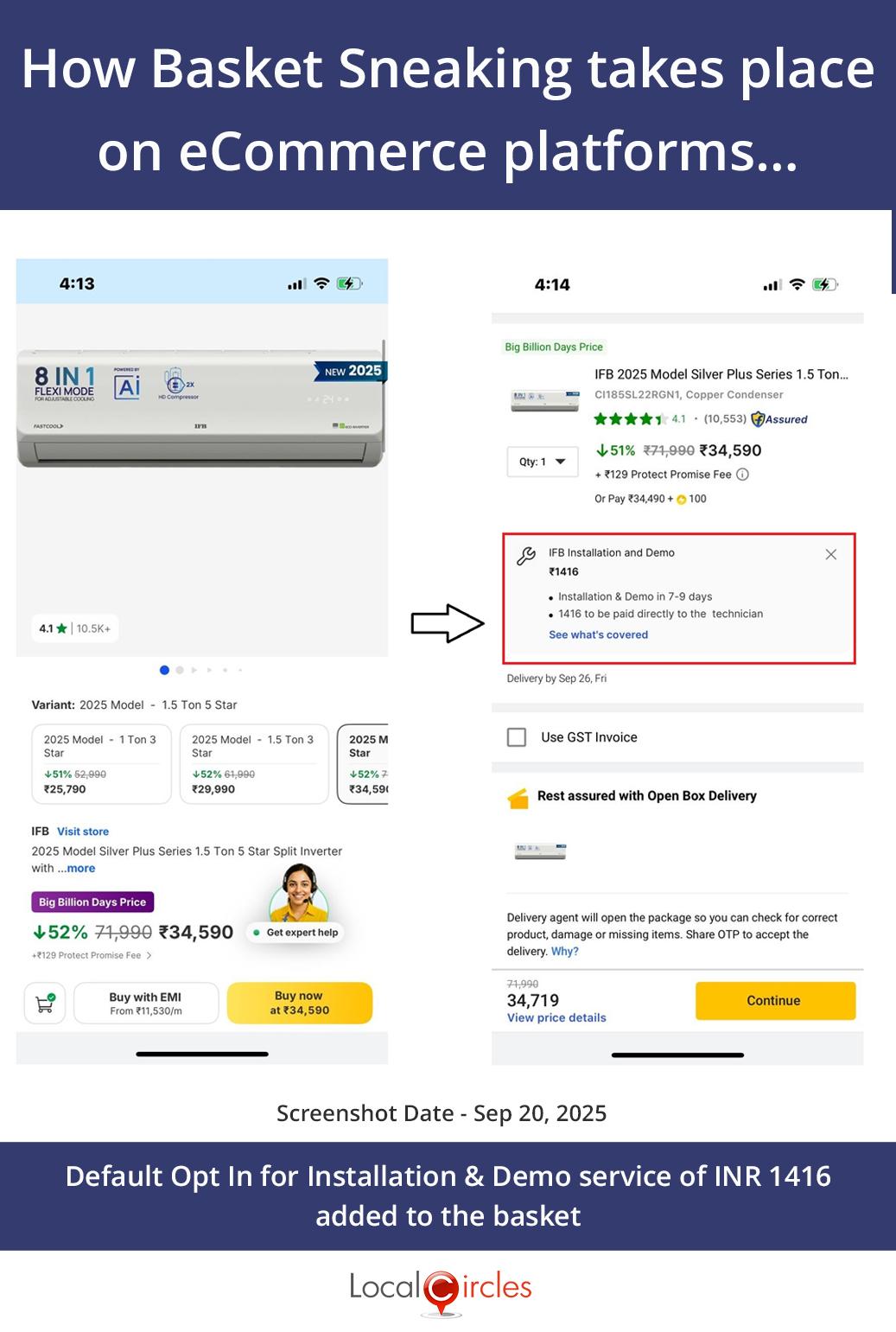
The Basket Sneaking dark pattern in the context of eCommerce marketplaces is generally experienced by consumers when a product, service, donation etc. is automatically added to their cart requiring them to opt out and if they don’t, end up incurring that charge. The example below illustrates the Basket Sneaking dark pattern, an installation service is added automatically to the user’s cart without their consent when they are purchasing a white good where they are required to pay a set amount to a technician who will visit them for installation.
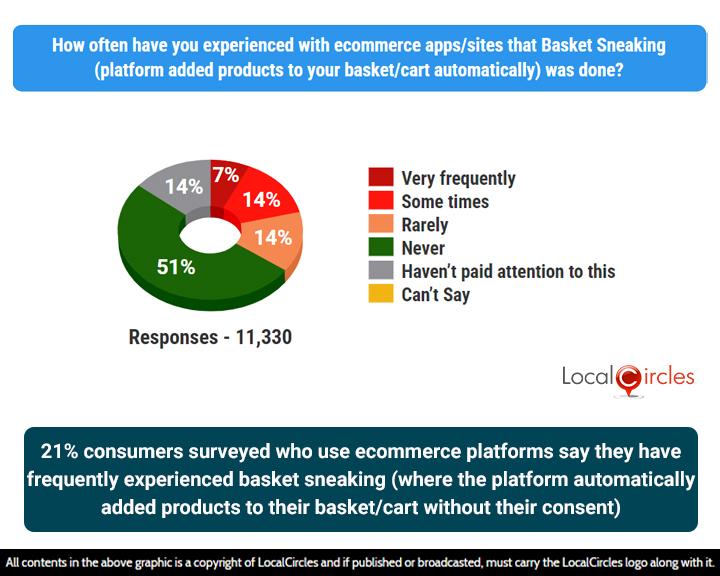
21% of consumers surveyed who use eCommerce platforms say they have frequently experienced basket sneaking (where the platform automatically added products to their basket/cart without their consent)
The survey on the Basket Sneaking dark patterns asked eCommerce users, “How often have you experienced with eCommerce apps/sites that Basket Sneaking (platform added products to your basket /cart automatically) was done?” The query received 11,330 responses with 51% of respondents stating that they have never experienced Basket Sneaking and 14% stating that they “haven’t paid attention to this”. Of the remaining respondents 7% admitted to having faced Basket Sneaking “very frequently”; 14% indicating that this has happened “sometimes” and 14% of respondents stating “rarely” have such incidents happened to them. To sum up, 21% of consumers surveyed who use eCommerce platforms say they have frequently experienced basket sneaking (where the platform automatically added products to their basket/cart without their consent).
Dark Pattern # 3: Forced Action
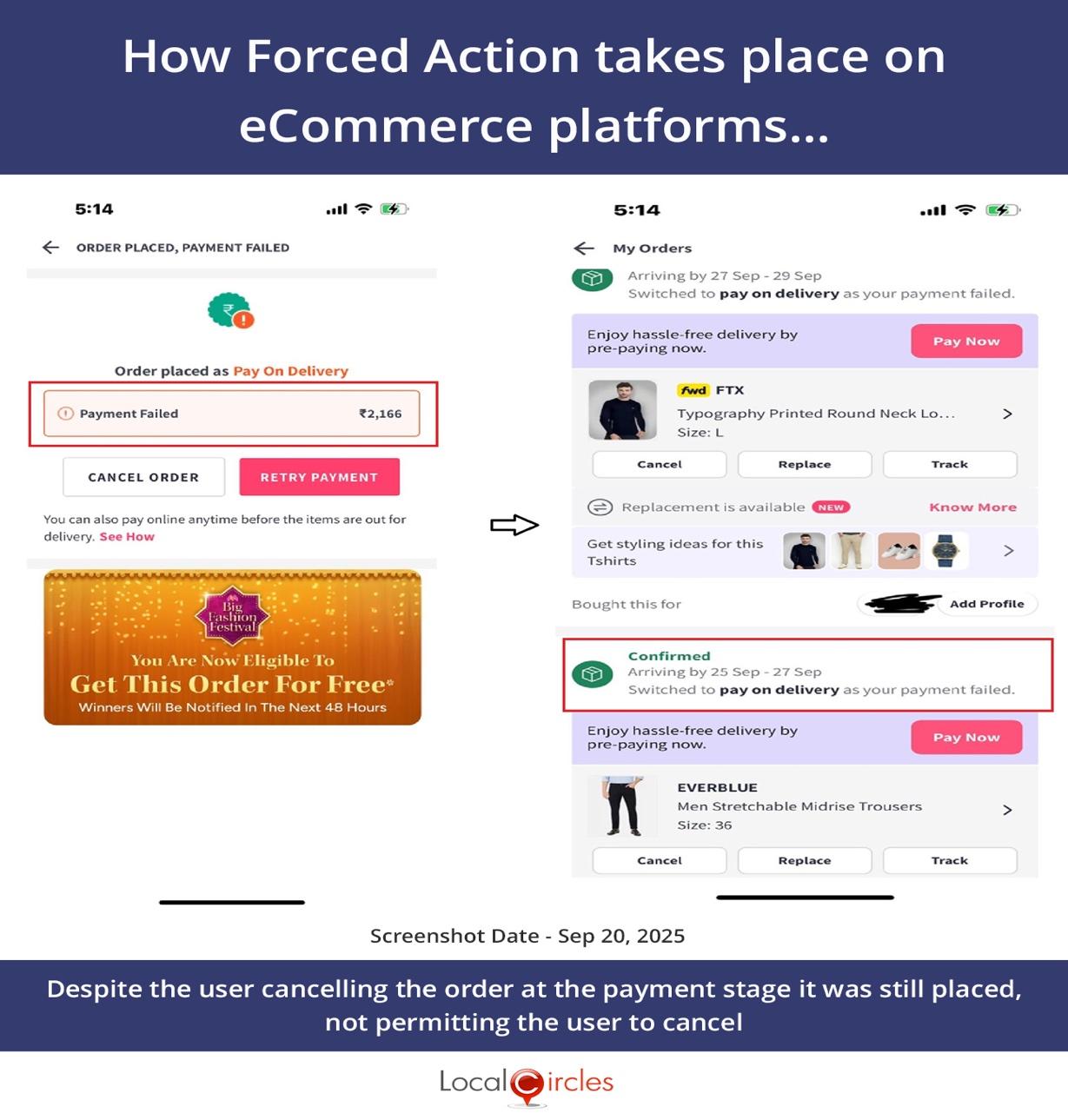
The Forced Action dark pattern in the context of eCommerce marketplaces is platforms forcing an action upon the user, without their consent. Common examples include cornering them via user flows such that they are required to share a particular data point forcibly to go to the next step even though the obtained data is not essential for the action that they came to the platform for. Similarly, Forced Action also becomes applicable when a user does not complete an order or payment on a platform and instead of the platform cancelling the order, they process it on Cash on Delivery basis without the user’s consent. The example below illustrates the Forced Action dark pattern where despite the user cancelling the order at payment stage, the order is still processed on Cash on Delivery basis and shipped to the user. The user cannot cancel the order and they must go through a lengthy process of cancelling every item and provide explanation of why they are cancelling.
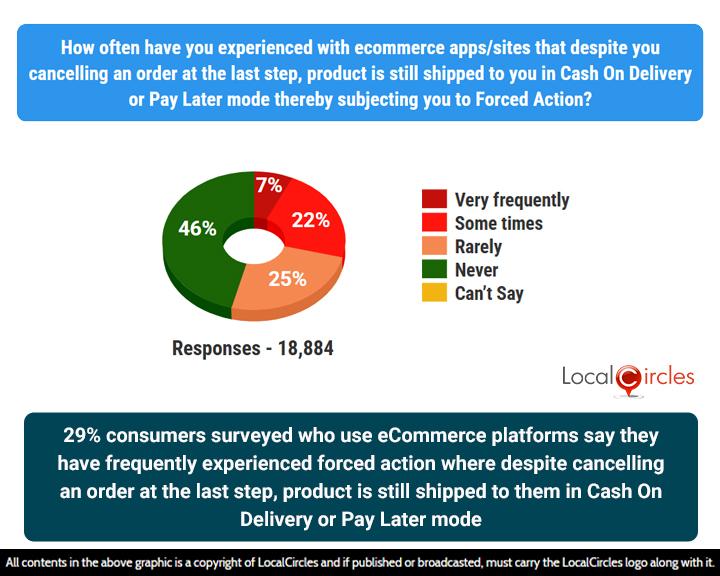
29% of consumers surveyed who use eCommerce platforms say they have frequently experienced forced action where despite cancelling an order at the last step, product is still shipped to them in Cash on Delivery or Pay Later mode
The survey on the Forced Action dark pattern asked eCommerce users, “How often have you experienced with ecommerce apps/ sites that despite you cancelling an order at the last step, the product is still shipped to you in Cash on Delivery or Pay Later mode thereby subjecting you to Forced Action?” Out of 18,884 eCommerce users who responded to the question 7% indicated they have experienced Forced Action “very frequently”; 22% of respondents indicated “sometimes”; 25% of respondents indicated that they have “rarely” experienced it; and 46% of respondents indicated that they have “never” faced Forced Action dark pattern. To sum up, 29% of consumers surveyed who use eCommerce platforms say they have frequently experienced forced action where despite cancelling an order at the last step, product is still shipped to them in Cash on Delivery or Pay Later mode.
Dark Pattern # 4: Privacy Zuckering
The Privacy Zuckering dark pattern in the context of eCommerce marketplaces involves platforms tricking users into sharing more personal data then they intended to and using it to manipulate prices or soliciting them with products and services. The example below illustrates the scenario where a user adds some products to their cart but does not check out. A few minutes later, the platform starts sending unsolicited messages to the user’s Whatsapp number without their consent in an aim to somehow get them to complete their order and pay. It is found that this dark pattern is deployed by the platform for various products and services. In another example, a user experiences that without they sharing their vehicle details the eCommerce platform has found them and pre-populated certain fields for them to purchase an insurance policy.
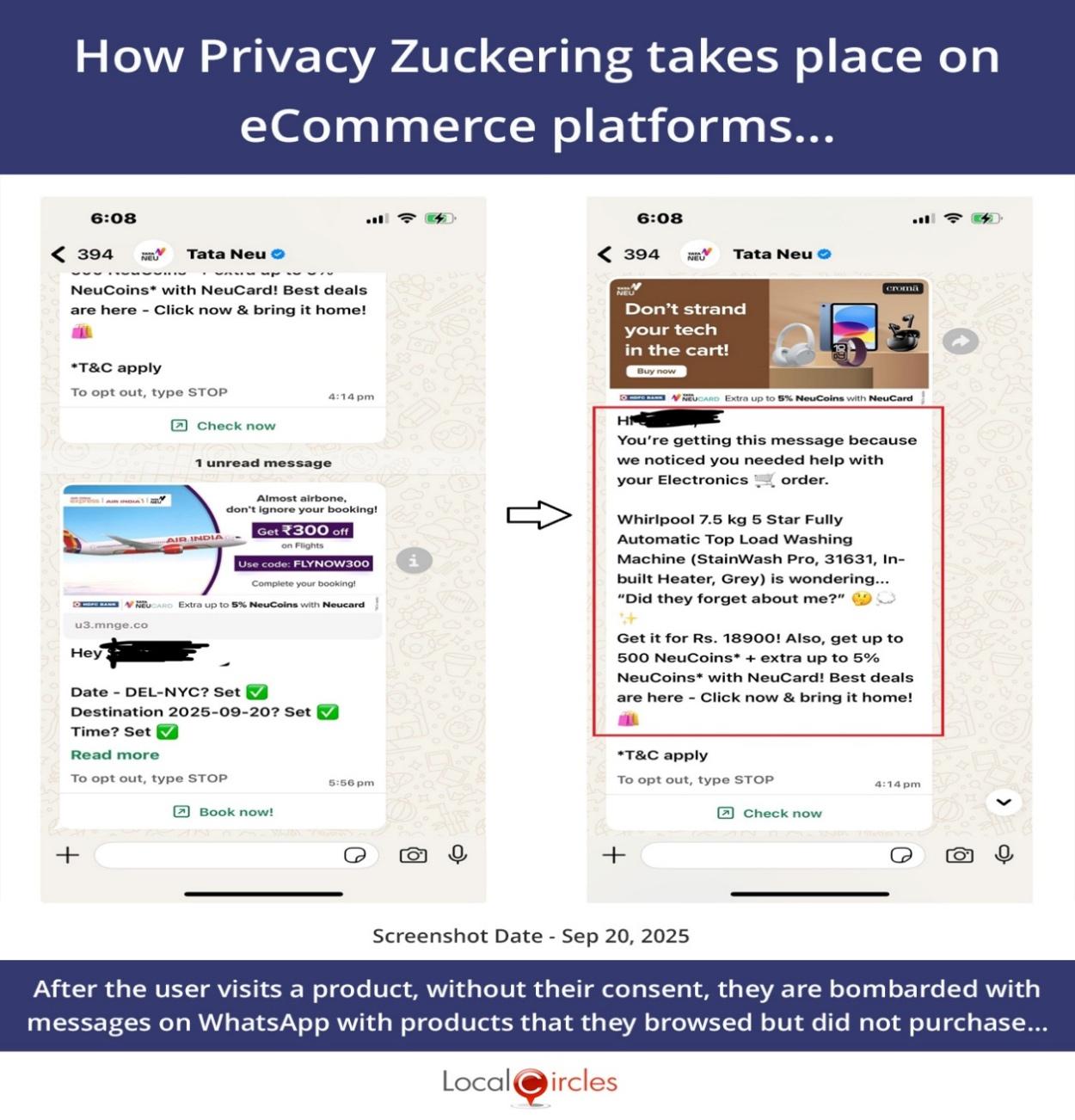
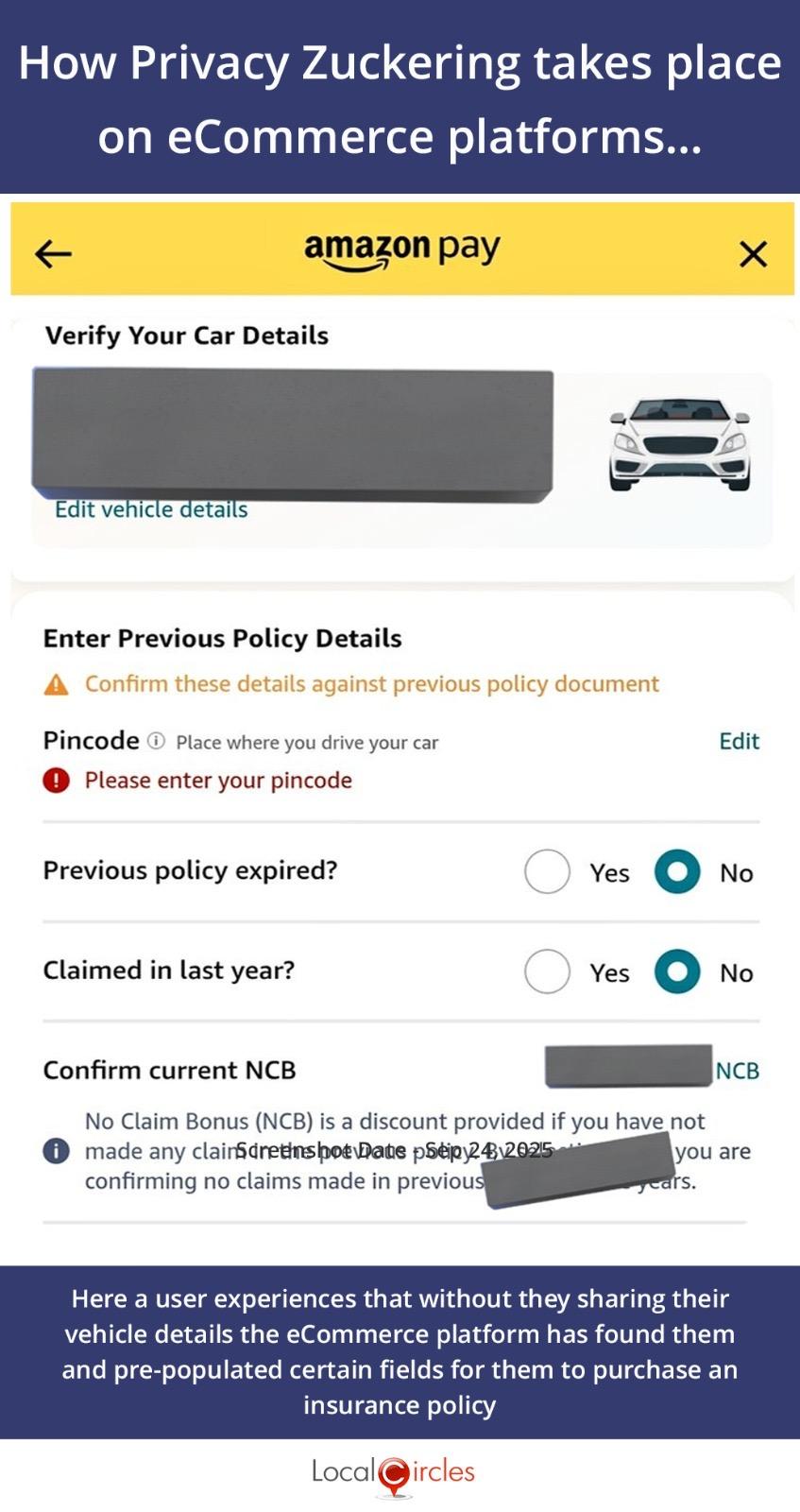
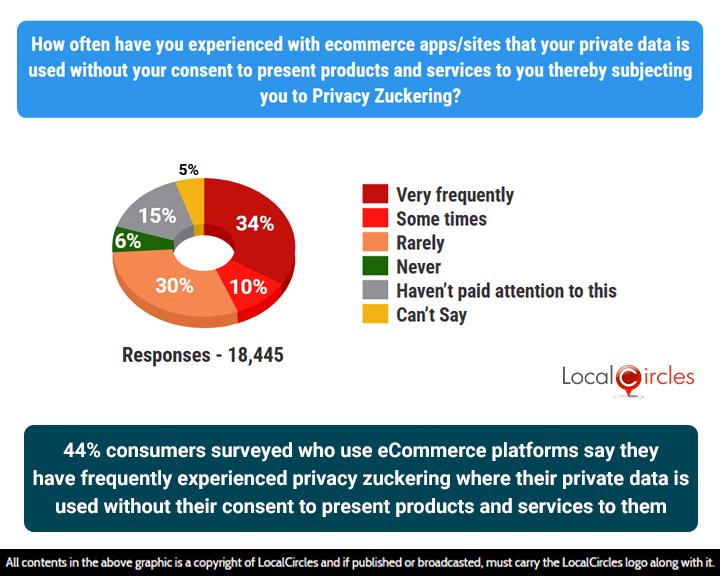
44% of consumers surveyed who use eCommerce platforms say they have frequently experienced Privacy Zuckering where their private data is used without their consent to present products and services to them
The survey on the Privacy Zuckering dark pattern asked eCommerce users, “How often have you experienced with eCommerce app/ sites that your private data is used without your consent to present products and services to you thereby subjecting you to Privacy Zuckering?” Out of 18,445 who responded to the question 34% indicated that they have “very frequently” experienced Privacy Zuckering; 10% of respondents indicated that they have “sometimes” experienced it; 30% of respondents indicated that they have “rarely” experienced it; 6% of respondents indicated that they have “never” experienced it; 15% of respondents admitted that they “haven’t paid attention to this” and 5% of respondents did not give a clear answer. To sum up, 44% of consumers surveyed who use eCommerce platforms say they have frequently experienced Privacy Zuckering where their private data is used without their consent to present products and services to them.
Dark Pattern # 5: Drip Pricing
The Drip Pricing dark pattern in the context of eCommerce marketplaces as discussed earlier, involves platforms not revealing elements of prices or revealing them surreptitiously within the user experience. In simpler terms, drip pricing refers to design or U/X practices where some components of the total price (e.g. taxes, fees, surcharges, additional mandatory costs) are withheld initially and revealed only later in the purchase process (e.g. at checkout or after confirmation). In the example below, the eCommerce platform does not disclose on the product selection page that a payment handling fee will be applicable to the transaction and adds it at the last step. Similarly, other charges like platform fee and convenience fee are not disclosed upfront and added at the last step. In similar category is the Cash on Delivery charge which in many cases is not disclosed upfront and added at the last step thereby getting classified as a dark pattern.
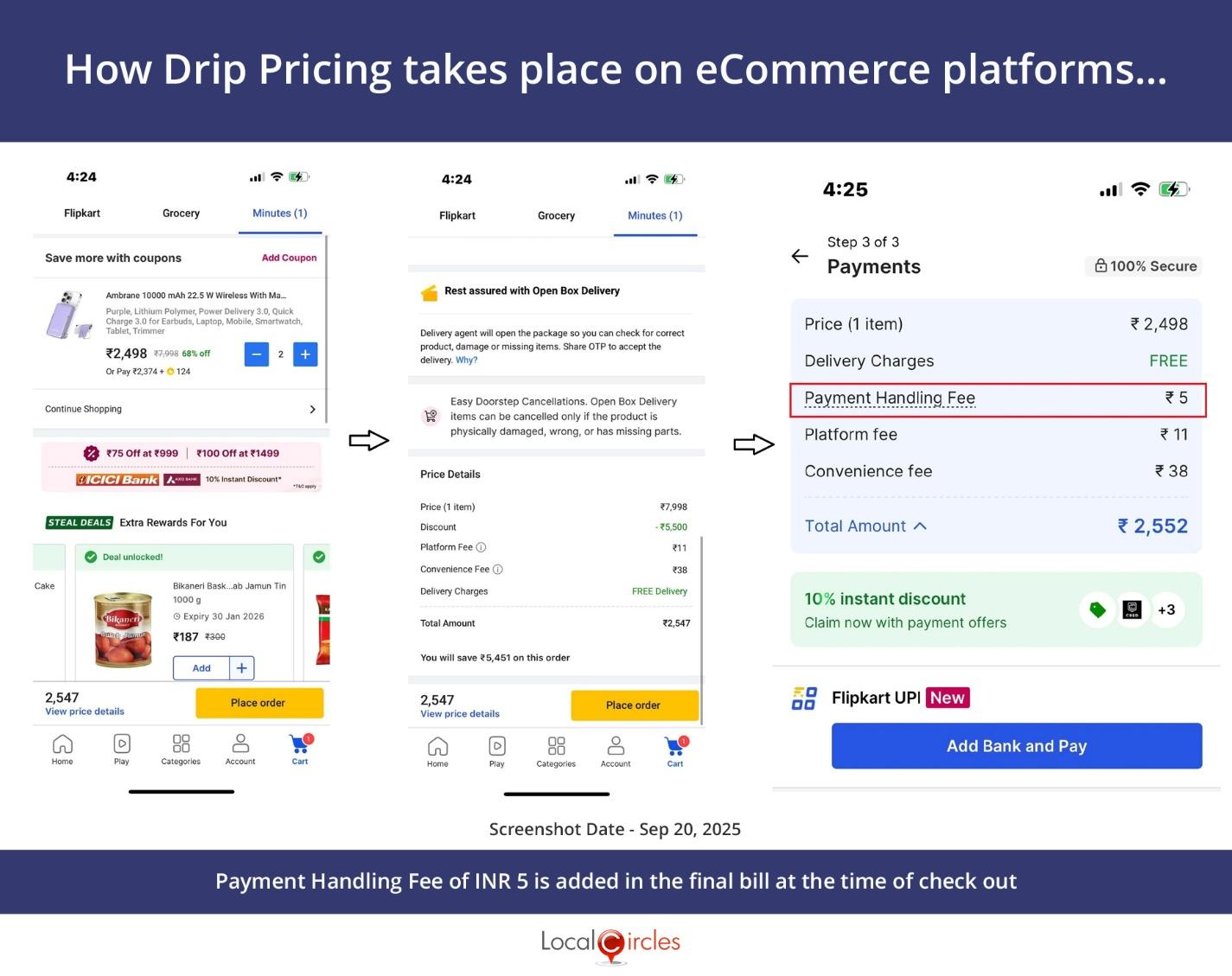
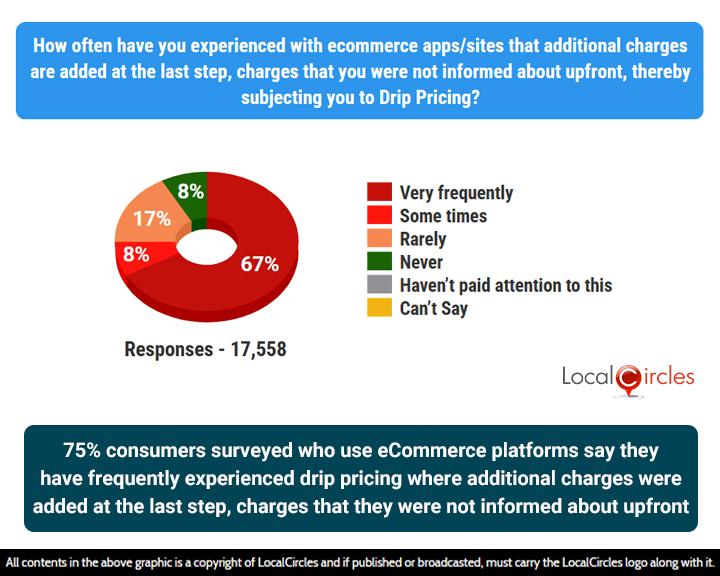
75% of consumers surveyed who use eCommerce platforms say they have frequently experienced drip pricing where additional charges were added at the last step, charges that they were not informed about upfront
The survey on the Drip Pricing dark pattern asked eCommerce users, “How often have you experienced with eCommerce apps/ sites that additional charges are added at the last step, charges that you were not informed about upfront, thereby subjecting you to Drip Pricing?” Out of 17,558 eCommerce platform users who responded to the question 67% stated that they have “very frequently” experienced Drip Pricing; 8% of respondents indicated that they “sometimes” experienced it; 17% of respondents indicated that they have “rarely” experienced it; and 8% of respondents stated that they have “never” experienced it. To sum up, 75% of consumers surveyed who use eCommerce platforms say they have frequently experienced drip pricing where additional charges were added at the last step, charges that they were not informed about upfront. The Drip Pricing dark pattern is one of the most prevalent dark patterns in India with over 200 online platforms in India utilizing it to levy various charges on the consumer without upfront disclosure.
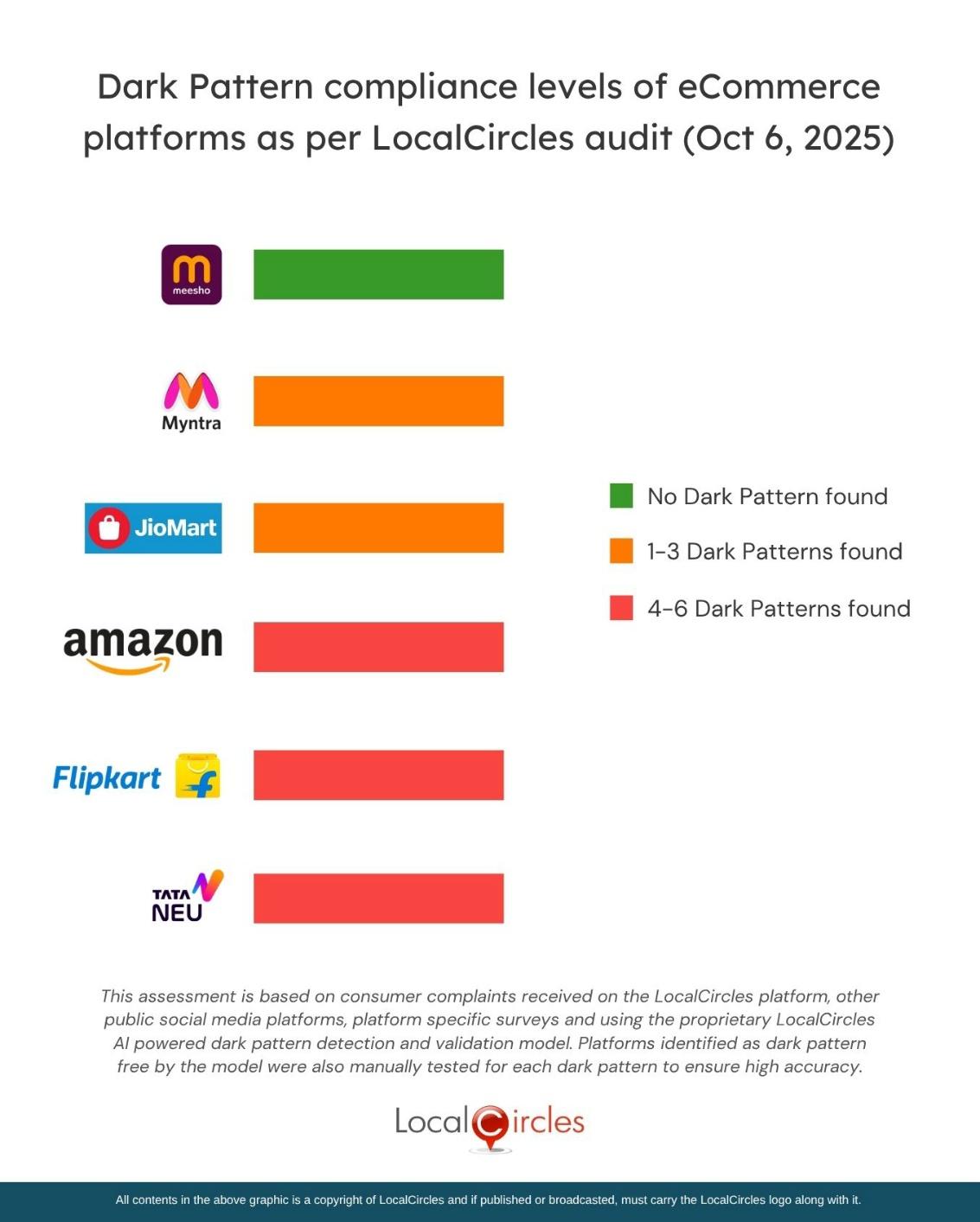
Dark Pattern audit of various eCommerce marketplaces finds that most platforms have dark patterns
Based on the consumer complaints, survey data and utilizing the proprietary LocalCircles Artificial Intelligence (AI) powered dark pattern detection and validation model, many eCommerce marketplace platforms including Amazon, Flipkart, Meesho, Tata Neu, Jiomart and Myntra were evaluated. All of these platforms with the exception of Meesho, were found to have dark patterns. The audit found 4 dark patterns each on Tata Neu, Amazon and Flipkart and 2 dark patterns each on Jiomart and Myntra. LocalCircles also ran a series of manual tests on Meesho including placement of orders to ensure that the platform was indeed dark pattern free. Meesho passed all the manual tests and as on October 6th, 2025 was found to be dark pattern free. LocalCircles will continue to audit Meesho on a quarterly basis and will update its findings in case a dark pattern is found on the platform.
To summarize, the study, which was a combination of consumer complaints analysis, consumer survey and utilizing the LocalCircles’ proprietary AI powered dark pattern validation model, found that most eCommerce marketplaces in India still have dark patterns. As far as the survey goes, the findings suggest that Drip Pricing is the most rampant dark pattern on eCommerce marketplaces with 75% eCommerce marketplace users experiencing it. Complaints on LocalCircles and public social media also show highest number of Drip Pricing complaints. The survey finds that the next two common dark patterns on eCommerce marketplaces are Bait & Switch and Privacy Zuckering with over 4 in 10 users confirming experiencing them. They are followed by dark patterns like Forced Action and Basket Sneaking, which are experienced by 29% and 21% eCommerce marketplace users respectively.
The need of the hour here is for all eCommerce marketplace platforms to make removing dark patterns a priority and in this process the key is to rely not just on their design and technology teams but also their consumer base to test and report them. Dark Patterns directly impact consumer trust and loyalty and once those are broken, it is usually very difficult for platforms to earn it back.
LocalCircles will also escalate the findings of this study to the Central Consumer Protection Authority and other regulators for their understanding and applicable actions.
Survey Demographics and Period
The survey received over 77,000 responses from consumers located in 334 districts of India. 62% respondents were men while 38% respondents were women. 44% respondents were from tier 1, 31% from tier 2 and 25% respondents were from tier 3, 4, 5 and rural districts. The survey was conducted via LocalCircles platform, and all participants were validated citizens who had to be registered with LocalCircles to participate in this survey. The survey was conducted between June 1, 2025 and Sep 30, 2025.
Survey Methodology
This survey has been conducted using the proprietary LocalCircles stratified sampling methodology. With a minimum target of 30% participation of each gender and a minimum target of 20% participation from each location group (Tier 1 districts, Tier 2 districts and Tier 3, 4 5, & rural districts) on each poll, all polls were run. After the minimum participation criteria were met, all polls were run for additional samples and till they achieved steady state. Post achievement of steady state, the LocalCircles system using the bootstrapping technique drew additional samples to test for the margin of error. All polls were found to have a margin of error under 5% and a confidence level of over 95%.
Study Disclaimer
For the dark patterns detection and validation exercise using the LocalCircles AI powered dark pattern validation model, the assessment of platforms in the eCommerce sector was conducted between June 1, 2025 and September 30, 2025 and was revalidated on October 6th, 2025. Any changes implemented by platforms post October 6th, 2025 are not captured by the study. Also, any platform that was identified as dark pattern free via the LocalCircles assessment could have a change in status with time as they introduce new business models, strategies and UI/UX changes. Similarly, some platforms could resolve their dark patterns over time and become dark pattern free. LocalCircles may conduct sectoral audits in the future to capture these changes and update the dark pattern status of platforms.
About LocalCircles
LocalCircles, India’s leading Community Social Media platform enables citizens and small businesses to escalate issues for policy and enforcement interventions and enables Government to make policies that are citizen and small business centric. LocalCircles is also India’s # 1 pollster on issues of governance, public and consumer interest. More about LocalCircles can be found on https://www.localcircles.com
For more queries - media@localcircles.com, +91-8585909866
All content in this report is a copyright of LocalCircles. Any reproduction or redistribution of the graphics or the data therein requires the LocalCircles logo to be carried along with it. In case any violation is observed LocalCircles reserves the right to take legal action.
Enter your email & mobile number and we will send you the instructions.
Note - The email can sometime gets delivered to the spam folder, so the instruction will be send to your mobile as well


