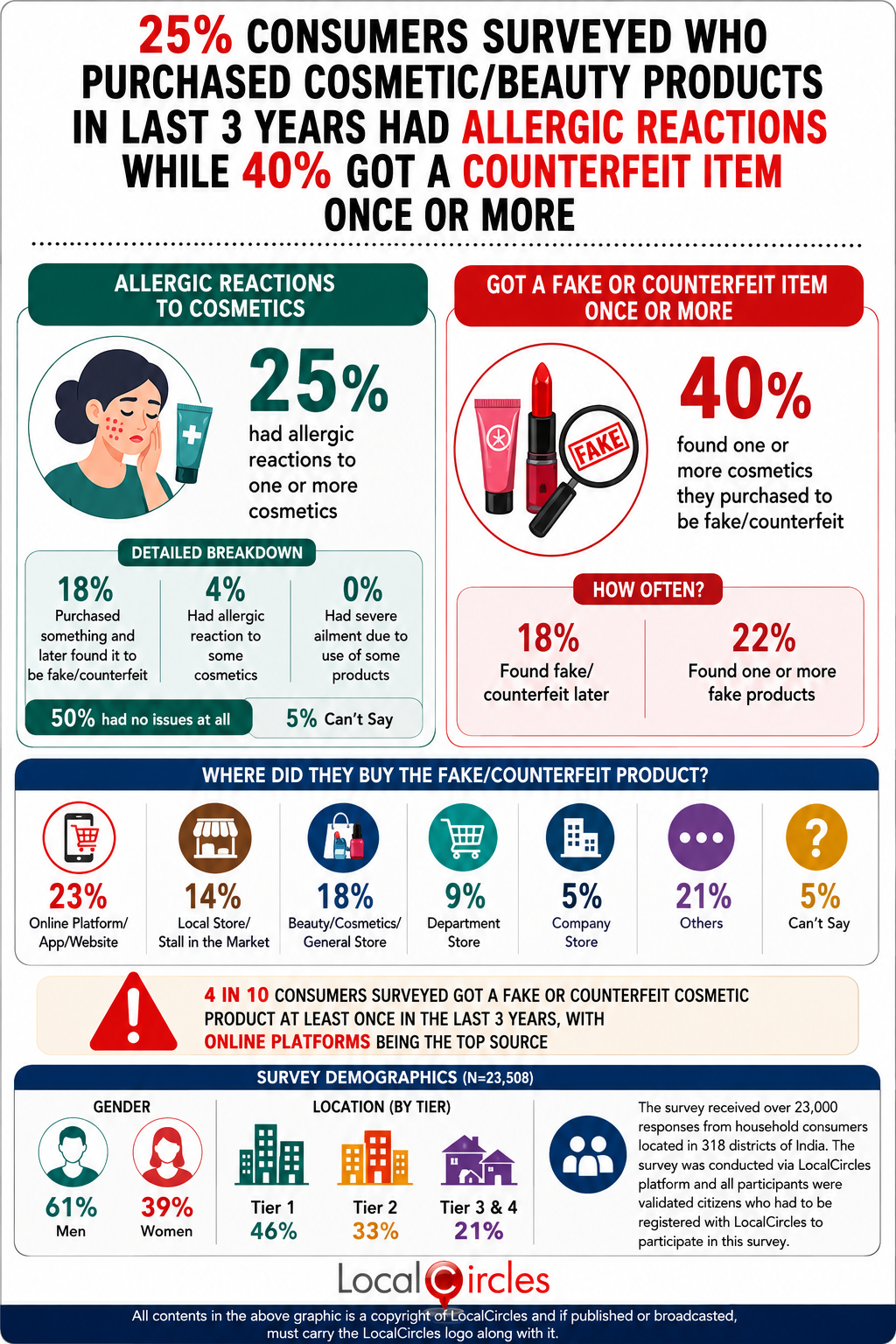
25% consumers surveyed who purchased cosmetic/beauty products in last 3 years had allergic reactions while 40% got a counterfeit item once or more
- ● 40% consumers surveyed who bought cosmetics and beauty products in the last 3 years found one or more of them to be fake or counterfeit
- ● 26% consumers surveyed had an allergic reaction to one or more cosmetics they purchased in the last 3 years
- ● Online platforms, apps and websites at 23% were the single largest source of the fake or counterfeit cosmetics consumers surveyed ended up buying, followed by beauty, cosmetics or general stores at 18% and local stores or stalls in the market at 14%
- ● Survey received 23,000+ responses from consumers located across
August 14, 2026, New Delhi: India’s beauty and personal care market has crossed USD 30 billion and is projected to generate close to USD 34 billion in revenue in 2026, with a lipstick, a face wash or a sunscreen now bought as routinely from an app on the phone as from a shop in the neighbourhood market. Growing alongside it, however, is a parallel market of counterfeit, misbranded, unlicensed, expired and relabelled cosmetics that is close to indistinguishable from the original both on the shelf and on the screen. A series of enforcement actions over the last few months across Maharashtra, Delhi, Kerala, Gujarat and other States has shown how deep that parallel market runs, and how directly it touches consumer health.
The most sustained action has come from the Maharashtra Food and Drug Administration (FDA), which has launched a statewide campaign against the manufacture and sale of unlicensed and deceptive cosmetic products. In two raids in Mumbai and Bhiwandi reported on June 18, 2026, the FDA seized illegal cosmetics stock and manufacturing machinery worth ₹1.52 crore. At Kriya Enterprises in Andheri East, officials found children’s hair and skin care products, shampoos, lotions, powders, sunscreens and men’s grooming products carrying the address of a non-existent manufacturing unit and missing batch numbers, manufacturing dates and expiry dates, with stock worth ₹29.84 lakh seized. At Sigma Lifestyle Pvt. Ltd. in Bhiwandi, an unlicensed unit with no nameplate and no quality testing laboratory was found manufacturing a wide range of products marketed as “Sulphate Free” and “Paraben Free” and sold on e-commerce platforms with a fake Mumbai address; goods and equipment worth ₹1.23 crore were seized, the factory sealed and an FIR registered under Sections 318(4) and 3(5) of the Bharatiya Nyaya Sanhita. Days earlier, in inspections on June 12 and 13, 2026, the FDA had stopped the sale of misbranded cosmetics worth ₹29.45 lakh at a facility in Karad, Satara district, and seized drugs, cosmetics, raw materials and manufacturing equipment worth ₹3.96 lakh from Radiant Creations in Kandivali (West), Mumbai. Across June 2026 alone, the FDA raided 34 manufacturing units and acted against illegal drugs, medical products and cosmetics worth ₹4.12 crore, testing 787 samples of which 35 were declared Not of Standard Quality, with nine FIRs registered and two arrests made. FDA Commissioner Tukaram Mundhe has warned that stringent action will be taken against any individual, company or online seller found violating the law.
The consumer health cost of this parallel market is no longer theoretical. Eighteen women in Nagpur developed kidney disorders over a two-year period after using Goree Beauty Cream, a Pakistan-made skin-lightening product bought largely through social media and e-commerce sites. Laboratory testing by the Maharashtra FDA found mercury in the samples at levels reported to be 752 times above the legal limit, and on July 4, 2026 the department banned the product and flagged two others — Face Fresh Gold Beauty Cream and Beauty Serum, and Golden Star Beauty Cream — after tests found mercury and lead far above permissible limits, with none of them carrying mandatory labelling details such as manufacturer name and address, batch number, manufacturing date or expiry date. Retailers, wholesalers, distributors and e-commerce platforms were directed to stop sale, stocking and distribution and to recall existing stock, and Mumbai Police registered a criminal case against a Chembur shopkeeper for stocking and selling Goree cream despite the import ban. The FDA has cautioned that prolonged exposure to such heavy metals can damage the skin, kidneys and nervous system. Independent testing has found the problem to be widespread rather than isolated — a Centre for Science and Environment study found mercury, which is banned in cosmetics in India, in 44% of the fairness creams it tested, and nickel and chromium in lipsticks. By some estimates, close to 2 million people in India suffer skin irritation or allergic reactions every year from the use of substandard cosmetics.
Counterfeiting itself has become an organised business. Consumer perception surveys by ASPA and CRISIL have pegged the extent of counterfeiting at 25-30% of the market, while FICCI estimates place the counterfeit share of FMCG products sold in India at around 30%, with beauty and cosmetics among the most targeted categories. An India Today Special Investigation Team sting published in June 2026 exposed a racket estimated at ₹500 crore operating out of Delhi-NCR hubs including Rohini, Azad Nagar and Shahdara, in which operators bought bulk expired stock of premium brands, chemically erased the original manufacturing and expiry details, pasted altered stickers carrying fresh dates and pushed the product to salons and retail consumers, marketing it through viral Instagram reels promising discounts of up to 90%. In Kerala, the Drugs Control Department registered 15 fresh cases on August 9, 2026 under ‘Operation Soundarya’, its continuing drive against fake and hazardous beauty products, an earlier phase of which had caught 12 establishments selling counterfeit soaps and creams and found a perfume containing 95% methyl alcohol. In Ahmedabad, a counterfeit cosmetics manufacturing racket was busted in Behrampura in early August 2026 with fake soaps and face washes worth ₹11.68 lakh seized, and on April 6, 2026 the Delhi Police Crime Branch busted an illegal unit manufacturing fake Veet hair removal cream at Sanjay Gandhi Transport Nagar in Badli.
The channel through which cosmetics reach the consumer has itself shifted sharply, which is central to how counterfeits now travel. Online sales are estimated to account for around 10% of beauty and personal care revenue in 2026, and within online, quick commerce has roughly doubled its share from about 9% in FY25 to about 18% in FY26 while growing at over 120% year-on-year, with Redseer projecting it to reach 30-40% of the segment by FY30. Marketplace models built on large third-party seller bases make provenance harder for a consumer to establish than at a company-owned store. Regulators have begun to respond — the Central Consumer Protection Authority has acted against a major e-commerce platform over the sale of counterfeit and spurious goods including cosmetics and beauty products, following which the platform reported delisting over 1.21 crore listings identified as counterfeit, while CDSCO has directed States to intensify checks on unregistered imported cosmetics. Yet a consumer buying a face cream today, online or offline, has no simple way of establishing whether it is genuine before it reaches the skin.
Against this backdrop, LocalCircles conducted a national survey to understand what issues consumers have faced with cosmetics and beauty products in the last 3 years, and where the products that turned out to be fake or counterfeit had been bought from. The survey received over 23,000 responses from household consumers located in 318 districts of India. The findings show that 40% of consumers surveyed who purchased cosmetics and beauty products in the last 3 years found one or more of them to be fake or counterfeit, 26% had an allergic reaction to one or more cosmetics, and that online platforms at 23% were the single largest source of the counterfeit products consumers ended up with. The key findings of the survey are detailed below.
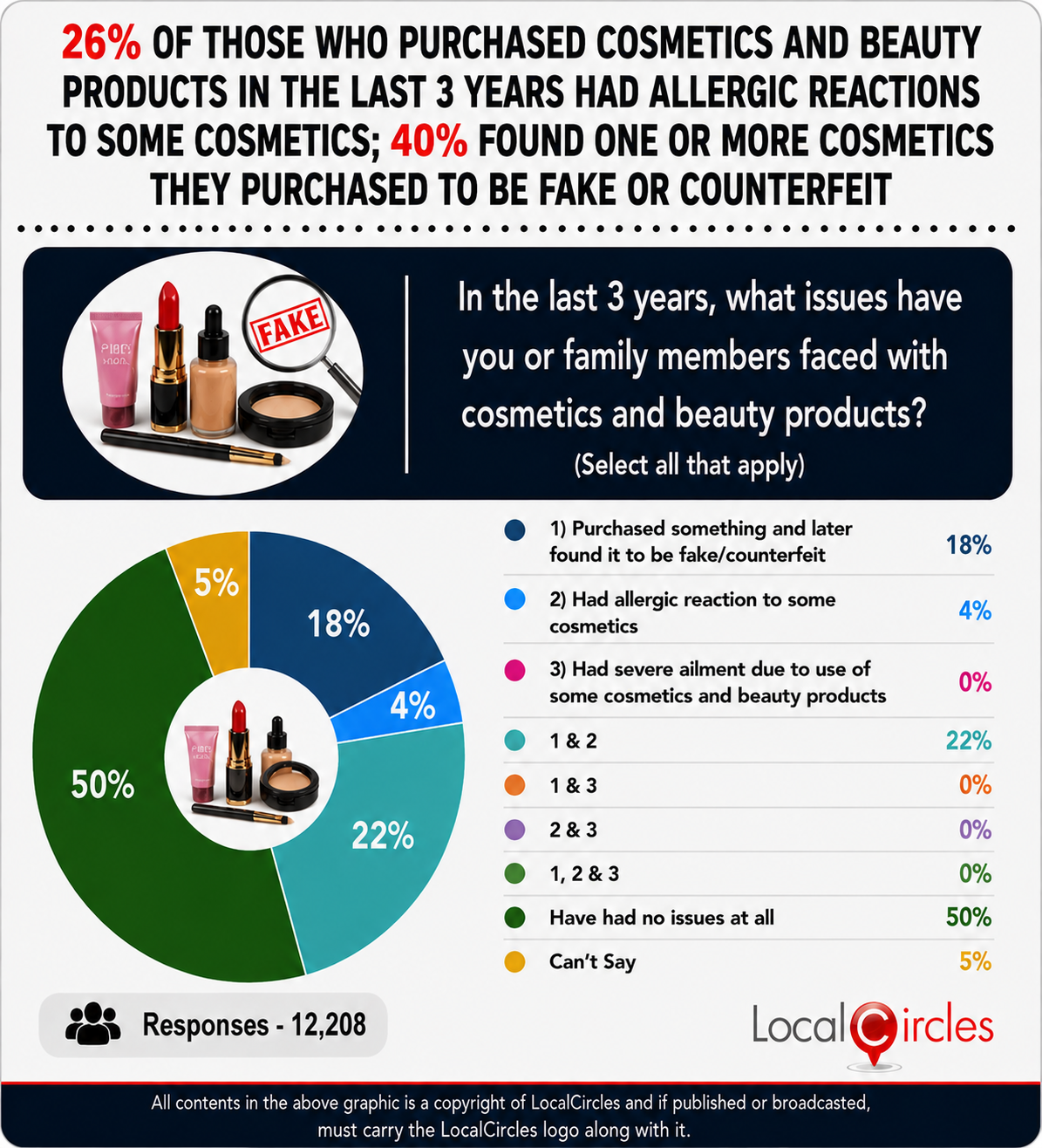
26% of those who purchased cosmetics and beauty products in the last 3 years had allergic reactions to some cosmetics; 40% found one or more cosmetics they purchased to be fake or counterfeit
To establish what consumers have actually experienced rather than what they fear, the survey asked, “In the last 3 years, what issues have you or family members faced with cosmetics and beauty products? (Select all that apply)” This question received 12,208 responses. In response, 18% said they had purchased something and later found it to be fake or counterfeit, 4% said they had an allergic reaction to some cosmetics and 22% said they had faced both of these issues. None reported having suffered a severe ailment due to the use of cosmetics and beauty products, either on its own or in combination with the other two issues. Half the respondents at 50% said they had faced no issues at all, while 5% could not say. Aggregating the responses, 40% of consumers surveyed — 18% plus 22% — found one or more cosmetics they purchased in the last 3 years to be fake or counterfeit, and 26% — 4% plus 22% — had an allergic reaction to one or more cosmetics. In effect, 4 in 10 consumers surveyed got a counterfeit cosmetic at least once in 3 years and 1 in 4 had an allergic reaction, and the overlap is telling: of those who reported an allergic reaction, the overwhelming majority had also bought a counterfeit product. That 50% reported no issues at all means the other half of consumers surveyed encountered a counterfeit, an adverse reaction or both — a failure rate that no other everyday household purchase category would be permitted to sustain, and one that sits at the same 25-30% band that ASPA and CRISIL have estimated for counterfeiting across the Indian market as a whole.
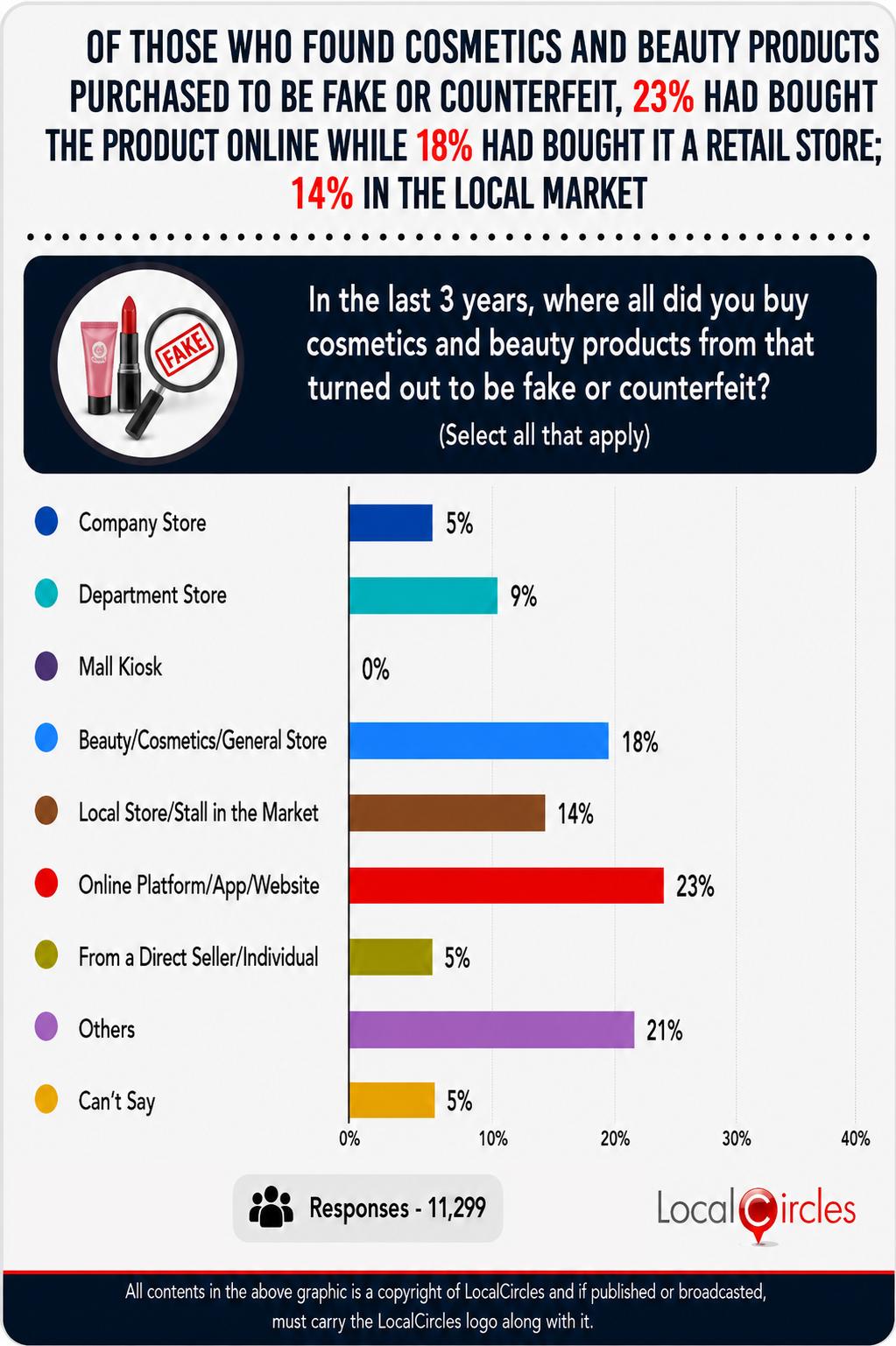
Of those who found cosmetics and beauty products purchased to be fake or counterfeit, 23% had bought the product online while 18% had bought it at a retail store; 14% in the local market
Having established the scale of the problem, the survey next sought to identify the channels through which counterfeit cosmetics are reaching consumers, asking, “In the last 3 years, where all did you buy cosmetics and beauty products from that turned out to be fake or counterfeit? (Select all that apply)” This question received 11,299 responses. In response, 23% said they had bought the counterfeit product from an online platform, app or website, making it the single largest source. Beauty, cosmetics or general stores followed at 18% and local stores or stalls in the market at 14%. Department stores accounted for 9%, while company stores and direct sellers or individuals were each cited by 5%, and no respondent reported having bought a counterfeit cosmetic from a mall kiosk. Another 5% could not say. Some respondents selected more than one option and hence the total does not equate to 100%. The pattern points clearly at the least controlled parts of the distribution chain. Online platforms and neighbourhood beauty or general stores together account for the bulk of counterfeit purchases, while company-owned stores at 5% — where the brand controls the supply chain end to end — are the least affected. The online finding is particularly significant given that online is estimated to be only about 10% of beauty and personal care sales but is the top counterfeit source at 23%, which suggests the risk of buying a fake cosmetic online is disproportionately higher than the channel’s share of the market would indicate. It also aligns closely with what enforcement agencies have been finding — the Bhiwandi unit sealed by the Maharashtra FDA was selling on e-commerce platforms using a fake Mumbai address, the Goree cream linked to kidney disorders in Nagpur was bought largely through social media and e-commerce sites, and the Delhi relabelling racket ran its sales through Instagram reels.
In summary, the survey findings indicate that counterfeit and unsafe cosmetics are not a fringe problem confined to the establishments regulators have named so far, but a mainstream consumer experience. Only 50% of consumers surveyed who purchased cosmetics and beauty products in the last 3 years reported no issues at all; 40% found one or more products they bought to be fake or counterfeit and 26% had an allergic reaction to one or more cosmetics. Online platforms, apps and websites at 23% are the single largest source of the counterfeit products consumers ended up with, ahead of beauty, cosmetics or general stores at 18% and local stores or stalls at 14%, while company stores at 5% are the least affected. Read alongside the enforcement record of the last few months — ₹1.52 crore of illegal cosmetics and machinery seized in a single day’s raids in Mumbai and Bhiwandi, mercury found at 752 times the legal limit in a skin-lightening cream linked to kidney disorders in 18 women in Nagpur, a ₹500 crore expired-cosmetics relabelling racket in Delhi-NCR and 15 fresh cases in Kerala in August 2026 — the survey suggests that enforcement is confirming what consumers have already been experiencing rather than uncovering something new. A brand name, a sealed pack and a listing on a well-known platform, the findings show, are not read by consumers as an assurance of authenticity.
These findings carry an important signal for CDSCO, State Drug Controllers, the Central Consumer Protection Authority and e-commerce and quick commerce platforms. The citizen pulse is clear that the burden of detecting a counterfeit cosmetic currently sits entirely with the consumer, and that it is failing 4 in 10 of them. LocalCircles will be escalating these findings to the Ministry of Health and Family Welfare, CDSCO, the Department of Consumer Affairs and the Central Consumer Protection Authority, the Maharashtra FDA and Drug Controllers of other States so that the citizen pulse can inform how cosmetics safety and authenticity are regulated and enforced. LocalCircles is also urging that every cosmetic product sold in India carry a unique, scannable authentication code that lets a consumer verify the product and its manufacturing and expiry details before use; that e-commerce and quick commerce platforms be held to a defined standard of seller due diligence for cosmetics with mandatory disclosure of the actual seller, licence details and batch and expiry information on the product listing page; that a public national database of cosmetics banned, recalled or found Not of Standard Quality be maintained and pushed to platforms for automatic delisting; that random market sampling of cosmetics be conducted at a defined minimum frequency across both online and offline channels with findings placed in the public domain; and that consumers be given a simple, single-window mechanism to report a suspected counterfeit or adverse reaction to a cosmetic product.
Survey Demographics
The survey received over 23,000 responses from household consumers located in 318 districts of India. 61% respondents were men while 39% respondents were women. 46% respondents were from tier 1, 33% from tier 2 and 21% respondents were from tier 3 & 4 districts. The survey was conducted via LocalCircles platform and all participants were validated citizens who had to be registered with LocalCircles to participate in this survey.
About LocalCircles
LocalCircles, India’s leading Community Social Media platform enables citizens and small businesses to escalate issues for policy and enforcement interventions and enables Government to make policies that are citizen and small business centric. LocalCircles is also India’s # 1 pollster on issues of governance, public and consumer interest. More about LocalCircles can be found on https://www.localcircles.com
Akshay Gupta - media@localcircles.com, +91-8585909866
All content in this report is a copyright of LocalCircles. Any reproduction or redistribution of the graphics or the data therein requires the LocalCircles logo to be carried along with it. In case any violation is observed LocalCircles reserves the right to take legal action.


