Urban Indian parents question the new DPDP rules as 1 in 2 say their children are addicted to social media, OTT and online gaming
- • 49% urban Indian parents say their children spend an average of 3 hours or more each day on social media, videos/OTT and online gaming platforms which is making them aggressive, impatient and hyperactive
- • Despite the new DPDP rules, 1 in 2 urban Indian parents still believe that Aadhaar should be key to parental consent process and all existing accounts must go through age verification as well
December 22, 2025, New Delhi: The Ministry of Electronics and Information Technology (MeitY) last month notified the Digital Personal Data Protection (DPDP) Rules, 2025, raising expectations that it will put in place safeguards for protection of children against many risks posed by their unsupervised exposure to social media and OTT platforms.
Taking a step further, the European Parliament has voted in favour of banning social media for children under the age of 16. If it becomes law, then people will likely have to use IDs to log into their social media profiles making anonymous accounts impossible, thereby providing further protection for children.
In India, the Digital Personal Data Protection Act sets rules were long awaited. The legislation, passed in 2023, aims to balance individual privacy rights with the need for lawful data use by addressing issues linked to the collection and processing of digital personal data. Intending to foster a more secure and accountable digital environment, the law aims to clear ambiguities on issues of consent and third-party risks.
The government has emphasized that awareness and capacity-building will be key to the rollout of the implementation which includes breach reporting within 72 hours, and robust identity verification to safeguard sensitive personal details, especially for children and people with disabilities. The exposure of children to social media is rising rapidly in India due to affordable smartphones and deeper internet penetration, especially in rural areas. As of 2024, India had over 880 million internet users, with adolescents are estimated to be spending close to 1.5 hours daily online.
The Annual Status of Education Report (ASER) 2024 found that while 82.2% of Indian children aged 14-16 can use a smartphone, only 57% use it for education, compared to 76% who use it for social media, indicating a higher engagement with social platforms than learning resources on these devices. Prevalence studies in Indian schools estimate that 11–37% of adolescents display signs of problematic or addictive social media use, depending on the scale applied.
Excessive screen exposure is linked to poor sleep quality, reduced concentration, and worsening academic performance. Research in Indian adolescents demonstrates strong associations between high social media use and depression, anxiety, stress, and low self-esteem.
Cyberbullying, a major risk, affects anywhere from 3% to over 60% of Indian children depending on the context and definition used. Professional pediatrics guidelines in India emphasize no screen use under two years, only one supervised hour a day for preschoolers, and strict limits, thereafter, reflecting growing concern. Hospitals and state programs are beginning to open dedicated “digital addiction” clinics, signaling official recognition of the problem.
Longitudinal studies from the U.S. and Europe show bidirectional effects: children with higher baseline depression or loneliness are more likely to engage in problematic social media use, which then worsens symptoms. Sleep disruption is a universal mediator — nighttime scrolling and blue light exposure reduce sleep duration, which in turn amplifies mood and attention difficulties.
Protective factors identified globally include strong parent–child communication, active mediation of online activity, and school-based digital literacy programs. India needs to undertake similar exercises as children are going online earlier and more intensively, with a significant minority showing addiction-like behaviours.
Globally, 5.24 billion people currently use social media, more than double from 2.07 billion in 2015. The average time a person spends on social media, including entertainment and gaming, a day is 2 hours 21 minutes. In India, as of early 2024, there were approximately 862 million social media users, representing nearly 60% of the population. The user base in India is projected to reach 1.3 billion by 2029.
Given the concerns of parents and educationists about the impact of excessive usage of social media by minors (under 18), the Indian government introduced draft rules in January 2025 requiring parental consent for under-18s to use social media.
The new DPDP rules are meant to enhance digital safety for minors. LocalCircles through a survey has strived to find out if there has been any change in social media usage by children due to greater accessibility. The survey received over 57,000 responses from parents of school children aged between 9 -18 located in 302 districts of urban India. 61% respondents were men while 39% respondents were women. 47% respondents were from tier 1, 31% from tier 2 and 22% respondents were from tier 3 & 4 districts.
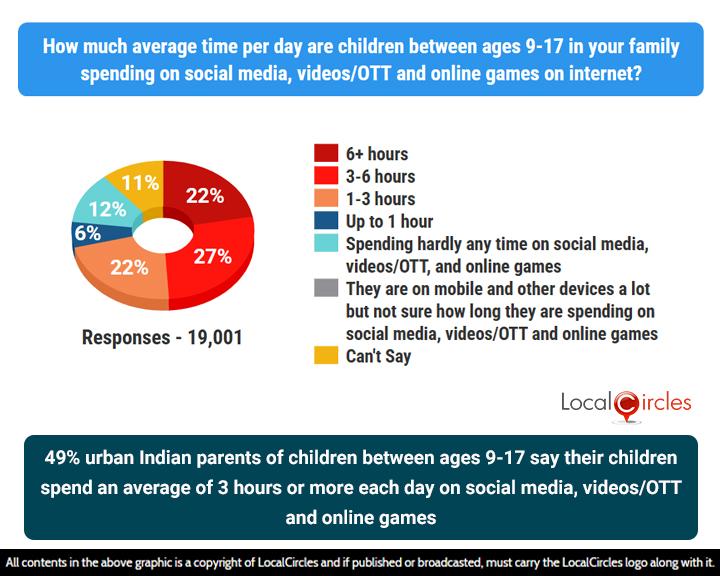
49% urban Indian parents of children between ages 9-17 say their children spend an average of 3 hours or more each day on social media, videos/OTT and online games
The survey first asked parents/ guardians of young children, “How much average time per day are children between 9-7 in your family spending on social media, video/ OTT and online games on internet?” Out of 19,001 parents who to the question 22% indicated that their children spend “6+ hours” on social media, video/ OTT and online games; 27% of respondents indicated that their children spend “3-6 hours” on social media platforms; 22% of respondents indicated that their children spend “1-3 hours" on social media; 6% of respondents indicated that their children spend “up to 1 hour" on social media; 12% of respondents indicated that their children are “spending hardly any time on social media, video/ OTT and online games” and 11% of respondents did not give a clear answer. To sum up, 49% urban Indian parents of children between ages 9-17 say their children spend an average of 3 hours or more each day on social media, videos/OTT and online games.
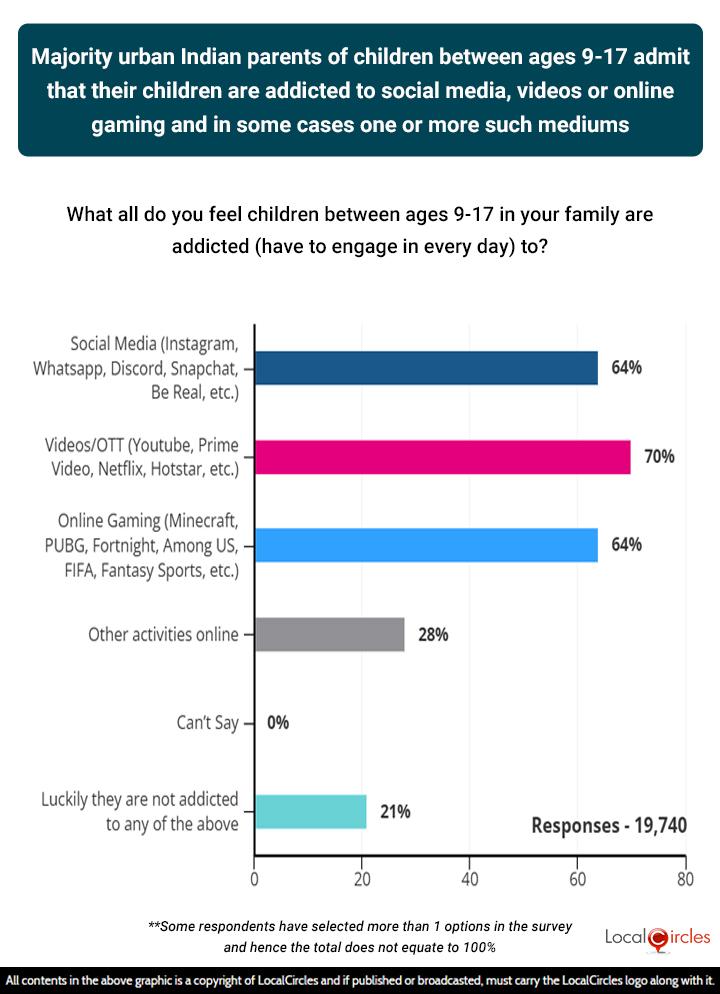
Majority of urban Indian parents of children between ages 9-17 admit that their children are addicted to social media, videos or online gaming and in some cases one or more such mediums
As the internet offers a range of social media and other platforms that interests children, the survey asked urban Indian parents, “What all do you feel children between ages 9-17 in your family are addicted (have to engage in every day) to?” Some among 19,740 who responded to the question indicated more than one option. Highest or 70% of respondents indicated “videos/OTT (YouTube, Prime Video, Netflix, Hotstar, etc.); 64% of respondents indicated “social media (Instagram, WhatsApp, Discord, Snapchat, Be Real, etc.)”; 64% of respondents indicated “online gaming (Minecraft, PUBG, Fortnight, Among US, FIFA, Fantasy Sports, etc.); 28% of respondents indicated “other activities online”; and 21% of respondents stated "luckily they are not addicted to any of the above”. To sum up, majority of urban Indian parents of children between ages 9-17 admit that their children are addicted to social media, videos or online gaming and in some cases one or more such mediums.
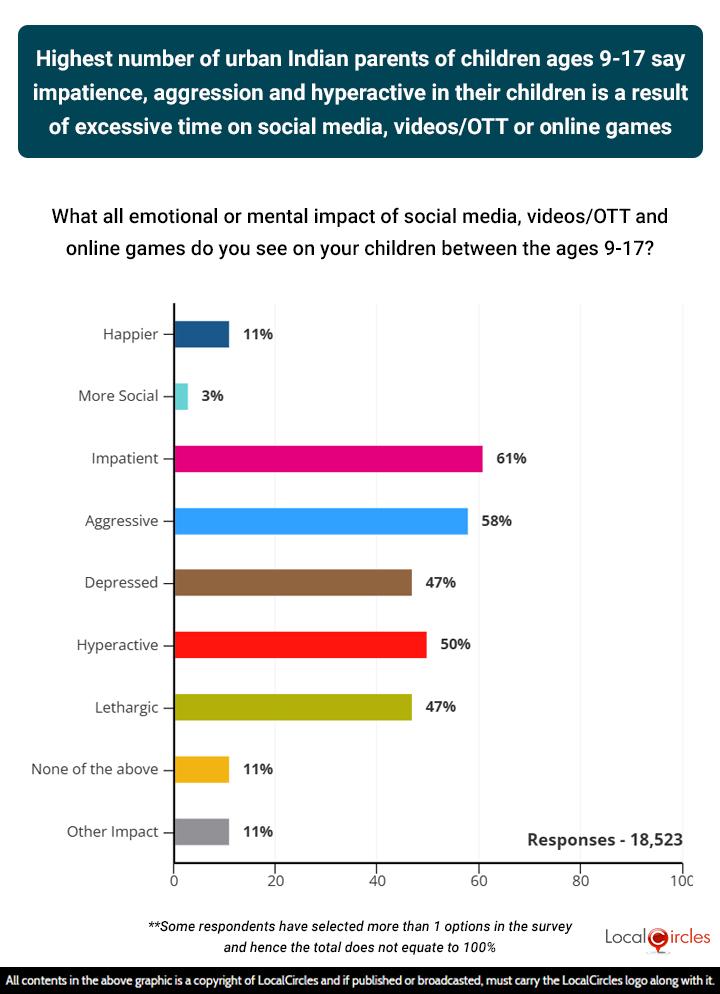
Highest number of urban Indian parents of children ages 9-17 say impatience, aggression and hyperactive behavior in their children is a result of excessive time on social media, videos/OTT or online games
Global studies have reported adverse behavioral changes in children excessively exposed to social media, videos/OTT and online games. The survey asked parents of under 18-years children, “What all emotional or mental impact of social media, videos/OTT and online games do you see on your children between the ages 9-17?” Some among 18,523 respondents to the question indicated more than one problem. The largest group of 61% of respondents indicated that their children have become “impatient”; 58% of respondents stated that they have become “aggressive”; 50% of respondents stated that the children have become “hyperactive”; 47% of respondents stated the children have become “depressed”; 47% of parents stated the children have become “lethargic”; on the other hand 11% of parents stated that their children are “happier” and 3% of parents stated that they have become “more social”. In addition, 11% of parents stated “none of the above” mental states apply to their children and 11% stated there has been “other impact” not mentioned above. To sum up, highest number of urban Indian parents of children ages 9-17 say impatience, aggression and hyperactive behavior in their children is a result of excessive time on social media, videos/OTT or online games.
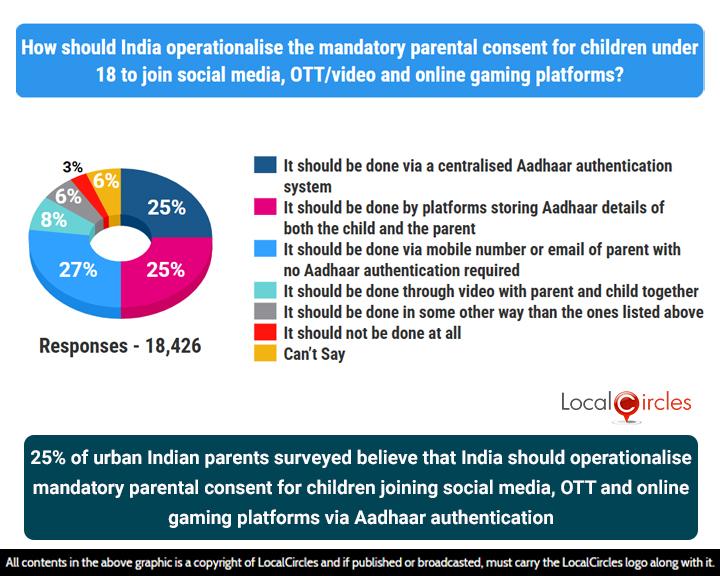
25% of urban Indian parents surveyed still believe that India should operationalize mandatory parental consent for children joining social media, OTT and online gaming platforms via Aadhaar authentication
In view of the government rules on requiring mandatory parental consent for minors joining social media, OTT and online gaming platforms, the survey asked parents, “How should India operationalize the mandatory parental consent for children under 18 to join social media, OTT/ video and online gaming platforms?” Out of 18,426 who responded to the question 25% stated that “it should be done via a centralized Aadhaar authentication system”; 25% of respondents stated that “it should be done by platforms storing Aadhaar details of both the child and the parent”;27% of respondents stated that “it should be done via mobile number or email of parent with no Aadhaar authentication required”; 8% of respondents stated that “it should be done through video with parent and child together”; 6% of respondents stated “it should be done in some other way than the ones listed above”; 3% of respondents stated that “it should not be done at all” and 6% of respondents did not give a clear answer. To sum up, 25% of urban Indian parents surveyed believe that India should operationalize mandatory parental consent for children joining social media, OTT and online gaming platforms via Aadhaar authentication.
In summary, the survey shows that 49% of urban Indian parents of children between ages 9-17 say their children spend an average of 3 hours or more each day on social media, videos/OTT and online games. This is having an adverse impact on large number of children as majority of urban Indian parents surveyed admitted that their children are addicted to social media, videos or online gaming and in some cases one or more such mediums. Highest number of urban Indian parents feel impatience, aggression and hyperactive in their children aged 9-17 is a result of excessive time on social media, videos/OTT or online games.
With the new DPDP, parental consent has been made mandatory for children under 18 to join social media platforms, however the age validation mechanism is left to the platforms. When parents were asked about how the age verification should be operationalized, 25% of urban Indian parents surveyed still want mandatory parental consent to be done through Aadhaar authentication. Another 25% supported platforms storing Aadhaar details of parent and the child. Many parents also believe that just the age validation for new accounts will not solve the problem but all existing accounts should also go through the age and identity verification process.
Survey Demographics
The survey received over 57,000 responses from parents of school children aged between 9 -18 located in 302 districts of urban India. 61% respondents were men while 39% respondents were women. 47% respondents were from tier 1, 31% from tier 2 and 22% respondents were from tier 3 & 4 districts. The survey was conducted via LocalCircles platform, and all participants were validated citizens who had to be registered with LocalCircles to participate in this survey.
About LocalCircles
LocalCircles, India’s leading Community Social Media platform enables citizens and small businesses to escalate issues for policy and enforcement interventions and enables Government to make policies that are citizen and small business centric. LocalCircles is also India’s # 1 pollster on issues of governance, public and consumer interest. More about LocalCircles can be found on https://www.localcircles.com
For more queries - media@localcircles.com, +91-8585909866
All content in this report is a copyright of LocalCircles. Any reproduction or redistribution of the graphics or the data therein requires the LocalCircles logo to be carried along with it. In case any violation is observed LocalCircles reserves the right to take legal action.
Enter your email & mobile number and we will send you the instructions.
Note - The email can sometime gets delivered to the spam folder, so the instruction will be send to your mobile as well


