Internet Safety for Children: 1 in 2 parents of children between ages 9-17 surveyed say their kids were exposed to inappropriate content or faced online bullying; Say it has led to emotional withdrawal, aggressive behaviour, fear & anxiety
- ● 82% of parents say reporting online bullying, harassment or harmful content involving children to platforms or authorities in India is either difficult, slow and lacks clarity
- ● Over 75% of parents say Government needs to ensure time bound mandatory response from platforms on complaints related to online child safety
February 10, 2026, New Delhi: The recent alleged suicidal death of three Ghaziabad based teenage sisters in protest after being stopped from pursuing their obsession with online games and Korean dramas has once again highlighted dangers of over exposure to online entertainment and social media at a young age.
Over the last year, several incidents have highlighted how Indian children and adolescents face serious risks from online interactions. Reported incidents include cases where social and gaming platforms were used by adults or strangers to befriend minors, leading to abduction and sexual assault. For example, a 16-year-old girl in Ahmedabad was allegedly lured via the game Free Fire by an adult she met online; she was kidnapped and raped before being rescued after coordinated efforts of family, local police and railway police. The suspect was also arrested and charged under the Protection of Children from Sexual Offences (POCSO) Act and related laws.
Several other cases have been reported of children using online dating apps or social messaging and encountering predators who organize sexual assault. In Kerala, police charged 14 individuals with sexually assaulting a 16-year-old boy whom they befriended online. There’s also an ongoing increase in digital sexual abuse material and child pornography concerns. In 2025 alone, Delhi Police’s Special Police Unit for Women and Children (SPUWAC) registered 60 FIRs related to child pornography following hundreds of leads from international partners such as the National Center for Missing & Exploited Children.
Beyond direct crimes, studies and national surveys show that excessive screen time on social media, gaming and video platforms is contributing to behavioural and mental health issues among children aged 9–17 — including increased aggression, poor sleep, anxiety, and distraction from schoolwork.
LocalCircles’ survey in December 2025 found that roughly half of parents report children in this age group spending three hours or more daily online, with concerns rising about addiction and its effects.
To tackle these harms, the Government of India introduced new provisions under the Digital Personal Data Protection (DPDP) Rules, 2025, which operationalize the Digital Personal Data Protection Act, 2023. These rules include a mandate that children below the age of 18 must obtain verifiable parental or guardian consent before opening and using social media accounts or any service that processes their personal data. This requirement means platforms cannot collect, store, or process a minor’s data unless a parent’s consent has been confirmed using government-approved identity proof. The aim is to enhance online safety by ensuring parents are involved in their children’s digital engagement, thereby reducing exposure to harmful content, exploitation, and privacy risks that minors might face on social media and gaming platforms. However, how existing accounts of children with age misrepresented will be revalidated by platforms has not been clarified by the Government yet.
Several state governments have also become active on the issue. Andhra Pradesh government, for instance, has publicly stated that it is studying an Australia-style ban on social media usage for children under 16. The Goa government has also confirmed that it is examining a prohibition on social media use for children below age 16. Both Andhra Pradesh and Goa are examining how such restrictions might work within India’s broader legal and federal framework. The Economic Survey 2025-26 has highlighted digital addiction among young people as a major concern, and recommended age-based regulation, awareness campaigns and digital literacy to promote safer online use.
Overall, while enforcement and new regulations are increasing, experts emphasize that education, parental involvement, digital literacy and coordinated multi-agency responses remain essential to protect children online. Through a new study on the occasion of Safer Internet Day, LocalCircles has strived to find out from urban Indian parents the experience of their children with online harassment, bullying, trolling etc, its impact on their mental health, the ability to report such cases with platforms and Government helplines and their responsiveness. The survey received over 89,000 responses from urban Indian parents of children between ages 9-17 & located across 302 districts of India. 61% respondents were men while 39% respondents were women. 44% respondents were from tier 1, 33% from tier 2 and 23% respondents were from tier 3 & 4 districts.
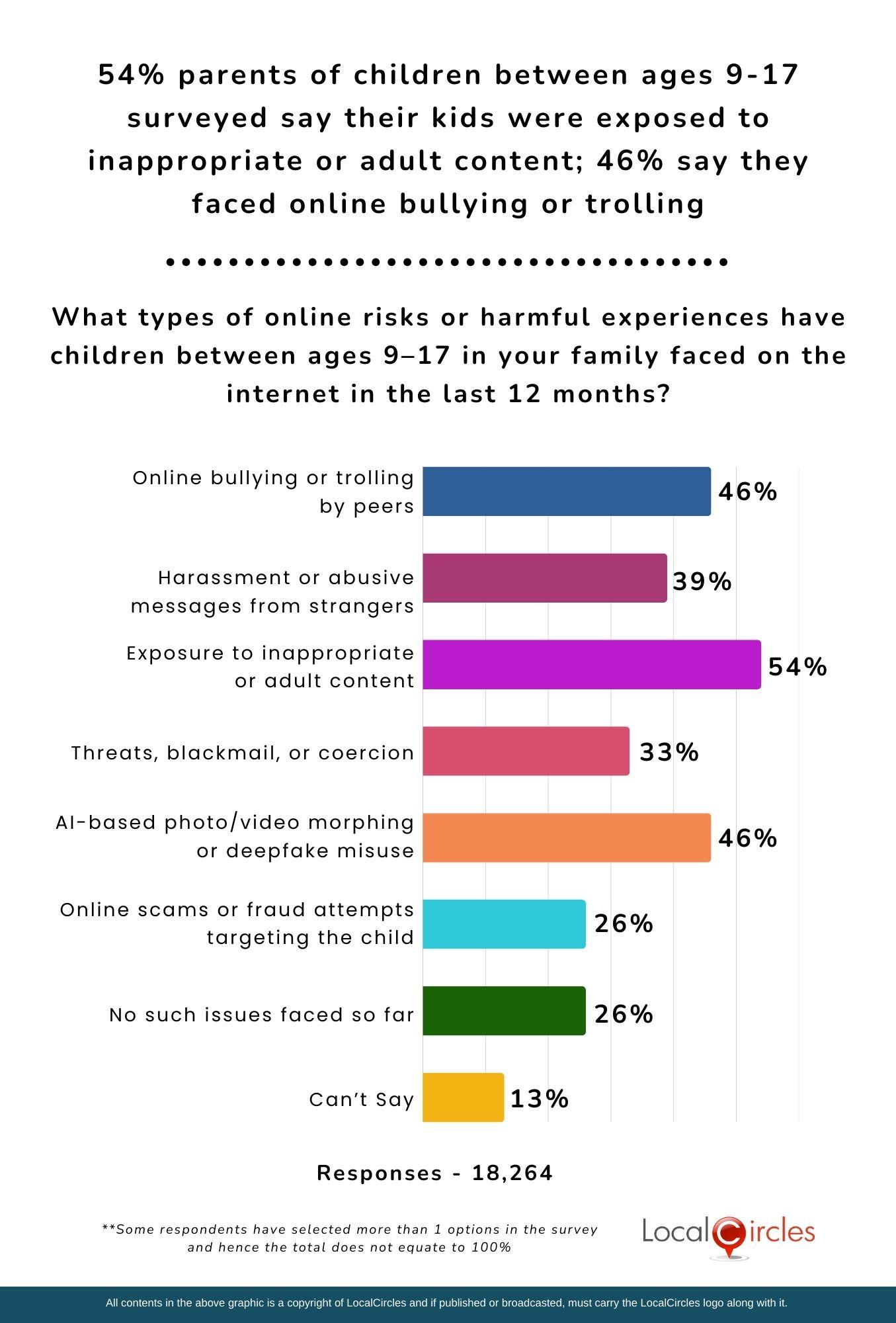
54% parents of children between ages 9-17 surveyed say their kids were exposed to inappropriate or adult content; 46% say they faced online bullying or trolling
As many children are unsupervised when online, whether studying or engaged in other pursuits, the survey asked parents of under 17 years children, “What types of online risks or harmful experiences have children between ages 9–17 in your family faced on the internet in the last 12 months?” Out of 18,264 who responded to the question some selected more than one option. 54% of responded indicated that their under 17-year kids have faced risk of “exposure to inappropriate or adult content” on the internet in the last 12 months; 46% of respondents indicated “online bullying or trolling by peers”; 46% of respondents indicated “AI-based photo/video morphing or deepfake misuse”; 39% of respondents indicated “harassment or abusive messages from strangers”; 33% of respondents indicated “threats, blackmail, or coercion”; 26% of respondents indicated that they children faced “Online scams or fraud attempts targeting the child”; 26% of respondents indicated that “No such issues (have been) faced so far”; and 13% of respondents did not give a clear answer. To sum up, 54% of parents of children between ages 9-17 surveyed say their kids were exposed to inappropriate or adult content; 46% say they faced online bullying or trolling.
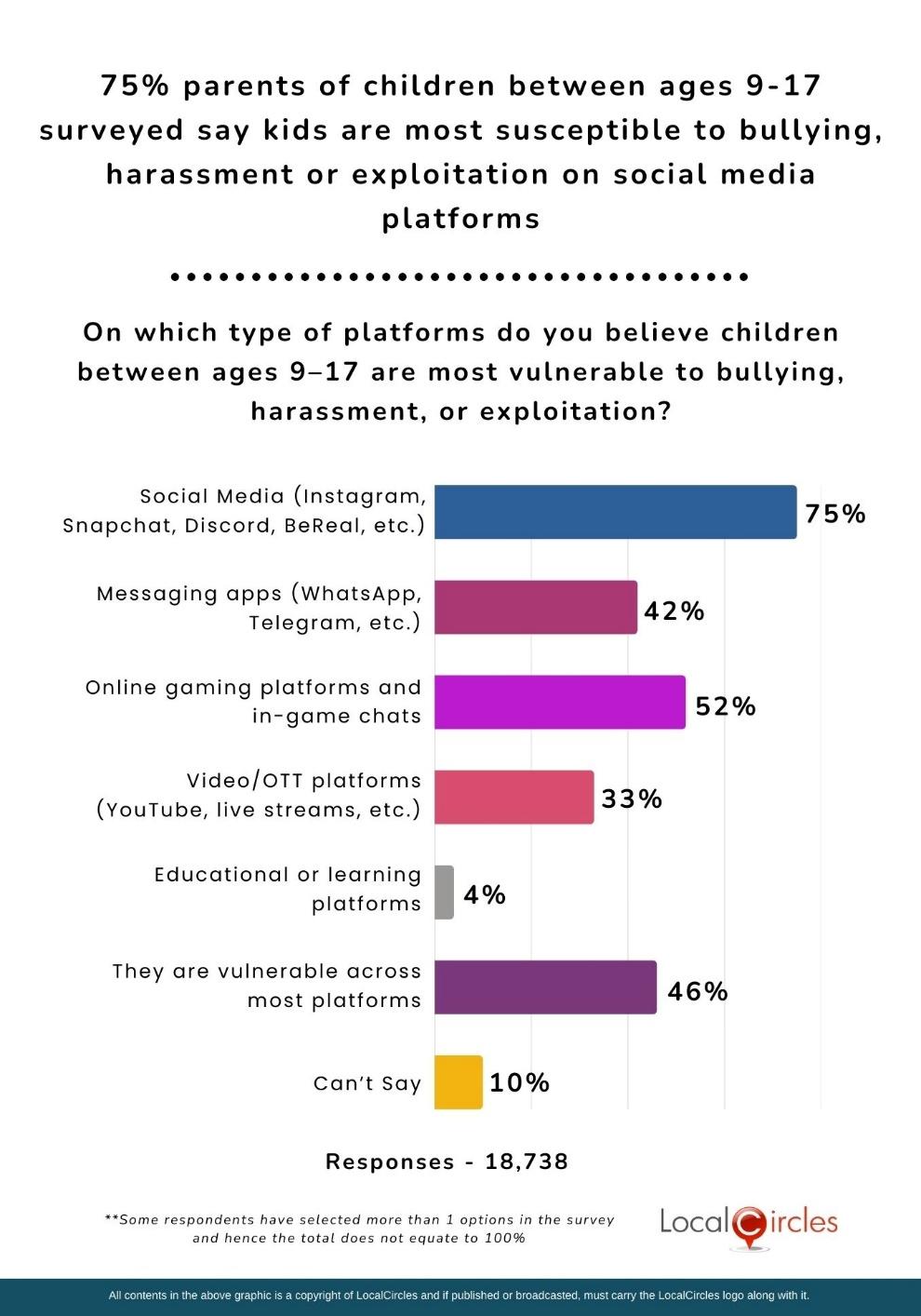
75% parents of children between ages 9-17 surveyed say kids are most susceptible to bullying, harassment or exploitation on social media platforms
As children use different types of platforms according to their interests, the survey asked parents of under 17 years kids, “On which type of platforms do you believe children, between ages 9–17, are most vulnerable to bullying, harassment, or exploitation?” Some out of 18,738 who responded to the question indicated more than one option. Largest group or 75% indicated that their kids are most vulnerable to bully, harassment or exploitation on “Social Media (Instagram, Snapchat, Discord, BeReal, etc.)”; 52% of respondents indicated “Online gaming platforms and in-game chats”; 46% of respondents indicated that “they are vulnerable across most platforms”; 42% of respondents indicated “Messaging apps (WhatsApp, Telegram, etc.)”; 33% of respondents indicated “Video/OTT platforms (YouTube, live streams, etc.)”; 4% of respondents indicated "Educational or learning platforms” and 10% of respondents did not give a clear answer. To sum up, 75% of parents of children between ages 9-17 surveyed say kids are most susceptible to bullying, harassment or exploitation on social media platforms.
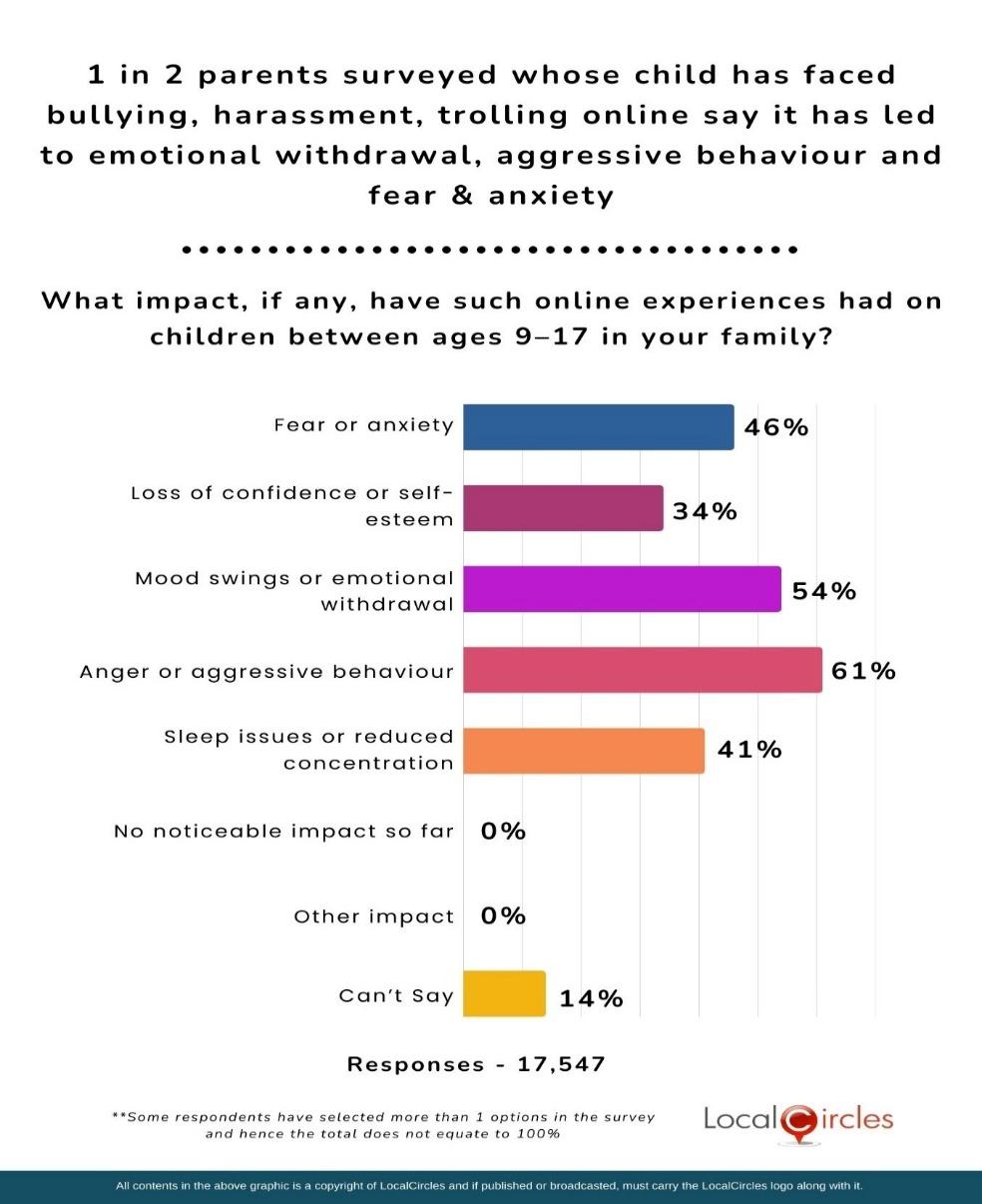
1 in 2 parents surveyed whose child has faced bullying, harassment, and trolling online say it has led to emotional withdrawal, aggressive behaviour and fear & anxiety
Several studies globally have established that over exposure to social media and gaming online at a very young age can have adverse impact on the behaviour of children. The survey asked parents of below 17-year-old children, “What impact, if any, have such online experiences had on children between ages 9–17 in your family?” Some out of 17,547 who responded to the question indicated more than one option. The largest group of 61% indicated that online experiences have led to “anger or aggressive behaviour” in their child; 54% of respondents indicated “Mood swings or emotional withdrawal”; 46% of respondents indicated “Fear or anxiety”; 41% of respondents indicated “Sleep issues or reduced concentration”; 34% of respondents indicated “Loss of confidence or self-esteem” and 14% of respondents did not give a clear answer. To sum up, 1 in 2 parents surveyed whose child has faced bullying, harassment, and trolling online say it has led to emotional withdrawal, aggressive behaviour and fear & anxiety
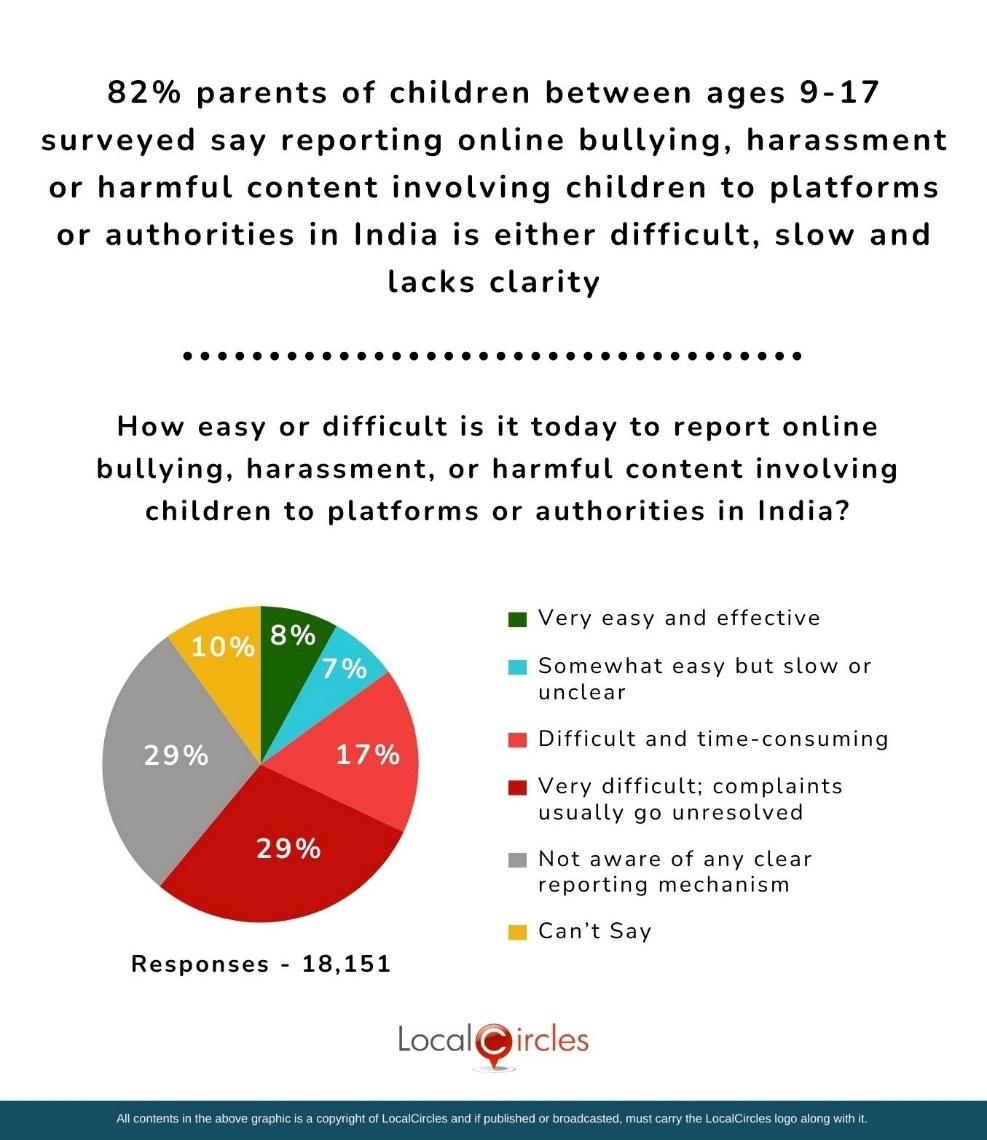
82% parents of children between ages 9-17 surveyed say reporting online bullying, harassment or harmful content involving children to platforms or authorities in India is either difficult, slow and lacks clarity
Not all parents or guardians report about cyber bullying. In fact, not all children confide in their parents or even friends when faced with such problems. The survey asked parents of under 17-year-old children, “How easy or difficult is it today to report online bullying, harassment, or harmful content involving children to platforms or authorities in India?” Out of 18,151 who responded to the question 8% indicated that it is “very easy and effective”; 7% of respondents indicated that it is “Somewhat easy but slow or unclear”; 17% of respondents indicated that reporting is “difficult and time-consuming”: 29% of respondents indicated that it is in fact “very difficult; complaints usually go unresolved”; 29% of respondents indicated that they are “not aware of any clear reporting mechanism”; and 10% of respondents did not give a clear answer. To sum up, 82% parents of children between ages 9-17 surveyed say reporting online bullying, harassment or harmful content involving children to platforms or authorities in India is either difficult, slow and lacks clarity.
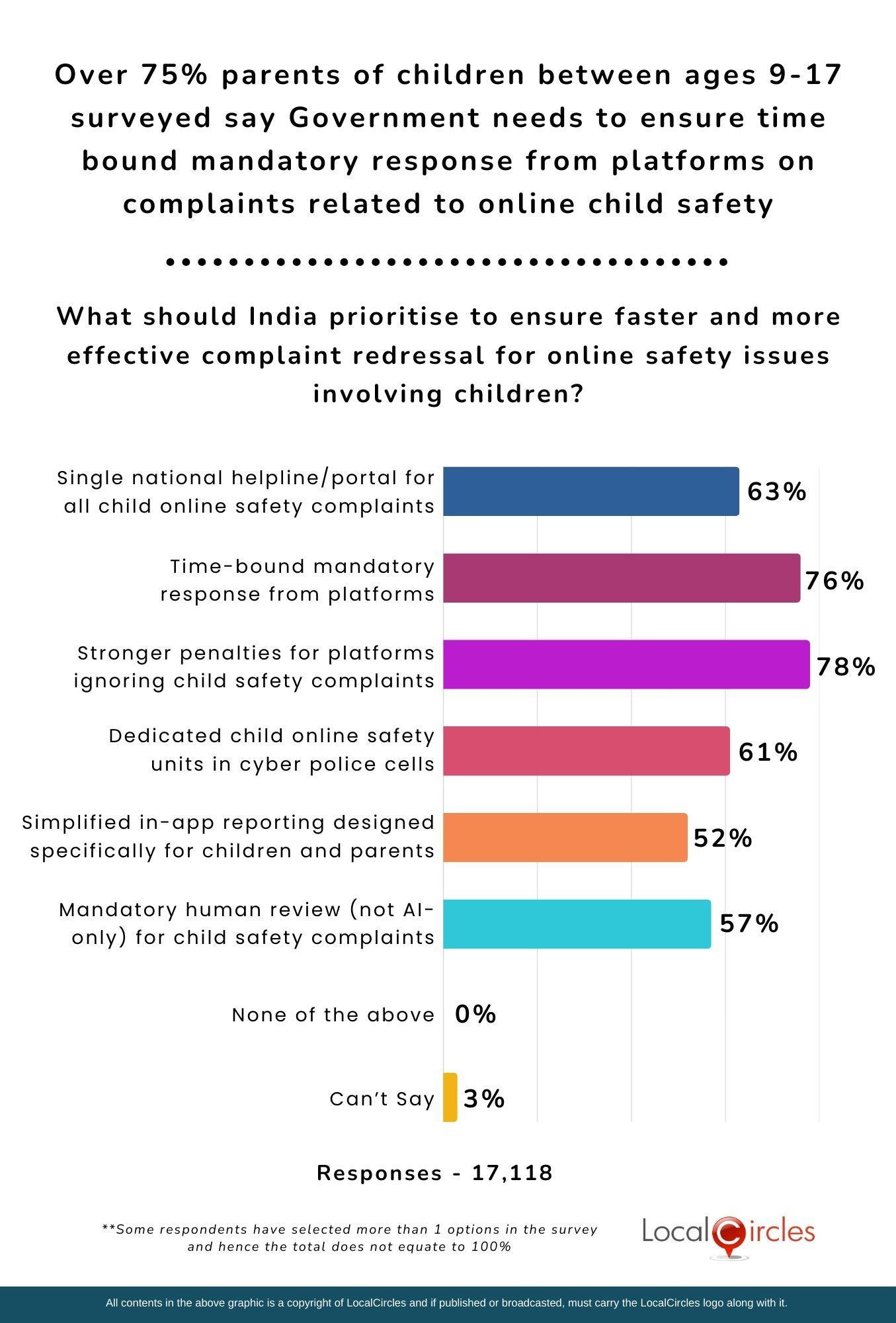
Over 75% parents of children between ages 9-17 surveyed say Government needs to ensure time bound mandatory response from platforms on complaints related to online child safety
With majority of parents pointing to the difficulty in filing complaints and not getting satisfying response or being unaware of clear reporting mechanism, the survey asked parents of children between ages 9-17, “What should India prioritize to ensure faster and more effective complaint redressal for online safety issues involving children?” Some of 17,118 parents who responded to the question indicated more than one option. The biggest group of 78% indicated that there should be “stronger penalties for platforms ignoring child safety complaints”; 76% of respondents indicated that there should be “time-bound mandatory response from platforms”; 63% of respondents indicated need for “Single national helpline/portal for all child online safety complaints”; 61% of respondents indicated need for “dedicated child online safety units in cyber police cells”; 57% of respondents indicated need for “mandatory human review (not AI-only) for child safety complaints”; 52% of respondents indicated need for “simplified in-app reporting designed specifically for children and parents” and 3% of respondents did not give a clear answer. To sum up, over 75% of parents of children between ages 9-17 surveyed say Government needs to ensure time bound mandatory response from platforms on complaints related to online child safety.
1 in 2 parents of children between ages 9-17 surveyed say their kids were exposed to inappropriate content or faced online bullying; Say it has led to emotional withdrawal, aggressive behaviour, fear & anxiety
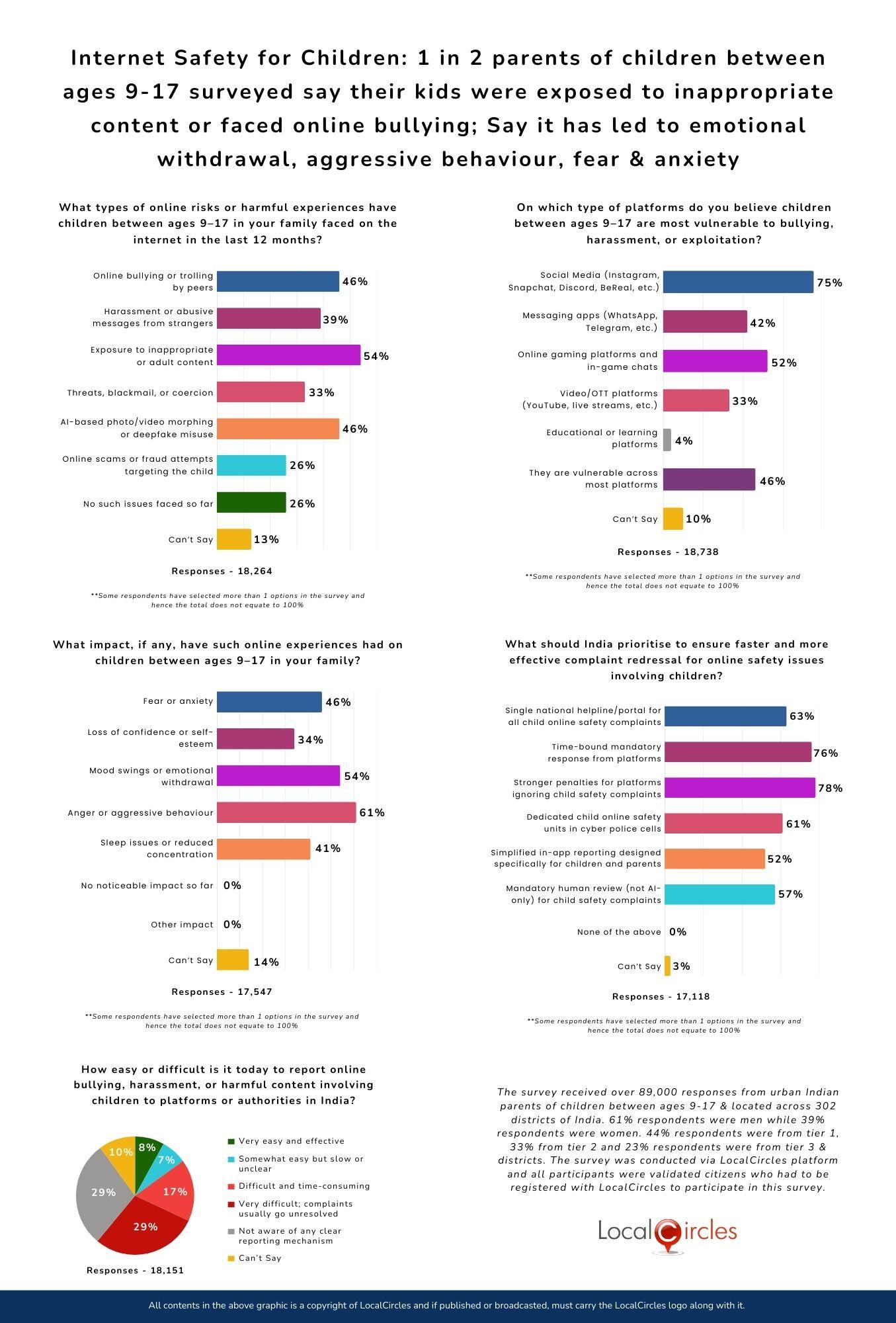
In summary, the study highlights several areas of deep concern as 54% of parents of children between ages 9-17 surveyed say their kids were exposed to inappropriate or adult content. In fact, 46% say they have faced online bullying or trolling. Not surprisingly, 75% of parents of children between ages 9-17 surveyed say kids are most susceptible to bullying, harassment or exploitation on social media platforms. What is worrying is that 1 in 2 parents surveyed whose child has faced bullying, harassment, and trolling online say it has led to emotional withdrawal of their children besides resulting in aggressive behaviour and fear & anxiety.
Despite the Digital Personal Data Protection Act, being operationalized, 82% parents of children between ages 9-17 surveyed say reporting online bullying, harassment or harmful content involving children to platforms or authorities in India is either difficult, slow and lacks clarity. Thus, over 75% of parents of children between ages 9-17 surveyed say Government needs to ensure time bound mandatory response from platforms on complaints related to online child safety.
As India along with several countries marks Safe Internet Day, this study stresses that more action by platforms and authorities is required to create a safer environment to safeguard young children particularly those below 17 years. The best-case scenario according to many parents is a ban on usage of such platforms till the age of 16 like multiple states are considering. However, in absence of that, the Central Government must ensure high levels of responsiveness by platforms as well as Government where complaints are acknowledged in real time and acted upon within hours as compared to days and weeks, which is the case currently.
Survey Demographics
The survey received over 89,000 responses from urban Indian parents of children between ages 9-17 & located across 302 districts of India. 61% respondents were men while 39% respondents were women. 44% respondents were from tier 1, 33% from tier 2 and 23% respondents were from tier 3 & 4 districts. The survey was conducted via LocalCircles platform, and all participants were validated citizens who had to be registered with LocalCircles to participate in this survey.
About LocalCircles
LocalCircles, India’s leading Community Social Media platform enables citizens and small businesses to escalate issues for policy and enforcement interventions and enables Government to make policies that are citizen and small business centric. LocalCircles is also India’s # 1 pollster on issues of governance, public and consumer interest. More about LocalCircles can be found on https://www.localcircles.com
For more queries - media@localcircles.com, +91-8585909866
All content in this report is a copyright of LocalCircles. Any reproduction or redistribution of the graphics or the data therein requires the LocalCircles logo to be carried along with it. In case any violation is observed LocalCircles reserves the right to take legal action.
Enter your email & mobile number and we will send you the instructions.
Note - The email can sometime gets delivered to the spam folder, so the instruction will be send to your mobile as well


