Ahead of Delhi’s November 1 curbs on pre-BS-VI vehicles, 87% of Delhi NCR residents say stronger action on other pollution sources should have come first
- ● 33% of respondents say stronger action on construction dust, road dust and waste burning should have come first, while another 33% want stronger action on all major pollution sources first
- ● Only 13% of respondents say restrictions on plying of old (pre-BS-VI) vehicles were necessary and should not have been delayed
October 29, 2026, New Delhi: From November 1, Delhi will bar the entry of petrol and diesel vehicles registered outside the capital that do not meet BS-VI emission norms. The restrictions will remain in force until January 31, 2027. BS-III and BS-IV vehicles from Gurugram, Noida, Ghaziabad and Faridabad are among those affected. CNG vehicles, electric vehicles, ambulances, fire tenders and other essential-service vehicles are exempt. Transport department estimates put the number of non-BS-VI vehicles in these NCR cities at over 10 lakh, including over 4 lakh in Noida and Greater Noida, about 4 lakh in Ghaziabad and nearly 2 lakh in Gurugram and Faridabad combined. Enforcement will rely on Automatic Number Plate Recognition (ANPR) and AI-based cameras at border points, supported by around 300 transport department personnel.
For commercial goods vehicles, the one-year window that allowed BS-IV trucks from outside Delhi to enter the capital ends on October 31, 2026. Gurugram traffic police have already issued an advisory asking transporters and bus operators to check the emission standard of their vehicles before heading to Delhi. The entry curbs are part of the Delhi Government's winter pollution plan announced by Chief Minister Rekha Gupta. The plan also doubles parking charges at authorised facilities till February 28, 2027, enforces a "No PUC, No Fuel" rule at fuel stations, caps physical attendance in offices at 50% and restricts construction and demolition activity.
The Commission for Air Quality Management (CAQM) invoked Stage I of the Graded Response Action Plan (GRAP) across Delhi NCR on October 21, after the city’s AQI rose from 179 to 244 within a day. After a brief spell in the “moderate” range, Delhi’s 24-hour average AQI rose from 197 on October 27 to 228 on October 28, with some monitoring stations recording “very poor” readings above 300. With Diwali falling on November 8, a Supreme Court bench hearing pollution matters observed on October 28 that air quality is likely to worsen sharply after the festival.
Local sources are increasingly in focus. An analysis by Climate Trends, released on October 28, found that farm fire events in Punjab and Haryana fell only 4% this season, from 201 to 193, while Delhi’s mean September–October AQI fell 15.8%. The analysis concluded that local, non-agricultural sources played a larger role in shaping Delhi’s air quality than stubble burning.
The entry curbs come on top of existing age-based rules for older vehicles in Delhi NCR. In December 2025, the Supreme Court barred coercive action against owners of overaged vehicles that are BS-IV or newer, while authorities may still act against BS-III and older vehicles. Implementation gaps remain: in August 2026, the owner of a 2016 BS-IV car told the Supreme Court that PUC software would not issue a certificate once the vehicle crossed the age limit, even though it passed the emissions test. To ease the transition, the Delhi EV Policy 2026, notified on July 1, 2026, offers scrappage incentives of up to ₹1 lakh for replacing a BS-IV or older four-wheeler with an electric car.
Against this backdrop, LocalCircles surveyed Delhi NCR residents on whether restrictions on plying of old (pre-BS-VI) vehicles should have been implemented only after stronger action on other major pollution sources. The survey received over 20,000 responses from residents of Delhi, Gurugram, Noida, Faridabad and Ghaziabad. The findings are presented below.
87% of Delhi NCR residents say other pollution sources should have been tackled first
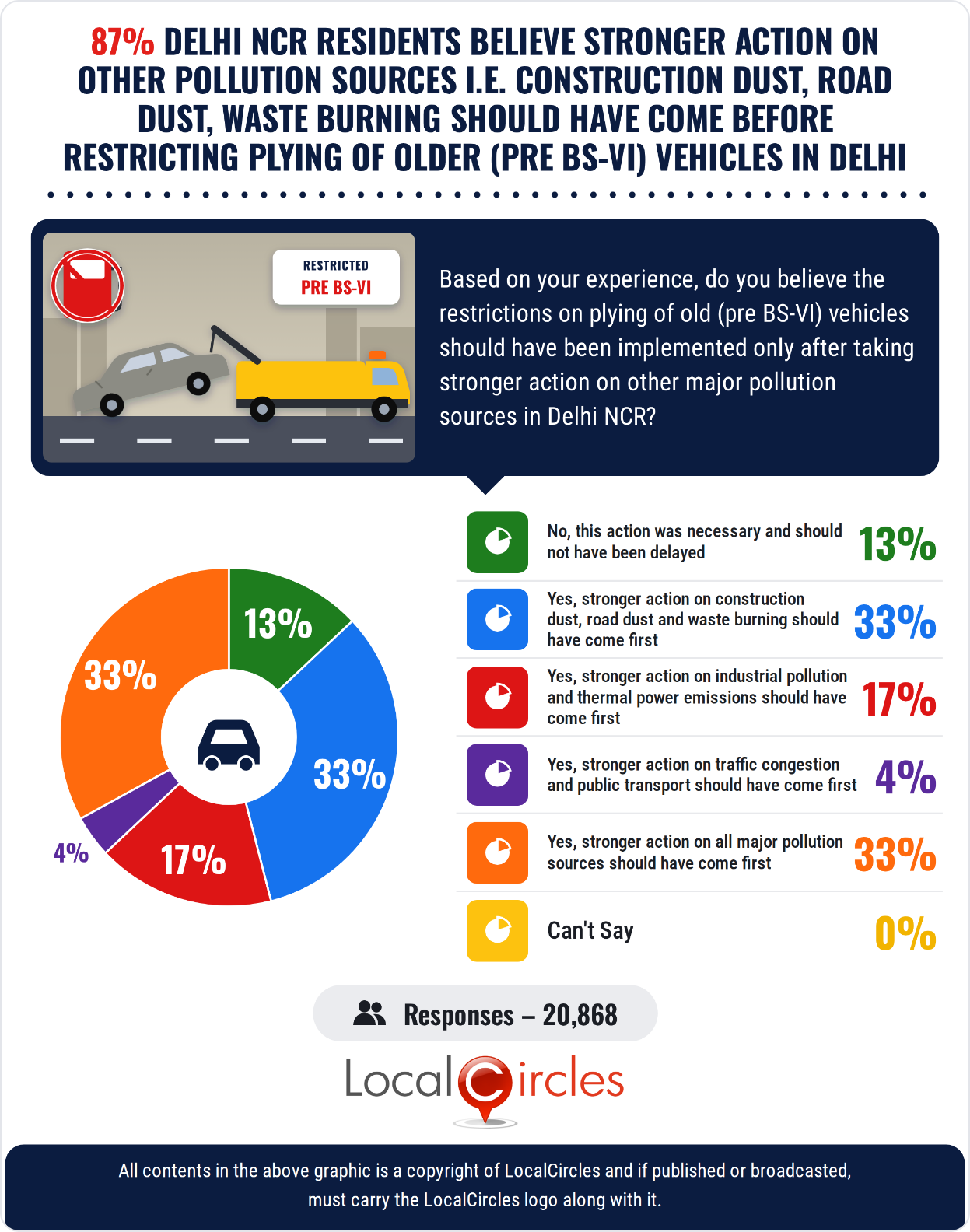
The survey asked: “Based on your experience, do you believe the restrictions on plying of old (pre BS-VI) vehicles should have been implemented only after taking stronger action on other major pollution sources in Delhi NCR?” Of the 20,868 responses to this question, 13% stated “no, this action was necessary and should not have been delayed”; 33% stated “yes, stronger action on construction dust, road dust and waste burning should have come first”; 17% stated “yes, stronger action on industrial pollution and thermal power emissions should have come first”; 4% stated “yes, stronger action on traffic congestion and public transport should have come first”; and 33% stated “yes, stronger action on all major pollution sources should have come first”.
Overall, 87% of respondents said stronger action on other pollution sources should have come before restricting older (pre-BS-VI) vehicles. Only 13% said the action was necessary and should not have been delayed. Construction dust, road dust and waste burning were the most cited specific priority, at 33%, matching the share who wanted stronger action on all major pollution sources. This finding reflects respondents’ views on the sequencing of enforcement; it does not establish the relative contribution of different pollution sources.
Public sentiment: residents want all pollution sources tackled together
The survey findings point to a strong sense among Delhi NCR residents that vehicle owners are being asked to carry a disproportionate share of the pollution-control burden. Only about one in eight respondents backed the vehicle restrictions without conditions, while the rest wanted visible action on dust, waste burning, industry and power plants first. For daily commuters from Gurugram, Noida, Ghaziabad and Faridabad, the curbs could mean switching to public transport, paying for alternatives or replacing a vehicle at short notice.
Similar concerns have been raised by vehicle owners and transporters. Owners of BS-IV vehicles have questioned why vehicles that pass emission tests and hold valid PUC certificates are being kept off the road. Transport bodies, including the All India Motor Transport Congress and the All India Motor and Goods Transport Association, have argued that the ban is based on emission category rather than actual emissions, and that operators who pay green, pollution and road taxes are being penalised. They estimate that about 2.5 lakh vehicles across NCR could be affected and have warned of protests, a chakka jam and legal action if the decision is not reconsidered.
At the same time, the 13% who backed the restrictions without delay, and the rising AQI ahead of Diwali, reflect the view that vehicular emissions remain a significant contributor to Delhi’s winter smog. The overall sentiment is not against cleaner air, but in favour of action that is fair, consistent and applied to every major source.
Summary
The LocalCircles survey found that 87% of Delhi NCR residents believe stronger action on other pollution sources should have come before restrictions on plying of older (pre-BS-VI) vehicles. A third of respondents prioritised construction dust, road dust and waste burning, and another third wanted stronger action on all major pollution sources. Only 13% said the vehicle restrictions were necessary and should not have been delayed.
These findings come days before Delhi bars the entry of non-BS-VI petrol and diesel vehicles registered outside the capital from November 1, 2026, a move that could affect over 10 lakh vehicles across NCR. With AQI rising ahead of Diwali and GRAP Stage I already in force, residents want vehicle curbs to be matched by visible and sustained enforcement against dust, waste burning and industrial emissions.
Policy planners should consider an emissions-based approach that targets genuinely high-emitting vehicles, rather than relying on emission category alone, and ensure that PUC systems, fuel-station checks and border enforcement align with the latest Supreme Court orders. Commuters from neighbouring NCR cities will need adequate public transport, last-mile connectivity and park-and-ride options at Delhi’s borders. Scrappage incentives should be accessible and attractive enough to make vehicle replacement a viable choice. Visible action on construction dust, road dust, waste burning and industrial emissions will be key to building public confidence in pollution-control measures.
Survey Demographics
The survey received over 20,000 responses from residents of Delhi, Gurugram, Noida, Faridabad and Ghaziabad. 68% of respondents were men while 32% were women. The survey was conducted via the LocalCircles platform, and all participants were validated citizens who had to be registered with LocalCircles to participate in this survey.
About LocalCircles
LocalCircles, India’s leading Community Social Media platform enables citizens and small businesses to escalate issues for policy and enforcement interventions and enables Government to make policies that are citizen and small business centric. LocalCircles is also India’s # 1 pollster on issues of governance, public and consumer interest. More about LocalCircles can be found on https://www.localcircles.com
For more queries - media@localcircles.com, +91-8585909866
All content in this report is a copyright of LocalCircles. Any reproduction or redistribution of the graphics or the data therein requires the LocalCircles logo to be carried along with it. In case any violation is observed LocalCircles reserves the right to take legal action.
Enter your email & mobile number and we will send you the instructions.
Note - The email can sometime gets delivered to the spam folder, so the instruction will be send to your mobile as well


